Summer Bon Chrétien
Pear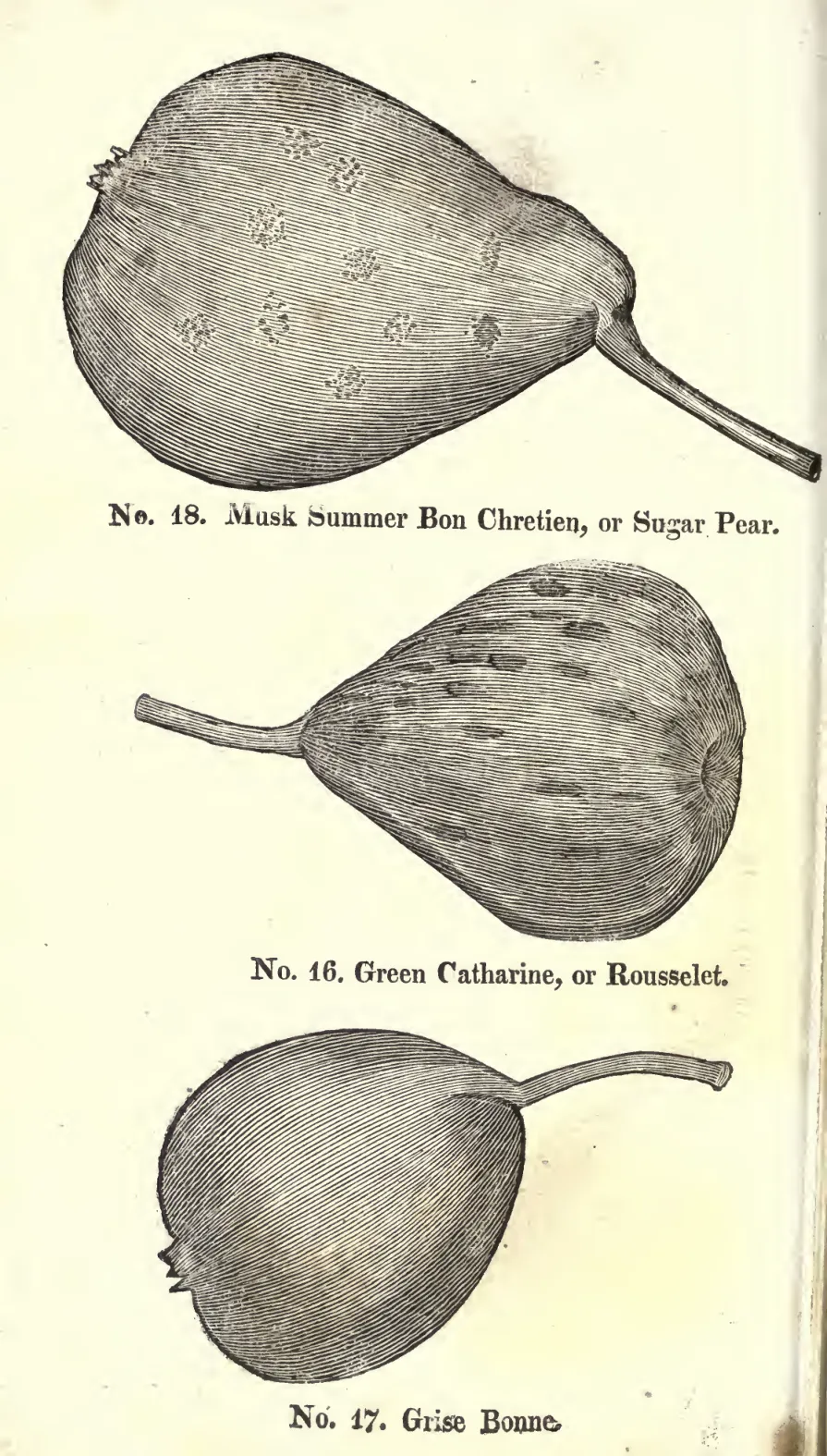
Summer Bon Chrétien
[NOTE: Source text may be incorrect — Coxe (1817) describes the "Musk Summer Bon Chretien, or Large Sugar Pear" (No. 18), a pear he lists separately from "Summer Bon Chretien, or Gracioli" (No. 21). His description may belong to a different variety; it is retained below with attribution. Lindley (1841) describes the Summer Bonchretien proper.]
Origin / History
Lindley (1841) calls it a valuable, well-known Autumn Pear, "the origin of which is lost in the darkness of antiquity." It has long been cultivated all over Europe for the size and delicious flavor of its fruit, but in Lindley's country its place "is too often supplied by inferior varieties, whose merit is more frequently novelty than excellence." Some pomologists suppose it the Regalia of Valerius Cordus, the Piri di Gacemella of Agostino Gallo, and the Domestica, Pentagonum perelegans, and Pugillanum Bollense of John Bauhin. If these conjectures are correct, its origin goes back at least to the beginning of the sixteenth century, and probably much higher. It has found a place in every work of consequence for the last 150 years. On the Continent it is known by a great number of names; in Italy it is called Gracioli, and in Vienna Plutzerbirne, from its resemblance in form to a wine-flask. Lindley's figured specimen was communicated by Mr. Fairbairn, from the garden of His Royal Highness Prince Leopold at Claremont.
Coxe (1817) describes the Musk Summer Bon Chrétien, or Large Sugar Pear, as "often mis-named the Jargonelle in this country." He calls it "a very estimable fruit" when free from skin cracking, but holds that its value "is much lessened by its ripening with the Seckle, and several other pears of high reputation."
Tree
Tree of vigorous growth (Coxe), drooping like the Jargonelle (Lindley). Wood long, flexuose or zigzag, smooth, with prominent buds. Leaves roundish, with a point, smooth, flat, slightly and regularly serrated; large (Coxe). Young leaves very thin and pale green on both sides, by which it is readily distinguished from the Jargonelle, whose young leaves are of a thick, cottony texture. Flowers the largest among pears. Fruit produced upon the extremities of young branches, which must be borne in mind in pruning.
Lindley says it requires a south-east or west wall and will not succeed in his country as a standard. It does not bear well on a quince stock, but should always be worked on a pear.
Fruit
Size: Large and handsome (Coxe). Lindley gives 3½ to 4½ inches in length and 2½ to 3 inches in breadth across the widest part.
Form: Very irregular; oblong, swelled in the middle, diminishing toward each end, but more toward the stalk (Coxe). Exceedingly knobby and irregular in outline, particularly about the eye, quite blunt at the base (Lindley).
Stem: Long and large, frequently inserted on one side (Coxe).
Cavity: Not described in source.
Calyx: Eye prominent, small (Lindley).
Basin: Not described in source.
Skin: Very smooth, yellowish green (Coxe); when fully ripe pale lemon-color, very slightly tinged with red on the sunny side (Lindley). Frequently cracks, which diminishes its excellence (Coxe).
Dots: Small, green, covering the surface all over pretty regularly (Lindley). Skin clouded with clusters of black spots (Coxe).
Flesh and flavor: Yellowish, breaking, firm, juicy, "very sweet and excellent" (Lindley). Rich, melting, of a highly musked taste, saccharine and waxy, yielding an uncommonly fine odor (Coxe).
Core and seeds: Core very small, placed near the eye. Seeds all abortive (Lindley).
Season
Ripens the latter end of August (Coxe), coinciding with the Seckle and several other pears of high reputation; about the middle of September (Lindley, who calls it an Autumn Pear). Keeps a few days only; in a week or ten days after being gathered it begins to rot at the core (Lindley).
Uses
Not described in source.
Subtypes / Variants
The Germans distinguish two varieties, the large and the small. Lindley is uncertain whether both exist in his country, but the old figure in Batty Langley's Pomona, t. 65, is so unlike the common form of the Summer Bonchretien that it is possible they do. Coxe lists the Musk Summer Bon Chrétien (Large Sugar Pear, or Sugar Pear) as No. 18 and the Summer Bon Chrétien, or Gracioli, separately as No. 21.
Other
Not described in source.
Book Sources
Described in 2 period pomological works
- Coxe, A View of the Cultivation of Fruit Trees (1817) — listed as 18. Musk Summer Bon Chretien, Or Large Sugar Pear
- Lindley, Pomologia Britannica Vol. 1 (1841) — listed as THE SUMMER BONCHRETIEN PEAR
Nursery Catalog Sources
Found in 2 catalogs (1845–1849) from Massachusetts
- Winship's Nursery (Brighton Nurseries , operated by the Winship family), Brighton (Boston) , Massachusetts — 1845
- Hovey & Co. , Cambridge , Massachusetts — 1849
View original book sources (2)
— William Coxe, A View of the Cultivation of Fruit Trees (1817)
- MUSK SUMMER BON CHRETIEN, OR LARGE SUGAR PEAR.
This is a large and handsome fruit, of very irregular form; the shape is oblong, swelled in the middle, and diminishing towards each end, but more towards the stalk, which is long and large, and frequently inserted on one side; the flesh is rich, melting, and of a highly musked taste, saccharine and waxy, yielding an uncommonly fine odour; the skin is very smooth, of a yellowish green, clouded with clusters of black spots.
It frequently cracks in the skin, which diminishes its excellence; when free from this defect, it is a very estimable fruit. The leaves are large and smooth, the tree of vigorous growth: it is often mis-named the Jargonelle in this country; the time of ripening, the latter end of August; its value is much lessened by its ripening with the Seckle, and several other pears of high reputation.
[Additional entry in this volume: "Musk Summer Bon Chretien, Or Large Sugar Pear", pp. 282–283]
- MUSK SUMMER BON CHRETIEN, OR LARGE SUGAR PEAR.
This is a large and handsome fruit, of very irregular form; the shape is oblong, swelled in the middle, and diminishing towards each end, but more towards the stalk, which is long and large, and frequently inserted on one side; the flesh is rich, melting, and of a highly musked taste, saccharine and waxy, yielding an uncommonly fine odour; the skin is very smooth, of a yellowish green, clouded with clusters of black spots.
It frequently cracks in the skin, which diminishes its excellence; when free from this defect, it is a very estimable fruit. The leaves are large and smooth, the tree of vigorous growth: it is often mis-named the Jargonelle in this country; the time of ripening, the latter end of August; its value is much lessened by its ripening with the Seckle, and several other pears of high reputation.
[Additional entry in this volume: "No. 21. Summer Bon Chretien, or Gracioli", pp. 286–286]
No. 21. Summer Bon Chretien, or Gracioli.
[Additional entry in this volume: "Musk Summer Bon Chretien, or Sugar Pear", pp. 277–277]
No. 18. Musk Summer Bon Chretien, or Sugar Pear.
[Additional entry in this volume: "No. 18. Musk Summer Bon Chretien, or Sugar Pear", pp. 277–277]
No. 18. Musk Summer Bon Chretien, or Sugar Pear.
— John Lindley, Pomologia Britannica, Vol. 1 (1841)THE SUMMER BONCHRETIEN PEAR.
Summer Bonchretien. Parkinson's Paradisus, 590, fig. 7. Forsyth's Treatise, ed. 5, p. 141. Boncretien. Miller's Dict. ed. 8, no. 24. Bonchretien d'Été. Duhamel Traité des Arbres Fr. vol. ii. p. 217, t. 47, f. 4. Knoop Pomolog. p. 99, t. 14. Mayer's Pomona Austriaca, vol. iii. t. 82. Noisette Jardin Fruit, p. 111, t. 41. Hort. Soc. Fruit Cat. no. 136. Die Sommer Christbirne. Kraft's Pomon. Austriaca, vol. i. p. 38, t. 82. Serrurier Fruitkundig Woordenboek, vol. ii. p. 234. Die gute Christbirne. Sickler's Obstgärtner, vol. i. p. 287. t. 15. Christ's Pomolog. Handwörterbuch, p. 166. Sommer gute Christenbirne, grosse. Baumann Taschenbuch des verständigen Gärtners, p. 425.
A valuable, well-known Autumn Pear, the origin of which is lost in the darkness of antiquity. It has long been cultivated all over Europe, for the sake of the size and the delicious flavour of its fruit; but in this country its place is too often supplied by inferior varieties, whose merit is more frequently novelty than excellence. By some Pomologists it is supposed to be the Regalia of Valerius Cordus; the Piri di Gacemella of Agostino Gallo; and the Domestica, Pentagonum perelegans, and Pugillanum Bollense, of John Bauhin. If these conjectures be correct, its origin must be dated as far back, at least, as the beginning of the sixteenth century, and probably much higher. It is quite certain that it has found a place in every work of consequence for the last 150 years. Upon the continent it is known by a great number of different names. In Italy it is called Gracioli and Gratiola di Roma; in Holland, Zomer Safraan, Apotheker Peer, Kanneelpeer, Sucker Kandijpeer, Kanjerweel, Kruidkanjerweel, Marsepeinpeer, and Schager Magd; in some parts of Germany, Malvasierbirne and Strasburgerbirne; in Württemberg and Anspach it has the name of Zuckerbirne; in Thuringia, of Zuckeradenbirne; and, finally, in Vienna, it is known by the name of Plutzerbirne, from its resemblance in form to a wine-flask.
The Germans distinguish two varieties of this, the large and the small: whether they both exist in this country is not certain; but the old figure in Batty Langley's Pomona, t. 65, is so unlike the common form of the Summer Bonchretien, that it is possible they do.
This requires a south-east or west wall, and will not succeed in this country as a standard. It does not bear well on a quince stock, but should be always worked on a pear. Ripens about the middle of September, and keeps a few days only. In a week or ten days after being gathered, it begins to rot at the core.
Wood long, flexuose or zigzag, smooth, with prominent buds, forming a drooping tree, like the Jargonelle.
Leaves roundish, with a point, smooth, flat, slightly and regularly serrated; when young, very thin and pale green on both sides, by which it is readily distinguished from the Jargonelle, in which they are at that time, of a thick, cottony texture.
Flowers the largest among Pears.
Fruit produced upon the extremities of young branches, which must be borne in mind in pruning the tree; varying from 3½ to 4½ inches in length, and from 2½ to 3 inches in breadth across the widest part, exceedingly knobby and irregular in outline, particularly about the eye, quite blunt at the base.
Skin, when fully ripe, of a pale lemon-colour, very slightly tinged with red on the sunny side, and covered all over pretty regularly with small green dots.
Eye prominent, small. Flesh yellowish, breaking, firm, juicy, very sweet and excellent. Core very small, placed near the eye. Seeds all abortive.
The specimen figured was communicated by Mr. Fairbairn, from the Garden of His Royal Highness Prince Leopold, at Claremont.