Bon-Chrétien d'été
Pear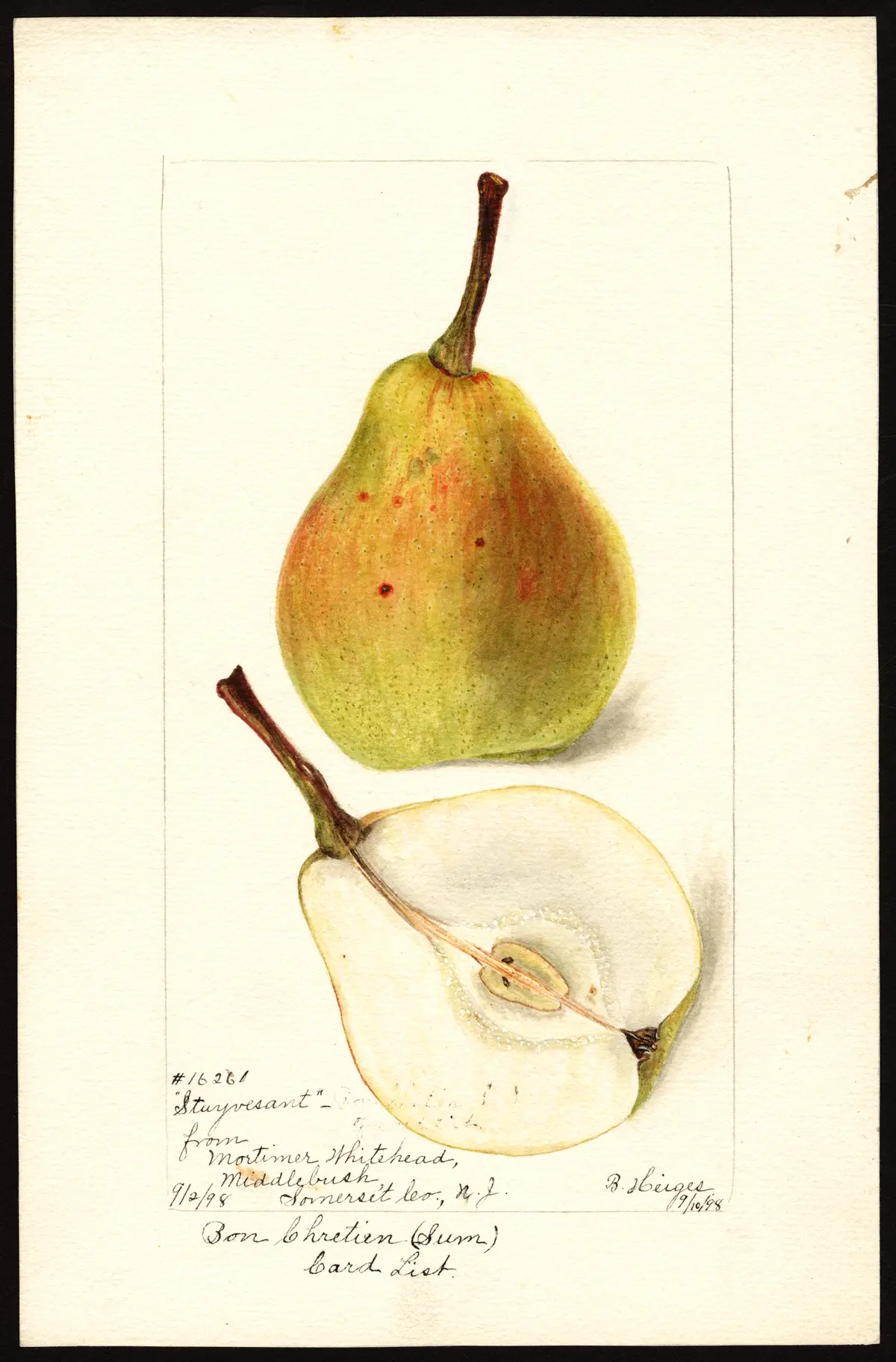
USDA Pomological Watercolor Collection
Bon-Chrétien d'été
Origin / History
Origin ancient and unknown (Hedrick). It was cultivated in French gardens about the end of the sixteenth century. Olivier de Serres mentions it in 1600, and Le Lectier of Orleans in 1628. Downing calls it one of the oldest pears, "cultivated for the last three centuries all over Europe." Hedrick says it has consequently acquired a number of synonyms. Duhamel described and figured it in 1768, and Leroy in 1867 (Hedrick's citations). Coxe gives it as "Bon Chretien d'Ete', or Summer Bon Chretien," and Downing and Thomas enter it under the English name Summer Bon Chrétien. Thomas calls it "formerly much valued."
Tree
Very fruitful. Leaves large and handsome, finely indented (Coxe). Thomas says that in his day the variety was "now generally destroyed by black mildew."
Fruit
Size: Large.
Form: Long, pyriform or irregularly bell-shaped, irregular in form, with swollen, knobby sides and ribbed. Swelled toward the blossom end and diminished toward the stalk.
Stem: Large and long (Coxe).
Cavity: Stalk inserted amid several hollows and projections (Coxe).
Calyx: Not described in source.
Basin: Not described in source.
Skin: Smooth, clear green, turning yellow to rich yellow when fully ripe, with an orange blush on the side next the sun. Thomas gives a reddish cheek.
Dots: Green specks strewn over the surface (Hedrick).
Flesh and flavor: Flesh white (Coxe) or yellowish (Downing). It is coarse-grained and very juicy, tender, half breaking to breaking and crisp. Flavor sweet and sugary, pleasant and rich. Downing rates it "Good"; Hedrick ranks it "second."
Core and seeds: Not described in source.
Season
Ripens from the latter part of August into early September. The later authors place it at the turn of August and September or in early September. Coxe alone gives the latter part of August.
Uses
Not described in source.
Subtypes / Variants
Not described in source.
Other
Not described in source.
Book Sources
Described in 4 period pomological works
- Coxe, A View of the Cultivation of Fruit Trees (1817) — listed as Bon Chretien d'Ete', Or Summer Bon Chretien
- Hedrick, The Pears of New York (1921)
- Downing, Fruits and Fruit Trees of America (1900) — listed as Summer Bon Chrétien
- Thomas, The American Fruit Culturist (1903) — listed as Summer Bon Chrétien
Nursery Catalog Sources
Found in 1 catalog (1900)
- Central Experimental Farm , Dominion Department of Agriculture, Agassiz, British Columbia (under test; Bulletin No. 3, Second Series) — 1900
View original book sources (4)
— William Coxe, A View of the Cultivation of Fruit Trees (1817)
- BON CHRETIEN D'ETE', OR SUMMER BON CHRETIEN.
The fruit is large and long, with a large long stalk inserted amidst several hollows and projections it is swelled towards the blossom end, and diminished towards the stalk ; the skin is smooth, of a clear green colour, which turns yellow when fully ripe ; the flesh is white, tender, half breaking, very juicy and sugary ; the time of ripening the latter part of August : the tree is very fruitful, the leaves large and handsome, and finely indented.
— A.J. Downing, The Fruits and Fruit Trees of America (1900)Summer Bon Chrétien.
Bon Chrétien d'Été. Gratioli. Gratioli d'Été. Gratioli di Roma. Summer Good Christian. Musk Summer Bon Chrétien. Sommer Apothekerbirne. Sommer Gute Christenbirne. Die Sommer Christebirne. Large Sugar, of some. Gros Bon Chrétien. Beauclerc. Safran d'Été. Schelis. Gracioli rouge. Bon Chrétien d'Été Jaune. Canelle d'Été. De Duchesse. Gros Bon Chrétien d'Été. Bon Chrétien Gratioly. Gros Bon Chrétien Beauclerc. William Powell. Stuyvesant. Richards Beurré, of some. Endicott.
This is one of the oldest Pears, having been cultivated for the last three centuries all over Europe.
Fruit large, irregularly bell-shaped or pyriform, with swollen, knobby sides. Skin yellow, with an orange blush. Flesh yellowish, coarse-grained, very juicy, and of a pleasant, rich, sweet flavor. Good. Last of August, or early in September.
— John J. Thomas, The American Fruit Culturist (1903)Summer Bon Chrétien. Large, pyriform, ribbed, rich yellow with a reddish cheek; breaking; very juicy, sweet. Formerly much valued, now generally destroyed by black mildew. Early September.
— U.P. Hedrick, The Pears of New York (1921)Bon-Chrétien d'été.
- Duhamel Trait. Arb. Fr. 2:217, Pl. XLVII, fig. 4. 1768. 2. Leroy Dict. Pom. 1:457, fig. 1867.
Origin ancient and unknown but was cultivated in French gardens about the end of the sixteenth century, being mentioned by Olivier de Serres in 1600, and by Le Lectier of Orleans in 1628. It has been cultivated all over Europe for over three centuries and has consequently acquired a number of synonyms. Fruit large, pyriform, irregular in form, yellow, with orange blush on side next the sun, and strewed with green specks; flesh yellowish, crisp, coarse-grained, very juicy and of a rich, sweet and pleasant flavor; second; early Sept.