Bonne Des Zees Pear
Pear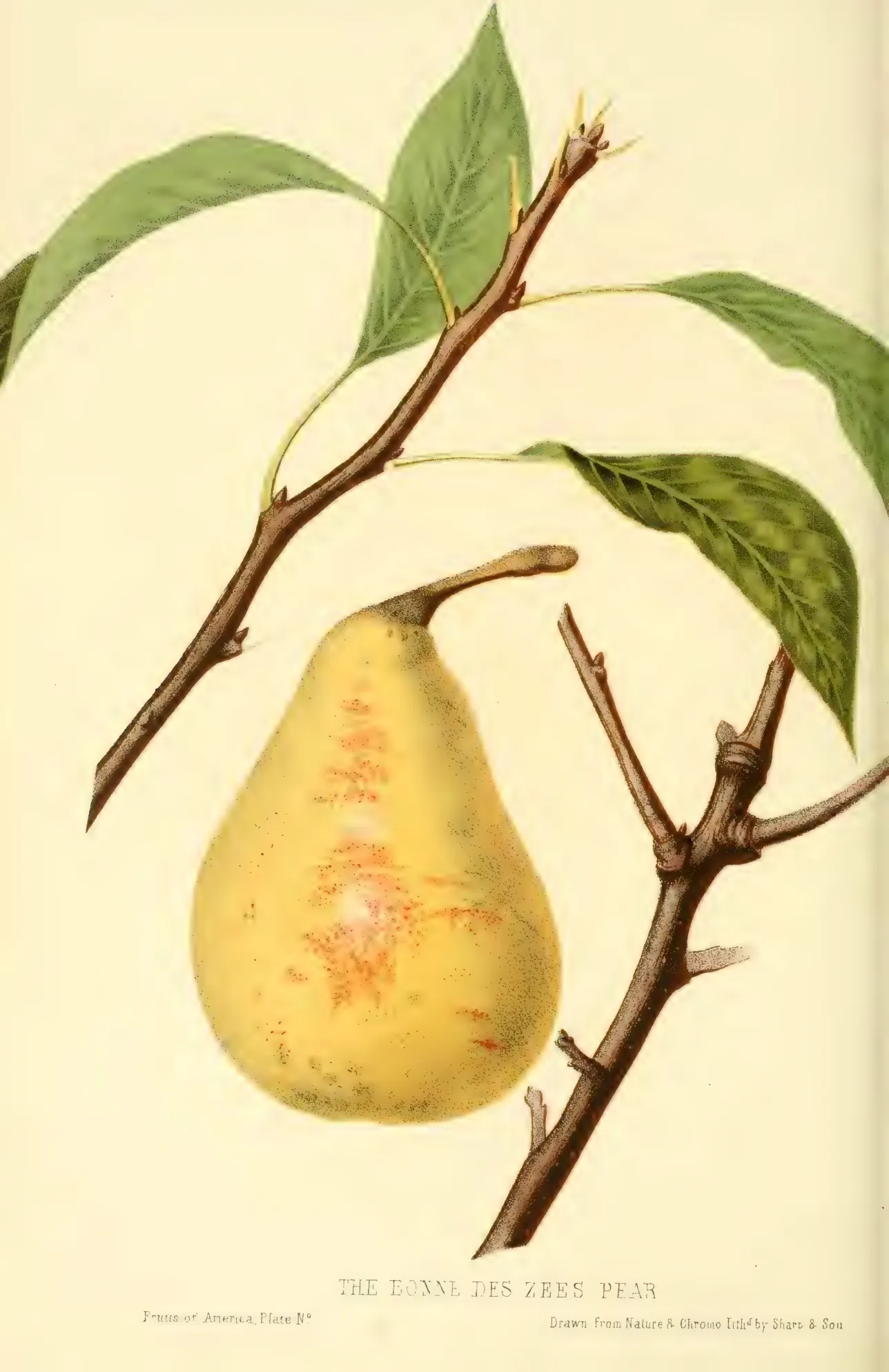
Bonne Des Zees Pear
Origin / History
Hovey wrote that it was "some eight or ten years" since he first saw the variety, which he noticed in the Magazine of Horticulture (cited as vol. xi. p. 205 in his text and vol. xix. p. 205 in his heading). He tasted it in September, 1844, at the nursery of M. Jamin, in Paris, and "at that time we thought it one of the best of pears". He allowed that few other pears were ripe at that season, and that he had not seen the Cushing, Golden Beurre of Bilboa, Bartlett, Belle Lucrative and the like there, so he might have forgotten their comparative merits; still he thought it excellent. After a trial of four years from his own collection he thought it "fully sustains the high character we gave it in 1844". Hovey gives its origin as unknown to him, whether a French or Belgian variety he was not aware. He first saw the name in M. Jamin's Catalogue, and "up to the present time it appears but partially disseminated abroad". There is doubt about the proper mode of writing the name, some French catalogues denominating it Bonne d'Ezee; Hovey adopted the form under which he received it, the one used by M. Jamin. McIntosh (Book of the Garden, 1855) described it as a recent introduction in England in 1855, as reported by Hedrick, who spells the name Bonne des Zoës.
Tree
Moderately vigorous, upright, erect, pyramidal; makes a very compact pyramidal head even without the pruning-knife, which has only to be used to thin out its thick and branchy growth. Wood dull yellowish olive, dotted with large grayish white specks, moderately stout, very short-jointed; old wood grayish olive; annual shoots short. Buds small, ovate, flattened, sharply pointed; flower-buds small, tapering to a point. Leaves medium size, ovate, narrowing most to the point, light green, thin, considerably folded inwards, recurved on the midrib, entire at the edge; petioles rather long, about one and a half inches, moderately stout. Flowers medium size; petals ovate, cupped. Hovey: does not come into bearing very early on the pear, nor does it succeed very well on the quince. McIntosh: tree productive, making a good standard (per Hedrick).
Fruit
Size: Large, about three and a half inches long and two and a half in diameter (Hovey). Medium (McIntosh, per Hedrick).
Form: Obtuse pyramidal, full at the crown, blunt at the stem, little enlarged on one side. Somewhat resembles the Bartlett in shape and color, more so than any other variety Hovey recollected. A very handsome pear.
Stem: Rather short, about half an inch long, stout, little knobby, straight, obliquely inserted.
Cavity: Scarcely perceptible, surrounded with knobby projections.
Calyx: Eye medium size, partially closed; segments of the calyx very short.
Basin: Slightly depressed, broad, shallow.
Skin: Fair, smooth; yellowish green, becoming lemon yellow when mature; beautifully mottled and clouded with pale red in the sun; somewhat russeted around the crown.
Dots: Very large russet specks, regularly covering the skin.
Flesh and flavor: Flesh yellowish white, rather fine, melting, buttery and juicy, though not so buttery as the Bartlett. Flavor rich, sprightly, somewhat vinous, highly aromatized, perfumed and excellent. Hovey thought it "one of the best of pears" on first tasting, called it excellent, and holds it superior to the Bartlett in quality. McIntosh's entry gives "first" (per Hedrick).
Core and seeds: Core large. Seeds medium size, obovate.
Season
Ripe in September, and keeps two or three weeks (Hovey). September also in McIntosh (per Hedrick).
Uses
Not described in source.
Subtypes / Variants
Not described in source.
Other
Not described in source.
Book Sources
Described in 2 period pomological works
- Hovey, The Fruits of America (1852) — listed as The Bonne Des Zees Pear
- Hedrick, The Pears of New York (1921)
Nursery Catalog Sources
Found in 1 catalog (1849) from Massachusetts
- Hovey & Co. , Cambridge , Massachusetts — 1849
View original book sources (2)
— C.M. Hovey, The Fruits of America (1852)THE BONNE DES ZEES PEAR.
Bonne des Zees. Magazine of Horticulture, vol. xix. p. 205. Bonne d'Ezee, } Bonne des haies, } of some French Collections. Belle et Bonne de Zee, }
It is now some eight or ten years since we first saw this variety, and noticed it in the Magazine of Horticulture, (vol. xi. p. 205.) It was in September, 1844, when visiting the nursery of M. Jamin, in Paris, that we tasted the Bonne des Zees, and at that time we thought it one of the best of pears : true, we had not many others to compare with it, for at that period of the year there were but few ripe ; and in the absence of such varieties as the Cushing, Golden Beurre of Bilboa, Bartlett, Belle Lucrative, &c., which we have abundant enough here, but which we did not see in Paris, we might have forgotten their comparative merits. Still, we thought it excellent, and now, after a trial of it for four years, from our own collection, we think it fully sustains the high character we gave it in 1844. It somewhat resembles the Bartlett in shape and color, at least more so than any other variety we now recollect ; and it is superior to it in quality. The flesh is not so buttery, but it possesses a rich, somewhat vinous and highly aromatized flavor. It is a very handsome pear.
The origin of the Bonne des Zees is unknown to us; whether a French or Belgian variety we are not aware. We first saw the name in M. Jamin's Catalogue, and up to the present time it appears but partially disseminated abroad. There is some doubt about the proper mode of writing the name, some French catalogues denominating it the Bonne d'Ezee ; but we have adopted that under which we received it, and which is the one used by M. Jamin.
The tree is a moderately vigorous grower, making a very compact pyramidal head, even without the aid of the pruning-knife, which has only to be used to thin out its thick and branchy growth. It does not come into bearing very early on the pear, nor does it succeed very well on the quince.
Tree. — Moderately vigorous, upright, erect, and pyramidally formed. Wood. — Dull yellowish olive, dotted with large grayish white specks, moderately stout, and very short-jointed ; old wood, grayish olive ; annual shoots, short; buds, small, ovate, flattened, and sharply pointed : Flower-buds, small, tapering to a point.
Leaves. — Medium size, ovate, narrowing most to the point, light green, thin, considerably folded inwards, recurved on the midrib, and entire at the edge ; petioles, rather long, about one and a half inches in length, and moderately stout.
Flowers. — Medium size ; petals, ovate, cupped.
Fruit. — Large, about three and a half inches long, and two and a half in diameter : Form, obtuse pyramidal, full at the crown, blunt at the stem, and little enlarged on one side : Skin, fair, smooth, yellowish green, becoming lemon yellow when mature, beautifully mottled and clouded with pale red in the sun, somewhat russeted around the crown, and regularly covered with very large russet specks : Stem, rather short, about half an inch long, stout, little knobby, straight, and obliquely inserted in a scarcely perceptible cavity, surrounded with knobby projections : Eye, medium size, partially closed, and slightly depressed in a broad, shallow basin ; segments of the calyx, very short : Flesh, yellowish white, rather fine, melting, buttery and juicy : Flavor, rich, sprightly, perfumed and excellent : Core, large : Seeds, medium size, obovate.
Ripe in September, and keeps two or three weeks.
— U.P. Hedrick, The Pears of New York (1921)Bonne des Zoes.
i. McIntosh Bk. Card. 2:463. 1855.
Described as a recent introduction in England in 1855. Fruit medium; first; Sept.; tree productive, making a good standard.
[Additional entry in this volume: "Bonne des Zoës", pp. 498–498]
Bonne des Zoës. 1. McIntosh Bk. Gard. 2:463. 1855. Described as a recent introduction in England in 1855. Fruit medium; first; Sept.; tree productive, making a good standard.