Golden Beurre of Bilboa
Pear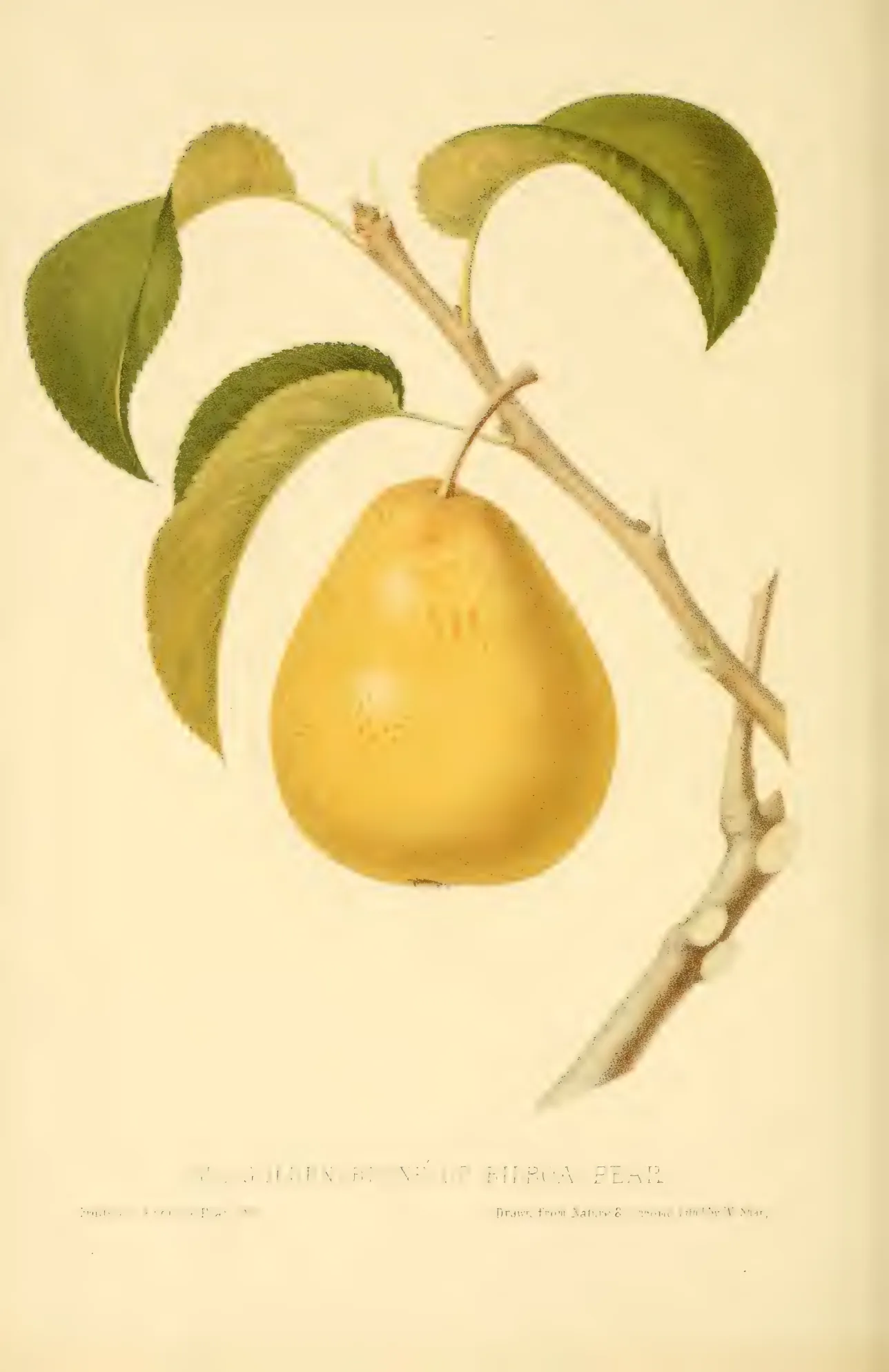
Golden Beurre of Bilboa
Origin / History
Imported from Bilboa, Spain, by Mr. J. Hooper of Marblehead, Massachusetts, who first introduced it into American collections. Hovey and Hedrick give the year of importation as 1821; Downing says about 1827. Specimens of the fruit were first exhibited before the Massachusetts Horticultural Society in October 1831. Elliott calls it "Foreign. From Spain," and Thomas calls it a native of Bilboa, Spain. Downing says its European name is unknown.
Mr. Manning took it into his collection and thought it might probably be detected among future importations from Europe. Hovey reports that after twenty years no similar variety had been seen, either among the immense number of varieties cultivated by Mr. Manning or in any other collection. From this he concludes that it "must have originated in the country from whence it was received."
Mr. W. Kenrick sent scions of Golden Beurre of Bilboa to England. Hovey later received, among several new pears from an English collection, one called simply "Golden Beurre." He supposed it an entirely new kind, "as no such pear has been described by any European pomologist," though its wood appeared familiar. He afterward traced it to Kenrick's scions and predicted that "it will be often received from abroad as a new pear." Hedrick's references begin with Kenrick's American Orchardist (1832) and Hovey's Fruits of America (1851). He also cites Leroy's Dict. Pom. (1867), where it appears under the name "Beurre Dore de Bilboa."
Hovey writes that "few of our early autumn pears have a more prepossessing appearance." He adds that its great beauty "is not its only merit," calling it "really a most excellent fruit" and "this desirable pear."
Tree
A vigorous, healthy, hardy grower with a fine habit; Hovey calls it a "vigorous and handsome growing tree." Upright and regular in form, making a symmetrical head, which Downing calls "a beautiful upright, round head." Branches slightly horizontal at first, curving gently upward at the ends. Annual shoots rather long, tapering but little to the ends; stout, upright, light yellowish brown (Downing), or yellow and ascending (Thomas).
Young wood clear yellowish brown, dotted with small whitish specks, moderately stout and rather short-jointed; old wood reddish brown. Buds medium size, oblong ovate, erect, with rather prominent shoulders; flower buds medium size, ovate (Hovey).
Leaves large, roundish ovate, largest near the base, tapering to the point; thick, light green, glossy, with prominent nerves; slightly recurved on the midrib, nearly flat; deeply, regularly and sharply serrated. Petioles rather short, about three quarters of an inch long, moderately stout. Flowers medium size; petals oval; claw rather short (Hovey).
Produces abundantly. Hovey says it does not come into bearing very early, nor does it succeed very well upon the quince. Elliott says it requires rich, strong, heavy soil, when it is an abundant bearer of fair, regular fruit.
Fruit
Size: Medium (Elliott, Downing) to large. Thomas calls it rather large, and Hovey calls it large, nearly three inches long and two and a half in diameter.
Form: Obovate to regular obovate-pyriform, very regular; slightly pyriform and rather obtuse (Thomas). Largest about one third from the eye, tapering in a swollen manner to the stem (Hovey).
Stem: Long, about an inch and a half, though Thomas gives an inch and a quarter. Rather slender. Hovey describes it as uneven and obliquely inserted, with a slight projection on one side.
Cavity: Small or slight; the stalk slightly sunk.
Calyx: Small, or of medium size (Hovey, of the eye); erect (Thomas). Closed (Hovey, Downing) or mostly open (Elliott), with segments long and narrow (Hovey) or short and stiff (Elliott).
Basin: Shallow or slight; round, with the eye moderately sunk (Hovey).
Skin: Unusually smooth and very fair. Golden yellow, rich or fine yellow, pale yellow when mature (Hovey). A large blotch of smooth russet encircles the stem. Hovey describes it as a deep blotch of cinnamon russet "whose outer line is lost in the delicate tracings and dottings which radiate from it." The skin is a little marked with russet, especially round the stalk (Downing); Elliott adds russet patches over the entire surface. Occasionally a faint tinge of blush on the sunny side (Hovey).
Dots: Many (Elliott), small, distinct, evenly or regularly distributed; russet or brown.
Flesh and flavor: Flesh white to yellowish white; fine-grained, melting, very buttery, juicy. Flavor vinous or slightly vinous. Hovey calls it "sprightly, refreshing, vinous and excellent" and "a pleasant flavor"; Thomas calls the flesh "moderately rich." Thomas notes "sometimes an obscure acid astringency," and Elliott says it is "sometimes a little acid and harsh."
Hovey calls it "a most excellent fruit," Downing "very good," and Hedrick rates it "first." Elliott dissents, calling it "of second-rate quality."
Core and seeds: Core small. Seeds medium size, nearly black (Hovey).
Season
Early autumn, in September, immediately following the Bartlett (Thomas). Downing places it at the first to the middle of September and Hovey at the last of September; Hovey says it keeps well for two or three weeks.
Uses
Downing calls it "a profitable orchard sort."
Subtypes / Variants
Not described in source.
Other
Not described in source.
Book Sources
Described in 5 period pomological works
Nursery Catalog Sources
Found in 4 catalogs (1845–1864) from Massachusetts
- Winship's Nursery (Brighton Nurseries , operated by the Winship family), Brighton (Boston) , Massachusetts — 1845 — listed as Golden of Bilboa Beurré
- Hovey & Co. , Cambridge , Massachusetts — 1849 — listed as Golden of Bilboa Beurré
- Joseph Breck & Co. , Boston , Massachusetts — 1855
- St. Helena Nursery , Howell Prairie, Marion County, OR (Marion Co., Ogn.) — 1864 — listed as Golden of Bilboa Beurré
View original book sources (5)
— C.M. Hovey, The Fruits of America (1852)THE GOLDEN BEURRÉ OF BILBOA.
Golden Beurré of Bilboa. Kenrick's American Orchardist. Golden Beurré, of some English Collections. Hooper's Bilboa, of some American Collections.
Few of our early autumn pears have a more prepossessing appearance than the Golden Beurre of Bilboa. Its skin is unusually smooth and fair, and its golden yellow hue, so indicative of its name, is made yet the more rich in contrast with the deep blotch of cinnamon russet which encircles its stem, and whose outer line is lost in the delicate tracings and dottings which radiate from it. But the great beauty of the Golden Beurre of Bilboa, as with some pears, is not its only merit. Independent of this it is really a most excellent fruit, having a fine melting flesh, a vinous juice, and a pleasant flavor; add to these a vigorous and handsome growing tree, producing abundant crops, and a fair estimate may be formed of this desirable pear.
The Golden Beurre of Bilboa was first introduced into American collections by Mr. J. Hooper, of Marblehead, who imported the tree from Bilboa, in Spain, in 1821; and in October, 1831, specimens of the fruit were first exhibited before the Massachusetts Horticultural Society. Mr. Manning, who introduced it into his collection, thought it might probably be detected among the future importations from Europe; but neither in the immense number of varieties cultivated by Mr. Manning, nor in any other collection, up to this time, a period of twenty years, has a similar variety yet been seen, showing conclusively that it must have originated in the country from whence it was received.
Some few years ago we received several new varieties of pears from an English collection, and among them was a Golden Beurre. We supposed it to be some entirely new kind, as no such pear has been described by any European pomologist. The wood appeared familiar, though we did not then think of identifying it as a synonyme. We have since ascertained that scions of the Golden Beurre of Bilboa were sent to England, some years ago, by Mr. W. Kenrick. This at once explained the history of the Golden Beurre, and we doubt not, hereafter, it will be often received from abroad as a new pear.
The tree is a vigorous and healthy grower, with a fine habit, making a symmetrical head. It does not come into bearing very early, nor does it succeed very well upon the quince.
Tree. — Vigorous, upright and regular in form, with the branches slightly horizontal at first, but gently curving upwards at the ends; annual shoots rather long, tapering but little to the ends.
Wood. — Clear yellowish brown, dotted with small whitish specks, moderately stout and rather short-jointed; old wood, reddish brown; buds, medium size, oblong ovate, erect, with rather prominent shoulders: Flower-buds, medium size, ovate.
Leaves. — Large, roundish ovate, largest near the base, tapering to the point, thick, light green, glossy, with prominent nerves, slightly recurved on the midrib, nearly flat, and deeply, regularly and sharply serrated; petioles, rather short, about three quarters of an inch long, moderately stout.
Flowers. — Medium size; petals, oval; claw, rather short.
Fruit. — Size large, nearly three inches long and two and a half in diameter: Form, obovate, largest about one third from the eye, and tapering in a swollen manner to the stem: Skin, very fair, smooth, pale yellow when mature, with a large blotch of smooth russet encircling the stem, regularly dotted with russet specks, and occasionally having a faint tinge of blush on the sunny side: Stem, long, about one and a half inches in length, uneven, rather slender, and obliquely inserted in a small cavity, with a slight projection on one side: Eye, medium size, closed, and moderately sunk in a round basin; segments of the calyx long and narrow: Flesh, yellowish white, fine, melting, buttery and juicy: Flavor, sprightly, refreshing, vinous and excellent: Core, small: Seeds, medium size, nearly black.
Ripe the last of September, and keeps well for two or three weeks.
— F.R. Elliott, The Western Fruit Book (1865)Golden Beurre of Bilboa.
Hooper's Bilboa.
Foreign. From Spain. Tree, hardy, requires rich, strong, heavy soil, when it is an abundant bearer of fair, regular, medium-sized fruit of second-rate quality.
Fruit, medium, obovate; color, rich yellow, with russet around the stem, and many russet dots and patches over the entire surface; stem, slender; cavity, slight; calyx, small, mostly open, short stiff segments; basin, shallow; flesh, fine-grained, melting, juicy, sometimes a little acid and harsh. September.
— A.J. Downing, The Fruits and Fruit Trees of America (1900)Golden Beurre or Bilboa.
Hooper's Bilboa. Beurre Doré de Bilboa. Driver? Beurre Gris de Bilboa. Beurre Gris de Portugal.
The Golden Beurre of Bilboa was imported from Bilboa, Spain, about 1827, by Mr. Hooper, of Marblehead, Mass. Its European name is unknown. The tree is healthy, hardy, and a vigorous grower, forming a beautiful upright, round head, and producing abundantly. It is a profitable orchard sort. Shoots stout, upright, light yellowish brown.
Fruit medium, regular obovate pyriform, golden yellow, evenly dotted with small brown dots, and a little marked with russet, especially round the stalk. Stalk about an inch and a half long, rather slender, set in a small cavity. Calyx small, closed, placed in a slight basin. Flesh white, very buttery and melting, and fine-grained, with a slightly vinous flavor. Very good. First to the middle of September.
— John J. Thomas, The American Fruit Culturist (1903)Golden Beurre of Bilboa. (Bilboa, Hooper's Bilboa.) Rather large, obovate, slightly pyriform, rather obtuse, very regular; surface smooth, fair, fine yellow, russeted round the stalk; dots small, distinct; stalk an inch and a quarter long, slightly sunk; calyx small, erect, basin shallow; flesh fine grained, very buttery, melting, moderately rich—sometimes an obscure acid astringency. Ripens the first of autumn, and immediately follows the Bartlett. Shoots yellow, ascending. A native of Bilboa, Spain.
— U.P. Hedrick, The Pears of New York (1921)Golden Beurre of Bilboa.
- Kenrick Am. Orch. 177. 1832.
- Hovey Fr. Am. 1:99, Pl. 1851. Beurre Dore de Bilboa. 3. Leroy Diet. Pom. 1:351, fig. 1867.
Imported to this country from Bilboa, Spain, in 1821 by J. Hooper, Marblehead, Mass. Fruit medium to large, obovate-pyriform, golden-yellow, speckled evenly with small, brown dots, and slightly marked with russet; flesh yellowish-white, fine, melting, very buttery, vinous and excellent flavor; first; Sept.