Andrews
Pear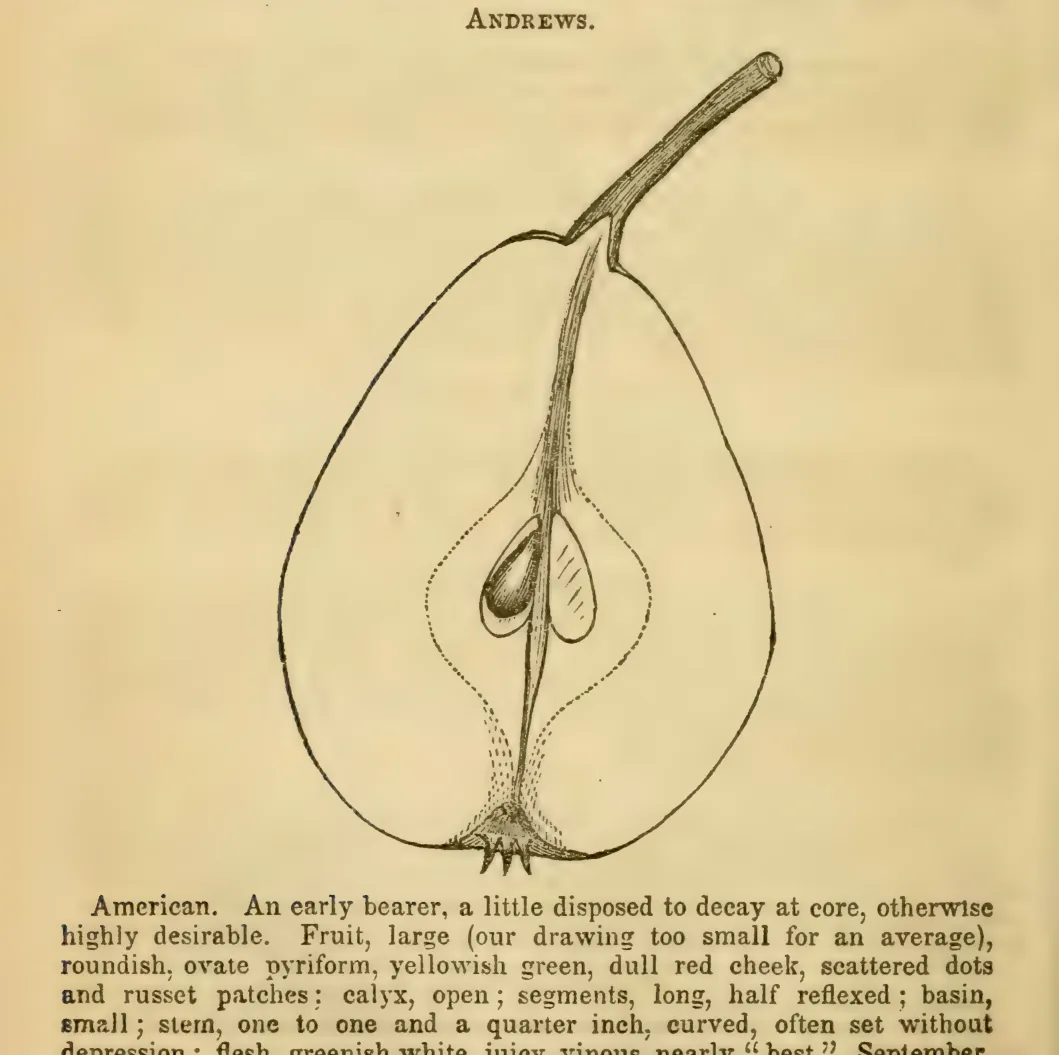
Andrews
Origin / History
A native American pear, from Dorchester, Massachusetts. Hovey cites the first account of it as the New England Farmer, vol. vii (1829), p. 266. That account was published by Samuel Downer, who introduced it to the notice of cultivators soon after the organization of the Massachusetts Horticultural Society in 1829. Downing instead says it was "first introduced to notice by a gentleman of Boston, whose name it bears," and calls it "a favorite native seedling, found in the neighborhood of Dorchester."
According to Hovey, Downer stated "that it originated in Dorchester, and that the original tree was purchased about sixty years ago by Mr. John Andrews, of Boston." Andrews removed the tree to his garden in Court Street, where it bore fruit for several years. From some cause, either its locality or neglect, it disappeared more than thirty years before Downer's account.
Hovey receives this history "with some doubt." In Somerville, Mass., there was growing in his day, in full vigor and bearing a large annual crop, a fine large tree of Andrews. The source of its scions is unknown. The owner could say only that his father grafted it when the owner was a little boy, upwards of sixty years before. Its age is as great as that claimed for the tree purchased by Mr. Andrews. It therefore remains a question whether the Andrews tree was the original, or was grafted from the same unknown source as the Somerville tree. Hovey holds that "of its native origin, however, there can be no doubt."
Hovey calls it "unquestionably, one of the finest American pears yet produced." He says it has "everywhere, and under all circumstances, so far as our knowledge extends," proved hardy, productive and superior. He finds it less prepossessing and showy than the Williams's Bon Chrétien (Bartlett) or the Golden Beurre of Bilboa, which ripen at the same time. Yet in its very melting flesh and "the peculiarly rich cinnamon aroma of its abundant juice" it surpasses either, and is "second to no other pear of its season." Elliott calls it "highly desirable" apart from its tendency to decay at the core. Downing calls it "of excellent flavor, but variable." Thomas finds it "on some localities not first-rate."
Tree
Tree slow growing and moderately vigorous; upright, a little irregular. Wood very slender while young, becoming stronger as it advances in age. It bears so profusely that it makes very little wood. Comes into bearing rather early. Hardy and productive (Hovey); "very productive and fair" (Thomas). Another of the many American pears which does not grow freely on the quince (Hovey).
Wood dark reddish brown, dotted with small white specks, rather slender and short-jointed. Annual shoots short; shoots diverging (Thomas). Old wood dull brown. Buds medium size, roundish ovate, full, diverging, with rather prominent shoulders. Flower buds medium size.
Leaves small, oblong ovate, dull green, shortly pointed, rather coarsely nerved, wavy on the margin, finely serrated. Petioles long, nearly two inches in length, very slender. Flowers medium size; petals cupped (Hovey).
Fruit
Size: Large to rather large or quite large, Thomas alone allowing medium. Hovey measures it about three inches long and two and three-quarter inches in diameter. Elliott says his own drawing is too small for an average.
Form: Pyriform, distinctly so by Thomas's account, ranging to obovate pyramidal or roundish ovate pyriform. One-sided, or often slightly one-sided, the sides unequal, one side a little larger than the other. Slightly irregular, full at the base, tapering to the stem.
Stem: Curved. Three-quarters of an inch to one and a quarter inches long, most authors giving one to one and a quarter inches. Hovey calls it medium length, about three-quarters of an inch, rather stout, twisted, obliquely inserted, usually with a projection on one side.
Cavity: Often none, the stem set without depression or on the blunt surface, otherwise in a shallow or very shallow, blunt depression; "scarcely sunk" (Thomas). Hovey gives no cavity at all.
Calyx: Eye medium size, open. Segments medium length (Hovey) to long and half reflexed (Elliott).
Basin: Small and round. Shallow to deep: Hovey has the eye deeply sunk, and Thomas calls the basin shallow, sometimes deep.
Skin: Fair and smooth; rather thick to thick. Yellowish green, pale to dull, with a dull red cheek, broad according to Thomas; Hovey describes it as tinged with brownish red on the sunny side. Elliott adds russet patches.
Dots: Few, scattered; russet specks (Hovey).
Flesh and flavor: Flesh greenish white to greenish; Hovey alone calls it yellowish white. Fine, melting to very melting, very juicy, "full of juice." Flavor vinous, fine or rich vinous, rich, sugary and refreshing, with "a peculiarly delicious aroma," a rich cinnamon aroma (Hovey); "fine, pleasant, agreeable" (Thomas). Quality runs from "good to very good" (Downing) through nearly "best" (Elliott) to "first" (Hedrick). Thomas dissents: "on some localities not first-rate."
Core and seeds: Core medium size. Seeds large, very long, light brown (Hovey). The core is a little disposed to decay (Elliott), "subject to rot at the core" (Downing).
Season
Ripens in September, early in September by Downing's account and early in autumn by Thomas's. Hovey says it keeps three or four weeks.
Uses
Not described in source.
Subtypes / Variants
Not described in source.
Other
Downing reports that the Beurre Oudinot, as he received it, always proved identical with Andrews, but that Leroy claims it is a distinct sort. Hedrick cites a plate of the fruit in Hovey's Fruits of America (1851) and a figure in Downing (1857).
Book Sources
Described in 6 period pomological works
Nursery Catalog Sources
Found in 3 catalogs (1845–1855) from Massachusetts
- Winship's Nursery (Brighton Nurseries , operated by the Winship family), Brighton (Boston) , Massachusetts — 1845
- Hovey & Co. , Cambridge , Massachusetts — 1849
- Joseph Breck & Co. , Boston , Massachusetts — 1855
View original book sources (6)
— C.M. Hovey, The Fruits of America (1852)THE ANDREWS PEAR.
Andrews, New England Farmer, vol. vii. (1829,) p. 266. Andrews, } Gibson, } of some American Collections.
The Andrews is, unquestionably, one of the finest American pears yet produced. It has everywhere, and under all circumstances, so far as our knowledge extends, proved to be a hardy, productive and superior variety. In appearance, it is less prepossessing and showy than the Williams's Bon Chrétien (Bartlett) or the Golden Beurre of Bilboa, which ripen at the same time; but in its very melting flesh, and the peculiarly rich cinnamon aroma of its abundant juice, surpasses either of them, and is second to no other pear of its season.
The history of the Andrews, though tolerably well authenticated, is, however, to be received with some doubt. The first account of it was published in the N. E. Farmer, by Mr. Samuel Downer, who introduced it to the notice of cultivators soon after the organization of the Massachusetts Horticultural Society, in 1829. Mr. Downer states that it originated in Dorchester, and that the original tree was purchased about sixty years ago by Mr. John Andrews, of Boston, who removed it to his garden in Court Street, where it continued to bear fruit for several years; but from some cause, either its locality or from neglect, it disappeared more than thirty years ago.
The only doubt respecting its origin, as above stated, is, that in Somerville, Mass., there is now growing, in full vigor, and bearing a large annual crop, a fine large tree of the Andrews. Where the scions came from is unknown; the only information the present owner of the tree can give, is, that his father grafted it when he was a little boy, upwards of sixty years ago. As the age of this tree is as great as that claimed for the one purchased by Mr. Andrews, it remains a question whether the latter was the original one, or whether it was grafted from the same unknown source from which the one in Somerville was obtained. Of its native origin, however, there can be no doubt.
The Andrews is a slow growing and moderately vigorous tree, bearing so profusely that it makes very little wood. It comes into bearing rather early, and is another of the many American pears which does not grow freely on the quince.
Tree.—Moderately vigorous, upright, little irregular, making very slender wood while young, but becoming stronger as it advances in age.
Wood.—Dark reddish brown, dotted with small white specks, rather slender and short-jointed; annual shoots, short; old wood, dull brown; buds, medium size, roundish ovate, full, diverging, with rather prominent shoulders: Flower-buds, medium size.
Leaves.—Small, oblong ovate, dull green, shortly pointed, rather coarsely nerved, wavy on the margin, and finely serrated; petioles, long, nearly two inches in length, very slender.
Flowers.—Medium size; petals cupped.
Fruit.—Large, about three inches long and two and three quarter inches in diameter: Form, obovate, pyramidal, slightly irregular, one side being a little larger than the other, full at the base, and tapering to the stem: Skin, fair, smooth, yellowish green, tinged with brownish red on the sunny side, and dotted with a few scattered russet specks: Stem, medium length, about three quarters of an inch long, rather stout, curved, twisted and obliquely inserted without any cavity, usually with a projection on one side: Eye, medium size, open, and deeply sunk in a round basin; segments of the calyx medium length: Flesh, yellowish white, fine, melting and very juicy: Flavor, rich, sugary and refreshing, with a peculiarly delicious aroma: Core, medium size: Seeds, large, very long, light brown.
Ripe in September and keeps three or four weeks.
— F.R. Elliott, The Western Fruit Book (1865)Andrews.
American. An early bearer, a little disposed to decay at core, otherwise highly desirable. Fruit, large (our drawing too small for an average), roundish, ovate pyriform, yellowish green, dull red cheek, scattered dots and russet patches : calyx, open ; segments, long, half reflexed ; basin, small ; stem, one to one and a quarter inch, curved, often set without depression ; flesh, greenish white, juicy, vinous, nearly " best." September.
— A.J. Downing, The Fruits and Fruit Trees of America (1900)Andrews. Beurre Oudinot ? Amory. Gibson. The Andrews is a favorite native seedling, found in the neighborhood of Dorchester, and first introduced to notice by a gentleman of Boston, whose name it bears. It is of excellent flavor, but variable and subject to rot at the core. Fruit rather large, pyriform, one-sided. Skin smooth, and rather thick, pale yellowish green, with a dull red cheek, and a few scattered dots. Stalk about an inch and a quarter long, curved, and set in a very shallow, blunt depression, or often without depression. Calyx open, placed in a small basin. Flesh greenish white, full of juice, melting, with a fine vinous flavor. Good to very good. Early in September. The Beurre Oudinot, as we have received it, has always proved identical with our Andrews, but Leroy claims it a distinct sort.
— John J. Thomas, The American Fruit Culturist (1903)Andrews. (Amory, Gibson.) Medium or rather large, distinct pyriform, often slightly one-sided; skin thick, dull yellowish-green, with a broad, dull red cheek; stalk about an inch long, curved, scarcely sunk; basin shallow, sometimes deep; flesh greenish, very juicy, melting, of a fine, pleasant, agreeable flavor. On some localities not first-rate. Ripens early in autumn. Very productive and fair. Shoots diverging. Origin, Dorchester, Mass.
— J.L. Budd & N.E. Hansen, American Horticultural Manual, Part II: Systematic Pomology (1914)Andrews. — Quite large, pyriform, sides unequal; skin quite thick, smooth, yellowish green, with dull red cheek, and scattering dots; stalk one and one-quarter inches long, curved, and inserted in shallow depression and often on the blunt surface. Flesh greenish white, juicy, melting, with rich vinous flavor, good to very good. Season, early September. Massachusetts.
— U.P. Hedrick, The Pears of New York (1921)Andrews. 1. Hovey Fr. Am. 1:97, Pl. 1851. 2. Downing Fr. Trees Am. 451, fig. 1857.
Samuel Downer introduced this pear soon after the Massachusetts Horticultural Society was organized in 1829. He stated "that it originated in Dorchester, and that the original tree was purchased about 60 years ago by John Andrews of Boston." Fruit rather large, pyriform, one-sided, pale yellowish-green, with a dull red cheek; flesh greenish-white, full of juice, melting, having a vinous flavor; first; early Sept.