Beurré Beaumont Pear
Pear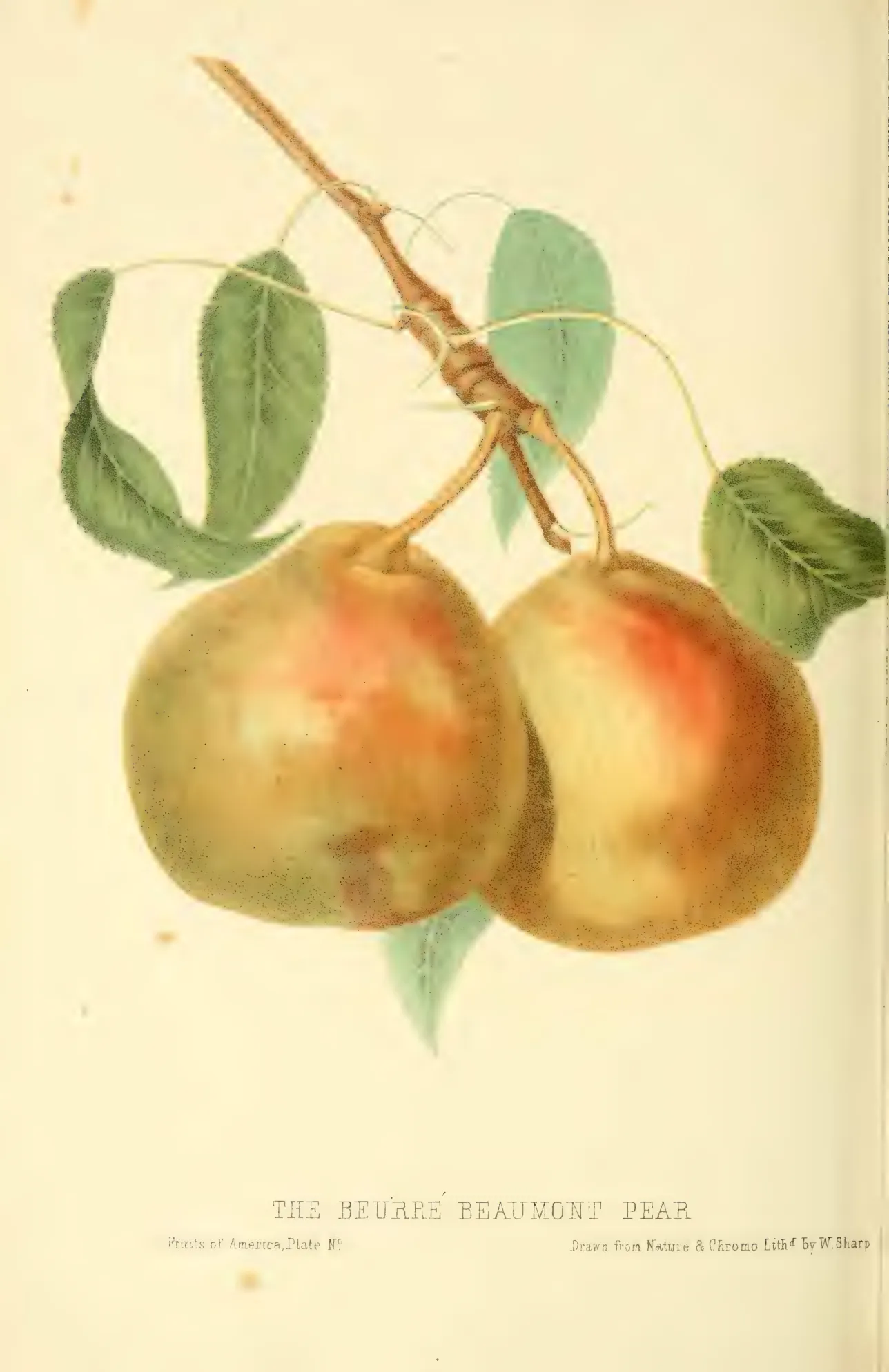
Beurré Beaumont Pear
Origin / History
Introduced into American collections fifteen or twenty years before 1852 and first fruited at Salem, from which fine specimens were described and figured in the Magazine of Horticulture (vol. xi, p. 331). Since much disseminated under the name Beurré Beaumont, though whether that is its legitimate name Hovey is unable to determine. Two pears received from France as the Beurré Le Fevre and Beurré Montefortaine proved synonymous with it; amid the confusion of names and the absence of accurate descriptions it is difficult to decide which has priority. The Beurré Le Fevre is a very old pear, raised in 1804, yet appears wholly unknown to English pomologists and is only briefly described by a few French authors. Hovey adheres to the familiar name Beurré Beaumont, under which it has been widely disseminated and will be everywhere recognized. "A most excellent pear," which "well deserves more attention than it has hitherto received."
Tree
Moderately vigorous, irregular and somewhat straggling in habit, with diverging or nearly horizontal branches, often drooping; annual growth rather slender, curved. Somewhat difficult to train into a good pyramid. Thrives exceedingly well on the quince, and is one of the sorts which may be generally cultivated on that stock.
Wood brownish olive, sparsely dotted with grayish specks, rather slender and short-jointed; old wood grayish olive. Buds medium size, ovate, sharply pointed, very diverging, with small shoulders. Flower-buds medium size, ovate, obtuse, light brown, with gray scales.
Leaves medium size, narrow ovate, broadest near the base, tapering to the point, deep green, wavy, slightly and sharply serrated; petioles about two inches long, slender.
Flowers medium size; petals roundish oval, cupped; clusters compact.
Fruit
Size: Medium, about two and a quarter inches long and two and a quarter in diameter.
Form: Roundish obovate, largest in the middle, full at the crown, rounding off to the stem. Roundish, and so not pyramidal as in the Andrews, with which it might otherwise be readily mistaken.
Stem: Short, about three quarters of an inch long, brown, often contracted and swollen on the sides.
Cavity: Very shallow.
Calyx: Eye medium size, closed; segments of the calyx medium length, pointed, stiff.
Basin: Moderately sunk, round.
Skin: Fair, smooth; yellowish green in the shade, broadly marbled with brownish red in the sun, assuming a ruddy color on the exposed side.
Dots: Thickly and regularly covered with dark green specks.
Flesh and flavor: Flesh white, fine, buttery and juicy, of the same buttery texture as the Andrews; the juice has much of that variety's rich spicy aroma. Flavor rich, sweet, perfumed and excellent.
Core and seeds: Core medium size. Seeds large, dark brown.
Season
Ripe the middle of September; keeps three or four weeks. Matures at the same season as the Andrews and keeps about the same length of time.
Uses
Not described in source.
Subtypes / Variants
Not described in source.
Other
In general character it approaches the Andrews and will not suffer by comparison with that old, highly esteemed, and truly luscious but too much neglected pear.
Book Sources
Described in 1 period pomological work
- Hovey, The Fruits of America (1852) — listed as The Beurré Beaumont Pear
Nursery Catalog Sources
Found in 1 catalog (1849) from Massachusetts
- Hovey & Co. , Cambridge , Massachusetts — 1849 — listed as Beurré de Montefortaine
View original book sources (1)
— C.M. Hovey, The Fruits of America (1852)THE BEURRÉ BEAUMONT PEAR.
Beurré Beaumont. Kenrick's American Orchardist. Beurré Le Fevre, } } of some French Collections. Beurré de Montefortaine, }
The Beurre Beaumont is a most excellent pear, and well deserves more attention than it has hitherto received. In its general character it approaches the Andrews, and, if it resembled it in form, might be readily mistaken for that variety. Its flesh has the same buttery texture, and its juice much of its rich spicy aroma. But, beyond this, there is no similarity in the two; for, while the Andrews is a somewhat pyramidal-shaped fruit, the Beaumont is a roundish one, and could never be mistaken for it. It matures at the same season, keeps about the same length of time, and will not suffer by a comparison with that old, highly esteemed, and truly luscious but too much neglected pear.
The Beurre Beaumont was introduced into our collections fifteen or twenty years ago, and first fruited at Salem, from whence we had fine specimens, which we described and figured in the Magazine of Horticulture, (vol. xi. p. 331.) It has since been much disseminated under this name, but whether it is its legitimate one or not we are unable to determine. Two other pears, received by us from France as the Beurré Le Fevre and Beurre Montefortaine, have proved synonymous with the Beurré Beaumont; but in the present confusion of names, and in the absence of accurate descriptions, it is difficult to decide which should have priority. The Beurre Le Fevre is a very old pear, raised in 1804; yet it appears to be wholly unknown to English pomologists, and is only briefly described by a few French authors. With such information, therefore, as we have been able to find in regard to it, we have thought it best to adhere to the familiar name of Beurre Beaumont, under which it has been widely disseminated, and under which it will be everywhere recognized.
The tree is a rather irregular grower, with diverging and often drooping branches, and is somewhat difficult to train into a good pyramid. It thrives exceedingly well on the quince, and may be set down as one of the sorts which may be generally cultivated on that stock.
[89]
BEURRÉ BEAUMONT PEAR.
Tree. — Moderately vigorous, irregular and somewhat straggling in habit, with diverging or nearly horizontal branches; annual growth rather slender, curved.
Wood. — Brownish olive, sparsely dotted with grayish specks, rather slender and short-jointed; old wood, grayish olive; buds, medium size, ovate, sharply pointed, very diverging, with small shoulders: Flower-buds, medium size, ovate, obtuse, light brown, with gray scales.
Leaves. — Medium size, narrow ovate, broadest near the base, tapering to the point, deep green, wavy, and slightly and sharply serrated; petioles, about two inches long, slender.
Flowers. — Medium size; petals, roundish oval, cupped; clusters, compact.
Fruit. — Medium size, about two and a quarter inches long, and two and a quarter in diameter: Form, roundish obovate, largest in the middle, full at the crown, and rounding off to the stem: Skin, fair, smooth, yellowish green in the shade, broadly marbled with brownish red in the sun, and thickly and regularly covered with dark green specks, assuming a ruddy color on the exposed side: Stem, short, about three quarters of an inch long, brown, inserted in a very shallow cavity, often contracted and swollen on the sides: Eye, medium size, closed, and moderately sunk in a round basin; segments of the calyx, medium length, pointed, stiff: Flesh, white, fine, buttery and juicy: Flavor, rich, sweet, perfumed and excellent: Core, medium size: Seeds, large, dark brown.
Ripe the middle of September, and keeps three or four weeks.
[90]