Beurré Dalbret
Pear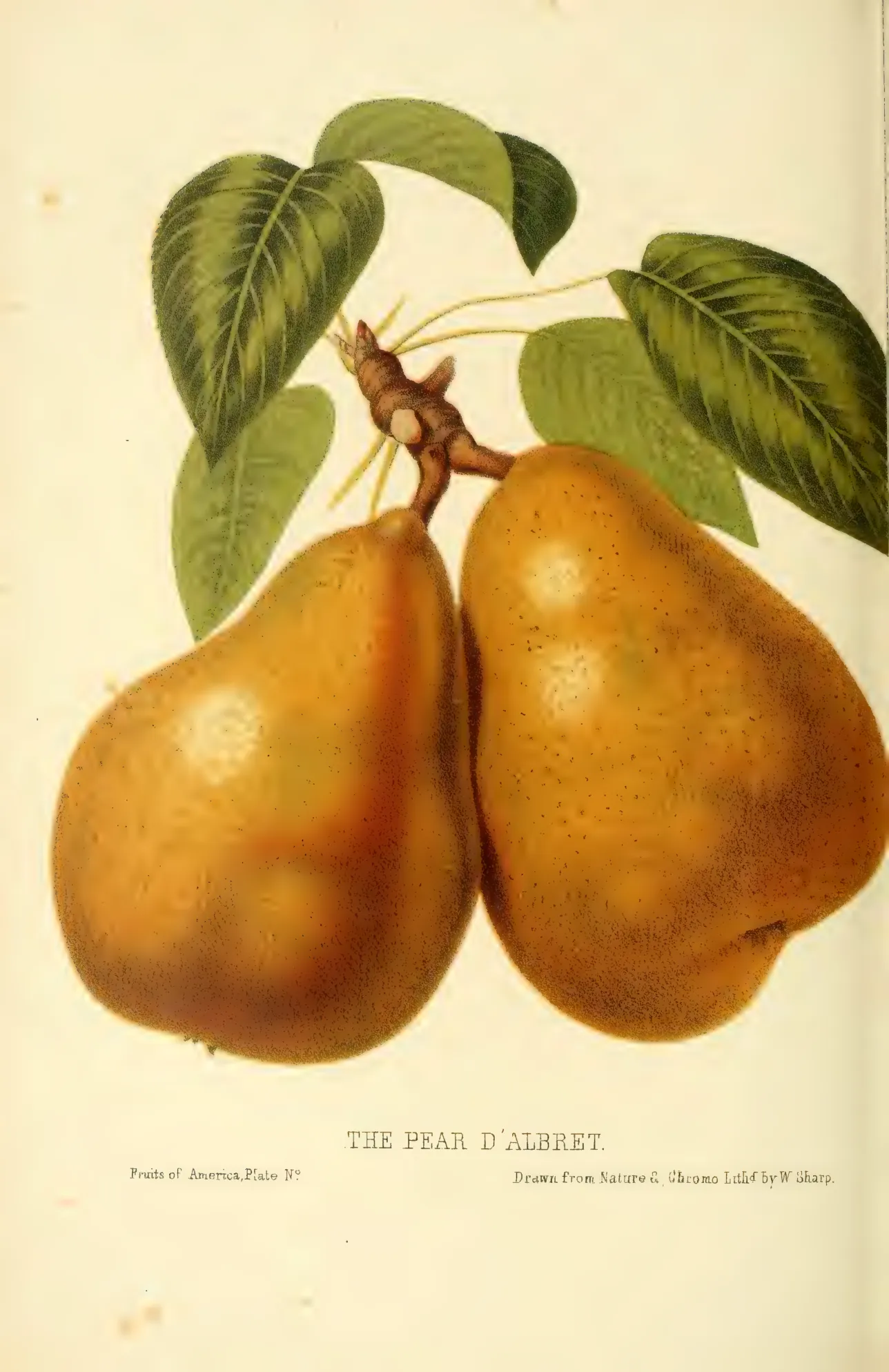
Beurré Dalbret
Origin / History
Hedrick states that Beurré Dalbret was obtained by Van Mons prior to 1832, citing Leroy's Dictionnaire de Pomologie (1867) and Downing (1869). Hovey writes that "the origin and history of the Pear d'Albret is unknown to us," and as far as he could ascertain it was known only in the catalogs of the French or Belgian nurserymen. Elliott and Downing call it a foreign variety. The Pear d'Albret is entered in the Magazine of Horticulture, vol. xx, 1854. The Beurré d'Albret of some foreign collections and catalogs proved, by Hovey's account, to be the same as the d'Albret.
Hovey received Beurré Dalbret from M. Jamin of Paris in 1846, with many new kinds. He planted it out with others of unknown merit, and it received little attention until it fruited in 1850. Even then it "did not show its true qualities," because the trees were still small and not sufficiently established to fix the character of the variety. In the following year, and more particularly in the season of 1853, the fruit was "so much larger, so rich in color, and of such luscious flavor, that it at once established its claim to a place among the very best pears yet introduced." Hovey counted it among the foreign pears of whose merits nothing was known and from which no high expectations were formed, but which "have proved of the greatest excellence, and have taken their place among the choicest pears."
Tree
Moderately vigorous to vigorous. Hovey calls it moderately vigorous, a good, though not a strong, grower, while Elliott and Downing call it vigorous. Upright, somewhat irregularly branched, making a rather open and loose head. With a little care it makes a fair pyramid, though it is inclined to grow somewhat spreading. Annual shoots not very stout. Wood dark reddish brown, dotted with whitish specks, moderately strong, rather short-jointed; young wood reddish; old wood grayish brown. Buds medium size, ovate, diverging, with prominent shoulders. Flower-buds medium size, swollen toward the base, acutely pointed, deep brown.
Leaves small, about two inches long and one inch wide, regularly ovate, narrowing to each end, thin, deep green, glossy, finely nerved, incurved a little at the edges, very finely serrated. Petioles medium length, about one and a quarter inches long, slender. Flowers medium size; petals narrow, ovate, cupped; claw long (Hovey).
Comes into bearing rather early (Hovey). Productive; a good bearer. Does well upon the quince (Hovey).
Fruit
Size: Medium to large; most authors give medium or medium or above. Hovey gives large, about four inches long and three in diameter, on established trees; the first fruits from young trees in 1850 were smaller.
Form: Pyramidal to elongated-pyriform or long pyriform, angular, often with a suture on one side (Downing). Largest near the crown, contracted about the middle, with a somewhat elongated neck (Hovey). Elliott gives the pyramidal form as elongated or obtuse-pyriform. Hedrick calls it rather indented and irregular.
Stem: Stout or thick, curved, swollen and fleshy at the base, obliquely attached. Hovey gives medium length, about one inch long. Downing gives it short and "much inclined at its insertion by a lip."
Cavity: Slight, on one side; on the lower side (Elliott).
Calyx: Eye small to medium, open or partially open to partially closed. Segments of the calyx short, twisted (Hovey).
Basin: Small, shallow, uneven; the eye very little depressed.
Skin: Slightly rough to rough. Yellow, mostly covered with clear deep to dark cinnamon or brown russet, bronzed on the sunny side. Hedrick instead describes the skin as golden or greenish yellow, mottled and spotted with bright red.
Dots: Dark russet specks (Hovey). Hedrick describes the fruit as dotted all over.
Flesh and flavor: Greenish white, coarse, buttery, melting to very melting, very to exceedingly juicy. Hedrick instead calls the flesh white and fine. Flavor vinous, rich to exceedingly rich, deliciously or highly perfumed; "luscious" (Hovey). Downing and Thomas rate it "very good"; Hedrick rates it "first."
Core and seeds: Core small. Seeds small, sharply pointed, dark (Hovey).
Season
Ripe in October; Hedrick gives September and October. Keeps two or three weeks (Hovey).
Uses
Not described in source.
Subtypes / Variants
Not described in source.
Other
Hovey set Beurré Dalbret against the new foreign pears brought to notice during the preceding eight or ten years. Most of these had been "heralded with a great reputation" and so attracted more than usual attention among cultivators. Some proved fully equal to their reputed merits, a larger part were only of secondary quality, and a few were entirely worthless. Despite the efforts of Bivort and other Belgian and French pomologists to establish a correct nomenclature, many of the new pears had no authentic published descriptions, and their identity had to be made out from the nursery catalogs. Bivort's Album de Pomologie had aided much in this work, and the Annals de Pomologie of the Belgian government would assist still more. Hovey urged that accurate descriptions and outline engravings be published in some journal within the reach of all, so that cultivators could determine more speedily the correctness of the varieties yearly added to their collections.
Book Sources
Described in 5 period pomological works
- Downing, Fruits and Fruit Trees of America (1900) — listed as Beurré d'Albret
- Hovey, The Fruits of America (1852) — listed as Pear d'Albret
- Hedrick, The Pears of New York (1921)
- Elliott, The Western Fruit Book (1865) — listed as Beurre d'Albert
- Thomas, The American Fruit Culturist (1903) — listed as Albret
Nursery Catalog Sources
Found in 2 catalogs (1849–1900) from Massachusetts
- Hovey & Co. , Cambridge , Massachusetts — 1849 — listed as Poire d'Albret
- Central Experimental Farm , Dominion Department of Agriculture, Agassiz, British Columbia (under test; Bulletin No. 3, Second Series) — 1900
View original book sources (5)
— C.M. Hovey, The Fruits of America (1852)THE PEAR D'ALBRET.
Pear d'Albret. Magazine of Horticulture, vol. xx. 1854. Beurré d'Albret of some Foreign Collections.
Most of the new foreign pears, that have been brought to notice during the last eight or ten years, have been heralded with a great reputation, and have, in consequence, attracted more than usual attention among cultivators. Some of them have proved fully equal to their reputed merits, while a larger part of them have only been of secondary quality, and a few entirely worthless. Others, again, have been added to our collections, of whose merits nothing was known, and from which no high expectations were formed ; but it has happened, in many instances, that the latter have proved of the greatest excellence, and have taken their place among the choicest pears.
The Pear d'Albret is one of the latter description ; unknown only in the Catalogues of the French or Belgian nurserymen, so far as we have been enabled to ascertain, it was received with many new kinds from M. Jamin of Paris, in 1846, and planted out with others of unknown merit, receiving but little attention until after it produced fruit in 1850. Even then it did not show its true qualities; the trees being yet small, and not sufficiently established to fix the character of the variety : but in the following year, and more particularly in the season of 1853, the fruit was so much larger, so rich in color, and of such luscious flavor, that it at once established its claim to a place among the very best pears yet introduced.
The origin and history of the Pear d'Albret is unknown to us. Notwithstanding the efforts of Bivort and other Belgian and French pomologists to establish a correct nomenclature, there has not yet been any authentic descriptions published of many of the new pears, and their identity must be made out from the Nursery Catalogues. Bivort's Album de Pomologie has aided much in this work, and the Annals de Pomologie of the Belgian government will assist still more ; but accurate descriptions and outline engravings, in some journal within the reach of all, would be the means of enabling cultivators to determine more speedily the correctness of many of the varieties which are yearly added to our collections. The Beurre d'Albret of some catalogues proves to be the same as the d'Albret.
This fine pear fortunately does well upon the quince ; the tree is a good, though not a strong, grower ; and with a little care makes a fair pyramid, though inclined to grow somewhat spreading. It comes into bearing rather early.
Tree. — Moderately vigorous, upright, and somewhat irregularly branched, making a rather open and loose head; annual shoots, not very stout.
Wood. — Dark reddish brown, dotted with whitish specks, moderately strong, rather short-jointed ; old wood, grayish brown ; buds, medium size, ovate, diverging, with prominent shoulders : Flower-buds, medium size, swollen towards the base, and acutely pointed, deep brown.
Leaves. — Small, about two inches long, and one inch wide, regularly ovate, narrowing to each end, thin, deep green, glossy, finely nerved, incurved little at the edges, and very finely serrated ; petioles, medium length, about one and a quarter inches long, slender.
Flowers. — Medium size ; petals, narrow, ovate, cupped ; claw, long.
Fruit. — Large, about four inches long, and three in diameter : Form, pyramidal, largest near the crown, contracted about the middle, with a somewhat elongated neck : Skin, slightly rough, clear deep cinnamon russet, bronzed on the sunny side, with dark russet specks : Stem, medium length, about one inch long, stout, curved, swollen, fleshy at the base, and obliquely attached, with a slight cavity on one side : Eye, medium size, partially open, and very little depressed, in a small shallow basin ; segments of the calyx, short, twisted : Flesh, greenish white, coarse, buttery, very melting and juicy : Flavor, vinous, exceedingly rich, and deliciously perfumed : Core, small : Seeds, small, sharply pointed, dark.
Ripe in October, and keeps two or three weeks.
— F.R. Elliott, The Western Fruit Book (1865)Beurre d'Albert. Poire d'Albert, | Poire Prince Albert. Foreign. Tree, vigorous, dark wood, good bearer. Fruit, medium, pyramidal, angular, dark russet, bronzed in sun ; stem, stout, curved, swollen at base ; calyx, partly open ; core, small ; flesh, greenish white, coarse, melting, juicy. October.
[Additional entry in this volume: "Poire d'Albert", pp. 410–410]
Poire d'Albert.
Foreign. Tree, vigorous, productive. Fruit, medium, pyramidal (elongated or obtuse-pyriform): skin, rough, clear dark cinnamon russet, bronzed on the sunny side; stem, of medium length, stout, curved, swollen and fleshy at the base, obliquely inserted in a slight cavity, on the lower side; eye, medium, partially open, and very slightly depressed, in a small, shallow basin; flesh, greenish white, coarse, buttery, melting and juicy; flavor, vinous, very rich, and deliciously perfumed. October. (Hov. Mag.)
— A.J. Downing, The Fruits and Fruit Trees of America (1900)Beurré d'Albret.
Poire d'Albret. Beurre Delbret. Dalbret. Calebasse d'Albret.
A foreign variety. Tree vigorous and productive. Young wood reddish.
Fruit medium or above, elongated pyriform, angular, often with a suture on one side. Skin yellow, mostly covered with cinnamon russet. Stalk short, thick, and fleshy, much inclined at its insertion by a lip. Calyx small, open, or partially closed. Basin small and uneven. Flesh greenish white, exceedingly juicy, buttery, melting, with a rich vinous flavor, highly perfumed. Very good. October.
— John J. Thomas, The American Fruit Culturist (1903)Albret. Medium, long pyriform, yellow, russeted, very juicy, buttery and melting, rich; very good. October.
[Additional entry in this volume: "Poire d'Albret", pp. 800–800]
Poire d'Albret or Beurré d'Albret. Medium, pyramidal, rough, brown russet; coarse; juicy, vinous, rich, perfumed. October.
— U.P. Hedrick, The Pears of New York (1921)Beurré Dalbret.
- Leroy Dict. Pom. 1:343, fig. 1867.
- Downing Fr. Trees Am. 678. 1869.
This variety was obtained by Van Mons prior to 1832. Fruit medium or above, elongated-pyriform, rather indented and irregular, golden or greenish-yellow, dotted all over, mottled and spotted with bright red; flesh white, fine, juicy, melting, perfumed; first; Sept. and Oct.