Jargonelle (French)
Pear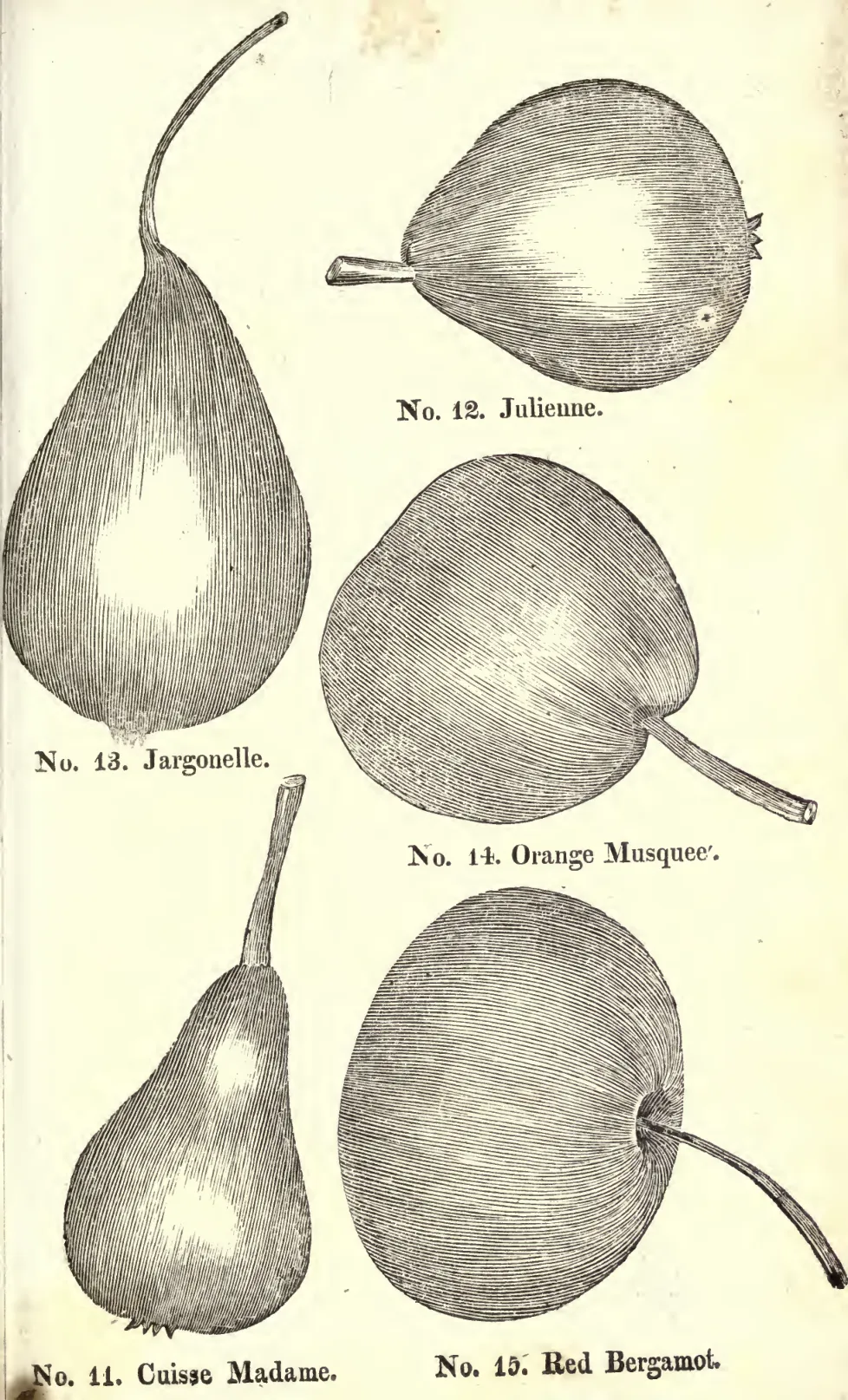
Jargonelle (French)
Origin / History
Said to have originated in Anjou, a former province of France, where it was much cultivated and highly esteemed toward the end of the fifteenth century (Hedrick). The name Jargonelle is used in France to denote a group of pears, which accounts for the confusion among the names and synonyms of several varieties of this class. Coxe described it in 1817 under the name "Cuisse Madame." A generation before Hedrick (1921) Jargonelle (French) was much grown in America, but it has given way to better sorts. Hedrick calls it an old sort, very different from the much better and older pear of the same name, and worthy of description only to distinguish it from that pear. He calls the pears handsome but "poor in quality."
Tree
Tree large, vigorous, upright, the younger branches inclined to droop; very productive. Branches stocky, dark reddish brown; branchlets often curved and drooping, short, sprinkled with elongated, inconspicuous lenticels. Leaf-buds large, conical, appressed. Leaves oval, enlarged at the base, apex abruptly pointed, margin coarsely serrate, petiole long and thick (Hedrick); of common size, almost as wide as long, and very little indented (Coxe). Flower-buds large, long-conic; flowers medium in size. The fruit is very liable to be blown off the tree (Coxe).
Fruit
Size: Medium to sometimes large, about 3¼ in. long and 2¼ in. wide (Hedrick); of moderate size, very long (Coxe).
Form: Obtuse-pyriform to oblong-pyriform; very long and small toward the stalk (Coxe).
Stem: One inch long, slender, obliquely inserted.
Cavity: Obtuse, very shallow; the stalk generally grows in a furrow or small hollow (Coxe).
Calyx: Small, open; lobes long, projecting.
Basin: Variable in depth, small, irregular, furrowed; the eye but little sunk (Coxe).
Skin: Smooth, glossy. Lemon-yellow, blushed with red on the sunny side, occasionally marbled with thin orange-russet about the neck (Hedrick); yellowish green with a reddish brown cheek next the sun (Coxe).
Dots: Light greenish or russet.
Flesh and flavor: Flesh white, coarse, juicy, sweet, aromatic; a little musky (Coxe). Quality good (Hedrick's description); Hedrick's introduction calls the pears "poor in quality." They quickly rot at the center and become dry and mealy toward the periphery.
Core and seeds: Core large. Seeds dark brown, small, narrow, long, often abortive.
Season
Ripens at the end of July (Coxe) or in August and September (Hedrick). Edible only a day or two after maturity (Hedrick).
Uses
Not described in source.
Subtypes / Variants
Not described in source.
Other
Not described in source.
Book Sources
Described in 2 period pomological works
- Hedrick, The Pears of New York (1921)
- Coxe, A View of the Cultivation of Fruit Trees (1817) — listed as Cuisse Madame
View original book sources (2)
— William Coxe, A View of the Cultivation of Fruit Trees (1817)
- CUISSE MADAME.
This fruit is of a moderate size, very long, and small towards the stalk, which generally grows in a furrow, or small hollow; the eye is small and but little sunk; the flesh is sweet and juicy, a little musky; the skin smooth and glossy; of a yellowish green, with a reddish brown cheek next the sun; it is very liable to be blown off the tree. The tree is of vigorous growth, the leaves of the common size, almost as wide as they are long, and very little indented; the time of ripening is the end of July.
— U.P. Hedrick, The Pears of New York (1921)JARGONELLE (FRENCH)
- Duhamel Trait. Arb. Fr. 2:123. 1768. 2. Prince Pom. Man. 1:154. 1831. 3. Downing Fr. Trees Am. 339. 1845. 4. Ibid. 767. 1869. 5. Leroy Dict. Pom. 2:303, fig. 1869. 6. Mathieu Nom. Pom. 237. 1889.
Bellissime d'Été. 7. Duhamel Trait. Arb. Fr. 2:203, Pl. XLII. 1768. 8. Mas Le Verger 2:193, fig. 95. 1866-73. 9. Leroy Dict. Pom. 1:216, fig. 1867. 10. Guide Prat. 70, 235. 1876.
Cuisse Madame. 11. Coxe Cult. Fr. Trees 181, fig. 11. 1817.
Red Muscadel. 12. Lindley Guide Orch. Card. 346. 1831.
Bassin. 13. Hogg Fruit Man. 491. 1884.
Schönsle Sommerbirne. 14. Mathieu Nom. Pom. 280. 1889.
This old sort, very different from Jargonelle, is worthy of description only to distinguish it from the much better and older pear of the same name. A generation ago this French Jargonelle was much grown in America, but has given way to better sorts. The pears are handsome, but are poor in quality and are edible only a day or two after maturity as they quickly rot at the center and become dry and mealy toward the periphery. The name Jargonelle is used in France to denote a group of pears. This fact accounts for the confusion which exists among the names and synonyms of several varieties of this class. The French Jargonelle is said to have originated in Anjou, a former province in France, where it was much cultivated and highly esteemed toward the end of the fifteenth century.
Tree large, vigorous, upright, the younger branches inclined to droop, very productive; branches stocky, dark reddish-brown; branchlets often curved and drooping, short, sprinkled with elongated, inconspicuous lenticels. Leaf-buds large, conical, appressed. Leaves oval, enlarged at the base; apex abruptly pointed; margin coarsely serrate; petiole long, thick. Flower-buds large, long-conic; flowers medium in size.
Fruit ripens in August and September; medium to sometimes large, 3¼ in. long, 2¼ in. wide, obtuse-pyriform to oblong-pyriform; stem 1 in. long, slender, obliquely inserted; cavity obtuse, very shallow; calyx small, open; lobes long, projecting; basin variable in depth, small, irregular, furrowed; skin smooth, glossy; color lemon-yellow, blushed with red on the sunny side, occasionally marbled with thin orange-russet about the neck; dots light greenish or russet; flesh white, coarse, juicy, sweet, aromatic; quality good. Core large; seeds dark brown, small, narrow, long, often abortive.