Saint André
Pear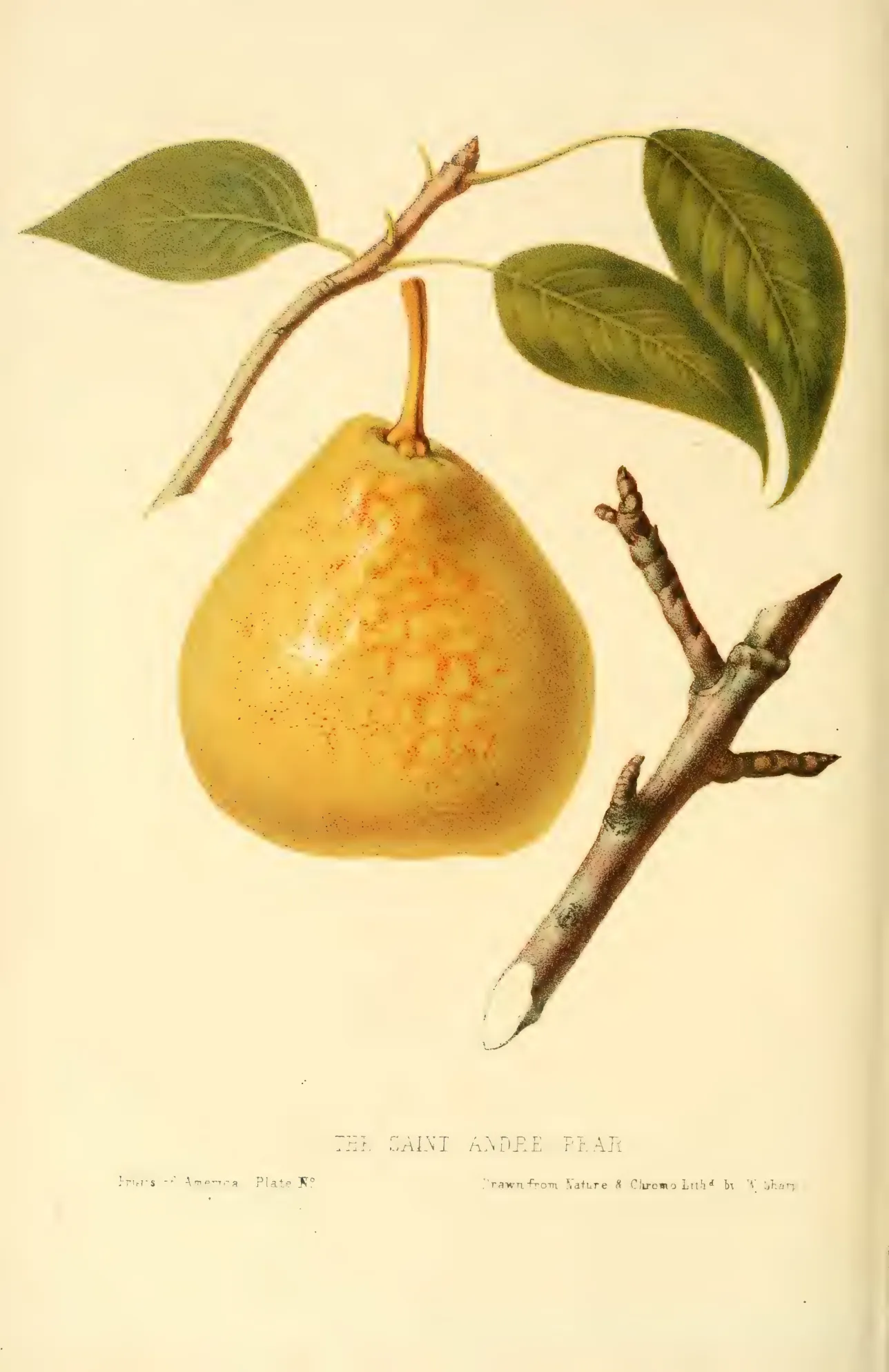
Saint André
Origin/History
Saint André was introduced to American collections by the late R. Manning of Salem, Massachusetts, who received scions from Messrs. Baumann, nurserymen of Bollwiller, France (Bollweiler, Alsace), in 1834 or 1835, at the same time he obtained the Rostiezer. It first fruited in his collection in 1841, and he briefly noticed it in the Magazine of Horticulture for 1842 (vol. viii, p. 58); it was subsequently fully described and figured in the same work at vol. xii, p. 297. From the Pomological Garden, scions were disseminated, and for four or five years prior to Hovey's 1852 account it had fruited in several amateur collections, fully maintaining its high character. (Hovey)
The origin of this pear is unascertainable (Hedrick). Hovey considered it probably a seedling produced by Flemish cultivators and introduced into the Baumann collection; until within a few years of his account, its name had been confined to the Baumann catalogue, and no pomological account of it prior to Manning's had been found. The shape of the tree and color of the wood somewhat resemble the Seckel, and Hovey noted that a number of trees had been received from France labeled as Seckel that proved upon bearing to be Saint André, though whether this error was general he had no opportunity of knowing. (Hovey)
Tree
The tree is of vigorous, upright habit, regular in form, with lateral shoots making a gentle curve upward; the annual wood is moderately stout. Young trees in the nursery branch near the ground. (Hovey) The foliage is conspicuously large, glossy, and handsome. (Hovey) The wood, as it acquires age, has a somewhat cracked and rough appearance, similar to the Van Mons Leon le Clerc, though in a much less degree (Hovey); Downing notes that the wood often cracks and cancers. Saint André possesses the desirable characteristics of coming early into bearing, growing freely on either the quince or pear stock, and producing abundant crops. (Hovey)
Wood: Clear reddish brown, dotted with small grayish specks, moderately stout, and rather short-jointed; old wood olive brown. Buds medium size, long, rounded, rather sharply pointed, diverging, with moderately large shoulders. Flower-buds medium size, obovate, with rather loose scales. (Hovey)
Leaves: Large, oblong obovate, broadest near the base, tapering to the point, nearly flat, smooth, deep glossy green, and quite entire on the edge. Petioles long, about one and a half inches in length, and moderately stout. (Hovey)
Flowers: Medium size; petals rather short, round and cupped. (Hovey)
Fruit
Size: Sources conflict on size. Hovey describes the fruit as large, about three inches long and two and a half inches in diameter. Downing describes it as medium, and Hedrick as medium or below.
Form: Obovate, full towards the crown, tapering regularly to the stem (Downing; Hovey). Hedrick describes it as ovate, rather symmetrical, bossed and sometimes a little ventriculated in its lower half.
Stem: Medium length, about one inch long, moderately stout, curved, somewhat oblique, often swollen and fleshy where it adjoins the fruit. (Hovey)
Cavity: Not described in source.
Calyx and Basin: Eye medium size, open, and little depressed in a very shallow basin; segments of the calyx short and round. (Hovey)
Skin: Fair and smooth (Hovey; Hedrick). Hovey describes the color as yellowish green, becoming paler when mature, finely spotted or marbled with dull red on the sunny side, and dotted with dark green and russet specks. Downing describes it as light greenish yellow, somewhat dotted with red. Hedrick describes the skin as yellow-green, dotted and streaked with gray, and notes that it is very rarely colored on the cheek next the sun — conflicting with Hovey and Downing on the degree of red coloring on the sun-exposed side.
Flesh and Flavor: Greenish white (Hovey; Hedrick; Downing describes it as white), fine-grained, buttery, melting, and highly juicy (all sources agree). Hedrick characterizes the flavor as sweet, saccharine, slightly vinous, delicate, and highly perfumed. Hovey describes it as rich, sprightly, and vinous, with a peculiarly delicious aroma. Downing calls it good. Hovey notes that it resembles the Belle Lucrative in its melting flesh and rich flavor, and considers it nearly or quite equal to that variety.
Core: Small. (Hovey)
Seeds: Medium size, very pointed, light brown. (Hovey)
Season
Ripe in September and October, keeping some time after harvest (Hovey). Downing places it early in September. Hedrick gives October. Hovey notes it comes to maturity immediately after the Williams's Bon Chrétien (Bartlett) and remains in eating for three or four weeks.
Uses
One of the finest autumn pears (Hovey). Suitable for dessert use given its melting, juicy, richly flavored flesh.
Subtypes/Variants
Not described in source.
Other
Hovey notes that Saint André had been fruited in several amateur collections over the four or five years prior to his 1852 account and had fully maintained its high character. The variety is cited in Hovey, Fruits of America, vol. 1, p. 79, fig. (1851), and in Leroy, Dictionnaire de Pomologie, vol. 2, p. 613, no. 186 (1869). (Hedrick)
Book Sources
Described in 3 period pomological works
- Downing, Fruits and Fruit Trees of America (1900)
- Hedrick, The Pears of New York (1921)
- Hovey, The Fruits of America (1852) — listed as THE SAINT ANDREW PEAR.
View original book sources (3)
— A.J. Downing, The Fruits and Fruit Trees of America (1900)Saint Andre.
Imported by Mr. Manning, from the Brothers Baumann, of Bolwyller. Wood often cracks and cancers.
Fruit medium, obovate. Skin light greenish yellow, somewhat dotted with red. Flesh white, fine-grained, buttery, melting, and good. Early in September.
— U.P. Hedrick, The Pears of New York (1921)Saint André.
- Hovey Fr. Am. 1:79, fig. 1851. 2. Leroy Diet. Pom. 2:613, n° 186. 1869.
The origin of this pear is unascertainable but it was introduced to this country by R. Manning, Salem, Mass., who imported cions of it from Messrs. Baumann, nurserymen, Bollwiller, Fr. (Bollweiler, Alsace), in 1834 or 1835. Fruit medium or below, ovate, rather symmetrical, bossed and sometimes a little ventriculated in its lower half; skin fine and smooth, yellow-green, dotted and streaked with gray, very rarely colored on the cheek next the sun; flesh greenish-white, fine and most melting, extremely juicy, sweet, saccharine, slightly vinous, delicate and highly perfumed; first; Oct.
— C.M. Hovey, The Fruits of America (1852)THE SAINT ANDREW PEAR.
Saint Andre'. Magazine of Horticulture, vol. xii. p. 297.
The Saint Andre is one of the finest autumn pears, recently introduced. It resembles, in its melting flesh and rich flavor, the Belle Lucrative, and is nearly, or quite, equal to that variety, which is admitted to stand at the head of our early autumn pears. The fruit is unusually fair, of good size, comes to maturity immediately after the Williams's Bon Chretien, (or Bartlett,) and is in eating three or four weeks.
For its introduction to American collections, we are indebted to the late Mr. R. Manning, of Salem. He received scions of the Saint Andre, with some other sorts, from the Messrs. Baumann, of Bollwiller, France, in 1834 or 1835, at the same time he obtained the Rostiezer, which we have already described. It first fruited in his collection in 1841, and he briefly noticed it in the Magazine of Horticulture, for 1842, (vol. viii. p. 58;) and subsequently, we fully described and figured it in the same work, as above quoted. From the Pomological Garden, scions have been disseminated, and, for four or five years, it has fruited in several amateur collections, fully maintaining its high character.
Of its origin, we have no information. Until within a few years, its name has been confined to the Catalogue of Messrs. Baumann, and we have not succeeded in finding any account of it, by pomological writers, previous to that of Mr. Manning. It is probably a seedling, produced by some of the Flemish cultivators, and introduced into their collection.
The tree is of vigorous and healthy growth, of upright habit, regular in form, and the foliage is conspicuously large, glossy and handsome. The wood, as it acquires age, has a somewhat cracked and rough appearance, similar to the Van Mons Leon le Clerc, though in a much less degree. It possesses the desirable characteristics of coming early into bearing, growing freely either upon the quince or pear stock, and of producing abundant crops. The shape of the tree and color of the wood somewhat resemble the Seckel ; and we have received a number of trees from France, for the latter variety, which have proved to be the Saint Andre ; but whether this error is general, we have no opportunity of knowing.
Tree. — Vigorous, upright, and regular in form, the lateral shoots making a gentle curve upward ; annual wood moderately stout. Young trees in the nursery branch near the ground.
Wood. — Clear reddish brown, dotted with small grayish specks, moderately stout, and rather short-jointed ; old wood, olive brown ; buds, medium size, long, rounded, rather sharply pointed, diverging, with moderately large shoulders : Flower-buds, medium size, obovate, with rather loose scales.
Leaves. — Large, oblong obovate, broadest near the base, tapering to the point, nearly flat, smooth, deep glossy green, and quite entire on the edge ; petioles long, about one and a half inches in length, and moderately stout.
Flowers. — Medium size ; petals rather short, round and cupped.
Fruit. — Large, about three inches long, and two and a half in diameter : Form, obovate, full towards the crown, and tapering regularly to the stem : Skin, fair, smooth, yellowish green, becoming paler when mature, finely spotted or marbled with dull red on the sunny side, and dotted with dark green and russet specks : Stem, medium length, about one inch long, moderately stout, curved, somewhat oblique, often swollen and fleshy where it adjoins the fruit : Eye, medium size, open, and little depressed in a very shallow basin ; segments of the calyx short, round : Flesh, greenish white, fine, buttery, melting and juicy : Flavor, rich, sprightly and vinous, with a peculiarly delicious aroma : Core, small : Seeds, medium size, very pointed, light brown.
Ripe in September and October, and keeps some time.