Kirtland
Pear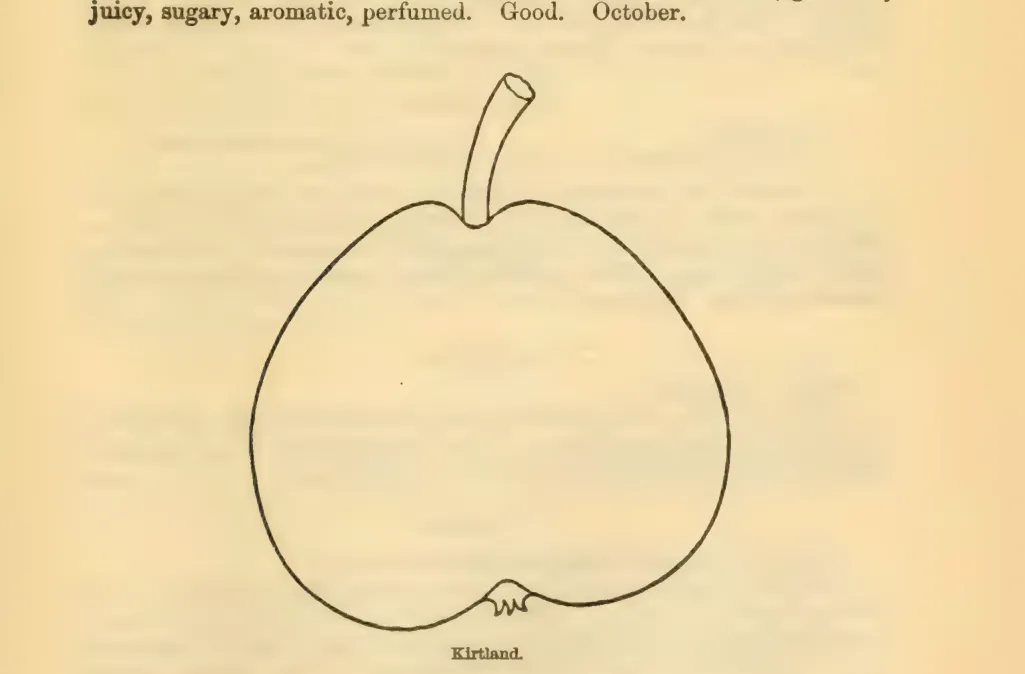
Kirtland
Origin / History
Grown from seeds of the Seckel pear by H. T. Kirtland, of Mahoning Co., Ohio (Elliott), given by Downing as of Poland, Ohio. Thomas likewise names the Seckel as its parent. Hedrick states that in 1819 Professor Kirtland, of Cleveland, Ohio, raised several trees on his farm in Poland, Ohio, of which this is one. He cites early accounts in "Mag. Hart. 16:112. 1850" and the Horticulturist 4:476, fig. 409, 1850. An Ohio variety.
Tree
Moderately vigorous (Downing) to vigorous (Elliott). Hardy, an early and very productive bearer on the pear root, and succeeds well on Quince (Elliott). Shoots yellowish brown, upright, stout (Elliott); young wood olive yellow brown (Downing).
Fruit
Size: Small to medium, sometimes above medium. Most authors place it at medium or below, Thomas at rather small. Elliott alone calls it medium, often above.
Form: Obtusely obovate to roundish-obovate, sometimes obscurely pyriform. Elliott calls it obtuse pyriform and Hedrick globular-ovate.
Stem: Short to medium in length, stout. Most authors call it short or rather short. Elliott gives it as usually stout, medium length, curved. Often fleshy at insertion (Thomas), often inserted by a ring or lip (Downing).
Cavity: Small.
Calyx: Persistent, partly open (Downing; Thomas). Elliott calls it short and reflexed.
Basin: Shallow and broad.
Skin: Ground fine, rich, or bright yellow, mostly covered or overspread with bright cinnamon russet, or wholly covered with a rich russet (Thomas). Budd and Hansen call the russet light. Often reddened in the sun (Thomas), occasionally mottled and streaked with red on the sunny side (Downing). Hedrick describes it as rich crimson-russet, varying to a dull green.
Dots: Not described in source.
Flesh and flavor: Flesh white, fine (Hedrick), melting, juicy, sweet, aromatic. Thomas calls it buttery, very rich, perfumed, somewhat resembling its parent, the Seckel; Hedrick also calls it rich. "Very good" (Downing); "first" (Hedrick).
Core and seeds: Core small. Seeds short, ovate, blackish (Elliott).
Season
September, an early-fall pear. Downing and Thomas place it at the first of September. Thomas warns that it often rots at the core and does not always soften well, and that it requires early gathering.
Uses
Grown for dessert use mainly (Budd and Hansen).
Subtypes / Variants
Not described in source.
Other
Not described in source.
Book Sources
Described in 5 period pomological works
View original book sources (5)
— F.R. Elliott, The Western Fruit Book (1865)Kirtland.
Seedling Seckel, Kirtland's Seedling, Kirtland's Beurre.
Grown from seeds of the Seckel pear, by H. T. Kirtland, of Mahoning Co., Ohio. Tree, vigorous, hardy, early and very productive bearer on the pear root ; shoots, yellowish brown, upright, stout ; succeeds well on Quince.
Fruit, medium, often above obovate, obtuse pyriform ; color, rich yellow, overspread with cinnamon russet ; stem, usually stout, medium length, curved ; calyx, short, reflexed, persistent ; basin, shallow ; core, small ; seeds, short, ovate, blackish ; flesh, white, melting, juicy, sweet, aromatic. September.
— A.J. Downing, The Fruits and Fruit Trees of America (1900)KIRTLAND.
Kirtland's Seedling. Hadley. Kirtland's Seckel. Kirtland's Beurre.
Raised by H. T. Kirtland, Poland, O. Tree moderately vigorous. Young wood olive yellow brown.
Fruit medium or below, obtusely obovate, sometimes obscurely pyriform, fine yellow, mostly covered with bright cinnamon russet, occasionally mottled and streaked with red on the sunny side. Stalk rather short and stout, inserted in a small cavity, often by a ring or lip. Calyx partially open, persistent. Basin shallow and broad. Flesh melting, juicy, sweet, aromatic. Very good. Ripe first of September.
— John J. Thomas, The American Fruit Culturist (1903)Kirtland. Rather small, roundish-obovate: covered with a rich russet, often reddened in the sun; stalk short, stout, often fleshy at insertion; calyx partly open, basin shallow; flesh buttery, very rich, perfumed, somewhat resembling its parent, the Seckel. Often rots at core, and does not always soften well; requires early gathering. First of September. Ohio.
— J.L. Budd & N.E. Hansen, American Horticultural Manual, Part II: Systematic Pomology (1914)Kirtland. — Small to medium, obtusely obovate, sometimes pyriform; color bright yellow, mostly covered with light russet, with red streaks in the sun; stalk short, stout, inserted in small cavity; basin shallow and broad. Flesh melting, juicy, sweet, aromatic, very good. Season, early fall. Grown for dessert use mainly. Ohio.
— U.P. Hedrick, The Pears of New York (1921)Kirtland.
- Mag. Hart. 16:112. 1850.
- Horticulturist 4:476, fig. 409. 1850.
In 1819 Professor Kirtland, Cleveland, Ohio, raised several trees on his farm in Poland, Ohio, of which this is one. Fruit medium, globular-ovate, rich crimson-russet, varying to a dull green; flesh white, fine, melting, juicy, rich, sweet, aromatic; first; Sept.