Lucy Duke
Pear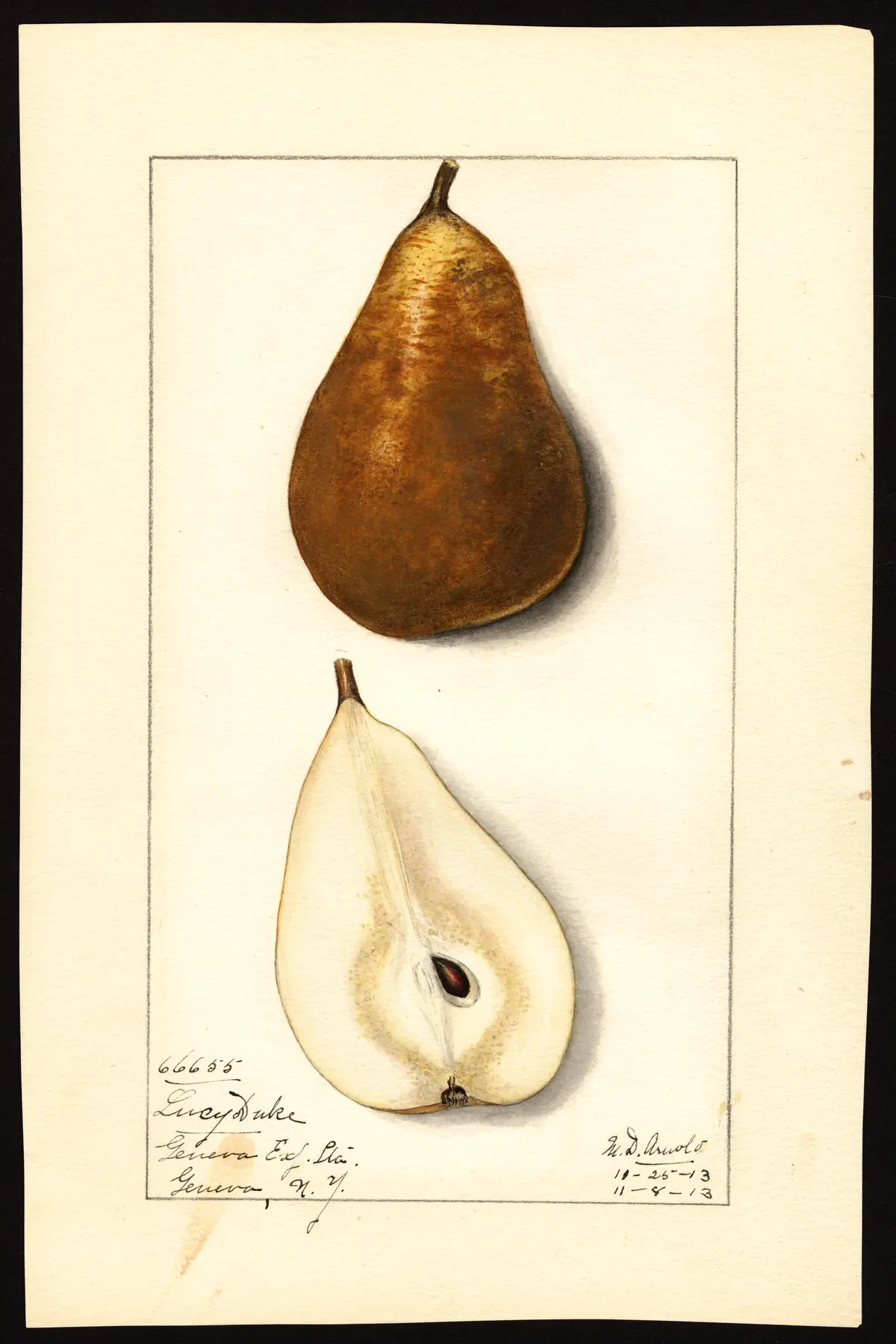
USDA Pomological Watercolor Collection
Lucy Duke
Origin/History
Lucy Duke was grown about 1880 by Mrs. Lucy Duke, Beaufort County, North Carolina, from seed of a Bartlett pear which she had received from California. Its tree-characters are so nearly like those of Winter Nelis that the other parent is supposed to be that variety. The variety was introduced about 1892 by J. Van Lindley, Pomona, North Carolina.
Charles Downing thought the pear "not quite so fine as a first-class Seckel, but I must aver it is not far behind." Why Lucy Duke is neglected is hard to see — the tree and fruit are highly praised. The pear has a rich, juicy, spicy, melting flesh that makes it one of the best. In form, the fruits resemble those of Bartlett; they are of a beautiful golden-russet color, which makes them as handsome as the handsomest. The skin is thick and the pears stand shipping well. The variety can be recommended for home and local markets, but the trees are too irregular in bearing for commercial orchards. The variety is relatively free from blight. (Hedrick, Pears of New York, 1921; Cyclopedia of Hardy Fruits, 1922)
Tree
Medium to large, variable in vigor, upright becoming slightly spreading, dense-topped, hardy; trunk shaggy; branches thick, zigzag, marked by numerous elongated lenticels; branchlets strongly curved, with short internodes, dark brownish-red mingled with green, mottled with scarf-skin, smooth, glabrous, with small, elongated or roundish, conspicuous, raised lenticels. The tree is only moderately vigorous and resembles Winter Nelis in habit of growth.
Productivity conflict: Hedrick (Pears of New York, 1921) describes the tree as "productive"; Hedrick (Cyclopedia of Hardy Fruits, 1922) describes it as "very productive." Both sources state in their introductory remarks that the trees are unproductive and too irregular in bearing for commercial orchards.
Leaf-buds small, short, pointed, plump, usually free; leaf-scars prominent. Leaves thin; margin occasionally glandular, finely serrate or entire. Leaf dimensions conflict: Hedrick (Pears of New York, 1921) gives 3 in. long, 1½ in. wide, petiole 1⅛ in. long, slender; Hedrick (Cyclopedia, 1922) gives 1¾ in. wide, petiole 1¼ in. long, slender (leaf length not legibly recorded in that source).
Flower-buds large, long, pointed, plump, free, borne singly on short spurs. Flowers open late, with an unpleasant odor. Flower diameter conflict: Hedrick (Pears of New York, 1921) gives 1⅛ in. across; Hedrick (Cyclopedia, 1922) gives 1¼ in. across. Pedicels 1⅛ in. long (Pears of New York).
Fruit
Size: Hedrick (both 1921 and 1922) describes the fruit as medium in size. Thomas (American Fruit Culturist, 1903) describes it as large.
Form: Conflict: Hedrick (Pears of New York, 1921) gives "acute-pyriform to oblong-pyriform, symmetrical"; Hedrick (Cyclopedia, 1922) gives "oblong-pyriform, symmetrical"; Thomas (1903) gives "pyriform."
Stem: Short, thick, curved.
Cavity: Obtuse, shallow, narrow, russeted, often wrinkled and occasionally lipped.
Calyx: Large, open, rounded and with a deeply-set center.
Basin: Obtuse, smooth, symmetrical.
Skin: Very tough, roughened with thick russet; color greenish-yellow, usually entirely overspread with solid, dark russet, changing to golden russet on the cheek exposed to the sun, with mottlings and flecks of russet (Hedrick, Pears of New York; the Cyclopedia omits the mottlings and flecks). Thomas describes the surface as "rough." Dots numerous, small, russet, obscure.
Flesh/Flavor: Yellowish-white, fine, melting, rich, juicy, sweet; quality very good (Hedrick). Thomas describes the flesh as "buttery, juicy, sweet." Hedrick (Pears of New York) additionally characterizes it as "spicy" in the introductory remarks.
Core/Seeds: Core large, closed, axile. Calyx-tube short, wide, broadly conical. Seeds large, wide, long, plump, acute.
Season
Ripens in late October and November (Hedrick, 1921 and 1922). Thomas (1903) gives October.
Uses
Suitable for home use and local markets. The thick skin allows the pears to stand shipping well. Not recommended for commercial orchards due to unproductive and irregular bearing habit.
Subtypes/Variants
Not described in source.
Other
References cited by Hedrick (Pears of New York, 1921): Am. Pom. Soc. Rpt. 153 (1885); W. N. Y. Hort. Soc. Rpt. 65 (1889); Van Lindley Cat. 22, Pl. (1892); N. Y. Sta. Bul. 364:182 (1913).
Book Sources
Described in 3 period pomological works
Nursery Catalog Sources
Found in 2 catalogs (1900–1901) from Illinois
- Central Experimental Farm , Dominion Department of Agriculture, Agassiz, British Columbia (under test; Bulletin No. 3, Second Series) — 1900
- Benjamin Buckman (personal inventory) , Farmingdale , Illinois — 1901
View original book sources (3)
— U.P. Hedrick, The Pears of New York (1921)LUCY DUKE
- Am. Pom. Soc. Rpt. 153. 1885. 2. W. N. Y. Hort. Soc. Rpt. 65. 1889. 3. Van Lindley Cat. 22, Pl. 1892. 4. N. Y. Sta. Bul. 364:182. 1913.
Why Lucy Duke is neglected is hard to see. Tree and fruit are highly praised. Charles Downing thought the pear "not quite so fine as a first-class Seckel, but I must aver it is not far behind." The pear has a rich, juicy, spicy, melting flesh that makes it one of the best. In form, the fruits resemble those of Bartlett, which is probably one of the parents; they are of but medium size, but are of a beautiful golden-russet color, which makes them as handsome as the handsomest. The skin is thick and the pears stand shipping well. The variety can be recommended for home and local markets, but the trees are a little too unproductive and too irregular in bearing for commercial orchards. The tree is hardy but only moderately vigorous and resembles Winter Nelis, supposed to be the other parent, in habit of growth. The variety is relatively free from blight.
Lucy Duke was grown about 1880 by Mrs. Lucy Duke, Beaufort County, North Carolina, from seed of a Bartlett pear which she had received from California. Its tree-characters are so nearly like those of Winter Nelis that the other parent is supposed to be that variety. Lucy Duke was introduced about 1892 by J. Van Lindley, Pomona, North Carolina.
Tree medium to large, variable in vigor, upright becoming slightly spreading, dense-topped, hardy, productive; trunk shaggy; branches thick, zigzag, marked by numerous elongated lenticels; branchlets strongly curved, with short internodes, dark brownish-red mingled with green, mottled with scarf-skin, smooth, glabrous, with small, elongated or roundish, conspicuous, raised lenticels.
Leaf-buds small, short, pointed, plump, usually free; leaf-scars prominent. Leaves 3 in. long, 1½ in. wide, thin; margin occasionally glandular, finely serrate or entire; petiole 1⅛ in. long, slender. Flower-buds large, long, pointed, plump, free, singly on short spurs; flowers open late, with an unpleasant odor, 1⅛ in. across; pedicels 1⅛ in. long.
Fruit ripens in late October and November; medium in size, acute-pyriform to oblong-pyriform, symmetrical; stem short, thick, curved; cavity obtuse, shallow, narrow, russeted, often wrinkled and occasionally lipped; calyx large, open, rounded and with a deeply-set center; basin obtuse, smooth, symmetrical; skin very tough, roughened with thick russet; color greenish-yellow, usually entirely overspread with solid, dark russet, changing to golden russet on the cheek exposed to the sun, with mottlings and flecks of russet; dots numerous, small, russet, obscure; flesh yellowish-white, fine, melting, rich, juicy, sweet; quality very good. Core large, closed, axile; calyx-tube short, wide, broadly conical; seeds large, wide, long, plump, acute.
— John J. Thomas, The American Fruit Culturist (1903)Lucy Duke. Large, pyriform, russet, rough surface; flesh buttery, juicy, sweet. October.
— U.P. Hedrick, Cyclopedia of Hardy Fruits (1922)LUCY DUKE. Why Lucy Duke is neglected is hard to see. The pear has a rich, juicy, spicy, melting flesh that makes it one of the best. In form, the fruits resemble those of Bartlett, which is probably one of the parents; they are but medium in size, but are of a beautiful golden russet color, which makes them as handsome as the handsomest. The skin is thick and the pears stand shipping well. The variety can be recommended for home and local markets, but the trees are unproductive and too irregular in bearing for commercial orchards. The tree is hardy, but only moderately vigorous, and resembles Winter Nelis, supposed to be the other parent, in habit of growth. The variety is relatively free from blight. Lucy Duke was grown about 1880 by Mrs. Lucy Duke of Beaufort County, North Carolina, from seed of a Bartlett pear.
Tree medium to large, variable in vigor, upright becoming slightly spreading, dense-topped, hardy, very productive; trunk shaggy; branches thick, zigzag, marked by numerous, elongated lenticels. Leaves inches long, 1¾ inches wide, thin; margin occasionally glandular, finely serrate or entire; petiole 1¼ inches long, slender. Flowers open late, 1¼ inches across. Fruit ripens in late October and November; medium in size, oblong-pyriform, symmetrical; stem short, thick, curved; cavity obtuse, shallow, narrow, russeted, often wrinkled and occasionally lipped; calyx large, open, rounded and with a deeply set center; basin obtuse, smooth, symmetrical; skin very tough, roughened with thick russet; color greenish-yellow, overspread with dark russet, changing to golden russet on the cheek exposed to the sun; dots numerous, small, russet, obscure; flesh yellowish-white, fine, melting, rich, juicy, sweet; quality very good; core large, closed, axile; calyx-tube short, wide, broadly conical; seeds large, wide, long, plump, acute.