Duchess Of Orleans
Pear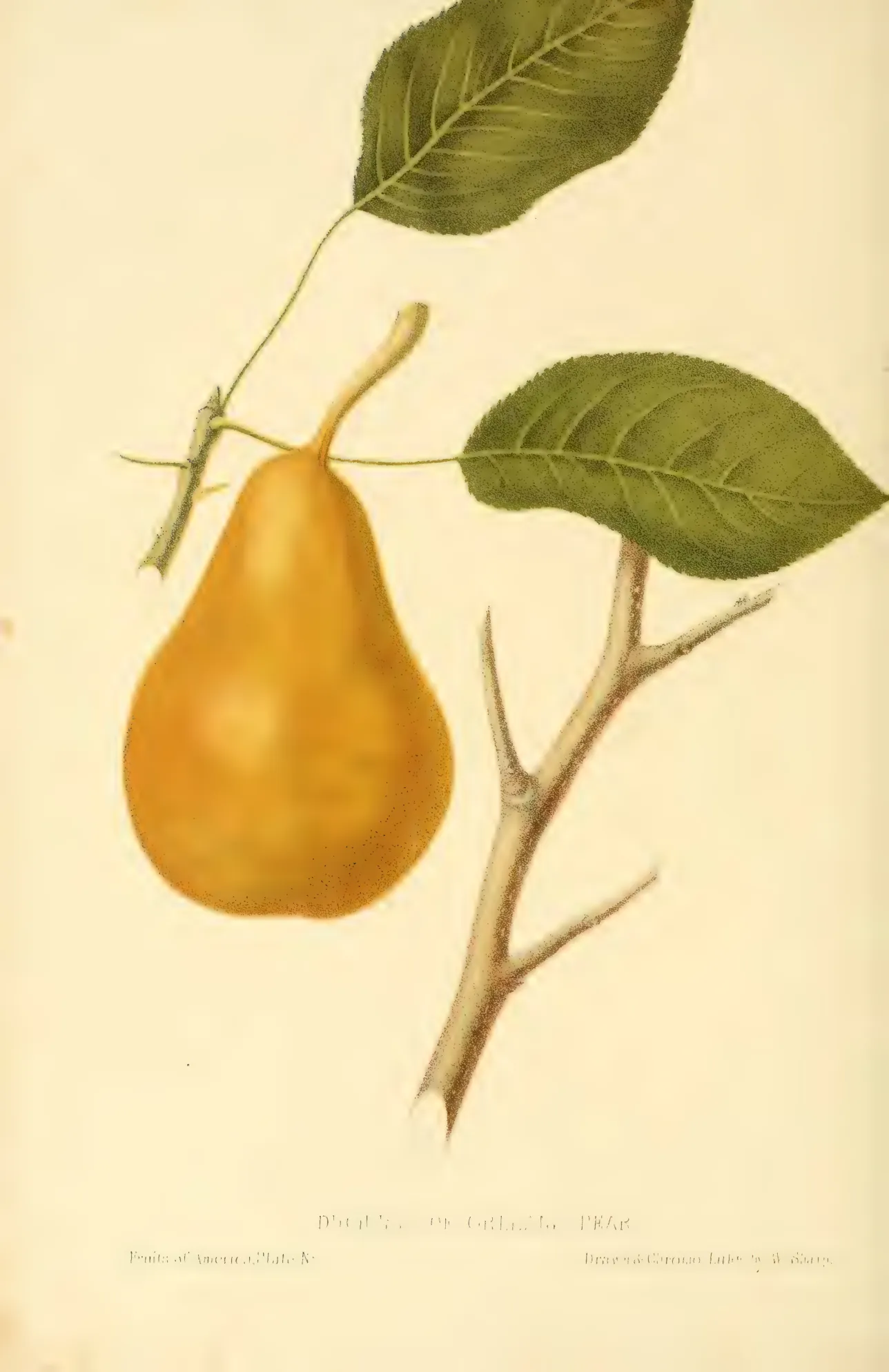
Duchess Of Orleans
Origin / History
The Duchess Of Orleans is a pear of French or Flemish origin, recently introduced to American cultivation and ranked among the new pears of that origin. Mr. William Kenrick, on his return from Europe, brought a few scions of the variety, which he procured in Paris. With his usual liberality, he gave a portion of these to the late Robert Manning of Salem, in whose pomological garden it first fruited about six years ago. Its beautiful appearance and superior quality at once commended it to notice, and successive trials have fully established its claim to a place among our finest pears.
The origin of the Duchess Of Orleans is unknown. Kenrick described it briefly in the American Orchardist, citing as his authority M. Oudin, a French nurseryman of high reputation, and stating that it had "lately been received from Normandy," the most favorable locality in France for fine pears. The variety is undoubtedly the production of some of the French nurserymen, or amateur cultivators, who are constantly raising new seedlings. Such seedlings are introduced to cultivation without any other knowledge of their merits than the recommendation of those who produced them from seed.
Tree
The trees are tolerably vigorous growers, with a somewhat peculiar, upright habit. The tree is moderately vigorous, upright, and somewhat irregular, with the branches curved inwards. The branches are long, curved or wavy, with the ends inclined towards the main stem. Annual shoots are long and rather slender.
The wood is yellowish olive, rather thickly dotted with oblong, grayish white specks, rather slender, and long-jointed. Old wood is brownish olive. The buds are small, slender, sharply pointed, and diverging, with moderately prominent shoulders. Flower-buds are of medium size.
Leaves are of medium size, oblong ovate, largest about the middle, narrowing most to the point, which is shortly acuminate. They are nearly flat, yellowish green, and obtusely serrated. Petioles are rather long, about one and a quarter inches in length, moderately stout, and often curved or wavy.
Flowers are large, with oblong petals that are somewhat cupped and a long claw.
The Duchess Of Orleans is rather late in coming into bearing, generally in the fifth or sixth year. It does not grow freely on the quince.
Fruit
Size: Large, about three and a half inches long and two and a half inches in diameter.
Form: Regular, pyramidal, full at the crown, little contracted about the middle, and tapering to the stem. In form it is very regular and pyramidal.
Stem: Long, about one and a quarter inches in length, rather stout, swollen at the end adjoining the branch, and straight. It is obliquely inserted in a fleshy base.
Cavity: Without any cavity.
Calyx: Segments of the calyx short and projecting.
Basin: Eye of medium size, open, and scarcely depressed.
Skin: Slightly rough, light yellow, mottled with golden russet in the shade, and thinly marked with red in the sun. When mature, the skin is of a fine rich yellow, beautifully mottled with golden russet, often so profusely as to cover the whole fruit.
Dots: Sparsely covered with small russet specks.
Flesh and flavor: Yellowish, fine, buttery, melting, and juicy. Flavor is rich, sugary, and delicious, with a pleasant musky aroma.
Core and seeds: Core of medium size. Seeds of medium size, rather long, and dark brown.
Season
The fruit ripens in October and keeps three or four weeks. It comes into eating at a good season, just after the Williams's Bon Chretien or Bartlett, and keeps better than most autumn pears.
Uses
The fruit is eaten fresh as a dessert pear, its flavor described as rich, sugary, and delicious.
Subtypes / Variants
Not described in source.
Other
The account appears in C.M. Hovey, The Fruits of America (1852), under the heading "The Duchess of Orleans Pear," and cites Kenrick's American Orchardist, 7th Ed. 1841, as its earlier published description.
Book Sources
Described in 1 period pomological work
- Hovey, The Fruits of America (1852) — listed as THE DUCHESS OF ORLEANS PEAR.
View original book sources (1)
— C.M. Hovey, The Fruits of America (1852)THE DUCHESS OF ORLEANS PEAR.
Duchess of Orleans. Kenrick's American Orchardist, 7th Ed. 1841.
Among the new pears of French or Flemish origin, which have been recently introduced, the Duchess of Orleans holds a high rank. It is but a few years since Mr. William Kenrick, on his return from Europe, brought with him a few scions of this variety, which he procured in Paris. A portion of these were, with his usual liberality, given to the late Robert Manning, of Salem, in whose pomological garden it first fruited about six years ago. Its beautiful appearance and superior quality at once commended it to notice, and successive trials have fully established its claim to a place among our finest pears.
The origin of the Duchess of Orleans is unknown. Mr. Kenrick briefly described it in the American Orchardist, and gave as his authority M. Oudin, a French nurseryman of high reputation. He merely adds, that it had "lately been received from Normandy," the most favorable locality in France for fine pears. Undoubtedly it is the production of some of the French nurserymen, or amateur cultivators, who are constantly raising new seedlings, which are introduced to cultivation without any other knowledge of their merits than the recommendation of those who produced them from seed.
The Duchess of Orleans is a peculiarly prepossessing fruit. In form it is very regular, pyramidal, and the skin, which is of a fine rich yellow, when mature, is beautifully mottled with golden russet, often so profusely as to cover the whole fruit. It comes into eating at a good season, just after the Williams's Bon Chretien or Bartlett, and keeps better than most autumn pears.
The trees are tolerably vigorous growers, with a somewhat peculiar, upright habit; the branches are long, curved or wavy, with the ends inclined towards the main stem. It is rather late in coming into bearing, being generally the fifth or sixth year. It does not grow freely on the quince.
Tree. — Moderately vigorous, upright, somewhat irregular, with the branches curved inwards; annual shoots long and rather slender.
Wood. — Yellowish olive, rather thickly dotted with oblong, grayish white specks, rather slender, and long-jointed; old wood brownish olive; buds, small, slender, sharply pointed, diverging, with moderately prominent shoulders: Flower-buds, medium size.
[91]
Leaves. — Medium size, oblong ovate, largest about the middle, narrowing most to the point, which is shortly acuminate, nearly flat, yellowish green, and obtusely serrated; petioles, rather long, about one and a quarter inches in length, moderately stout, often curved or wavy.
Flowers. — Large; petals oblong, somewhat cupped; claw long.
Fruit. — Large, about three and a half inches long and two and a half in diameter: Form, regular, pyramidal, full at the crown, little contracted about the middle, and tapering to the stem: Skin, slightly rough, light yellow, mottled with golden russet in the shade, thinly marked with red in the sun, and sparsely covered with small russet specks: Stem, long, about one and a quarter inches in length, rather stout, swollen at the end adjoining the branch, straight, and obliquely inserted in a fleshy base, without any cavity: Eye, medium size, open, and scarcely depressed; segments of the calyx short, projecting: Flesh, yellowish, fine, buttery, melting and juicy: Flavor, rich, sugary and delicious, with a pleasant musky aroma: Core, medium size: Seeds, medium size, rather long, dark brown.
Ripe in October, and keeps three or four weeks.
[92]