Duchesse D'Orléans
Pear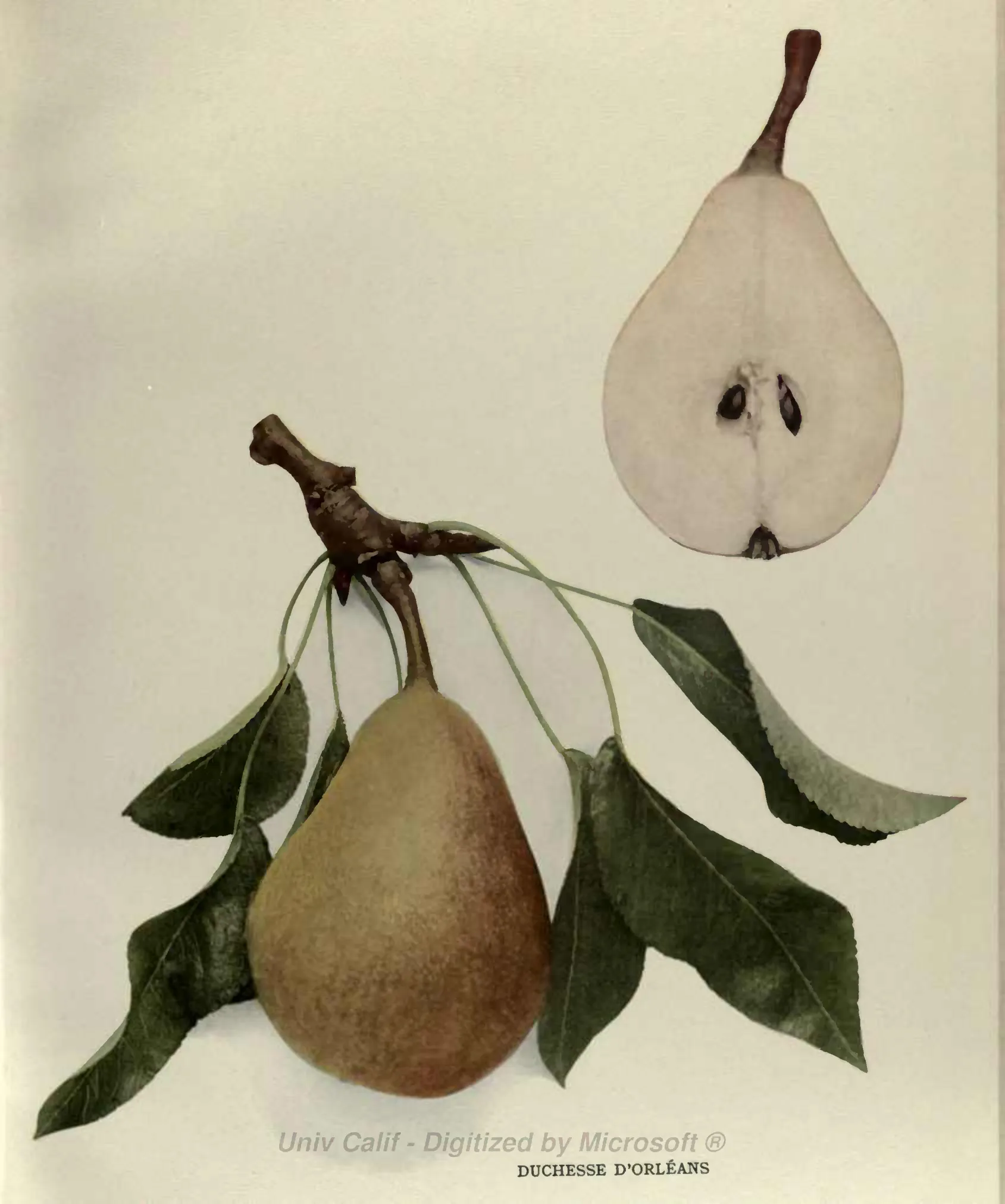
Duchesse D'Orléans
Origin / History
A French pear (Downing, Thomas), "Foreign" in Elliott. Bunyard and Hedrick place its origin near Angers, France, as a chance seedling. Downing writes that "the precise location of origin is unknown." Hedrick names the finder as M. Maurier, near Angers, Maine-et-Loire, "nearly a century ago." He says it was propagated by M. Flon, a nurseryman of Angers, and first fruited in 1839. Bunyard instead gives 1839 as the year the seedling was found.
Hedrick writes that in England and America the variety has been chiefly known as Duchesse D'Orléans, while many French horticulturists have used the name Saint-Nicolas. Bunyard writes that it is "described and generally known in England as Duchesse d'Orleans, but the French name is the correct one," which is Beurré St. Nicholas. Elliott enters it under Beurré St. Nicholas.
Hedrick's earliest reference is Kenrick, 1841. He then cites Hovey's plate under "Duchess of Orleans" (1851), the American Pomological Society (1862), Downing (1869) and Hogg (1884). French accounts appear under Saint-Nicolas in Pom. France (1863) and Cat. Cong. Pom. France (1906), and under Beurré de Saint-Nicolas in Mas (1866–73) and Leroy (1867). Mathieu gives a German entry (1889).
The variety was added to the fruit-catalog list of the American Pomological Society in 1862 and dropped in 1871. Hedrick writes that in the middle of the nineteenth century it was "heralded as one of the best of the French varieties which were then coming to this country in great numbers, but it is now almost lost to cultivation." He calls it "in no way remarkable" but "too valuable to be discarded." He adds that "the quality, as well as the appearance, is pleasing," and that "the variety finds favor with all who like pears." Thomas calls it "a handsome, fine, French variety."
Tree
Upright (Elliott, Downing), or rather spreading to spreading (Thomas, Hedrick). Vigor moderate to good; Downing calls it "a good grower." Hedrick calls the tree medium in size and vigor and rapid-growing, yet counts "not very vigorous" among its failings.
Wood long-jointed (Downing), olive-colored (Elliott). Young shoots dull olive brown, slightly grayish (Downing); Thomas gives them as yellowish green. Branches medium in thickness and smoothness, reddish-brown, with few indistinct lenticels (Hedrick).
Leaves dark blue green, narrow (Elliott). Hedrick gives them as 3 inches long and 1¾ inches wide, apex taper-pointed, margin coarsely serrate and tipped with small brownish glands, petiole glabrous and reddish-green. Flowers showy, 1¾ inches across, in dense clusters, the petals widely separated at the base (Hedrick).
Productiveness moderate (Bunyard, Hedrick). Elliott found it "thus far productive and healthy on Quince": one little tree, two years planted, yielded forty-three beautiful specimens in a single season. Hedrick writes that "the variety fails in its tree-characters." The trees are late in coming into bearing, not very vigorous, somewhat tender to cold, and do not resist blight well.
Fruit
Size: Medium to large, Thomas calling it "large, often only medium." Bunyard measures 3½ by 2½ inches. Hedrick, who calls it medium, gives 2¾ inches long by 2¼ inches wide, with the fruits more uniform in size than those of most varieties.
Form: Pyriform, elongated or oblong-ovate to obovate, narrowing or tapering toward the basin and eye. Thomas gives it as sometimes long pyriform but usually obovate-pyriform, somewhat pyramidal; Hedrick gives obovate-acute-pyriform. Hedrick finds few pears "more symmetrical in shape"; Bunyard calls it uneven.
Stem: Long, about an inch and a half (Thomas), curved (Downing), variable (Elliott). Fleshy at the base (Elliott), "rather fleshy and often lipped at base" (Bunyard). Pretty large or thick (Downing, Thomas, Hedrick); Bunyard alone calls it thin.
Cavity: Lacking, the flesh drawn up in a symmetrical fold about the stem (Hedrick); the stalk scarcely sunk (Thomas).
Calyx: Small. Open (Elliott, Hedrick), nearly closed (Downing), or closed (Bunyard). Segments short (Elliott); lobes separated at the base, narrow, acute (Hedrick). Calyx-tube short, conical (Hedrick).
Basin: Shallow to very shallow, small (Thomas), narrow and obtuse (Hedrick); Bunyard sets the eye on the surface. Even or smooth (Thomas, Hedrick, who adds "or slightly wrinkled"); Downing calls it uneven.
Skin: Smooth; few pears are smoother (Hedrick), and Bunyard gives it as fairly smooth. Thin, tender (Hedrick).
Greenish, becoming greenish yellow (Elliott). Downing gives it as yellowish green, Bunyard as pale yellow green, Thomas as golden yellow and Hedrick as bright yellow. The exposed side carries a cheek or blush, which Elliott and Downing give as sometimes present. The cheek is red (Elliott, Thomas), a dull red flush (Bunyard), or "brilliant" and pinkish-red (Hedrick).
Russet in stripes, streaks, patches or mottling. Elliott calls it dull thin russet, and Bunyard "a little russet streaking." Thomas gives the fruit as slightly russeted, "sometimes nearly overspread with russet." Hedrick describes the whole fruit as "more or less mottled with golden russet," faintly so in his technical description. Handsome, beautiful and prepossessing in appearance.
Dots: Numerous, conspicuous, whitish or russet (Hedrick); brown (Downing).
Flesh and flavor: Melting and juicy. Thomas calls it buttery and melting, rich, "when well ripened, delicious." Downing calls it slightly aromatic, "with a very good flavor." Bunyard gives it as white, "very sweet and juicy."
Hedrick describes the flesh as tinged with yellow, firm, granular, crisp, juicy and subacid. He calls it "a little dry and not as rich in flavor as that of most other varieties of its season." He also writes that it is "so crisp and refreshingly piquant in contrast to the sweeter, buttery pears with which it ripens" that it finds favor.
Quality "very good" (Elliott, Downing); Hedrick rates it "good."
Core and seeds: Core small, closed, axile, with meeting core-lines. Seeds long, plump, acute (Hedrick).
Season
The recorded season runs from early September through October. Bunyard, the earliest, gives early to mid September. The other authors give September and October, October alone, or mid-autumn. Hedrick gives late September and October, just after Bartlett.
Uses
A dessert pear (Bunyard). Hedrick writes that it "has little value for commercial places, but if the trees can be obtained, is well worth planting in the home orchard."
Subtypes / Variants
Not described in source.
Other
Bunyard cites Her. Pom. II., 32. Hedrick figures the variety in a color-plate in The Pears of New York.
Book Sources
Described in 6 period pomological works
Nursery Catalog Sources
Found in 2 catalogs (1849–1900) from Massachusetts
- Hovey & Co. , Cambridge , Massachusetts — 1849
- Central Experimental Farm , Dominion Department of Agriculture, Agassiz, British Columbia (under test; Bulletin No. 3, Second Series) — 1900
View original book sources (6)
— F.R. Elliott, The Western Fruit Book (1865)Beurre St. Nicholas. St. Nicholas, | Duchess of Orleans. Foreign. Tree, moderately vigorous, upright, olive-colored wood, leaves dark blue green, narrow. Thus far productive and healthy on Quince: one little tree, two years planted, this season yielded forty-three beautiful specimens. Fruit, large, oblong ovate pyriform, greenish, becoming greenish yellow, with stripes and patches of dull thin russet, sometimes red cheek in sun; stem, variable, fleshy at base; calyx, small, open, short segments: flesh, melting, juicy; "very good." October.
— A.J. Downing, The Fruits and Fruit Trees of America (1900)Duchesse d'Orleans.
Beurré St. Nicholas. St. Nicholas. Duc d'Orleans.
A French Pear, of which the precise location of origin is unknown. Tree a good grower, upright, with long jointed wood. Young shoots dull olive brown, slightly grayish.
Fruit rather above medium, elongated pyriform, narrowing towards the basin. Skin yellowish green, sometimes a sunny cheek, with brown dots. Stalk long, pretty large, curved. Calyx nearly closed, set in a shallow uneven basin. Flesh juicy, melting, slightly aromatic, with a very good flavor. Very good. September, October.
— John J. Thomas, The American Fruit Culturist (1903)Duchesse d'Orleans. Large, often only medium, sometimes long pyriform, but usually obovate-pyriform, somewhat pyramidal; skin golden yellow, slightly russeted, sometimes nearly overspread with russet, with a red cheek; stalk thick, about an inch and a half long, scarcely sunk; basin small, even; flesh buttery and melting, rich; when well ripened, delicious. Ripens mid-autumn. A handsome, fine, French variety. Growth rather spreading, shoots yellowish green.
— E.A. Bunyard, A Handbook of Hardy Fruits (1920)DUCHESSE D'ORLEANS. Her. Pom. II., 32. F. Beurré St. Nicholas. G. Butterbirn von St. Nicholas. Dessert, early to mid September, medium to large, 3½ by 2½, long pyriform, tapering to eye, uneven. Skin, fairly smooth. Colour, pale yellow green with dull red flush and a little russet streaking. Flesh, white, melting, very sweet and juicy. Eye, closed, on surface. Stem, long and thin, rather fleshy and often lipped at base. Growth, moderate; fertility moderate. Origin, a chance seedling found near Angers, France, in 1839. Described and generally known in England as Duchesse d'Orleans, but the French name is the correct one.
— U.P. Hedrick, The Pears of New York (1921)DUCHESSE D'ORLÉANS
- Kenrick Am. Orch. 143. 1841. 2. Am. Pom. Soc. Rpt. 68. 1862. 3. Downing Fr. Trees Am. 749. 1869. 4. Hogg Fruit Man. 570. 1884. Duchess of Orleans. 5. Hovey Fr. Am. 1:91, Pl. 1851. Saint-Nicolas. 6. Pom. France 1: No. 33, Pl. 33. 1863. 7. Cat. Cong. Pom. France 343, fig. 1906. Beurré de Saint-Nicolas. 8. Mas Le Verger 3: Pt. 1, 137, fig. 67. 1866-73. 9. Leroy Dict. Pom. 1:426, fig. 1867. Butterbirne von Saint-Nicolas. 10. Mathieu Nom. Pom. 191. 1889.
In the middle of the last century this pear was heralded as one of the best of the French varieties which were then coming to this country in great numbers, but it is now almost lost to cultivation. While in no way remarkable, the variety is too valuable to be discarded. As the color-plate shows, the fruits are prepossessing in appearance. The pears are bright yellow, with a brilliant cheek, the whole fruit being more or less mottled with golden russet. Few pears are smoother of skin or more symmetrical in shape, and the fruits are more uniform in size than those of most varieties. The quality, as well as the appearance, is pleasing. While the flesh is a little dry and not as rich in flavor as that of most other varieties of its season, it is so crisp and refreshingly piquant in contrast to the sweeter, buttery pears with which it ripens, its season being just after that of Bartlett, that the variety finds favor with all who like pears. The variety fails in its tree-characters. Thus, the trees are late in coming in bearing; are not very vigorous; are somewhat tender to cold; and do not resist blight well. The variety has little value for commercial places, but if the trees can be obtained, is well worth planting in the home orchard.
This pear is a chance seedling found by M. Maurier near Angers, Maine-et-Loire, France, nearly a century ago. It was propagated by M. Flon, a nurseryman of Angers and fruited first in 1839. In England and America the variety has been chiefly known as Duchesse d'Orléans, but many French horticulturists have used the name Saint-Nicolas. The variety was added to the fruit-catalog list of the American Pomological Society in 1862, but was dropped from the list in 1871.
— U.P. Hedrick, Cyclopedia of Hardy Fruits (1922)DUCHESSE D'ORLEANS. Saint-Nicolas. While in no way remarkable, this variety is too valuable to be discarded. The pears are bright yellow with a brilliant cheek, the whole fruit being more or less mottled with golden russet; smooth of skin; symmetrical in shape; and the fruits are more uniform in size than those of most varieties. While the flesh is a little dry and not as rich in flavor as that of most other varieties of its season, it is so crisp and refreshingly piquant in contrast to the sweeter, buttery pears with which it ripens, that the variety finds favor with all who like pears. The variety fails in its tree-characters. The trees are late in coming in bearing; not very vigorous; somewhat tender to cold; and do not resist blight well. The variety is well worth planting in the home orchard. This pear is a chance seedling found by M. Maurier near Angers, France.
Tree medium in size and vigor, spreading, rapid-growing, moderately productive; branches medium in thickness and smoothness, reddish-brown, with few indistinct lenticels. Leaves 3 inches long, 1¾ inches wide; apex taper-pointed; margin tipped with small brownish glands, coarsely serrate; petiole inches long, glabrous, reddish-green. Flowers showy, 1¾ inches across, in dense clusters, average buds in a cluster, the petals widely separated at the base. Fruit matures in late September and October; medium in size, 2¾ inches long, 2¼ inches wide, obovate-acute-pyriform, symmetrical; stem inch long, thick; cavity lacking, the flesh drawn up in a symmetrical fold about the stem; calyx small, open; lobes separated at the base, narrow, acute; basin very shallow, narrow, obtuse, smooth or slightly wrinkled; skin thin, tender, smooth; color yellow overlaid with a pinkish-red blush, faintly mottled with golden russet; dots numerous, whitish or russet, conspicuous; flesh tinged with yellow, firm, granular, crisp, juicy, subacid; quality good; core small, closed, axile, with meeting core-lines; calyx-tube short, conical; seeds long, plump, acute.