Pitmaston
Pear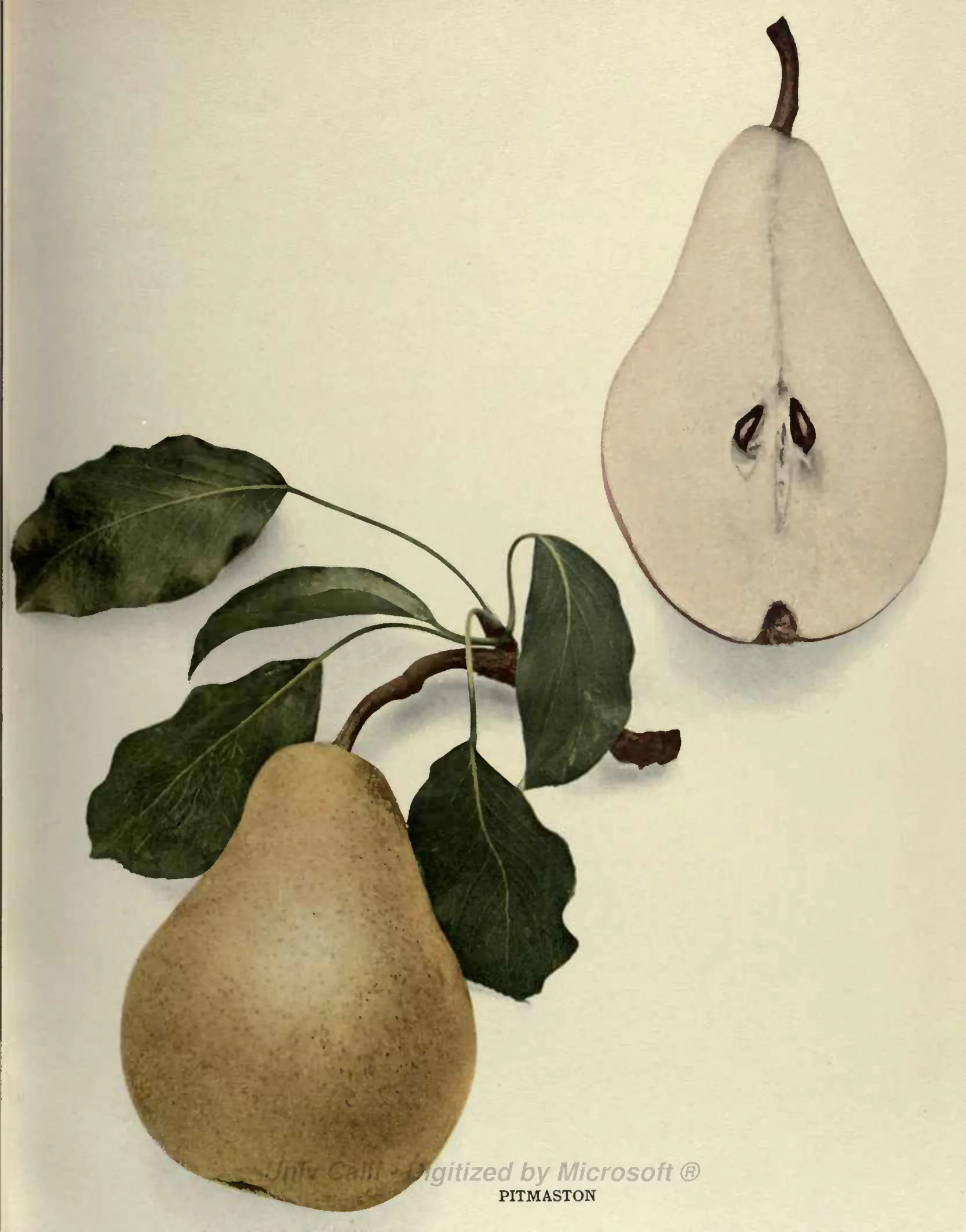
Pitmaston
Origin / History
Pitmaston is an English pear, "of British origin" in the words of the Herefordshire Pomona, which calls it "this beautiful pear." It was raised by John Williams at Pitmaston, near Worcester; the Pomona of 1885 refers to him as "the late Mr. Williams." Hedrick dates the raising to 1841, while the Herefordshire Pomona thought the seedling "some thirty or forty years old" in 1885, and Bunyard gives about 1865.
The parentage is generally stated as Duchesse d'Angoulême × Glou Morceau, as in the Herefordshire Pomona and Bunyard. Hedrick records that an old gardener employed by Mr. Williams said there was no record whatever of its parentage, and that it was the best of a number of seedlings.
For some time it was known as Pitmaston Duchesse d'Angoulême, on account of the theory of its derivation in part from the Duchesse d'Angoulême. Downing calls this "the unfortunate name given to a Pear raised by John Williams." It was figured under that name in Gardeners' Chronicle in 1864. In 1870 the name was simplified in England to Pitmaston Duchess. In 1874 it obtained a first-class certificate from the Royal Horticultural Society.
In America it was first fruited by John Saul, Washington, District of Columbia, in 1870. Elliott noted and illustrated it in the Rural New Yorker under the name Pitmaston Duchesse d'Angoulême. The American Pomological Society mentioned it favorably several times but never gave it a place in its fruit-catalog. Thomas listed it in 1903 as "English. New." Budd and Hansen report it grown under the name Duchess by several nurserymen.
Bunyard calls it "a very popular fruit though decried by some." Hedrick calls it a "fine old English pear" of "more than ordinary merit" that "seems to be little grown in America."
Tree
Large, vigorous, hardy, and grows freely. Bunyard gives the habit as upright spreading, very strong, making a good open tree; Hedrick gives it as spreading and dense-topped. Budd and Hansen call it "much like Angouleme but a better tree on varied soils and in varied climates."
Trunk stocky, shaggy. Branches thick, slightly zigzag, reddish-brown, overlaid with very dark grayish scarf-skin, marked with numerous large lenticels. Branchlets long, dull, dark reddish-brown, roughish, glabrous, with numerous small, raised, conspicuous lenticels. Leaf-buds short, obtuse, appressed; leaf-scars prominent (Hedrick).
Leaves leathery, 2½ in. long and 1¼ in. wide, with the apex abruptly pointed, the margin finely serrate, and the petiole 1⅛ in. long (Hedrick). The Cyclopedia prints the width as 1¾ in. and the petiole as 1¾ in. Bunyard gives the leaf as very large, round oval, dark, held nearly flat, irregularly serrate, and turning dark red.
Flower-buds short, conical, pointed, free. Flowers showy, 1⅛ in. across (1¼ in. in the Cyclopedia), well distributed, averaging seven buds in a cluster. Pedicels 1 in. long, pubescent.
Bunyard gives fertility as good. Hedrick calls the tree moderately productive but an annual bearer, with the large size of the fruit making it a high yielder. He finds it fairly immune to blight. He notes that the variety has not been grown widely enough in America for him "to speak with assurance of the tree-characters," but on the grounds of his Station the trees have "fewer faults than those of most of the standard varieties." The Herefordshire Pomona finds it well adapted for pyramids, bushes, or espaliers, the fruit being too large for it to be grown as a standard.
Fruit
Size: Large to very large. Recorded measurements run from 3¼ to 4½ in. long and 2¾ to 3 in. wide: 4¼ by 2¾ in. (Herefordshire Pomona); 3½ by 4½ (Bunyard); and 3½ in. long by 3 in. wide (Hedrick), printed as 3¼ by 2¾ in. in the Cyclopedia. Hedrick says well-grown pears are larger than his color-plate shows. Bunyard calls the Herefordshire Pomona figure rather smaller than the average.
Form: Oblong, obovate, pyriform: oblong-obovate-pyriform, slightly pyriform (Budd and Hansen), obtuse pyriform (Thomas), pyramidal (Herefordshire Pomona), to long pyriform (Bunyard). Outline generally even or a little undulating, sometimes rather prominently bossed (Herefordshire Pomona). Thomas calls it uneven and Budd and Hansen call the surface somewhat uneven, while Hedrick calls it symmetrical.
Stem: Stout, thick, about 1 in. long (¾ in. in the Cyclopedia), often curved (Hedrick). Budd and Hansen call it short and quite stout; Bunyard calls it long and woody, generally set at an angle.
Cavity: Small, very shallow and very narrow, or lacking, the stem inserted level with the surface. The flesh is drawn up in a wrinkled fold around the base of the stem, often lipped (Hedrick). Budd and Hansen call the cavity uneven.
Calyx: Large, with lobes long, broad, acute. The Herefordshire Pomona and Bunyard call it open; Hedrick calls it closed. Calyx-tube short, wide, conical (Hedrick).
Basin: A wide depression (Herefordshire Pomona). Bunyard calls it rather deep, while Hedrick calls it shallow, obtuse, furrowed and wrinkled.
Skin: Thin, fine, smooth, granular, tender, dull, though Bunyard calls it slightly rough. Pale lemon-yellow to yellow. Dotted, patched, and marbled with light, delicate cinnamon-colored to brown russet, especially around the stem, where the Herefordshire Pomona notes a large patch. The extent of russet runs from somewhat patched (Hedrick) to thickly covered with patches (Herefordshire Pomona). Hedrick says it is without blush; Thomas notes "some red." Very handsome; Hedrick calls it unsurpassed in appearance, "fruits of few other sorts being so alluring in shape and color."
Dots: Numerous, small, russet, conspicuous, as dots and specks over the whole surface.
Flesh and flavor: Flesh yellowish white to pale yellow, very tender, melting, buttery, very juicy. Hedrick calls it somewhat granular, and his Cyclopedia adds firm. Thomas calls it half melting. Flavor subacid, sprightly, vinous, piquant. The Herefordshire Pomona calls it exceedingly rich, with a delicate perfume. Hedrick calls it flavored very differently from Bartlett, "more piquant and refreshing."
Flavor depends on site and season: on warm soils or in warm seasons "choicely good," in cold soils and seasons "often austere, or even acid and astringent" (Hedrick). Bunyard finds it "pleasantly flavoured in a good season."
Quality runs from "good" (Thomas) through "good to very good" (Hedrick) and "very good" (Budd and Hansen) to "of the finest quality" (Herefordshire Pomona). Bunyard calls it "of good quality when well finished."
Core and seeds: Core large, closed, with clasping core-lines. Seeds narrow, long, flat, acute, very often abortive (Hedrick).
Season
October and November. The Herefordshire Pomona gives the end of October till the end of November, while Thomas gives October. Hedrick has the fruit ripe in October, its season prolonging that of Bartlett. Such reports as were at hand to Hedrick state that the fruits keep and ship well.
Uses
An exhibition or dessert pear (Bunyard). Hedrick considers the subacid flavor makes it "one of the very best pears for culinary purposes." Because its flavor differs from Bartlett's and the fruits are "ordinarily larger and handsomer," he holds that Pitmaston "ought to make a good market variety where it thrives." He says it "should be put on probation by those who grow for the markets" and is "well worthy a place in all home orchards."
Subtypes / Variants
Not described in source.
Other
Not described in source.
Book Sources
Described in 7 period pomological works
- Hedrick, The Pears of New York (1921)
- Hedrick, Cyclopedia of Hardy Fruits (1922)
- Budd & Hansen, Systematic Pomology (1914) — listed as Pitmaston (Duchess)
- Bunyard, A Handbook of Hardy Fruits (1920) — listed as PITMASTON DUCHESS
- Downing, Fruits and Fruit Trees of America (1900) — listed as Pitmaston Duchesse d'Angouleme
- The Herefordshire Pomona (1876–1885) — listed as Pitmaston Duchess
- Thomas, The American Fruit Culturist (1903) — listed as Pitmaston Duchesse
View original book sources (7)
— Woolhope Naturalists Field Club, The Herefordshire Pomona (1885)Plate XIII.
- PITMASTON DUCHESS.
[Syn : Pitmaston Duchesse d'Angouleme ; Williams Duchesse d'Angouleme.]
This beautiful pear is of British origin. The seedling was raised by the late Mr. Williams, of Pitmaston, near Worcester, and obtained from crossing Duchesse d'Angouleme with Glou Morceau. It may be at this time some thirty or forty years old.
Description.—Fruit, large and handsome, four inches and a quarter long, and two inches and three quarters wide ; pyramidal, generally even or a little undulating in its outline, and sometimes rather prominently bossed. Skin, smooth and fine, of a pale lemon colour, thickly covered with patches of delicate cinnamon coloured russet, with a large patch round the stalk. Eye, large and open, set in a wide depression. Stalk, about an inch long, stout, and inserted either level with the surface, or in a small narrow cavity. Flesh, very tender and melting, very juicy, exceedingly rich, with a sprightly vinous flavour and delicate perfume.
A very handsome pear, of the finest quality ; in season from the end of October till the end of November. The tree is hardy, and grows freely. It is well adapted for pyramids, bushes, or espaliers. The fruit is too large to be grown as a standard.
— A.J. Downing, The Fruits and Fruit Trees of America (1900)PITMASTON DUCHESSE D'ANGOULEME.
This is the unfortunate name given to a Pear raised by John Williams, of Pitmaston, England. Tree vigorous.
Fruit very large, oblong obovate, yellow, with light russet near the stalk. Flesh yellowish white, melting, buttery, juicy. October, November. (Gard. Chron.)
— John J. Thomas, The American Fruit Culturist (1903)Pitmaston Duchesse. Large, obtuse pyriform, uneven, yellow, with some red and russet; half melting, vinous; good. October. English. New.
— J.L. Budd & N.E. Hansen, American Horticultural Manual, Part II: Systematic Pomology (1914)Pitmaston (Duchess). — Very large, oblong, obovate, slightly pyriform; color yellow with light russet near the stalk and many russet dots and specks over the whole surface, which is somewhat uneven; stalk short, quite stout, in small uneven cavity. Flesh yellowish, juicy, melting, buttery, sprightly, vinous, very good. Grown under the name of Duchess by several nurserymen. Much like Angouleme but a better tree on varied soils and in varied climates. Europe.
— E.A. Bunyard, A Handbook of Hardy Fruits (1920)PITMASTON DUCHESS. Her. Pom., I., 13. F. Williams' Duchess. G. Pitmaston's Herzogin. Exhibition or dessert, October to November, very large, 3½ by 4½, long pyriform. Skin, slightly rough. Colour, pale yellow, marbled with brown russet, especially around the stem. Flesh, pale yellow melting, very juicy and pleasantly flavoured in a good season. Eye, open in a rather deep basin. Stem, long and woody, generally at an angle. Growth, upright spreading, very strong, making a good open tree ; fertility good. Leaf, very large, round oval, dark, held nearly flat, irregularly serrate, turns dark red. Origin, raised by Mr. Williams, of Pitmaston about 1865, from Duchess d'Angoulême × Glou Morceau. A very popular fruit though decried by some, but of good quality when well finished. The figure referred to is rather smaller than the average.
— U.P. Hedrick, The Pears of New York (1921)PITMASTON
- Can. Hort. 26:129, fig. 1903. 2. Ont. Dept. Agr. Fr. Ont. 173, fig. 1914. Pitmaston Duchesse d'Angoulême. 3. Gard. Chron. 1108, fig. 1864. 4. Am. Pom. Soc. Rpt. 55. 1871. Pitmaston Duchess. 5. Jour. Hort. N. S. 18:11, fig. 1870. 6. Tilton Jour. Hort. 7:239, fig. 1870. 7. Jour. Hort. N. S. 38:201, fig. 30. 1880. 8. Hogg Fruit Man. 631. 1884. 9. Gard. Chron. 3rd Ser. 4:608. 1888. 10. Rev. Hort. 196, 651. 1900. 11. Bunyard Handb. Hardy Fr. 193. 1920.
Although this fine old English pear has more than ordinary merit, it seems to be little grown in America. In appearance, the pears are unsurpassed. The accompanying color-plate shows the shape and color very well, but not the size, as, well grown, the pears are larger. From the illustration, all must agree that the pears are handsome, fruits of few other sorts being so alluring in shape and color. On warm soils or in warm seasons, the flavor is choicely good giving the pears a rating of "good to very good;" but in cold soils and seasons, the flavor is often austere, or even acid and astringent. The season prolongs that of Bartlett, and as the fruits are flavored very differently, being more piquant and refreshing, and are ordinarily larger and handsomer, Pitmaston ought to make a good market variety where it thrives. The subacid flavor makes this one of the very best pears for culinary purposes. Such reports as are at hand state that the fruits keep and ship well. The variety seems not to have been grown widely in America, so that one cannot speak with assurance of the tree-characters; but on the grounds of this Station, the trees have fewer faults than those of most of the standard varieties. They are hardy, vigorous, fairly immune to blight, and while but moderately productive, bear annually, and the large size of the fruits makes them high yielders. The variety should be put on probation by those who grow for the markets, and is well worthy a place in all home orchards.
Pitmaston was raised by John Williams at Pitmaston, near Worcester, England, in 1841. It has been generally stated that it originated from a cross between Duchesse d'Angoulême and Glou Morceau, although an old gardener, who was employed by Mr. Williams, stated that there was no record whatever of its parentage, but that it was the best of a number of seedlings. For some time it was known as the Pitmaston Duchesse d'Angoulême on account of the theory of its derivation in part from the Duchesse d'Angoulême; but in 1870 its name was simplified in England to Pitmaston Duchess. In 1874 it obtained a first-class certificate from the Royal Horticultural Society, England. In this country it was first fruited by John Saul, Washington, District of Columbia, in 1870, and was noted and illustrated by Elliott in the Rural New Yorker under the name Pitmaston Duchesse d'Angoulême. Although favorably mentioned several times by the American Pomological Society, the variety has never received a place in the Society's fruit-catalog.
Tree large, vigorous, spreading, dense-topped, moderately productive; trunk stocky, shaggy; branches thick, slightly zigzag, reddish-brown, overlaid with very dark grayish scarf-skin, marked with numerous large lenticels; branchlets long, dull, dark reddish-brown, roughish, glabrous, with numerous small, raised, conspicuous lenticels.
Leaf-buds short, obtuse, appressed; leaf-scars prominent. Leaves 2½ in. long, 1¼ in. wide, leathery; apex abruptly pointed; margin finely serrate; petiole 1⅛ in. long. Flower-buds short, conical, pointed, free; flowers showy, 1⅛ in. across, well distributed, average 7 buds in a cluster; pedicels 1 in. long, pubescent.
Fruit ripe in October; large, 3½ in. long, 3 in. wide, oblong-obovate-pyriform, symmetrical; stem 1 in. long, thick, often curved; cavity very shallow and very narrow, or lacking, the flesh drawn up in a wrinkled fold around the base of the stem, often lipped; calyx closed, large; lobes long, broad, acute; basin shallow, obtuse, furrowed and wrinkled; skin thin, granular, smooth, tender, dull; color pale lemon-yellow, dotted and somewhat patched with light russet especially around the stem, without blush; dots numerous, small, russet, conspicuous; flesh tinged with yellow, somewhat granular, melting, buttery, very juicy, piquant and vinous; quality good to very good. Core large, closed, with clasping core-lines; calyx-tube short, wide, conical; seeds narrow, long, flat, acute, very often abortive.
— U.P. Hedrick, Cyclopedia of Hardy Fruits (1922)PITMASTON. Fig. 92. Pitmaston Duchess. Although this fine old English pear has more than ordinary merit, it seems to be little grown in America. In appearance, the pears are unsurpassed. On warm soils or in warm seasons, the flavor is choicely good, but in cold soils and seasons, the flavor is often austere, or even acid and astringent. The season prolongs that of Bartlett, and as the fruits are flavored very differently, being more piquant and refreshing, and are ordinarily larger and handsomer, Pitmaston ought to make a good market sort where the variety thrives. The subacid flavor makes this one of the very best pears for culinary purposes. The fruits keep and ship well. The trees have fewer faults than those of most of the standard varieties. They are hardy, vigorous, fairly immune to blight, and while but moderately productive, bear annually, and the large size of the fruits make them high yielders. The variety should be put on probation by those who grow for the markets, and is well worthy a place in all home orchards. Pitmaston was raised by John Williams, Pitmaston, England, in 1841. Tree large, vigorous, spreading, dense-topped; trunk stocky, shaggy; branches thick, slightly zigzag, reddish-brown, marked with numerous, large lenticels. Leaves 2½ inches long, 1¾ inches wide, leathery; apex abruptly pointed; margin finely serrate; petiole 1¾ inches long. Flowers showy, 1¼ inches across, well distributed, average 7 buds in a cluster. Fruit ripe in October; large, 3¼ inches long, 2¾ inches wide, oblong-obovate-pyriform, symmetrical; stem ¾ inch long, thick, often curved; cavity very shallow and very narrow or lacking, the flesh drawn up in a wrinkled fold around the base of the stem, often lipped; calyx closed, large; lobes long, broad, acute; basin shallow, obtuse, furrowed and wrinkled; skin thin, granular, smooth, tender, dull; color pale lemon-yellow, dotted and patched with light russet, especially around the stem, without blush; dots numerous, small, russet, conspicuous; flesh tinged with yellow, firm, somewhat granular, melting, buttery, very juicy, piquant and vinous; quality good to very good; core large, closed, with clasping core-lines; calyx-tube short, wide, conical; seeds narrow, long, flat, acute, very often abortive.