Rossney
Pear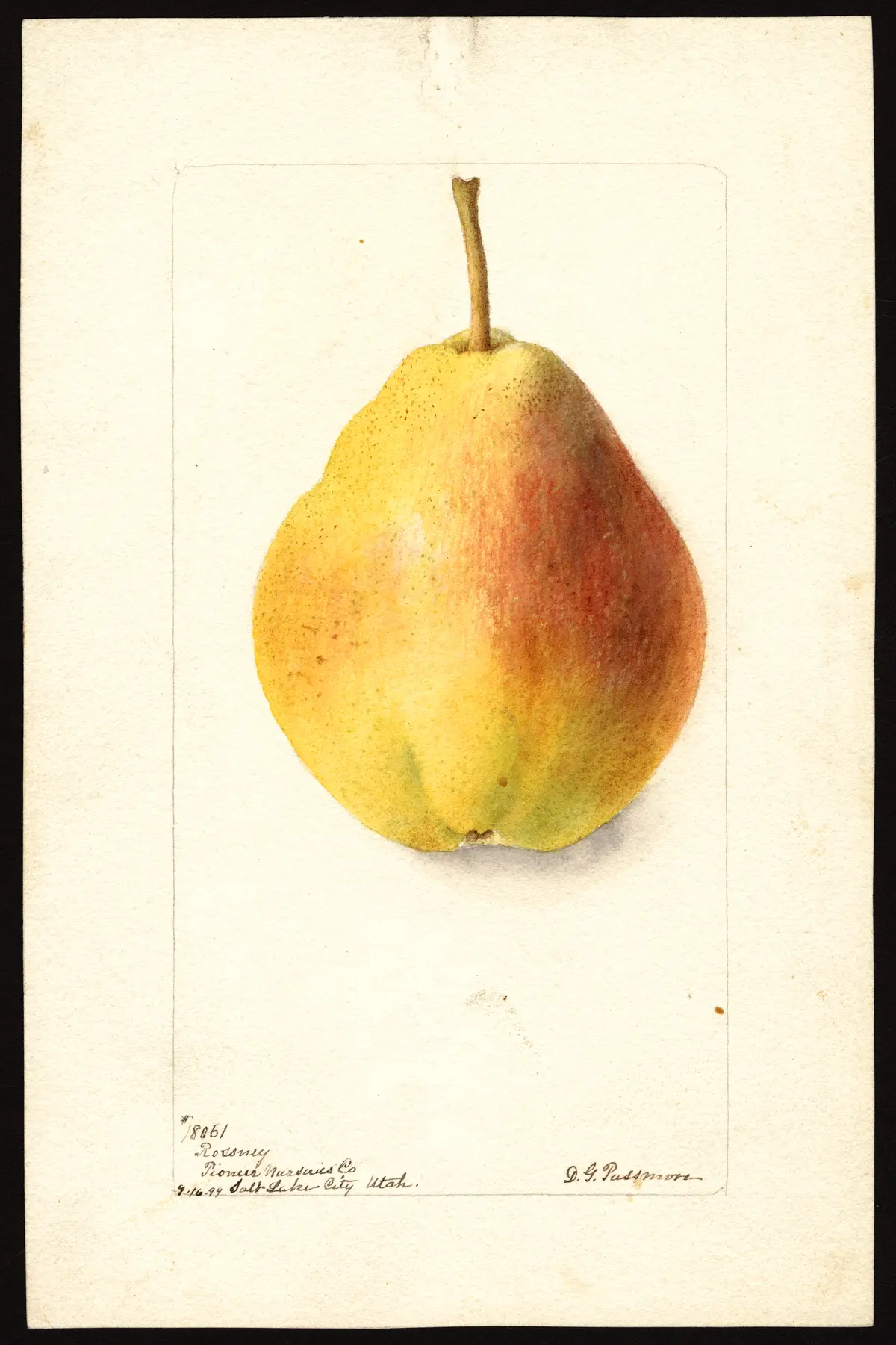
USDA Pomological Watercolor Collection
Rossney
Origin / History
Raised in Salt Lake City, Utah, from a mixed lot of Winter Nelis and Bartlett seed planted for stocks by William Woodberry about 1881. Introduced by the Pioneer Nurseries Company, Salt Lake City, in 1898. Budd and Hansen list it as a Utah variety. Stark Bros. (1910) call it "a beautiful, large, pale yellow pear" of good quality and productive, and say that "when one of the newer pear is needed, Rossney is a good choice."
Tree
Productive (Stark Bros.). The fruit hangs well upon the tree. Stark Bros. say it seems to blight less than most varieties. Budd and Hansen rate the tree about like Bartlett in hardiness.
Fruit
Size: Medium to large; Stark Bros. say large.
Form: Oval, pyriform; oval-pyriform, somewhat angular and ribbed towards the apex (Hedrick).
Stem: Short, quite stout, inserted at top of neck (Budd and Hansen); Hedrick alone gives it rather long, moderately stout.
Cavity: Slight (Budd and Hansen).
Calyx: Closed (Hedrick).
Basin: Medium, ridged (Budd and Hansen).
Skin: Creamy yellow (Budd and Hansen), pale yellow (Stark Bros.) or golden yellow (Hedrick), with a crimson blush (Budd and Hansen), blushed with scarlet (Hedrick), a red cheek (Stark Bros.). Thinly overspread with a bluish-white bloom (Hedrick).
Dots: Numerous, minute, russet (Hedrick).
Flesh and flavor: Yellow or yellowish, fine-grained, melting (Budd and Hansen), buttery (Hedrick), juicy. Sweet (Budd and Hansen); subacid (Hedrick). Budd and Hansen rate the quality "very good"; Hedrick and Stark Bros. say "good".
Core and seeds: Not described in source.
Season
Ripens about October 1st to November 1st (Stark Bros.). Later than Bartlett: two weeks (Budd and Hansen), ten days (Hedrick).
Uses
Not described in source.
Subtypes / Variants
Not described in source.
Other
Not described in source.
Book Sources
Described in 2 period pomological works
Nursery Catalog Sources
Found in 17 catalogs (1901–1920) from Illinois, Nebraska, Oregon, Washington
- Washington Nursery Co. , Toppenish , Washington — 1901
- Phoenix Nursery Company (W. E. Rossney , President; Sidney Tuttle, Vice-President), Bloomington , Illinois — 1904
- Milton Nursery Co. (A. Miller & Sons , Proprietors), Milton , Oregon — 1909
- Washington Nursery Company , Toppenish , Washington — 1909
- Island Nurseries & Fruit Farm , Vashon (Vashon Island) , Washington — 1910
- Galbraith Nursery Co. (DeWitt Hansen , Pres.-Mgr.), Fairbury , Nebraska — 1911
- Island Nurseries & Fruit Farm , Vashon (Vashon Island) , Washington — 1911
- Pacific Nursery Company , Portland , Oregon — 1912
- Vineland Nurseries Company , Clarkston , Washington — 1912
- Washington Nursery Company , Toppenish , Washington — 1912
- Van Holderbeke Nursery Co. , Incorporated, Spokane, Washington (nurseries at Otis Orchards WA, Pasadena WA, Kennewick WA) — 1913
- Island Nurseries & Fruit Farm , Vashon (Vashon Island) , Washington — 1914
- Island Nurseries & Fruit Farm , Vashon (Vashon Island) , Washington — 1915
- Island Nurseries & Fruit Farm , Vashon (Vashon Island) , Washington — 1916
- Island Nurseries & Fruit Farm , Vashon (Vashon Island) , Washington — 1917
- Oregon Nursery Co. , Orenco , Oregon — 1920
- Washington Nursery Company , Toppenish, Washington (on Yakima Indian Reservation) - [undated; companion to the 1912 "Sixth Edition" descriptive catalogue; same cover design and incorporated 1903 date; dated as c.1912]
View original book sources (3)
— J.L. Budd & N.E. Hansen, American Horticultural Manual, Part II: Systematic Pomology (1914)Rossney. — Medium to large, oval, pyriform; color creamy yellow with crimson blush; stem short, quite stout, inserted at top of neck into slight cavity; basin medium, ridged. Flesh yellow, fine-grained, melting, juicy, sweet, very good. Season, two weeks later than Bartlett and about like it in hardiness of tree. Utah.
— U.P. Hedrick, The Pears of New York (1921)Rossney.
i. Pioneer Nurs. Co. Cat. fig. 1898. 2. U. S. D. A. Yearbook 402, Pl. LII. 1904.
Raised in Salt Lake City, Utah, from a mixed lot of Winter Nelis and Bartlett seed planted for stocks by William Woodberry about 1881, and introduced by the Pioneer Nurseries Company, Salt Lake City, in 1898. Fruit medium to large, oval-pyriform, somewhat angular and ribbed towards the apex, golden yellow, blushed with scarlet and thinly overspread with a bluish-white bloom; dots numerous, minute, russet; stem rather long, moderately stout; calyx closed; flesh yellowish, buttery, juicy, subacid; good; ten days later than Bartlett.
— Stark Bros. Nurseries & Orchards Co., Stark Bros. Year Book (1910) (1910)A beautiful, large, pale yellow pear with a red cheek, and having good quality and being productive. The fruit hangs well upon the tree. Ripens about October 1st to November 1st. One of the strong points in its favor is that it seems to blight less than most varieties and when one of the newer pear is needed, Rossney is a good choice.