Madame Loriol de Barny
Pear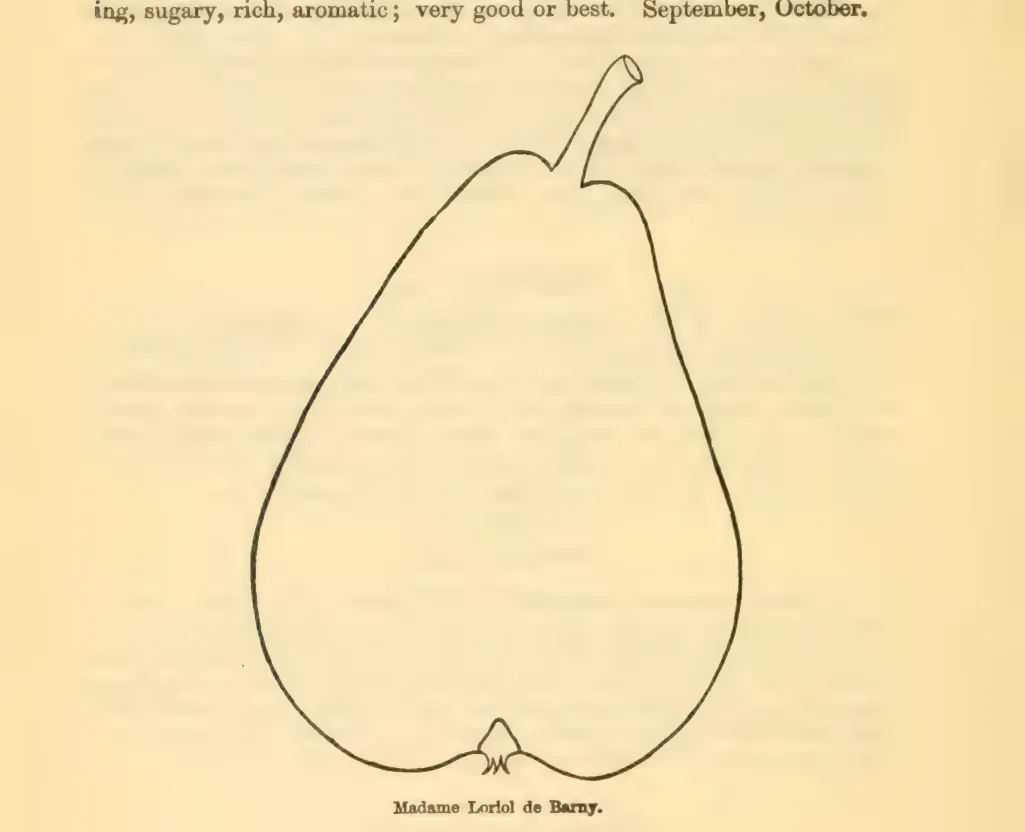
Madame Loriol de Barny
Origin/History
Raised by André Leroy in 1866 at his nurseries at Angers, France, from seed of Bartlett. References: Leroy Dict. Pom. 2:381, fig. 1869; Mass. Hort. Soc. Rpt. 92, 1872.
Tree
Vigorous, upright, productive. (Downing.)
Fruit
Size and Form: Downing describes the fruit as medium, oblong pyriform, a little obtuse. Hedrick describes it as large, ovate and nearly cylindrical, always rather irregular.
Stem: Short. (Downing.)
Cavity: Small, or slight depression. (Downing.)
Calyx: Closed, or nearly so. (Downing.)
Basin: Rather shallow, a little uneven. (Downing.)
Skin: Downing describes the skin as greenish yellow at first, changing to a deep yellow, slightly bronzed, sometimes a shade of red in the sun. Hedrick gives a more detailed account: clear yellow clouded with green, more or less streaked and mottled with russet, covered with large, grayish-brown or greenish dots, and often stained with fawn around the calyx and stem.
Flesh and Flavor: Downing describes the flesh as yellowish, a little coarse, melting, juicy, and slightly vinous. Hedrick describes it as yellowish-white, excessively melting and fine, juicy, rarely gritty, sugary, perfumed, with a tart flavor and a delicate and agreeable after-taste of musk. (Note conflict on texture: Downing finds it a little coarse; Hedrick finds it fine and excessively melting.)
Quality: Good to very good (Downing); first quality (Hedrick).
Season
October–November (Downing); November (Hedrick).
Uses
Not described in source.
Subtypes/Variants
Not described in source.
Other
Not described in source.
Book Sources
Described in 2 period pomological works
View original book sources (2)
— A.J. Downing, The Fruits and Fruit Trees of America (1900)Madame Loriol de Barny.
Originated in the nurseries of Andre Leroy, Angers, France. Tree vigorous, upright, productive.
Fruit medium, oblong pyriform, a little obtuse; skin greenish yellow at first, changing to a deep yellow, slightly bronzed, sometimes a shade of red in the sun; stalk short; cavity small, or slight depression; calyx closed, or nearly so; basin rather shallow, a little uneven; flesh yellowish, a little coarse, melting, juicy, slightly vinous; good to very good. October, November.
— U.P. Hedrick, The Pears of New York (1921)Madame Loriol de Barny.
- Leroy Diet. Pom. 2:381, fig. 1869.
- Mass. Hort. Soc. Rpt. 92. 1872.
Raised by Leroy in 1866 at his nurseries at Angers, Fr., from seed of Bartlett. Fruit large, ovate and nearly cylindrical, always rather irregular, clear yellow clouded with green, more or less streaked and mottled with russet, covered with large, grayish-brown or greenish dots and often stained with fawn around the calyx and stem; flesh yellowish-white, excessively melting and fine, juicy, rarely gritty, sugary, perfumed, with a tart flavor and a delicate and agreeable after-taste of musk; first; Nov.