Goodale
Pear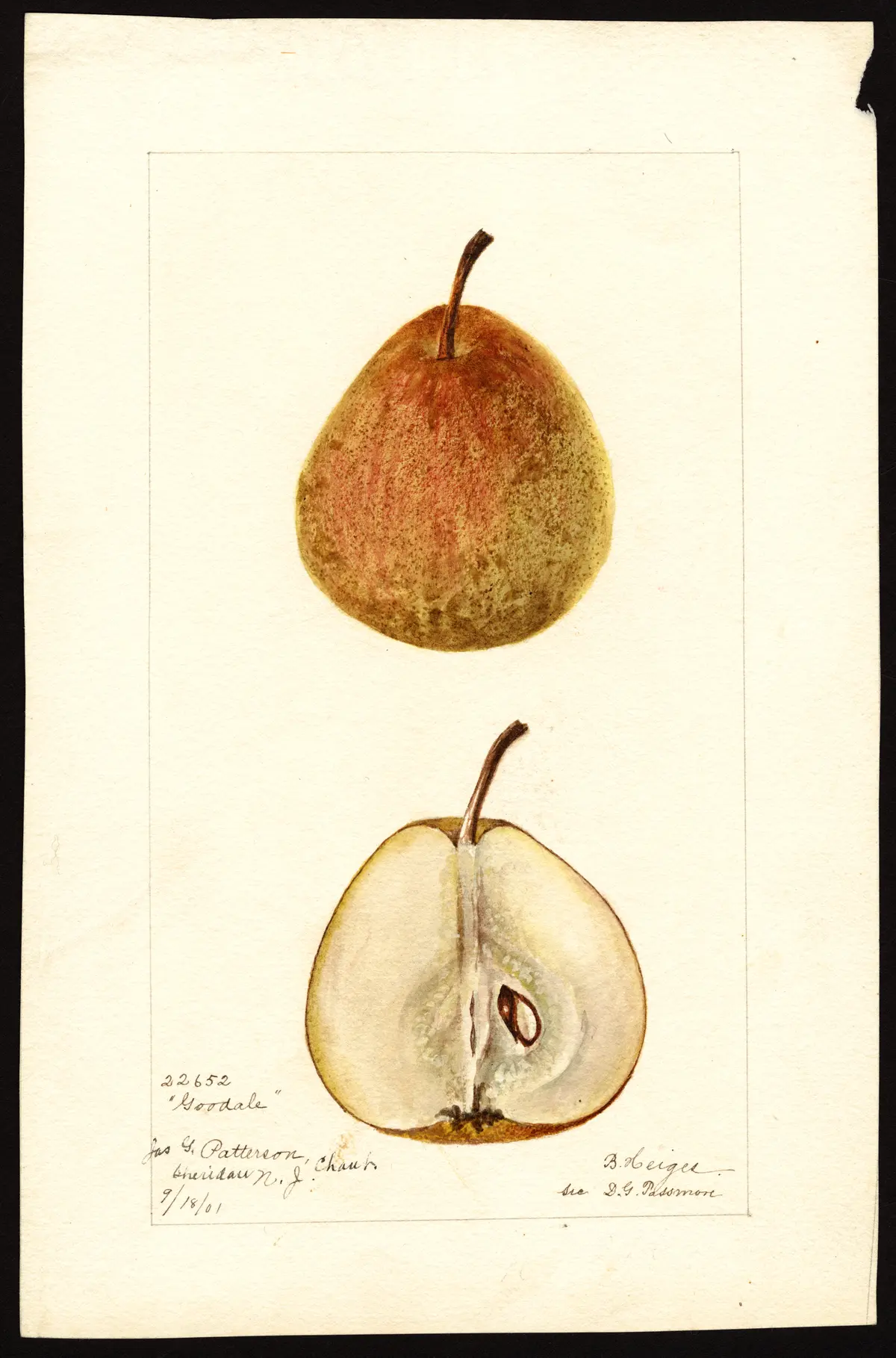
USDA Pomological Watercolor Collection
Goodale
Origin / History
Raised from seed of the McLaughlin by Enoch Goodale of Saco, Maine (Downing; Hedrick; Thomas attributes the seedling work to S. L. Goodale). Hedrick cites Downing's Fruits and Fruit Trees of America (1869 ed., p. 773, with figure) and the Ontario Department of Agriculture Fruits of Ontario (1914, p. 163, with figures) as references. At the Central Experimental Farm trial station in Agassiz, BC, trees were planted in the spring of 1890.
Tree
Very hardy; a vigorous, thrifty, strong grower, spreading upright in habit, and uniformly productive (Downing; Thomas; Central Experimental Farm corroborates "strong grower"). Young wood very stout, olive (Downing).
Fruit
Size and form: Large; oblong-obovate-obtuse-pyriform — short Bartlett-shaped (Downing, Hedrick, Budd & Hansen, Thomas). The Central Experimental Farm at Agassiz, BC, reports the fruit as "above medium size, oblong, pyriform" — somewhat smaller than the other sources describe.
Stem: Rather short, stout, and (per Budd & Hansen) curved; set in an inclined cavity of considerable depth, sometimes with a projection on one side — Budd & Hansen describe this as "one side of neck highest." (Hedrick and the Central Experimental Farm do not separately describe the stalk and cavity.)
Calyx: Small, closed; segments thick (Downing). Not described in the other sources.
Basin: Rather deep and uneven (Downing). Not described in the other sources.
Skin: Light yellow (Downing, Budd & Hansen) — Hedrick describes it as green, yellowing at maturity; pale yellow per the Central Experimental Farm. Shaded with crimson and fawn in the sun (Downing, Hedrick); Budd & Hansen describe the blush as "crimson and light red where exposed"; the Central Experimental Farm describes it more modestly as "a little red in the sun." Slightly netted and patched with russet, and thickly sprinkled with small russet-brown dots (Downing, Hedrick, Budd & Hansen).
Flesh / flavor: Whitish to white, juicy, melting (Downing, Budd & Hansen) — Hedrick calls it "fine" rather than melting. A little gritty at the core (Downing, Hedrick; "rather gritty," Central Experimental Farm). Sweet, slightly vinous, with a brisk refreshing musky perfume (Downing); sweet, pleasant, perfumed, slightly vinous (Hedrick); sweet (Central Experimental Farm). Quality rated "very good" (Downing, Budd & Hansen, Thomas); Hedrick distinguishes between dessert and market use, calling it "fair for dessert; first for market."
Core / seeds: Core noted as somewhat gritty (Downing, Hedrick, Central Experimental Farm). Seeds not described in source.
Season
October (Downing, Hedrick, Central Experimental Farm).
Uses
Promising as a market sort on account of its size and period of ripening (Downing); Hedrick ranks it "first for market" but only "fair for dessert."
Subtypes / Variants
Not described in source.
Other
Not described in source.
Book Sources
Described in 4 period pomological works
Nursery Catalog Sources
Found in 4 catalogs (1894–1904) from Illinois, Oregon
- Woodburn Nurseries , Woodburn, Marion Co. , Oregon — 1894
- Central Experimental Farm , Dominion Department of Agriculture, Agassiz, British Columbia (under test; Bulletin No. 3, Second Series) — 1900
- Benjamin Buckman (personal inventory) , Farmingdale , Illinois — 1901
- Phoenix Nursery Company (W. E. Rossney , President; Sidney Tuttle, Vice-President), Bloomington , Illinois — 1904
View original book sources (5)
— A.J. Downing, The Fruits and Fruit Trees of America (1900)GOODALE.
Goodale's Seedling. Saco.
Raised from seed of the McLaughlin, by Enoch Goodale, Saco, Me. Its size and period of ripening make it promise of high value as a market sort. The tree is very hardy, a vigorous, thrifty grower, spreading upright in habit, and uniformly productive. Young wood very stout, olive.
Fruit large, oblong obovate obtuse pyriform, light yellow, shaded with crimson and fawn in the sun, slightly netted and patched with russet, and thickly sprinkled with small russet brown dots. Stalk rather short and set in an inclined cavity of considerable depth, sometimes a projection one side. Calyx small, closed. Segments thick. Basin rather deep and uneven. Flesh whitish, juicy, melting, a little gritty at the core, sweet, slightly vinous, with a brisk refreshing musky perfume. Very good. October.
— John J. Thomas, The American Fruit Culturist (1903)Goodale. Large, pyriform (short Bartlett-shaped), handsome; very good. Tree vigorous, hardy, productive—from seed of the McLaughlin, Maine. S. L. Goodale.
— J.L. Budd & N.E. Hansen, American Horticultural Manual, Part II: Systematic Pomology (1914)Goodale. — Large, oblong, obovate, pyriform; color light yellow, with crimson and light red where exposed, with some netting and patches of russet; stalk short, curved, stout and inserted in quite deep inclined cavity with one side of neck highest. Flesh whitish, juicy, melting, very good. Maine.
— U.P. Hedrick, The Pears of New York (1921)Goodale.
- Downing Fr. Trees Am. 773, fig. 1869.
- Ont. Dept. Agr. Fr. Ont. 163, figs. 1914.
Raised by E. Goodale, Saco, Me., from seed of the McLaughlin. Fruit large, oblong-obovate-pyriform, green, yellowing at maturity, shaded with crimson and fawn in the sun, slightly netted and patched with russet and sprinkled with small russet dots; flesh white, fine, rather gritty at core, juicy, sweet, pleasant, perfumed, slightly vinous; fair for dessert; first for market; Oct.
— Central Experimental Farm, Central Experimental Farm, Agassiz BC — Catalogue of Fruit Trees under Test (Bulletin No. 3, 1900) (1900)Planted Spring 1890. Tree a strong grower. Fruit above medium size, oblong, pyriform. Skin pale yellow, with a little red in the sun. Flesh white, juicy, sweet, rather gritty. Season October.