McLaughlin
Pear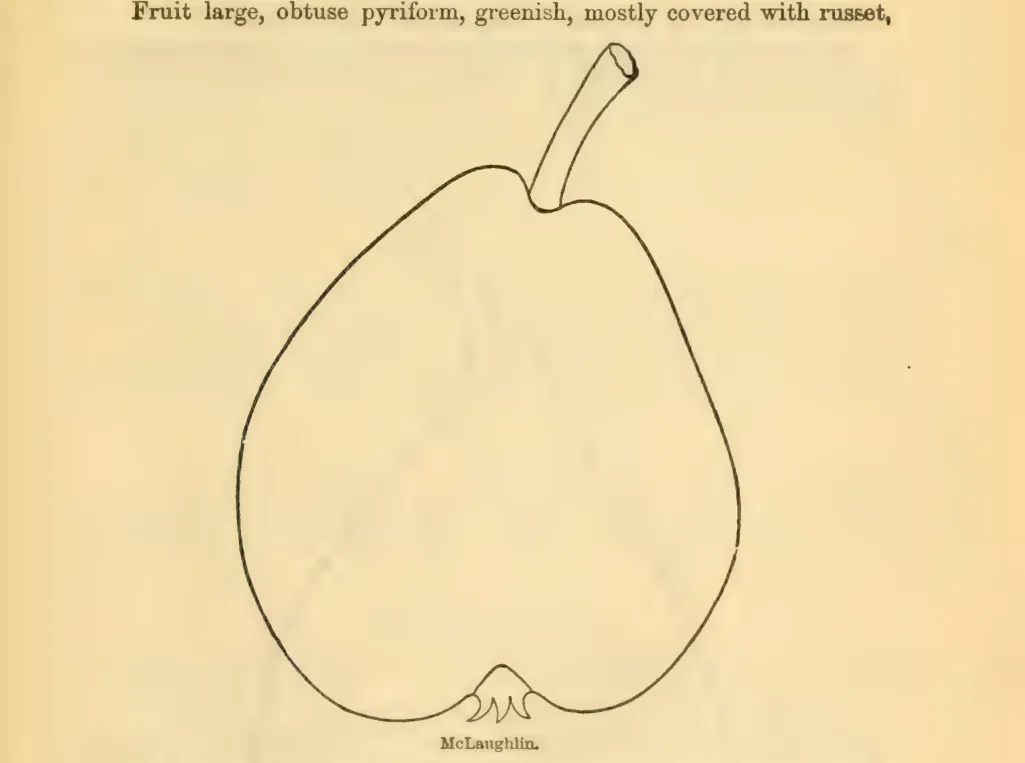
McLaughlin
Origin / History
McLaughlin is a native of Maine, an American seedling. According to Hedrick, in October 1831, General Wingate of Portland, Maine, stated "That a person in Oxford County, many years since raised a number of pear trees from seeds, all of which produced inferior fruit, with the exception of one tree; and from that tree, the scions were taken and engrafted by a Mr. McLaughin, of Scarborough." It was introduced by S. L. Goodale of Saco (Downing). Elliott notes the origin as unknown but probably an American seedling, and reports it was first described in the N. E. Farmer. Early published references include the Magazine of Horticulture 8:62 (1842) and 13:251 (1847), and Downing's Fruits and Fruit Trees of America (1869, with figure). Budd & Hansen note it is grown east of the lakes.
Tree
Hardy and vigorous (Downing, Elliott). Elliott also describes the tree as a moderate, healthy grower, productive. Young wood light dull red (Downing).
Fruit
Size: Large (Downing, Hedrick, Thomas, Budd & Hansen). Elliott in one description gives "above medium," in another "large."
Form: Obtuse pyriform (Downing, Hedrick); elongated, obtuse pyriform (Elliott); oblong obtuse pyriform (Elliott); pyramidal-pyriform, often roundish-obovate when small (Thomas); pyramidal pyriform, and often obovate (Budd & Hansen).
Stem / Stalk: Short, inserted at an inclination, with some appearance of a lip (Downing, Elliott). Elliott elsewhere notes the stem as short, swollen at junction with tree. Thomas describes the stalk as short, oblique, not sunk. Budd & Hansen: short, oblique, and inserted at surface without cavity.
Cavity: Not sunk (Thomas); inserted at surface without cavity (Budd & Hansen).
Calyx: Open (Downing, Elliott).
Basin: Shallow, corrugated (Downing, Elliott); shallow (Thomas).
Skin: Slightly rough, bright cinnamon-russet, tinged with brownish-red on the sunny side, with some traces of a bright yellow ground on the shaded side (Hedrick). Rough, greenish, mostly covered with russet, which becomes yellowish at maturity, with a warm sunny cheek (Downing, Elliott). Pale yellow, with brownish red in sun (Elliott, in his shorter description). Rough, partly russeted, greenish, becoming yellow (Thomas). Greenish yellow, and yellow when ripe; skin rough, with some russeting (Budd & Hansen).
Flesh / Flavor: Whitish, not very fine, juicy, and melting; flavor sweet, rich, and perfumed (Downing, Elliott). Yellowish, rather coarse, melting, juicy, rich, sugary (Hedrick). Yellowish white, a little coarse, juicy (Elliott, shorter description). Juicy, melting, sweet, rich, perfumed (Thomas, Budd & Hansen). Rated "good to very good" (Downing), "very good" (Elliott, Budd & Hansen).
Core / Seeds: Core medium (Elliott). Seeds not described in source.
Season
November to January (Downing, Elliott, Hedrick); November and December (Elliott, shorter description); early winter (Thomas, Budd & Hansen).
Uses
Not described in source.
Subtypes / Variants
Not described in source.
Other
Not described in source.
Book Sources
Described in 5 period pomological works
View original book sources (5)
— A.J. Downing, The Fruits and Fruit Trees of America (1900)McLaughlin.
A native of Maine, introduced by S. L. Goodale, of Saco. Tree hardy and vigorous. Young wood light dull red.
Fruit large, obtuse pyriform, greenish, mostly covered with russet, which becomes yellowish at maturity, with a warm sunny cheek. Stalk short, inserted at an inclination, with some appearance of a lip. Calyx open, set in a shallow corrugated basin. Flesh whitish, not very fine, juicy, and melting. Flavor sweet, rich, and perfumed. Good to very good. November to January.
— U.P. Hedrick, The Pears of New York (1921)McLaughlin.
- Mag. Hort. 8:62. 1842. 2. Ibid. 13:251. 1847. 3. Downing Fr. Trees Am. 807, fig. 1869.
In October, 1831, General Wingate of Portland, Me., stated "That a person in Oxford County, many years since raised a number of pear trees from seeds, all of which produced inferior fruit, with the exception of one tree; and from that tree, the scions were taken and engrafted by a Mr. McLaughin, of Scarborough."
Fruit large, obtuse-pyriform; skin slightly rough, bright cinnamon-russet, tinged with brownish-red on the sunny side, with some traces of a bright yellow ground on the shaded side; flesh yellowish, rather coarse, melting, juicy, rich, sugary; Nov. to Jan.
— F.R. Elliott, The Western Fruit Book (1865)McLaughlin.
Origin unknown; probably an American seedling. Tree, moderate, healthy grower, productive. Fruit, above medium, oblong obtuse pyriform, pale yellow, with brownish red in sun; stem, short, swollen at junction with tree; calyx, open; core, medium; flesh, yellowish white, a little coarse juicy; "very good." November and December.
McLaughlin.
A native of Maine, first described in the N. E. Farmer. Tree, hardy and vigorous.
Fruit, large, elongated, obtuse pyriform: skin, rough, greenish, mostly covered with russet, which becomes yellowish at maturity, with a warm, sunny cheek; stalk, short, inserted at an inclination, with some appearance of a lip; calyx, open, set in a shallow, corrugated basin; flesh, whitish, not very fine, juicy, and melting; flavor, sweet rich, and perfumed. November to January.
— John J. Thomas, The American Fruit Culturist (1903)McLaughlin. Large, pyramidal-pyriform, often roundish-obovate when small; skin rough, partly russeted, greenish, becoming yellow; stalk short, oblique, not sunk; basin shallow; flesh juicy, melting, sweet, rich, perfumed. Early winter. Maine.
— J.L. Budd & N.E. Hansen, American Horticultural Manual, Part II: Systematic Pomology (1914)McLaughlin. — Large, pyramidal pyriform, and often obovate; color greenish yellow, and yellow when ripe; skin rough, with some russeting; stalk short, oblique, and inserted at surface without cavity. Flesh juicy, melting, sweet, rich, perfumed, very good. Season, early winter. Grown east of the lakes. Maine.