Ontario
Pear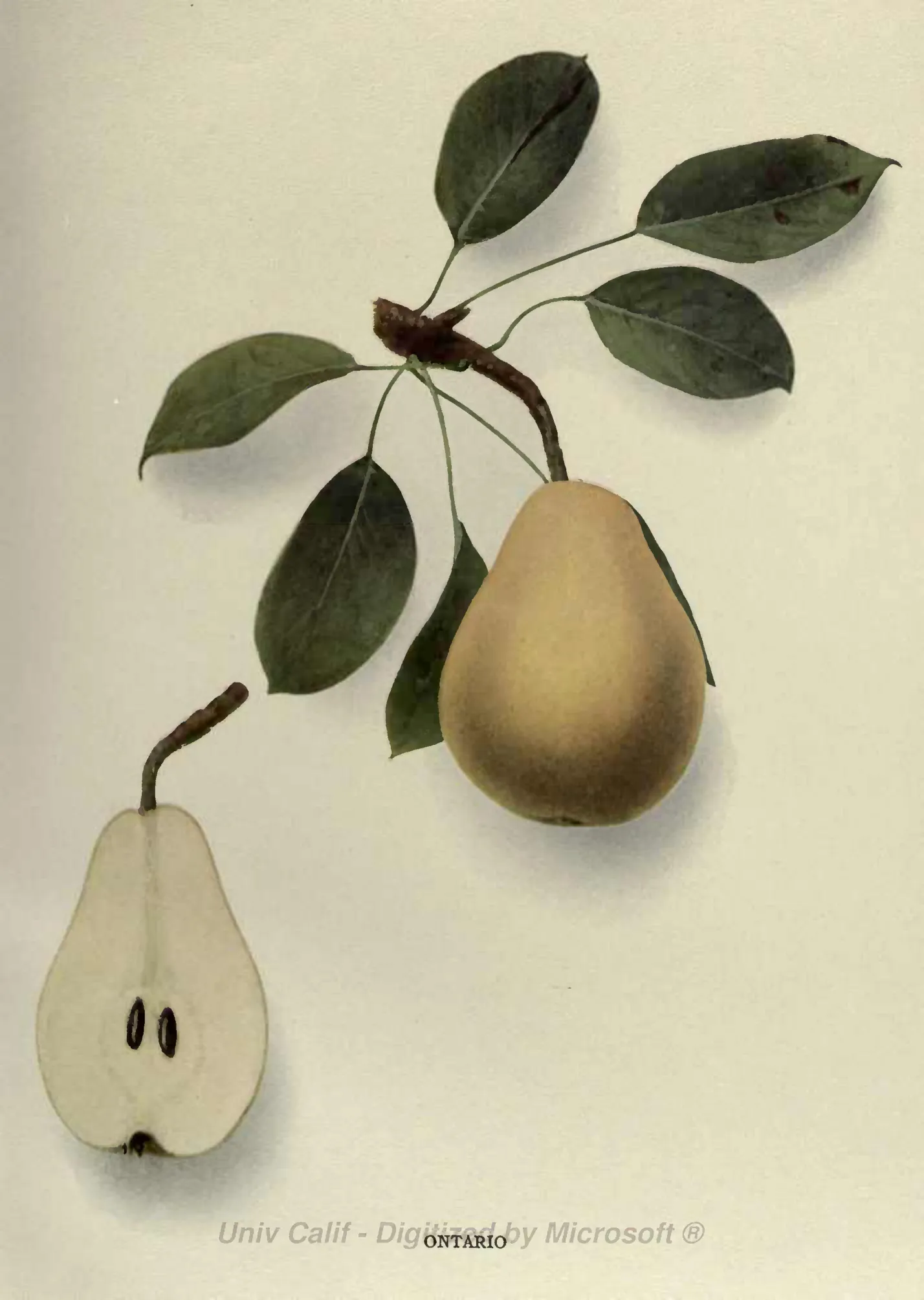
Ontario
Origin / History
Ontario was raised from seed of Canandaigua in the nurseries of W. and T. Smith, Geneva, Ontario County, New York. It was first introduced at the meeting of the American Pomological Society at Rochester, New York, in 1856. Hedrick writes that it was introduced "nearly seventy years ago" with the expectation that the crop would follow that of Bartlett and be in as great demand. The variety did not come up to expectations, but it "seems to have been too good to discard," and in Hedrick's time it was to be found in many collections in New York. He judges that it fails chiefly in the small size of its fruits.
Tree
Vigorous and productive. Hedrick describes the tree as large, upright, open-topped, and hardy; trunk stocky. Branches thick, roughish, dull reddish-brown, overspread with dark ash-gray scarf-skin, marked by small lenticels. Branchlets thick, very short, with short internodes, light brown mingled with green, smooth, glabrous, with small, raised, conspicuous lenticels. Young wood light yellow, with a shade of red next the buds (Downing); shoots yellowish-red, rather erect (Thomas).
Leaf-buds small, short, pointed, free. Leaves 2 in. long and 1½ in. wide (1¾ in. in Hedrick's Cyclopedia). They are oval, thin, leathery, and slightly curled under along the margins; apex abruptly pointed; margin glandular toward the apex, very finely serrate. Petiole 1½ in. long (1¾ in. in the Cyclopedia). Flower-buds small, short, conical or pointed, plump, free, borne singly or in small clusters on short branches or very short spurs. Flowers 1⅛ in. across (1⅜ in. in the Cyclopedia), in a scattering raceme, 8 to 10 buds in a cluster; pedicels 1½ in. long, slender, pubescent, light green. Hedrick calls the trees "very satisfactory."
Fruit
Size: Medium to rather large, the upper end from Thomas. The fruit measures 2¼ in. long by 1⅞ in. wide (1¾ in. wide in the Cyclopedia) and is uniform in size. Hedrick calls the fruits smaller than Bartlett. He adds that they are not as small as the rather poor specimens in his plate, which were grown on the grounds of his Station, where the pears run below the average.
Form: Oblong-pyriform, oblong ovate pyriform, or elongated obtuse pyriform, of the Bartlett type. Thomas calls it somewhat Bartlett-shaped but more obovate, and sometimes faintly ribbed. Somewhat irregular, with sides usually unequal, yet uniform in shape from fruit to fruit.
Stem: Long and curved, inserted by a fleshy ring or lip. It measures ¾ in. long and thick (Hedrick) to an inch long (Thomas).
Cavity: Small, irregular, shallow, narrow, obtuse, often russeted and lipped (Downing, Thomas, Hedrick). Elliott's text, credited to Downing, describes "a rather large depression."
Calyx: Open or partly closed, with long, recurved segments; lobes separated at the base, narrow, acute. Calyx-tube short, wide, conical (Hedrick).
Basin: Shallow to medium, obtuse, irregular, wrinkled or corrugated, gently furrowed, sometimes compressed.
Skin: Smooth, dull, pale yellow, slightly netted with russet, with small patches and streaks of light-colored russet. Hedrick says the fruits usually lack the blush found on Bartlett.
Dots: Numerous, thickly set, minute, gray, brown, green, or russet, obscure.
Flesh and flavor: Flesh white or whitish, slightly veined with yellow, with a yellow tinge at the core. Granular or slightly granulous, firm but tender, juicy, buttery, melting or almost melting. Flavor sweet, mild, pleasant, agreeable, slightly aromatic. Downing rates it "Good to very good"; Hedrick rates its quality "good."
Core and seeds: Core closed, with clasping core-lines. Seeds large, wide, long, plump, acute.
Season
Middle of September to the first of October, centering on the last of September. Hedrick begins the season at the middle of the month; Thomas places it at the first of October.
Uses
Elliott says it is "said to be a valuable market variety."
Subtypes / Variants
Not described in source.
Other
Hedrick lists these early published accounts: the American Pomological Society Report (1856, figured); Downing's Fruits and Fruit Trees of America (1857, 1869); the Horticulturist (1857, figured; 1868, figured); the Magazine of Horticulture (1857, figured); Mas's Le Verger (1866–73, figured); Thomas's American Fruit Culturist (1897, figured). The 1903 edition of Thomas illustrates the variety at Fig. 705.
Book Sources
Described in 5 period pomological works
View original book sources (5)
— F.R. Elliott, The Western Fruit Book (1865)Ontario.
Origin, Geneva, Ontario County, N. Y. Tree vigorous and productive, said to be a valuable market variety.
Fruit, medium, elongated obtuse pyriform, somewhat irregular ; skin, pale yellow, thickly covered with gray or green dots ; stalk, long, curved, inserted by a fleshy ring in a rather large depression ; calyx, partially closed, or open in a shallow, irregular, corrugated basin ; flesh, white, granular, juicy, almost melting, with a sweet pleasant flavor. Ripens last of September. (Downing.)
— A.J. Downing, The Fruits and Fruit Trees of America (1900)Ontario.
Origin, Geneva, Ontario Co., N. Y. Tree vigorous and productive. Young wood light yellow, a shade of red next the buds.
Fruit medium, oblong ovate pyriform, pale yellow, thickly dotted with minute brown and green dots, and slightly netted with russet. Stalk long, inserted in a small cavity, with a ring or lip. Calyx open, with long recurved segments. Flesh whitish, slightly veined with yellow, melting, juicy, buttery, slightly granulous, sweet. Good to very good. Last September.
— John J. Thomas, The American Fruit Culturist (1903)Ontario. Medium or rather large, oblong-pyriform (somewhat Bartlett-shaped, but more obovate), sometimes faintly ribbed, somewhat irregular; pale yellow, thickly dotted; stalk an inch long; cavity small, irregular; calyx open or partly closed; basin wrinkled; flesh buttery, melting, with a mild, pleasant, agreeable flavor. First of October. Shoots yellowish-red, rather erect. Geneva, N. Y. Fig. 705.
— U.P. Hedrick, The Pears of New York (1921)ONTARIO
- Am. Pom. Soc. Rpt. 200, fig. 1856. 2. Downing Fr. Trees Am. 529. 1857. 3. Horticulturist N. S. 7:112, fig. 1857. 4. Mag. Hort. 23:110, fig. 3. 1857. 5. Mas Le Verger 3: Pt. 2, 85, fig. 139. 1866-73. 6. Horticulturist 23:331, fig. 102. 1868. 7. Downing Fr. Trees Am. 824. 1869. 8. Thomas Am. Fruit Cult. 463, fig. 672. 1897.
This variety was introduced nearly seventy years ago with the expectation that the crop would follow that of Bartlett and be in as great demand. While the variety did not come up to expectations, it seems to have been too good to discard, and is to be found in many collections in New York. The fruits are of the type of Bartlett, but are smaller and usually lack the blush found on the fruits of Bartlett. The trees are very satisfactory. The variety fails chiefly in the small size of the fruits, although these are not as small as the rather poor specimens illustrated in the accompanying plate, which were grown on the grounds of this Station where the pears run below the average.
This variety was raised from seed of Canandaigua in the nurseries of W. and T. Smith, Geneva, Ontario County, New York, and was first introduced at the meeting of the American Pomological Society, Rochester, New York, in 1856.
Tree large, vigorous, upright, open-topped, hardy, productive; trunk stocky; branches thick, roughish, dull reddish-brown, overspread with dark ash-gray scarf-skin, marked by small lenticels; branchlets thick, very short, with short internodes, light brown mingled with green, smooth, glabrous, with small, raised, conspicuous lenticels.
Leaf-buds small, short, pointed, free. Leaves 2 in. long, 1½ in. wide, oval, thin, leathery, slightly curled under along the margins; apex abruptly pointed; margin glandular toward the apex, very finely serrate; petiole 1½ in. long. Flower-buds small, short, conical or pointed, plump, free, singly or in small clusters on short branches or very short spurs; flowers 1⅛ in. across, in a scattering raceme, from 8 to 10 buds in a cluster; pedicels 1½ in. long, slender, pubescent, light green.
Fruit in season from the middle to the last of September; medium in size, 2¼ in. long, 1⅞ in. wide, uniform in size and shape, oblong-pyriform, with sides usually unequal; stem ¾ in. long, thick; cavity obtuse, shallow, narrow, often russeted and lipped; calyx open; lobes separated at the base, narrow, acute; basin shallow to medium, obtuse, gently furrowed, sometimes compressed; skin smooth, dull; color pale yellow, with small patches and streaks of light-colored russet; dots numerous, very small, russet, obscure; flesh whitish, with a yellow tinge at the core, granular, firm but tender, juicy, sweet, slightly aromatic; quality good. Core closed, with clasping core-lines; calyx-tube short, wide, conical; seeds large, wide, long, plump, acute.
— U.P. Hedrick, Cyclopedia of Hardy Fruits (1922)ONTARIO. Ontario was introduced nearly seventy years ago with the expectation that the crop would follow that of Bartlett and be in as great demand. While the variety has not come up to expectations, it is too good to discard. The fruits are of the type of Bartlett, but are smaller and usually lack the blush. The trees are very satisfactory. The variety fails chiefly in the small size of the fruits. Ontario was raised from seed in the nurseries of W. & T. Smith, Geneva, New York.
Tree large, vigorous, upright, open-topped, hardy, productive; trunk stocky; branches thick, roughish, dull reddish-brown, marked by small lenticels. Leaves 2 inches long, 1¾ inches wide, oval, thin, leathery; apex abruptly pointed; margin glandular toward the apex, very finely serrate; petiole 1¾ inches long. Flowers 1⅜ inches across, in a scattering raceme, from 8 to 10 buds in a cluster. Fruit in season from the middle to the last of September; medium in size, 2¼ inches long, 1¾ inches wide, uniform in size and shape, oblong-pyriform, with sides usually unequal; stem ¾ inch long, thick; cavity obtuse, shallow, narrow, often russeted and lipped; calyx open; lobes separated at the base, narrow, acute; basin shallow to medium, obtuse, gently furrowed, sometimes compressed; skin smooth, dull; color pale yellow with small patches and streaks of light colored russet; dots numerous, very small, russet, obscure; flesh whitish, with a yellow tinge at the core, granular, firm but tender, juicy, sweet, slightly aromatic; quality good; core closed, with clasping core-lines; calyx-tube short, wide, conical; seeds large, wide, long, plump, acute.