Winter Bartlett
Pear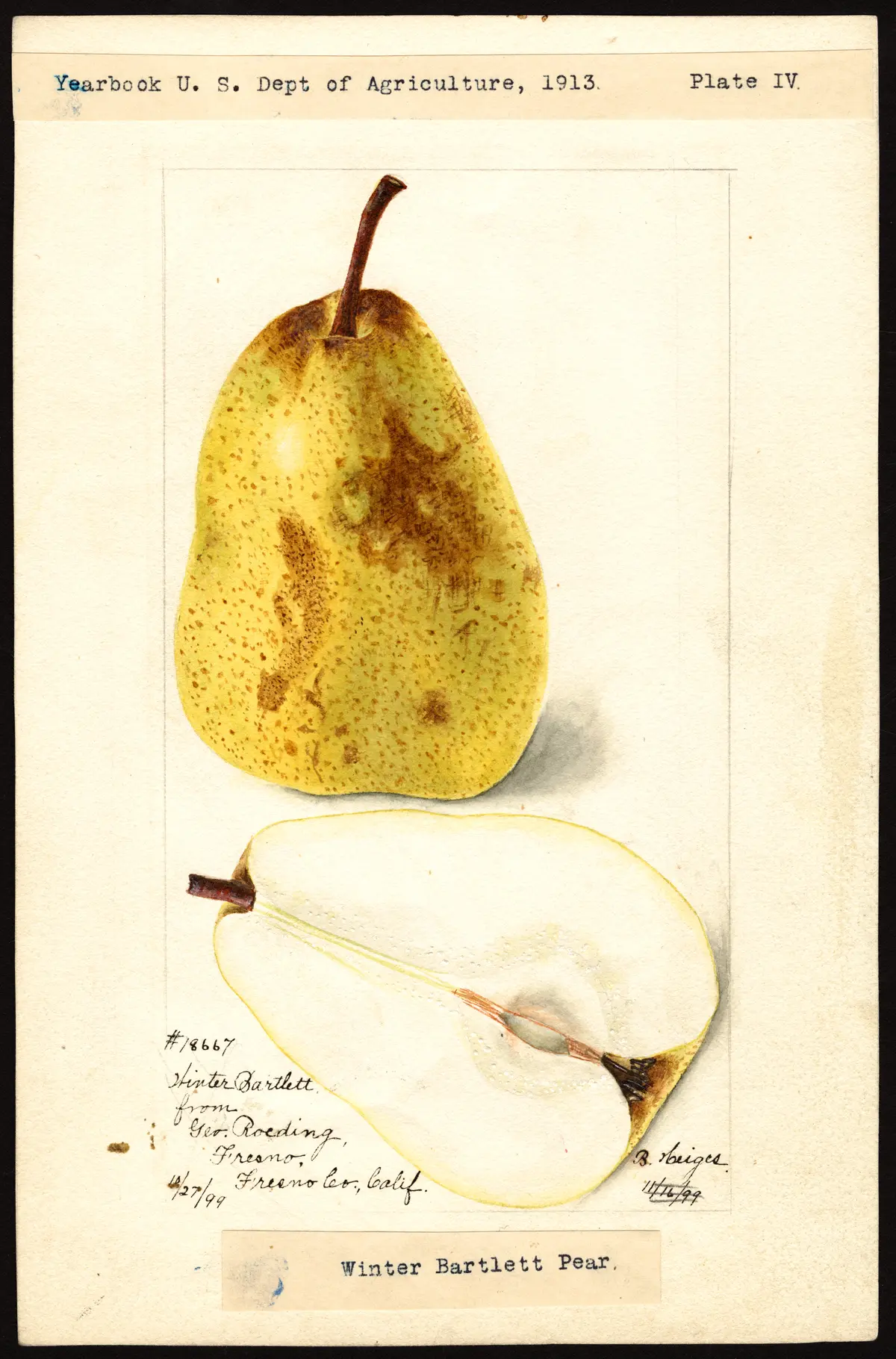
USDA Pomological Watercolor Collection
Winter Bartlett
Origin / History
Winter Bartlett seems to have originated at Eugene, Oregon, some time prior to 1880, and to have been introduced by D. W. Coolidge of Eugene, although it must have been grown to some extent before Mr. Coolidge brought it to the front. Because of its resemblance to Bartlett it is assumed to be a seedling of that variety. The American Pomological Society added it to its catalog of fruits in 1909.
Heralded from the Pacific Coast as a winter variety bearing fruits similar to those of Bartlett. As the fruits grow in New York there is a suggestion of Bartlett in shape, color, and flavor, but in size, as the color-plate shows, the newcomer falls far short of the older pear. Hedrick finds that, as the variety grows in the East, "the name is a misnomer, several other sorts being more like Bartlett than this one." Since it has no outstanding characters to make it notable, and its season falls when a half-dozen other good pears are available, Hedrick thinks it doubtful that it will outlive a brief period of probation in eastern orchards; he judges it worth trying in a small way in New York.
Tree
Tree large, vigorous, upright, scraggly, open-topped, hardy, productive. Branches stocky, smooth, light-brown overlaid with gray scarf-skin, with few lenticels. Branchlets thick, curved, long, with long internodes, brownish-red, streaked with gray scarf-skin, glossy, smooth, glabrous, sprinkled with conspicuous, raised lenticels.
Leaf-buds large, long, conical, pointed, plump, free; leaf-scars with very prominent shoulders. Leaves 3½ in. long, 1¾ in. wide, stiff; apex taper-pointed; margin finely serrate; petiole 2¼ in. long. Flower-buds conical, plump, free, borne singly on spurs variable in length. Flowers very late, 1⅜ in. across, in dense clusters averaging 5 buds to a cluster; pedicels 1 in. long, thick, thinly pubescent. The Cyclopedia gives leaves 3¼ in. long and flowers 1¾ in. across.
The westerners say the tree is very resistant to blight, a statement neither proved nor disproved in the East as yet.
Fruit
Size: Large, 3 in. long, 2⅜ in. wide (2¾ in. wide in the Cyclopedia). In size falls far short of Bartlett as grown in New York.
Form: Oblong-obovate-pyriform.
Stem: 1 in. long, thick, curved.
Cavity: Narrow, shallow, smooth, oblique.
Calyx: Small, nearly closed; lobes short; calyx-tube short, wide.
Basin: Small, shallow, irregular.
Skin: Uneven in surface. Color yellow ("attractive yellow" in the Cyclopedia), splashed with russet and often blushed on the exposed cheek with bright red.
Dots: Numerous, small, brownish-russet.
Flesh and flavor: Yellowish-white, fine-grained, tender, juicy, sweet, pleasant-flavored; a suggestion of Bartlett in flavor. Quality good to very good.
Core and seeds: Core small, nearly closed, with meeting core-lines. Seeds large, long, plump, obtuse.
Season
Ripe in December and January, a time when there are a half-dozen other good pears.
Uses
Not described in source.
Subtypes / Variants
Not described in source.
Other
References cited: Ore. Bd. Hort. Rpt. 42, 1895; Ore. Nur. Cat. 19, 1903; Cal. Com. Hort. Pear Grow. Cal. 7: No. 5, 278, fig. 94, 1918.
Book Sources
Described in 2 period pomological works
Nursery Catalog Sources
Found in 28 catalogs (1900–1926) from Missouri, Oregon, Washington
- Central Experimental Farm , Dominion Department of Agriculture, Agassiz, British Columbia (under test; Bulletin No. 3, Second Series) — 1900
- Washington Nursery Co. , Toppenish , Washington — 1901
- Russellville Nursery Co. , Russellville, OR (three miles east of Portland, one mile from Montavilla car line) — 1903
- The Dalles Nurseries , The Dalles , Oregon — 1906
- Stark Bros. Nurseries & Orchards Co. , Louisiana , Missouri — 1906
- Russellville Nursery Co. , Montavilla Station, Portland, OR (three miles east of Portland, one mile from Montavilla car line) — 1907
- Carlton Nursery Co. , Carlton , Oregon — 1909
- Milton Nursery Co. (A. Miller & Sons , Proprietors), Milton , Oregon — 1909
- Washington Nursery Company , Toppenish , Washington — 1909
- Island Nurseries & Fruit Farm , Vashon (Vashon Island) , Washington — 1910
- Stark Bros. Nurseries & Orchards Co. , Louisiana , Missouri — 1910
- Island Nurseries & Fruit Farm , Vashon (Vashon Island) , Washington — 1911
- Stark Bros. Nurseries & Orchards Co. , Louisiana , Missouri — 1911
- Pacific Nursery Company , Portland , Oregon — 1912
- Vineland Nurseries Company , Clarkston , Washington — 1912
- Washington Nursery Company , Toppenish , Washington — 1912
- Stark Bros. Nurseries & Orchards Co. , Louisiana , Missouri — 1912
- Van Holderbeke Nursery Co. , Incorporated, Spokane, Washington (nurseries at Otis Orchards WA, Pasadena WA, Kennewick WA) — 1913
- Island Nurseries & Fruit Farm , Vashon (Vashon Island) , Washington — 1914
- Island Nurseries & Fruit Farm , Vashon (Vashon Island) , Washington — 1915
- Ornamental & Fruit Nursery Company , Wapato, County of Yakima , Washington — 1915
- Island Nurseries & Fruit Farm , Vashon (Vashon Island) , Washington — 1916
- Island Nurseries & Fruit Farm , Vashon (Vashon Island) , Washington — 1917
- Oregon Nursery Co. , Orenco , Oregon — 1920
- Columbia & Okanogan Nursery Co. , Wenatchee , Washington — 1925
- Hudson's Wholesale Nurseries , Tangent , Oregon — 1926
- North-Western Nurseries , Walla Walla , Washington
- Washington Nursery Company , Toppenish, Washington (on Yakima Indian Reservation) - [undated; companion to the 1912 "Sixth Edition" descriptive catalogue; same cover design and incorporated 1903 date; dated as c.1912]
View original book sources (2)
— U.P. Hedrick, The Pears of New York (1921)WINTER BARTLETT
- Ore. Bd. Hort. Rpt. 42. 1895. 2. Ore. Nur. Cat. 19. 1903. 3. Am. Pom. Soc. Cat. 41. 1909. 4. Cal. Com. Hort. Pear Grow. Cal. 7: No. 5, 278, fig. 94. 1918.
Winter Bartlett is heralded from the Pacific Coast as a winter variety bearing fruits similar to those of Bartlett. As the fruits grow in New York there is a suggestion of Bartlett in the shape, color, and flavor of the fruits, but in size, as the color-plate shows, the newcomer falls far short of the older pear. The season is December and January, a time when there are a half-dozen other good pears, and since this one has no outstanding characters to make it notable, it is doubtful if it will outlive a brief period of probation in eastern orchards. The westerners say that the tree is very resistant to blight, a statement neither proved nor disproved in the East as yet. The variety is worth trying in a small way in New York.
This pear seems to have originated at Eugene, Oregon, some time prior to 1880, and to have been introduced by D. W. Coolidge of Eugene, although it must have been grown to some extent before Mr. Coolidge brought it to the front. Because of its resemblance to Bartlett, it is assumed that it is a seedling of that variety. The American Pomological Society added Winter Bartlett to its catalog of fruits in 1909.
Tree large, vigorous, upright, scraggly, open-topped, hardy, productive; branches stocky, smooth, light-brown overlaid with gray scarf-skin, with few lenticels; branchlets thick, curved, long, with long internodes, brownish-red, streaked with gray scarf-skin, glossy, smooth, glabrous, sprinkled with conspicuous, raised lenticels.
Leaf-buds large, long, conical, pointed, plump, free; leaf-scars with very prominent shoulders. Leaves 3½ in. long, 1¾ in. wide, stiff; apex taper-pointed; margin finely serrate; petiole 2¼ in. long. Flower-buds conical, plump, free, singly on spurs variable in length; flowers very late, 1⅜ in. across, in dense clusters, average 5 buds in a cluster; pedicels 1 in. long, thick, thinly pubescent.
Fruit ripe in December and January; large, 3 in. long, 2⅜ in. wide, oblong-obovate-pyriform; stem 1 in. long, thick, curved; cavity narrow, shallow, smooth, oblique; calyx small, nearly closed; lobes short; basin small, shallow, irregular; skin uneven in surface; color yellow, splashed with russet and often blushed on the exposed cheek with bright red; dots numerous, small, brownish-russet; flesh yellowish-white, fine-grained, tender, juicy, sweet, pleasant-flavored; quality good to very good. Core small, nearly closed, with meeting core-lines; calyx-tube short, wide; seeds large, long, plump, obtuse.
— U.P. Hedrick, Cyclopedia of Hardy Fruits (1922)WINTER BARTLETT. Winter Bartlett is heralded from the Pacific Coast as a winter variety bearing fruits similar to those of Bartlett. As the fruits grow in New York, there is a suggestion of Bartlett in the shape, color and flavor, but in size they fall far short. As the variety grows in the East, the name is a misnomer, several other sorts being more like Bartlett than this one. The season is December and January, a time when there are a half-dozen other good pears, and since this one has no outstanding characters, it is doubtful if it will outlive a brief period of probation in eastern orchards. The westerners say that the tree is very resistant to blight. This pear originated at Eugene, Oregon, some time prior to 1880. Tree large, vigorous, upright, scraggly, open-topped, hardy, productive; branches stocky, smooth, light-brown, with few lenticels. Leaves 3¼ inches long, 1¾ inches wide, stiff; apex taper-pointed; margin finely serrate; petiole 2¼ inches long. Flowers 1¾ inches across, in dense clusters, average buds in a cluster. Fruit ripe in December and January; large, inches long, 2¾ inches wide, oblong-obovate-pyriform; stem inch long, thick, curved; cavity narrow, shallow, smooth, oblique; calyx small, nearly closed; lobes short; basin small, shallow, irregular; skin uneven in surface; color attractive yellow, splashed with russet and often blushed on the exposed cheek with bright red; dots numerous, small, brownish-russet; flesh yellowish-white, fine-grained; seeds long, plump, obtuse.