Onondaga
Pear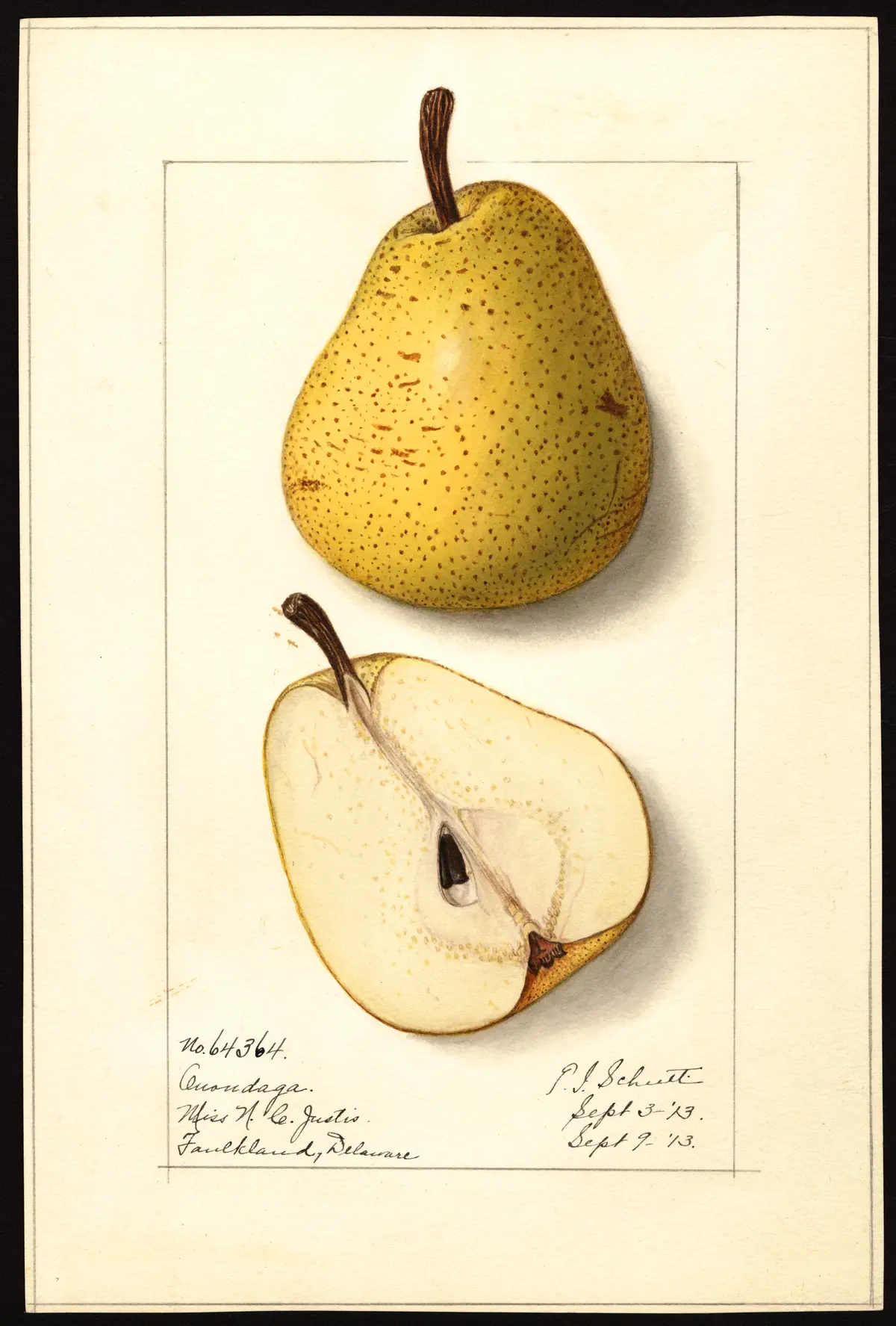
USDA Pomological Watercolor Collection
Onondaga
Origin / History
Onondaga is of Connecticut origin, from Farmington. Elliott calls it "probably a native of Farmington Ct." and Downing says it is "supposed to have originated" there. Hedrick, in his Cyclopedia (1922), says it originated with a Mr. Curtiss of Farmington about 1790. In The Pears of New York (1921), however, he finds it "impossible to trace this variety to its ultimate source." He records that Henry Case of Liverpool, New York, cut a graft during the winter of 1806 from a tree growing on the land of a Mr. Curtiss at Farmington. In the spring of the same year Case grafted the cion into a tree about three miles west of Onondaga Hill, New York. In 1808 he moved the tree to Liverpool, where it grew and bore fruit, and many grafts were taken from it before it died in 1823. Up to that time the variety "appears to have received no name nor had it been generally disseminated."
Nothing further is heard of it until about 1840. In that year a Mr. Swan of Onondaga Hollow brought it to notice by exhibiting specimens in Rochester. Ellwanger and Barry were so impressed with the fruit that they secured cions and propagated it under the name Swan's Orange, later changing the name to Onondaga. Elliott says the variety takes its name from having been first brought to notice by cultivators in Onondaga County, New York.
Onondaga is figured in the Horticulturist of 1846–47. It appears as Swan's Orange in the Magazine of Horticulture in 1847 and in Hovey's Fruits of America in 1851. Onondaga was given a place in the American Pomological Society's fruit-catalog in 1858.
Hedrick (1921) writes that some seventy or eighty years before, the pear was widely introduced under the names Onondaga and Swan's Orange, and "for a generation and more was much grown in eastern pear regions." By his day it had "practically passed from cultivation in commercial orchards," though it was still to be found in collections and home plantings.
Tree
Vigorous; very vigorous by Downing. Medium in size, spreading, open-topped (Hedrick). Shoots strong, upright or ascending. Productive; very productive by Hedrick, who calls the trees vigorous, hardy, and fruitful, "almost ideal in every character but one." That one character is blight: the tree is so susceptible to it that Hedrick judges the variety unfit for commercial orchards. Elliott says it does not succeed in all locations.
Young wood olive-colored (Elliott), olive brown (Downing), or yellow (Thomas). Branches zigzag, reddish brown, overspread with thin gray scarf-skin, marked with many large lenticels. Branchlets slender, short, light brown tinged with green, lightly streaked with ash-gray scarf-skin, dull, smooth. New growth slightly pubescent, with small, raised, pinkish lenticels.
Leaf-buds small, short, sharply pointed, plump, free. Leaves 3½ inches long, 1¼ inches wide, narrow, oval, stiff, leathery. Hedrick's 1922 text adds "inclining to lanceolate." Apex taper-pointed. Margin coarsely but shallowly serrate, tipped with many reddish glands. Petiole 1½ inches long, or 1⅝ inches in the 1922 text, light green mingled with red. Stipules often lacking, but when present very small and pale green.
Flower-buds small, short, conical, plump, free, borne singly on very short spurs. Blossoms 1½ inches across, or 1⅜ inches in the 1922 text, in dense clusters of 7 to 8 buds, or 7 to 9 in the 1922 text. Pedicels pubescent, greenish.
Fruit
Size: Above medium to very large. Most authors give large; Thomas calls it quite large, and Budd and Hansen large to very large. Hedrick gives above medium to large, measuring 2¾ inches long by 2½ inches wide, or 2⅞ by 2⅝ inches in his 1922 text.
Form: Ovate-obovate, obtusely pyriform. Hedrick gives ovate or obovate-obtuse-pyriform, and Budd and Hansen obovate and usually oblate pyriform. Hedrick adds that the fruit is symmetrical, with unequal sides. Thomas calls it obtuse oval-pyriform, "nearly in the form of a double cone," with the neck very short and obtuse and the body large, tapering to an obtuse apex.
Stem: Stout or thick, inclined, often curved. An inch to an inch and a half long; Downing calls it of medium length, and Hedrick alone gives ¾ inch.
Cavity: Small and slight, the stem slightly sunk. Elliott alone has the stem inserted without depression. He describes the lip of the fruit folded unevenly around it; Budd and Hansen place lips at one side of the stem, and Hedrick a fleshy enlargement at one side.
Calyx: Small or rather small, closed; firmly closed by Downing. Lobes narrow, acute; calyx-tube long, conical (Hedrick).
Basin: Narrow, somewhat uneven to uneven, furrowed, ribbed, or plaited. Elliott and Budd and Hansen call it shallow, and Hedrick obtuse. Elliott describes it as abrupt and marked with patches of cinnamon russet.
Skin: Somewhat coarse and uneven (Downing) or roughish (Thomas); Hedrick calls it granular, tender, smooth, and dull. Pale greenish yellow to greenish yellow, becoming golden or fine rich yellow at maturity. Hedrick gives pale yellow, and "rich, pale yellow" in 1922. Generally with some traces of russet (Downing); a few lines of russet and many russet spots (Hedrick); crown often slightly russeted (Thomas). A dull blush or sunny cheek occasionally or sometimes appears on the exposed side; Thomas gives "often a slight brown cheek." Hedrick calls the fruit handsome.
Dots: Many, numerous, small, gray russet, conspicuous. Downing describes the skin as thickly covered with them.
Flesh and flavor: White to whitish, yellowish by Hedrick. Buttery, melting, juicy, "abounding in juice" (Downing), very juicy by Hedrick. Slightly granular; Hedrick says granular both near the skin and at the center. Thomas calls it slightly coarse and "sometimes a little breaking." Rich and vinous; Downing says "when in perfection with a fine, rich, vinous flavor." Hedrick adds aromatic and sweet, and says the fruit resembles Bartlett in flavor and has even better flesh-characters. Thomas calls it "rich, fine, but not of the highest quality, sometimes astringent."
Quality "good to very good" (Downing; Budd and Hansen), "very good" by Hedrick. Elliott calls it variable in quality, and Downing calls it "a variable fruit."
Core and seeds: Core compact (Elliott); large, closed, with clasping core-lines (Hedrick). Seeds small (Elliott); narrow, long, acute (Hedrick).
Season
Autumn, September to November. Most authors place it in mid-autumn, October into November. Hedrick gives ripe in early October, and Downing begins the season in September.
Uses
A dessert and market pear. Downing calls it "a profitable market variety," and Budd and Hansen "a valuable market and dessert variety in several States." Hedrick says that because of blight the variety "can never have commercial value in American orchards." He adds that whether it is worth planting in home orchards "depends upon the planter's willingness to suffer loss from blight."
Subtypes / Variants
Not described in source.
Other
Thomas figures the fruit in his Figs. 654 and 703. Hedrick also cites Mas, Le Verger (1866–73); Downing, Fruits and Fruit Trees of America (1869); Leroy, Dict. Pom. (1869); Guide Prat. (1876); and Hogg, Fruit Manual (1884).
Book Sources
Described in 6 period pomological works
Nursery Catalog Sources
Found in 19 catalogs (1864–1904) from Alabama, California, Illinois, Oregon, Washington
- St. Helena Nursery , Howell Prairie, Marion County, OR (Marion Co., Ogn.) — 1864
- Felix Gillet , Barren Hill Nursery, Nevada City , California — 1884
- Huntsville Wholesale Nurseries (Jessie S. Moss , Proprietor; W.F. Heikes, Manager), Huntsville , Alabama — 1886
- Felix Gillet , Barren Hill Nursery, Nevada City , California — 1888
- Felix Gillet , Barren Hill Nursery, Nevada City , California — 1889
- California Nursery Co. , Niles , California — 1889
- Felix Gillet , Barren Hill Nursery, Nevada City , California — 1890
- Felix Gillet , Barren Hill Nursery, Nevada City , California — 1891
- Puyallup & Yakima Nurseries , Puyallup, Washington (Lock Box 191) and North Yakima , Washington — 1892
- Sherwood Hall Nursery Co. , Timothy Hopkins (Menlo Park Nurseries), San Francisco / Menlo Park , California — 1893
- The Vineland Nurseries (Kelsey & Co. , Proprietors), St. Joseph, Missouri (Office: 13th and Atchison Sts., 2 Blocks East of the Citizens St. Car Line) — 1894
- Woodburn Nurseries , Woodburn, Marion Co. , Oregon — 1894
- Felix Gillet , Barren Hill Nursery, Nevada City , California — 1895
- Felix Gillet , Barren Hill Nursery, Nevada City , California — 1897
- Alabama Nursery Co. , Huntsville , Alabama — 1900
- Central Experimental Farm , Dominion Department of Agriculture, Agassiz, British Columbia (under test; Bulletin No. 3, Second Series) — 1900
- The Dalles Nurseries , The Dalles , Oregon — 1901
- Benjamin Buckman (personal inventory) , Farmingdale , Illinois — 1901
- Phoenix Nursery Company (W. E. Rossney , President; Sidney Tuttle, Vice-President), Bloomington , Illinois — 1904
View original book sources (6)
— F.R. Elliott, The Western Fruit Book (1865)Onondaga.
Swan's Orange, | Onondaga Seedling.
Probably a native of Farmington Ct. It takes its name from having been first brought to notice by cultivators in Onandaga Co. N. Y. Tree vigorous, with strong, upright, olive-colored shoots. In quality it is variable, not succeeding in all locations.
Fruit, large, ovate obovate ; color, pale greenish yellow, becoming golden yellow at maturity, many gray russet dots, and occasionally a dull blush in sun ; stem, one to one and a half inch long, inserted without depression, but with lip of fruit folded unevenly around it ; calyx, rather small, closed ; basin, shallow, abrupt and marked with patches of cinnamon russet, core, compact ; seeds, small ; flesh, white, juicy, buttery. October and November.
— A.J. Downing, The Fruits and Fruit Trees of America (1900)Onondaga.
Swan's Orange. Kilmer.
Supposed to have originated in Farmington, Conn. Tree very vigorous and productive. Young wood olive brown. A profitable market variety.
Fruit large, ovate obovate obtusely pyriform. Skin somewhat coarse and uneven, thickly covered with russet dots, fine rich yellow at maturity, generally with some traces of russet, and sometimes with a sunny cheek. Stalk rather stout, of medium length, inserted in a small cavity, at an inclination. Calyx small, firmly closed, set in a narrow, somewhat uneven basin. Flesh buttery, melting, abounding in juice, slightly granular, and when in perfection with a fine, rich, vinous flavor. A variable fruit. Good to very good. September to November.
— John J. Thomas, The American Fruit Culturist (1903)Onondaga.* (Swan's Orange.) Quite large, obtuse oval-pyriform, nearly in the form of a double cone, neck very short and obtuse, body large and tapering to obtuse apex; skin roughish, greenish-yellow, becoming rich yellow, dots numerous, often a slight brown cheek, crown often slightly russeted; stalk an inch to an inch and a half long, stout, slightly sunk; calyx small, closed, basin narrow, ribbed; flesh slightly coarse, buttery, melting, sometimes a little breaking, juicy, rich, fine, but not of the highest quality, sometimes astringent. Ripens mid-autumn. Growth vigorous, shoots yellow, ascending. Productive. Connecticut. Figs. 654 and 703.
— J.L. Budd & N.E. Hansen, American Horticultural Manual, Part II: Systematic Pomology (1914)Onondaga (Swan's Orange). — Large to very large, obovate and usually oblate pyriform; color rich yellow when ripe, with russet dots; stalk one inch long, stout, inclined, often curved, and inserted in slight cavity with lips at one side; basin narrow, plaited, shallow. Flesh whitish, juicy, buttery, melting, slightly granular, quality good to very good. Season, autumn. A valuable market and dessert variety in several States. Connecticut.
— U.P. Hedrick, The Pears of New York (1921)ONONDAGA
- Horticulturist 1:322, fig. 77. 1846-47. 2. Am. Pom. Soc. Rpt. 231. 1858. 3. Mas Le Verger 3: Pt. 1, 179, fig. 88. 1866-73. 4. Downing Fr. Trees Am. 823, fig. 1869. 5. Leroy Dict. Pom. 4:480, fig. 1869. 6. Guide Prat. 74, 292. 1876. 7. Hogg Fruit Man. 625. 1884.
Swan's Orange. 8. Mag. Hort. 13:243, fig. 19. 1847. 9. Hovey Fr. Am. 1:21, Pl. 1851.
Some seventy or eighty years ago this pear was widely introduced under the names Onondaga and Swan's Orange, and for a generation and more was much grown in eastern pear regions. It has now practically passed from cultivation in commercial orchards, but is still to be found in collections and home plantings. The fruits are large, handsome, and of very good quality, resembling those of Bartlett in flavor and with even better flesh-characters. The trees are vigorous, hardy, fruitful — almost ideal in every character but one. The tree is so susceptible to blight that the variety can never have commercial value in American orchards. Whether or not it is worth planting in home orchards depends upon the planter's willingness to suffer loss from blight.
It seems impossible to trace this variety to its ultimate source. We know, however, that Henry Case, Liverpool, New York, cut a graft during the winter of 1806 from a tree growing on land of a Mr. Curtiss at Farmington, Connecticut. In the spring of the same year, Mr. Case grafted this cion into a tree about three miles west of Onondaga Hill, New York, and in 1808 moved the tree to Liverpool where it grew and bore fruit. Many grafts were taken from this tree before it died in 1823. Up to this time, the variety appears to have received no name nor had it been generally disseminated. We hear nothing further of it until about 1840 when it was brought to notice by a Mr. Swan of Onondaga Hollow, who exhibited specimens of the variety in Rochester. Ellwanger and Barry were so impressed with the fruit that they secured cions and propagated it under the name Swan's Orange which they changed later to Onondaga. Onondaga was given a place in the American Pomological Society's fruit-catalog in 1858.
Tree medium in size, vigorous, spreading, open-topped, very productive; branches zigzag, reddish-brown, overspread with thin gray scarf-skin, marked with many large lenticels; branchlets slender, short, light brown, tinged with green and lightly streaked with ash-gray scarf-skin, dull, smooth, the new growth slightly pubescent, with small, raised, pinkish lenticels.
Leaf-buds small, short, sharply pointed, plump, free. Leaves 3½ in. long, 1¼ in. wide, narrow, oval, stiff, leathery; apex taper-pointed; margin coarsely but shallowly serrate, tipped with many reddish glands; petiole 1½ in. long, light green mingled with red; stipules often lacking but when present very small, pale green. Flower-buds small, short, conical, plump, free, arranged singly on very short spurs; blossoms 1½ in. across, in dense clusters, 7 to 8 buds in a cluster; pedicels pubescent, greenish.
Fruit ripe in early October; above medium to large, 2¾ in. long, 2½ in. wide, ovate or obovate-obtuse-pyriform, symmetrical, with unequal sides; stem ¾ in. long, thick, curved; cavity a slight depression, with a fleshy enlargement at one side of the stem; calyx closed; lobes narrow, acute; basin narrow, obtuse, furrowed, uneven; skin granular, tender, smooth, dull; color pale yellow, with few lines of russet and with many russet spots; dots numerous, small, russet, conspicuous; flesh yellowish, granular both near the skin and at the center, melting, buttery, very juicy, aromatic, with a sweet, rich, vinous flavor; quality very good. Core large, closed, with clasping core-lines; calyx-tube long, conical; seeds narrow, long, acute.
— U.P. Hedrick, Cyclopedia of Hardy Fruits (1922)ONONDAGA. Swan's Orange. Some seventy or eighty years ago this pear was widely introduced under the names Onondaga and Swan's Orange, and for a generation was much grown in eastern pear regions. It has now practically passed from cultivation in commercial orchards, but is still to be found in collections and home plantings. The fruits are large, handsome, and of very good quality, resembling those of Bartlett in flavor and with even better flesh-characters. The trees are vigorous, hardy, and fruitful, but so susceptible to blight that the variety can never have commercial value in American orchards. Whether or not it is worth planting in home orchards depends on the planter's willingness to suffer loss from blight. The variety originated with a Mr. Curtiss, Farmington, Connecticut, about 1790. Tree medium in size, vigorous, spreading, open-topped, very productive; branches zigzag, reddish-brown, marked with many large lenticels. Leaves 3½ inches long, 1¼ inches wide, narrow, oval inclining to lanceolate, stiff, leathery; apex taper-pointed; margin coarsely but shallowly serrate, tipped with many reddish glands; petiole 1⅝ inches long, light green mingled with red. Blossoms 1⅜ inches across, in dense clusters, 7 to 9 buds in a cluster. Fruit ripe in early October; above medium to large, 2⅞ inches long, 2⅝ inches wide, obovate-obtuse-pyriform, symmetrical, with unequal sides; stem ¾ inch long, thick, curved; cavity a slight depression, with fleshy enlargement at one side of the stem; calyx closed; lobes narrow, acute; basin narrow, obtuse, furrowed, uneven; skin granular, tender, smooth, dull; color rich, pale yellow, with a few lines of russet and with many russet spots; dots numerous, small, russet, conspicuous; flesh yellowish, granular both near the skin and at the center, melting, buttery, very juicy, aromatic, with a sweet, rich, vinous flavor; quality very good; core large, closed, with clasping core-lines; calyx-tube long, conical; seeds narrow, long, acute.