Swan's Orange
Pear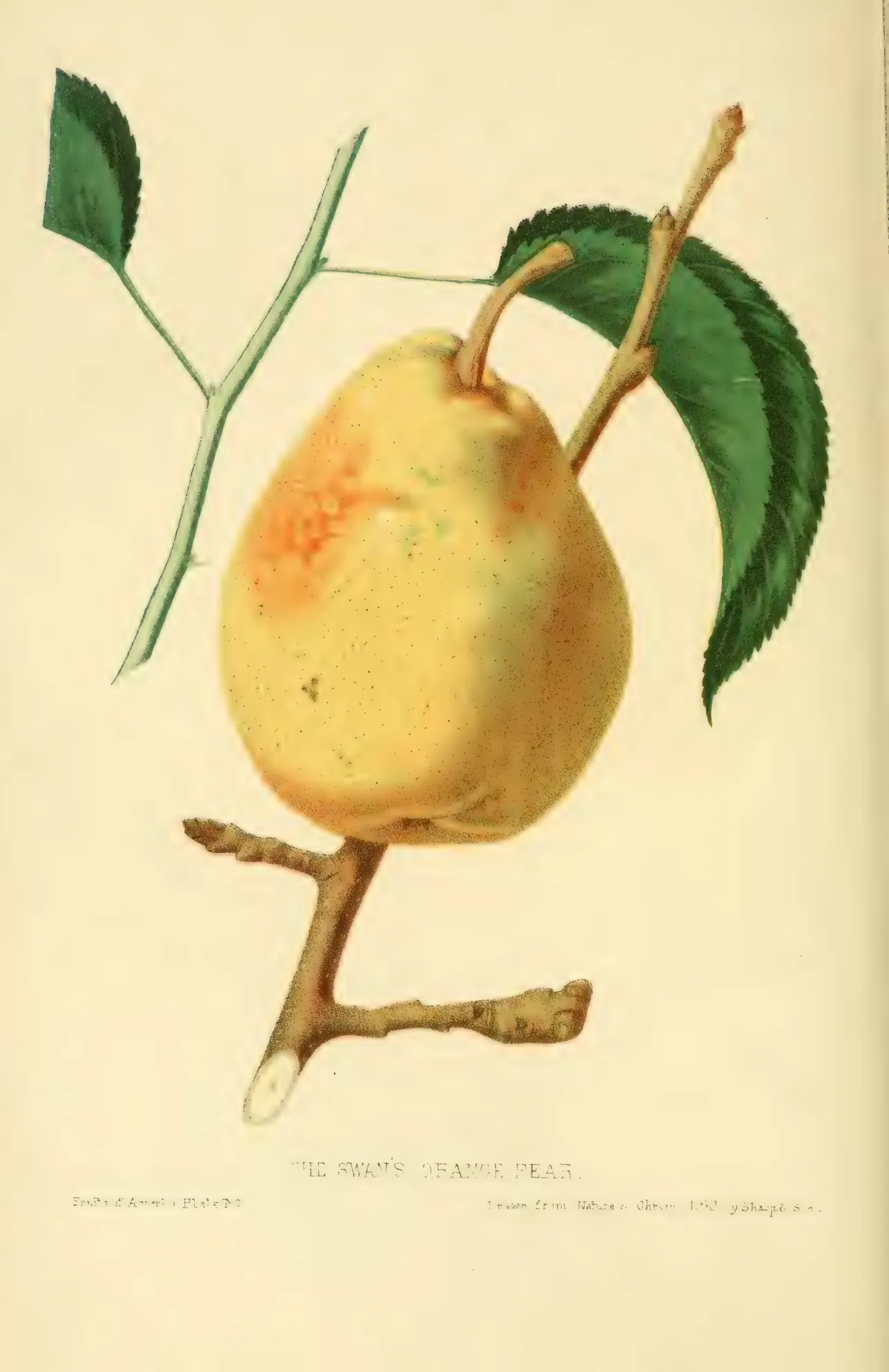
Swan's Orange
Origin / History
No pear of recent introduction can claim so high a rank as the Swan's Orange. Possessing all the hardy and vigorous qualities of the hardiest native varieties, the fruit is not only of the largest size, but unsurpassed in its beauty, and unequalled in excellence. The Van Mons Leon le Clerc has obtained, and justly, a high reputation, and has been designated as the "best pear in the world;" yet Swan's Orange, considered in all its qualities, far surpasses it; and, if that epithet belongs to any variety, it is to the last named pear.
A full account of the fruit appeared in the Magazine of Horticulture (vol. xiii, p. 243), in which its history is traced back to 1806, when scions were carried from Farmington, Conn., by Mr. Henry Case of Onondaga, N.Y. In 1808 Mr. Case removed his tree to Liverpool, where he then resided, and the tree died in 1823. Before its death, however, scions had been distributed, and among those who received them was Dea. Joseph Swan of Onondaga Hollow. About ten years before the time of writing, Mr. Swan's son, who resided in Rochester, carried some of the pears to that city for exhibition. From its great beauty as well as superior quality, the Horticultural Society, in compliment to Mr. Swan, called it Swan's Orange, its origin then being wholly unknown.
Its excellence was not well known around Rochester until within a very few years, and cultivators generally became acquainted with it more recently still. Last autumn, some beautiful specimens were sent from Rochester to the author.
Tree
Very vigorous, upright in its growth, forming a handsome head; on young trees the lateral shoots are horizontal. The whole aspect of the tree denotes vigor and health, and it grows well upon either the pear or quince stock. The tree is figured from a specimen grafted in 1843, now nine feet high and bearing fruit.
Wood clear olive, stout, rather short-jointed, and dotted with large, grayish specks; old wood dark olive. Buds large, long, tapering to the point, diverging, with prominent shoulders. Flower-buds of medium size.
Leaves large, oblong, tapering to the end, thick, deep green, recurved on the midrib, a little wavy, partially folded, with prominent nerves and coarse, rather deep serratures. Petioles of medium length, stout.
Flowers of medium size; petals yellowish white, obovate, flat.
Fruit
Size: Large, about four and a half inches long and three and a half inches in diameter. The largest of the specimens sent from Rochester measured twelve inches in circumference and weighed thirteen ounces.
Form: Oblong obovate, a little uneven and irregular, or Bon Chretien-shaped. Largest in the middle, narrowing to the crown, which is small and tapering to the stem, near which, on one side, it is suddenly contracted.
Stem: Rather short, about three quarters of an inch, moderately stout, grayish brown with white specks, slightly fleshy at the base, curved, and obliquely inserted.
Cavity: Very shallow and contracted, with a swollen lip or projection on one side.
Calyx: Eye of medium size, closed, and rather deeply sunk. Segments of the calyx broad, fleshy, and partially reflexed.
Basin: Large, round, and smooth.
Skin: Very fair, smooth, greenish yellow, becoming bright yellow when mature and leaving a few traces of green. Smoothly russeted around the eye, faintly tinged with blush on the sunny side, and regularly covered with large, round, russet specks.
Dots: Large, round, russet specks, regularly distributed over the surface.
Flesh and flavor: White, fine, very melting, buttery and juicy. Flavor rich, sugary, sprightly, vinous and delicious, with a most agreeable and high perfume.
Core and seeds: Core small and very close. Seeds remarkably small and very dark.
Season
Ripe in October. The fruit will keep from three to four weeks.
Uses
Not described in source.
Subtypes / Variants
Not described in source.
Other
Published descriptions appear in the Genesee Farmer, vol. vii, p. 25, and the Horticulturist, vol. i, p. 322.
Book Sources
Described in 1 period pomological work
- Hovey, The Fruits of America (1852) — listed as THE SWAN'S ORANGE PEAR
Nursery Catalog Sources
Found in 1 catalog (1849) from Massachusetts
- Hovey & Co. , Cambridge , Massachusetts — 1849
View original book sources (1)
— C.M. Hovey, The Fruits of America (1852)THE SWAN'S ORANGE PEAR.
Swan's Orange. Genesee Farmer, vol. vii. p. 25. Onondaga, Horticulturist, vol. i. p. 322. Onondaga Seedling, of some Collections in Western New York.
No pear of recent introduction can claim so high a rank as the Swan's Orange. Possessing all the hardy and vigorous qualities of our hardiest native varieties, the fruit is not only of the largest size, but unsurpassed in its beauty, and unequalled in excellence. The Van Mons Leon le Clerc has obtained, and justly, a high reputation, and has been designated as the "best pear in the world;" yet Swan's Orange, considered in all its qualities, far surpasses it; and, if that epithet belongs to any variety, it is to the last named pear.
In the Magazine of Horticulture, (vol. xiii. p. 243,) we have given a full account of this fine fruit, in which its history has been traced back to 1806, at which period scions were carried from Farmington, Conn., by Mr. Henry Case, of Onondaga, N. Y. In 1808, Mr. Case removed his tree to Liverpool, where he then resided, but it died in 1823. Previous to its death, however, scions had been distributed; and, among those who received them, was Dea. Joseph Swan, of Onondaga Hollow. About ten years ago, Mr. Swan's son, who resided in Rochester, carried some of the pears to that city for exhibition, and, from its great beauty as well as superior quality, the Horticultural Society, in compliment to Mr. Swan, called it Swan's Orange, its origin then being wholly unknown.
It was not, however, until within a very few years, that its excellence became well known around Rochester, and more recent still that cultivators have generally become acquainted with it. Last autumn, some beautiful specimens were sent us from Rochester, the largest of which measured twelve inches in circumference, and weighed thirteen ounces.
The whole aspect of the tree denotes vigor and health: it grows well upon either the pear or quince stock.
Tree. — Very vigorous, upright in its growth, forming a handsome head; on young trees the lateral shoots are horizontal. Our vignette is from a tree grafted in 1843, now nine feet high, and bearing fruit.
Wood. — Clear olive, stout, rather short-jointed, and dotted with large, grayish specks; old wood dark olive; buds large, long, tapering to the point, diverging, with prominent shoulders: Flower-buds medium size.
Leaves. — Large, oblong, tapering to the end, thick, deep green, recurved on the midrib, little wavy, partially folded, with prominent nerves, and coarse, rather deep serratures; petioles medium length, stout.
Flowers. — Medium size; petals yellowish white, obovate, flat.
Fruit. — Large, about four and a half inches long, and three and a half in diameter: Form, oblong obovate, little uneven and irregular, or Bon Chretien-shaped; largest in the middle, narrowing to the crown, which is small, and tapering to the stem, near which, on one side, it is suddenly contracted: Skin, very fair, smooth, greenish yellow, but becoming of bright yellow when mature, leaving a few traces of green; smoothly russeted around the eye, faintly tinged with blush on the sunny side, and regularly covered with large, round, russet specks: Stem, rather short, about three quarters of an inch, moderately stout, grayish brown, with white specks, slightly fleshy at the base, curved, and obliquely inserted in a very shallow, contracted cavity, with a swollen lip or projection on one side: Eye, medium size, closed, and rather deeply sunk in a large, round, smooth basin; segments of the calyx broad, fleshy, and partially reflexed: Flesh, white, fine, very melting, buttery and juicy: Flavor, rich, sugary, sprightly, vinous and delicious, with a most agreeable and high perfume: Core, small, very close: Seeds, remarkably small, and very dark.
Ripe in October, and will keep from three to four weeks.