Tolman Sweet
Apple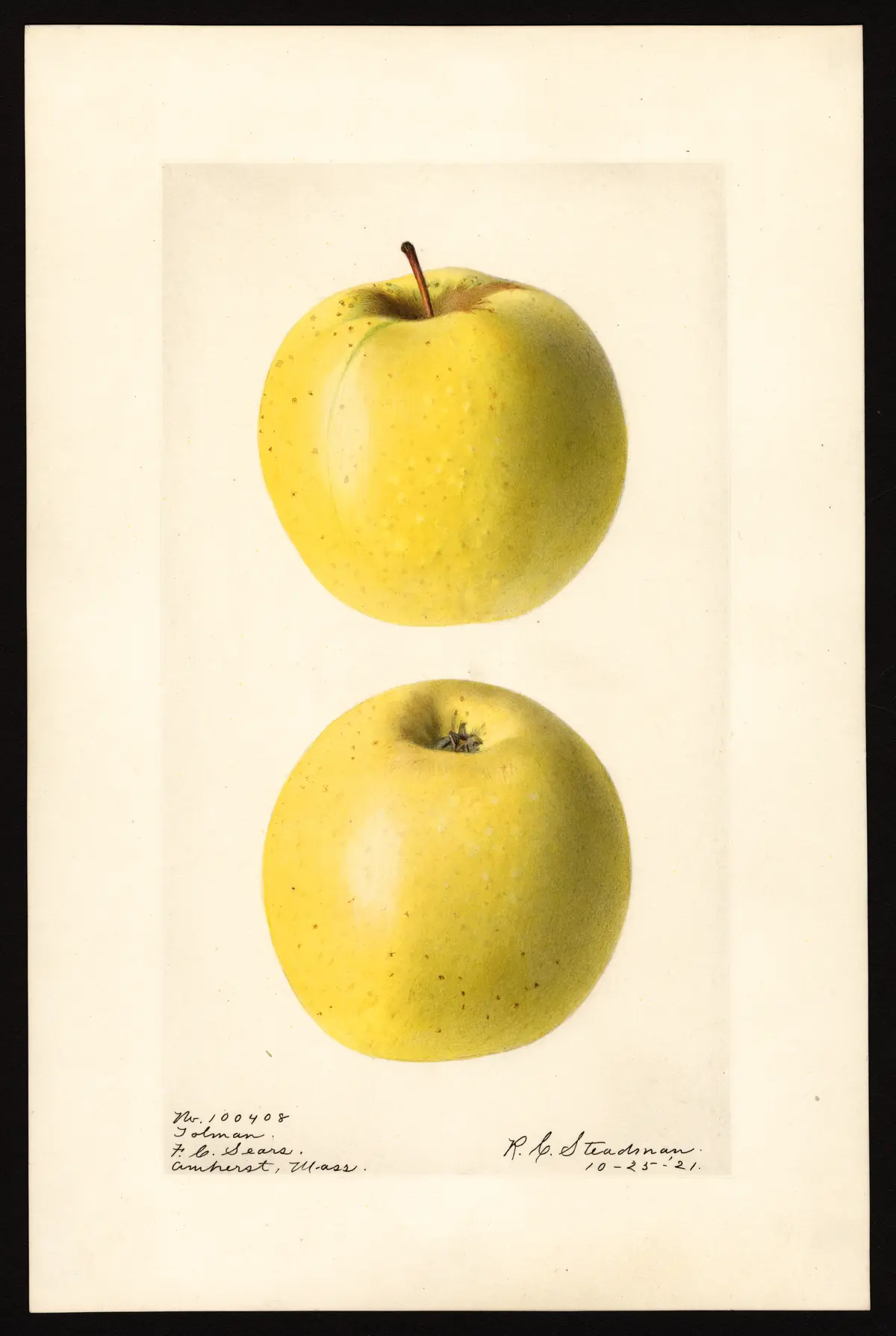
USDA Pomological Watercolor Collection
Origin/History
The earliest known description of Tolman Sweet is that of Thacher in 1822, who was unable to trace it to its origin (Beach). It has been supposed that the variety originated in Dorchester, Massachusetts (Beach), and Warder describes it as "this favorite baking apple of New England" that "has traveled from Rhode Island wherever her hardy sons have gone westward." Thomas also attributes it to Rhode Island. It has long been known in cultivation in New York and appears to be more generally grown in the home orchards of that state than any other sweet apple (Beach).
Tree
Tree moderately vigorous (Beach). Young tree vigorous, upright, shoots becoming spreading (Thomas). Hardy, very productive (Warder). Throughout Northern New York, Northern New England, certain portions of Canada, and the northern portion of the apple belt in the prairie region of the Middle West, Tolman Sweet has gained the reputation of being one of the hardiest of the old New England varieties; for this reason it is often selected as a stock upon which to top-graft less hardy kinds (Beach). The tree is a good grower and long-lived (Beach). It comes into bearing at a moderately early age, and generally speaking is a reliable cropper, yielding from moderate to heavy crops biennially or sometimes almost annually (Beach).
Form upright, very spreading, drooping, open; top roundish; branches long, moderately stout, curved and drooping (Beach). Twigs medium to long, straight or bowed, stout; internodes medium to short (Beach). Bark clear brownish mingled with olive-green, lightly streaked with scarf-skin, heavily pubescent (Beach). Lenticels rather conspicuous, scattering, medium or above, roundish or oval, not raised (Beach). Buds medium in size, broad, plump, obtuse, appressed, pubescent (Beach). Leaves wavy (Thomas).
Fruit
Size
Medium or below (Beach); medium to large (Warder); medium or rather large (Thomas). Fruit is pretty uniform in size and shape (Beach).
Form
Nearly globular or varying to roundish conical or to roundish oblate, often inclined to elliptical or obscurely ribbed (Beach). Nearly round, somewhat flattened, regular (Warder). Roundish-oblate, slightly conical (Thomas). Rather attractive for a yellow apple (Beach).
Stem
Medium to rather long, slender (Beach). Medium size, long (Warder). Nearly an inch long (Thomas).
Cavity
Obtuse to acute, broad, deep, often russeted, often obscurely furrowed yet pretty symmetrical (Beach). Rather wide, regular (Warder).
Calyx
Medium to small, somewhat open or sometimes closed; lobes often long and acuminate (Beach). Small, closed (Warder). Calyx tube urn-shape to truncate funnel-form; stamens basal or nearly so (Beach).
Basin
Small to medium, often oblique, moderately shallow to moderately deep, medium in width, rather abrupt, furrowed, wrinkled, sometimes compressed (Beach). Wide, regular, leather-cracked (Warder). Distinct, slightly wrinkled (Thomas).
Skin
Tough, often marked by a suture line extending out from the cavity, sometimes reaching even to the basin (Beach). Warder and Thomas also note a distinct line on one side from stem to eye. Color pale clear yellow or whitish-yellow, sometimes a little blushed (Beach); yellow (Warder); clear light yellow (Thomas), with a clear brownish line from stalk to apex (Thomas). Dots small, inconspicuous, pale yellow or faint russet (Beach); minute, dark (Warder). The skin is apt to be roughened slightly by very inconspicuous capillary russet lines over the entire surface, becoming heavier and concentric at the basin (Beach).
Flesh/Flavor
White, firm, neither tender nor crisp, rather hard, moderately fine, rather dry to moderately juicy, decidedly sweet, good to very good (Beach). Yellow, breaking, firm; flavor very sweet, rich; quality good (Warder). White, firm, rich, very sweet (Thomas).
Beach describes the flesh as white; Warder describes it as yellow.
Core/Seeds
Core medium to rather small, axile; cells symmetrical, closed; core lines slightly clasping (Beach). Core heart-shaped, regular, closed, clasping (Warder). Carpels rather flat, broadly roundish, slightly emarginate, tufted (Beach). Seeds medium in size, wide, plump, acute to somewhat obtuse, tufted (Beach); numerous, plump, pointed, dark (Warder).
Season
In ordinary storage in season from November to January with December as the commercial limit; in cold storage its commercial limit varies under different conditions from February 1 to April (Beach). December and January (Warder). Keeps into spring (Thomas). Its keeping quality varies in different seasons; some find that it stands heat well before going into storage, others report that it does not (Beach).
Uses
Generally much esteemed for certain culinary purposes as pickling, boiling and baking (Beach). Baking and stock (Warder). Excellent for winter baking (Thomas). It meets with little demand in the general market, but is sold to a limited extent in special markets and to special classes of trade (Beach).
Handling
The fruit shows bruises very readily and requires careful handling (Beach). The fruit hangs pretty well to the tree, is quite uniform in grade and suffers comparatively little loss in drops and culls (Beach).
Subtypes/Variants
Not described in sources.
Other
Description absent; variety present in variety-characteristic table.
Tolman Sweet. M r gy VG W 19* 18*
(Lowther, Encyclopedia of Practical Horticulture, 1914)
Book Sources
Described in 4 period pomological works
Nursery Catalog Sources
Found in 52 catalogs (1845–1936) from Alabama, California, Illinois, Massachusetts, Missouri, Nebraska, Oregon, Washington
- Winship's Nursery (Brighton Nurseries , operated by the Winship family), Brighton (Boston) , Massachusetts — 1845
- Hovey & Co. , Cambridge , Massachusetts — 1849
- Azell Bowditch (Nursery / Fruit Catalog) , Boston , Massachusetts — 1850
- Joseph Breck & Co. , Boston , Massachusetts — 1855
- Hutchison Nursery , James Hutchison, Oakland , California — 1881
- Felix Gillet , Barren Hill Nursery, Nevada City , California — 1884
- Felix Gillet , Barren Hill Nursery, Nevada City , California — 1888
- California Nursery Co. , Niles , California — 1889
- Felix Gillet , Barren Hill Nursery, Nevada City , California — 1889
- Felix Gillet , Barren Hill Nursery, Nevada City , California — 1890
- Felix Gillet , Barren Hill Nursery, Nevada City , California — 1891
- Puyallup & Yakima Nurseries , Puyallup, Washington (Lock Box 191) and North Yakima , Washington — 1892
- Milwaukie-Canby Nurseries , Canby, OR (and Milwaukie, OR) — 1893
- Sherwood Hall Nursery Co. , Timothy Hopkins (Menlo Park Nurseries), San Francisco / Menlo Park , California — 1893
- Multnomah Nurseries , Russellville , Oregon — 1894
- The Vineland Nurseries (Kelsey & Co. , Proprietors), St. Joseph, Missouri (Office: 13th and Atchison Sts., 2 Blocks East of the Citizens St. Car Line) — 1894
- Felix Gillet , Barren Hill Nursery, Nevada City , California — 1895
- Felix Gillet , Barren Hill Nursery, Nevada City , California — 1897
- Stark Bros. Nurseries & Orchards Co. , Louisiana , Missouri — 1898
- Alabama Nursery Co. , Huntsville , Alabama — 1900
- Washington Nursery Co. , Toppenish , Washington — 1901
- S.L. Watkins , Grizzly Flats, El Dorado County , California — 1901
- Pacific Nursery Company (W. O. Hudson & A. D. Hudson) , Tangent , Oregon — 1903
- Russellville Nursery Co. , Russellville, OR (three miles east of Portland, one mile from Montavilla car line) — 1903
- OSU Bulletin 81 — 1904
- Phoenix Nursery Company (W. E. Rossney , President; Sidney Tuttle, Vice-President), Bloomington , Illinois — 1904
- The Dalles Nurseries , The Dalles , Oregon — 1906
- Stark Bros. Nurseries & Orchards Co. , Louisiana , Missouri — 1906
- Russellville Nursery Co. , Montavilla Station, Portland, OR (three miles east of Portland, one mile from Montavilla car line) — 1907
- Carlton Nursery Co. , Carlton , Oregon — 1909
- Milton Nursery Co. (A. Miller & Sons , Proprietors), Milton , Oregon — 1909
- Washington Nursery Company , Toppenish , Washington — 1909
- Island Nurseries & Fruit Farm , Vashon (Vashon Island) , Washington — 1910
- Stark Bros. Nurseries & Orchards Co. , Louisiana , Missouri — 1910
- Galbraith Nursery Co. (DeWitt Hansen , Pres.-Mgr.), Fairbury , Nebraska — 1911
- Island Nurseries & Fruit Farm , Vashon (Vashon Island) , Washington — 1911
- Stark Bros. Nurseries & Orchards Co. , Louisiana , Missouri — 1911
- Pacific Nursery Company , Portland , Oregon — 1912
- Stark Bros. Nurseries & Orchards Co. , Louisiana , Missouri — 1912
- Vineland Nurseries Company , Clarkston , Washington — 1912
- Washington Nursery Company , Toppenish , Washington — 1912
- Island Nurseries & Fruit Farm , Vashon (Vashon Island) , Washington — 1914
- Stark Bros. Nurseries & Orchards Co. , Louisiana , Missouri — 1914
- Island Nurseries & Fruit Farm , Vashon (Vashon Island) , Washington — 1915
- Island Nurseries & Fruit Farm , Vashon (Vashon Island) , Washington — 1916
- Island Nurseries & Fruit Farm , Vashon (Vashon Island) , Washington — 1917
- Fancher Creek Nurseries , George C. Roeding, Fresno , California — 1918
- Stark Bros. Nurseries & Orchards Co. , Louisiana , Missouri — 1918
- Oregon Nursery Co. , Orenco , Oregon — 1920
- Island Nurseries & Fruit Farm , Vashon , Washington — 1921
- Hudson's Wholesale Nurseries , Tangent , Oregon — 1936
- North-Western Nurseries , Walla Walla , Washington
View original book sources (4)
— John A. Warder, American Pomology: Apples (1867)Tallman's Sweet.
This favorite baking apple of New England has traveled from Rhode Island wherever her hardy sons have gone westward.
Tree hardy, very productive.
Fruit medium to large, nearly round, somewhat flattened, regular; Surface smooth, yellow; Dots minute, dark; frequently a distinct line on one side from stem to eye.
Basin wide, regular, leather-cracked; Eye small, closed.
Cavity rather wide, regular; Stem medium size, long.
Core heart-shaped, regular, closed, clasping; Seeds numerous, plump, pointed, dark; Flesh yellow, breaking, firm; Flavor very sweet, rich; Quality good; Use, baking and stock; Season, December and January.
— S.A. Beach, The Apples of New York, Vol. 1 (1905)TOLMAN SWEET.
REFERENCES. 1. Thacher, 1822:139. 2. Buel, N. Y. Bd. Agr. Mem., 1826:476. 3. Manning, Mag. Hort., 7:50. 1841. 4. Downing, 1845:137. 5. Phoenix, Horticulturist, 1:361. 1846. 6. Thomas, 1849:162. 7. Hovey, Mag. Hort., 15:162. 1849. fig. 8. Cole, 1849:131. fig. 9. Emmons, Nat. Hist. N. Y., 3:87. 1851. fig. 10. Elliott, 1854:110. fig. 11. Gregg, 1857:60. fig. 12. Hooper, 1857:93. 13. Horticulturist, 17:150, 167. 1862. 14. Am. Pom. Soc. Cat., 1862. 15. Warder, 1867:557. fig. 16. Barry, 1883:355. 17. Lyon, Mich. Hort. Soc. Rpt., 1890:298. 18. Manning, Am. Pom. Soc. Rpt., 1891:137. 19. Taylor, Me. Pom. Soc. Rpt., 1892:57. 20. Bailey, An. Hort., 1892:251. 21. Woolverton, Ont. Fr. Assn. An. Rpt., 26:169. 1894. 22. Can. Hort., 17:229, 280. 1894. col. pl. 23. Hoskins, Rural N. Y., 53:310. 1894. 24. Atwood, Va. Sta. Bul., 130:125. 1901. 25. Waugh, Vt. Sta. An. Rpt., 14:311. 1901. 26. Hansen, S. D. Sta. Bul., 76:106. 1902. fig. 27. Budd-Hansen, 1903:189. fig. 28. Powell and Fulton, U. S. B. P. I. Bul., 48:58. 1903. 29. Beach and Clark, N. Y. Sta. Bul., 248:146. 1904.
SYNONYMS. Brown's Golden Sweet (10). TALLMAN'S SWEET (15). TALLMAN SWEET (26). Tollman Sweet (27). TALLMAN SWEETING (2, 6, 11). Tollman's Sweeting (10). TALMAN SWEET (5, 17, 20, 21, 22, 23). TALMAN'S SWEET (14, 16, 19). Talman Sweet (28). TALMAN SWEETING (8). TALMAN'S SWEETING (9, 10, 12). TOLMAN (25, 28). TOLMAN SWEET (3, 13, 18, 24). Tolman Sweet (25, 28). TOLMAN'S SWEETING (4, 7). TOLMAN SWEETING (1). Tolman's Sweeting (6, 10).
Fruit medium or below, rather attractive for a yellow apple. It meets with little demand in the general market, but is sold to a limited extent in special markets and to special classes of trade. The fruit is generally much esteemed for certain culinary purposes as pickling, boiling and baking. Its keeping quality varies in different seasons. In ordinary storage it is in season from November to January with December as the commercial limit. In cold storage its commercial limit varies under different conditions from February 1 to April (29). Some find that it stands heat well before going into storage; others report that it does not. It shows bruises very readily and requires careful handling. The fruit hangs pretty well to the tree, is quite uniform in grade and suffers comparatively little loss in drops and culls. The tree is a good grower, long-lived and very hardy. Throughout Northern New York, Northern New England, certain portions of Canada and the northern portion of the apple belt in the prairie region of the Middle West, Tolman Sweet has gained the reputation of being one of the hardiest of the old New England varieties. For this reason it is often selected as a stock upon which to top-graft less hardy kinds. The tree comes into bearing at a moderately early age, and, generally speaking, is a reliable cropper, yielding from moderate to heavy crops biennially or sometimes almost annually.
Historical. Thacher's description of this variety is the earliest one of which we have any record. He was unable to trace it to its origin (1). Manning (18) in 1891 called attention to the correct orthography, the name having been differently spelled by various authors, and mentioned the supposition that the variety originated in Dorchester (Massachusetts). It has long been known in cultivation in New York and it appears that it is more generally grown in the home orchards of this state than any other sweet apple.
TREE.
Tree moderately vigorous. Form upright, very spreading, drooping, open; top roundish; branches long, moderately stout, curved and drooping. Twigs medium to long, straight or bowed, stout; internodes medium to short. Bark clear brownish mingled with olive-green, lightly streaked with scarf-skin, heavily pubescent. Lenticels rather conspicuous, scattering, medium or above, roundish or oval, not raised. Buds medium in size, broad, plump, obtuse, appressed, pubescent.
FRUIT.
Fruit commonly averages below medium but sometimes grows rather large. It is pretty uniform in size and shape. Form nearly globular or varying to roundish conical or to roundish oblate, often inclined to elliptical or obscurely ribbed. Stem medium to rather long, slender. Cavity obtuse to acute, broad, deep, often russeted, often obscurely furrowed yet pretty symmetrical. Calyx medium to small, somewhat open or sometimes closed; lobes often long and acuminate. Basin small to medium, often oblique, moderately shallow to moderately deep, medium in width, rather abrupt, furrowed, wrinkled, sometimes compressed.
Skin tough, often marked by a suture line extending out from the cavity, sometimes reaching even to the basin; color pale clear yellow or whitish-yellow, sometimes a little blushed. Dots small, inconspicuous, pale yellow or faint russet. The skin is apt to be roughened slightly by very inconspicuous capillary russet lines over the entire surface, becoming heavier and concentric at the basin.
Calyx tube urn-shape to truncate funnel-form. Stamens basal or nearly so. Core medium to rather small, axile; cells symmetrical, closed; core lines slightly clasping. Carpels rather flat, broadly roundish, slightly emarginate, tufted. Seeds medium in size, wide, plump, acute to somewhat obtuse, tufted.
Flesh white, firm, neither tender nor crisp, rather hard, moderately fine, rather dry to moderately juicy, decidedly sweet, good to very good.
— Granville Lowther (ed.), Encyclopedia of Practical Horticulture (1914)Tolman Sweet. M r gy VG W 19* 18*
— John J. Thomas, The American Fruit Culturist (1903)Tolman Sweet.* Medium or rather large, roundish-oblate slightly conical; clear light yellow, with a clear brownish line from stalk to apex; stalk nearly an inch long; calyx in a distinct, slightly wrinkled basin; flesh white, firm, rich, very sweet. Excellent for winter baking. Keeps into spring. Young tree vigorous, upright, shoots becoming spreading; leaves wavy. Fig. 406. Productive. Hardy. Rhode Island.