Roxbury Russet
Apple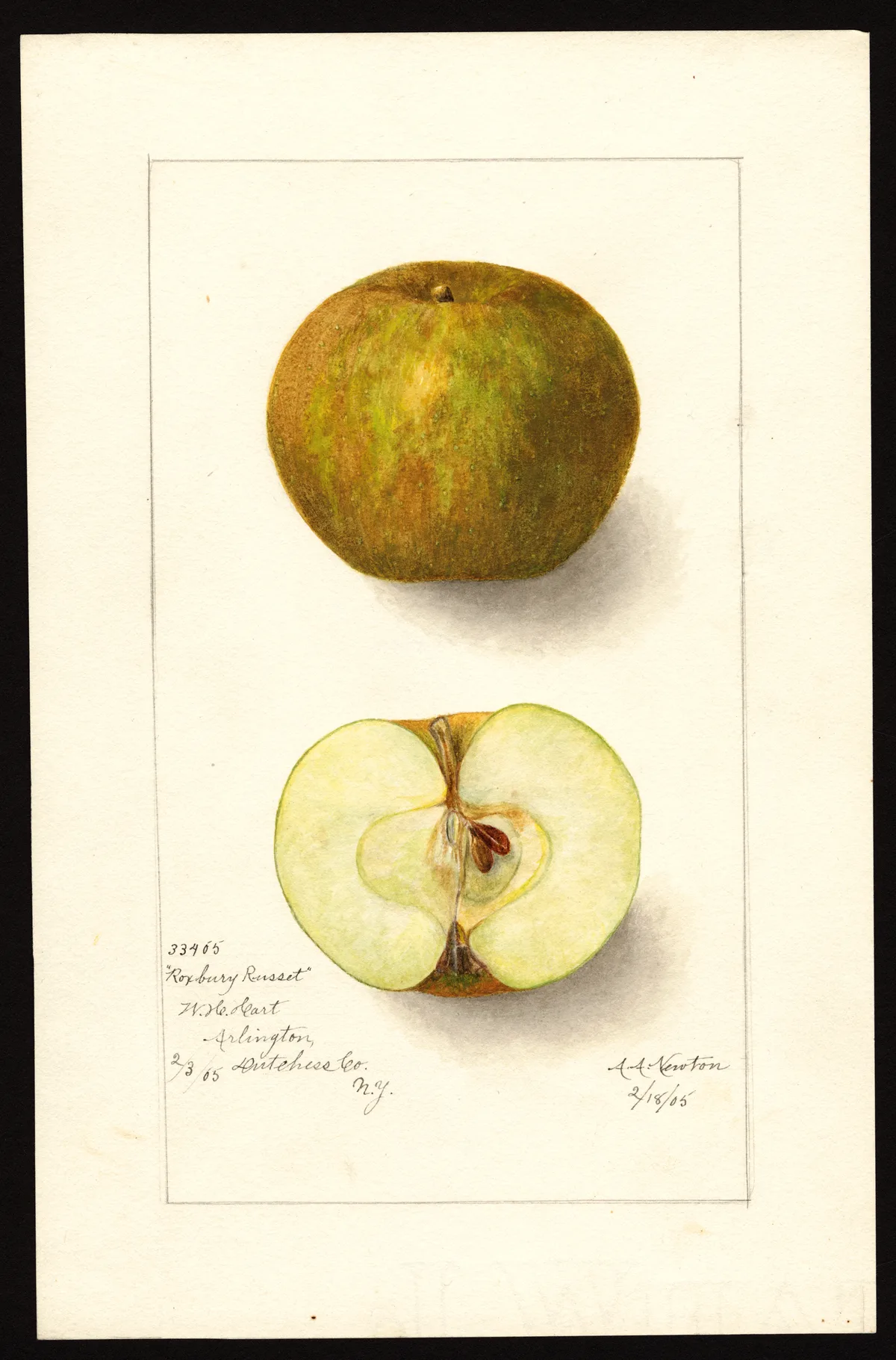
USDA Pomological Watercolor Collection
Origin & History
A native of Massachusetts (Downing, Thomas), though Elliott notes the origin as uncertain, "either Connecticut or Massachusetts." It was introduced to the Ohio Valley in 1796 or 1797 by Israel Putnam (Elliott), brought to the West by different routes—by the Ohio River and by the lakes—and universally distributed (Warder). Those brought to the mouth of the Muskingum River and propagated by Mr. Putnam had the name changed to Marietta Russet and Putnam Russet; at the same time the appearance of the fruit was so altered by increase in the russeting that it was long thought to be a different variety, until the question was at length settled by interchange of grafts, and when these fruited the identity was proved (Warder).
One of the most popular market fruits in the country (Downing). Warder claims more money has been realized from this variety than from any other, though on the Ohio River the Rome Beauty was considered equally profitable. However, Warder notes that the popularity of this Russet was on the wane, as it is very subject to attacks of the codling-moth, which makes the fruit fall, and because it is apt to ripen too early in southern locations and on limestone soils.
Elliott describes it as "a thick-skinned fruit, generally a good keeper, but hardly above second rate in quality." Thomas notes that "although not of the highest flavor, its productiveness, uniformly fair fruit, and long keeping, render this variety one of the most profitable for orchard culture." It succeeds well throughout the Northern States but partially fails in a few localities at the West (Thomas). Downing similarly notes it drops its fruit too early south and west, and is therefore not valuable there. Elliott calls it "unreliable, West or South."
Tree
Growth spreading (all sources agree). Warder describes the tree as robust and vigorous, while Downing calls it healthy and moderately vigorous. Young shoots are downy (Downing, Elliott, Thomas); Warder describes shoots as stout, straggling, and dark, while Downing specifies them as reddish brown. Foliage gray-green (Warder). Young trees often crooked (Elliott). A prodigious bearer (Downing). On rich prairie soils, the tree is sometimes liable to "bark burst" near the ground, but elsewhere perfectly hardy and very productive (Elliott).
Fruit
Size: Medium to large.
Form: Roundish, somewhat flattened or oblate, frequently angular. Warder notes the fruit is often lop-sided in western regions, and sometimes conic and truncated. Thomas describes it as remotely conical, and observes that large specimens become conical with short thick stalks, while small specimens are more flat with longer and more slender stalks.
Stem: Warder describes the stem as medium length and curved. Downing gives it as nearly three-fourths of an inch long, rather slender, not deeply inserted. Thomas gives one-half to an inch long, noting variation with fruit size. Elliott describes it simply as slender.
Cavity: Regular and pointed (Warder). Medium (Elliott). Acute (Thomas).
Calyx: Closed. Warder describes the eye as medium.
Basin: Round, of moderate depth (Downing, Elliott, Thomas). Warder describes it as regular or wavy, green, often folded.
Skin: At first dull green, covered with brownish yellow russet when ripe, with rarely a faint blush on one side (Downing, Elliott). Warder notes regional variation: overspread with heavy brown russet in the South, but green, often bronzed, and with partial light russet north of latitude 41°. Thomas describes it as partly or wholly covered with rather rough russet on a greenish yellow ground, sometimes with a dull brown cheek. Elliott notes it is a thick-skinned fruit. Dots minute, scattered (Warder).
Flesh & Flavor: Flesh greenish white (Downing, Elliott, Thomas), though Warder describes it as greenish-yellow. Moderately juicy (Downing, Elliott). Warder calls it breaking, granular, often coarse, and juicy. Thomas describes it as rather granular and slightly crisp. Flavor subacid, with sources differing on intensity and quality: Warder calls it "decidedly acid" and rates the quality as second rate; Elliott describes a "mild sub-acid" and considers it "hardly above second rate in quality"; Downing gives "a rather rich subacid flavor" and rates it good to very good; Thomas describes "a good sub-acid flavor."
Core & Seeds: Core regular, closed, clasping (Warder). Core compact (Elliott). Seeds numerous, angular, imperfect (Warder). Seeds ovate, defective (Elliott).
Season
November to January according to Warder, who notes it is a better keeper in the North. Downing states it ripens in January and may be brought to market in June. Elliott gives January to June. Thomas says it keeps late in spring. Its value as a keeping apple is diminished in southern locations and on limestone soils, where it is apt to ripen too early (Warder).
Uses
Market and cooking (Warder). One of the most popular market fruits in the country (Downing). One of the most profitable varieties for orchard culture (Thomas).
Subtypes/Variants
Not described in sources.
Other
The Encyclopedia of Practical Horticulture (1914) lists Roxbury Russet in a variety-characteristic table:
Description absent; variety present in variety-characteristic table.
Roxbury Russet. Mo rob yru VG b W 18* 1*
Book Sources
Described in 5 period pomological works
Nursery Catalog Sources
Found in 60 catalogs (1845–1924) from Alabama, California, England, Illinois, Maryland, Massachusetts, New Jersey, New York, Oregon, Pennsylvania, Washington
- Winship's Nursery (Brighton Nurseries , operated by the Winship family), Brighton (Boston) , Massachusetts — 1845
- Hovey & Co. , Cambridge , Massachusetts — 1849
- Azell Bowditch (Nursery / Fruit Catalog) , Boston , Massachusetts — 1850
- Joseph Breck & Co. , Boston , Massachusetts — 1855
- St. Helena Nursery , Howell's Prairie, Marion County , Oregon — 1864
- Hutchison Nursery , James Hutchison, Oakland , California — 1881
- Felix Gillet , Barren Hill Nursery, Nevada City , California — 1884
- Fancher Creek Nursery , Fresno , California — 1886
- Felix Gillet , Barren Hill Nursery, Nevada City , California — 1888
- California Nursery Co. , Niles , California — 1889
- Felix Gillet , Barren Hill Nursery, Nevada City , California — 1889
- Palouse Nursery and Pleasant Dale Fruit Farm , Colfax, Washington Territory (situated two miles northeast of Colfax) - undated (single-page broadside flyer; "Washington Territory" suggests pre — 1889
- Felix Gillet , Barren Hill Nursery, Nevada City , California — 1890
- William H. Moon Co. , Morrisville, Bucks County , Pennsylvania — 1890
- Felix Gillet , Barren Hill Nursery, Nevada City , California — 1891
- Puyallup & Yakima Nurseries , Puyallup, Washington (Lock Box 191) and North Yakima , Washington — 1892
- Milwaukie-Canby Nurseries , Canby, OR (and Milwaukie, OR) — 1893
- Sherwood Hall Nursery Co. , Timothy Hopkins (Menlo Park Nurseries), San Francisco / Menlo Park , California — 1893
- Oregon Wholesale Nurseries , Salem , Oregon — 1893
- Rogers Nursery Co. , Moorestown , New Jersey — 1893
- Green's Nursery Co. (Charles A. Green) , Rochester , New York — 1894
- Multnomah Nurseries , Russellville , Oregon — 1894
- Woodburn Nurseries , Woodburn, Marion Co. , Oregon — 1894
- The Vineland Nurseries (Kelsey & Co. , Proprietors), St. Joseph, Missouri (Office: 13th and Atchison Sts., 2 Blocks East of the Citizens St. Car Line) — 1894
- Felix Gillet , Barren Hill Nursery, Nevada City , California — 1895
- The Lovett Company , Little Silver , New Jersey — 1896
- Felix Gillet , Barren Hill Nursery, Nevada City , California — 1897
- Kelway & Son , Langport, Somerset , England — 1897
- Arthur J. Collins & Sons , Moorestown , New Jersey — 1898
- Reading Nursery , Jacob W. Manning, Proprietor, Reading , Massachusetts — 1898
- Brown Brothers Co. , Continental Nurseries, Rochester, NY (also operated from Toronto, Canada) — 1899
- Alabama Nursery Co. , Huntsville , Alabama — 1900
- The Dalles Nurseries , The Dalles , Oregon — 1901
- Washington Nursery Co. , Toppenish , Washington — 1901
- S.L. Watkins , Grizzly Flats, El Dorado County , California — 1901
- Brown Brothers Co. , Continental Nurseries, Rochester, NY (also operated from Toronto, Canada) — 1901
- Forestville Nurseries , T.J. True, Forestville , California — 1902
- Russellville Nursery Co. , Russellville, OR (three miles east of Portland, one mile from Montavilla car line) — 1903
- Phoenix Nursery Company (W. E. Rossney , President; Sidney Tuttle, Vice-President), Bloomington , Illinois — 1904
- J.B. Pilkington , Portland , Oregon — 1907
- Russellville Nursery Co. , Montavilla Station, Portland, OR (three miles east of Portland, one mile from Montavilla car line) — 1907
- Carlton Nursery Co. , Carlton , Oregon — 1909
- Milton Nursery Co. (A. Miller & Sons , Proprietors), Milton , Oregon — 1909
- Wm. J. Corse (successor to Robert Sinclair / Sinclair Nurseries) , Baltimore , Maryland — 1909
- Washington Nursery Company , Toppenish , Washington — 1909
- C.F. Lansing , Salem , Oregon — 1910
- James Veitch & Sons , Ltd., Royal Exotic Nursery, Chelsea, London (also Coombe Wood, Langley, and Feltham) , England — 1911
- Ballygreen Nurseries , Hanford , Washington — 1912
- Vineland Nurseries Company , Clarkston , Washington — 1912
- Pacific Nursery Company , Portland , Oregon — 1912
- Washington Nursery Company , Toppenish , Washington — 1912
- Samuel Fraser , Geneseo , New York — 1913
- Union Nurseries , J.B. Weaver & Sons, Union , Oregon — 1915
- Manalapan Nurseries , Englishtown , New Jersey — 1916
- Fancher Creek Nurseries , George C. Roeding, Fresno , California — 1918
- Oregon Nursery Co. , Orenco , Oregon — 1920
- Christopher Nurseries / John Stewart & Sons , Christopher , Washington — 1920
- Benedict Nursery Co. , Portland , Oregon — 1921
- Fresno Nursery Co. , Fresno , California — 1924
- North-Western Nurseries , Walla Walla , Washington
View original book sources (5)
— John A. Warder, American Pomology: Apples (1867)Roxbury Russet.
BOSTON RUSSET.—PUTNAM RUSSET.
This standard apple is perhaps as widely known and as much admired as any other in the catalogue. It was brought to the West by different routes—by the Ohio River and by the lakes—and has been universally distributed. Those brought to the mouth of the Muskingum River, and propagated by Mr. Putnam, had the name changed to that of the Marietta and the Putnam Russet; and at the same time the appearance of the fruit was so altered by increase in the russeting, that it was long thought to be a different variety, until the question was at length settled by interchange of grafts; and when these fruited the identity was proved.
It is claimed that more money has been realized from this than from any other variety, though, on the Ohio River, the Rome Beauty is considered to be equally profitable. The popularity of this Russet is on the wane, however, as it is very subject to attacks of the Codling-moth, which makes it fall, and because it is apt to ripen too early in the season in southern locations and on limestone soils. Hence its value as a keeping apple is diminished.
Tree robust, vigorous, spreading; Shoots stout, straggling, dark; Foliage gray-green.
Fruit large, oblate, often lop-sided at the West, frequently angular, sometimes conic and truncated; Surface overspread with heavy brown russet in the South, but green, often bronzed, and with partial light russet at the north of latitude 41°; Dots minute, scattered.
Basin regular or wavy, green, often folded; Eye medium, closed.
Cavity regular, pointed; Stem medium, curved.
Core regular, closed, clasping; Seeds numerous, angular, imperfect; Flesh greenish-yellow, breaking, granular, often coarse, juicy; Flavor decidedly acid; Quality second rate; Use, market and cooking; Season, November to January; a better keeper in the North.
— A.J. Downing, The Fruits and Fruit Trees of America (1900)Roxbury Russet.
Reinette Rousse de Boston. Howe's Russet. Marietta Russet. Belpre Russet. Boston Russet. Putnam Russet. Warner Russet. Sylvan Russet.
This Russet, a native of Massachusetts, is one of the most popular market fruits in the country, as it is excellent, a prodigious bearer, and keeps till late in the spring wherever the soil and climate suit it. South and West it drops its fruit too early, and is therefore not valuable.
The tree is healthy, moderately vigorous, spreading, with young shoots of a reddish brown, downy.
Roxbury Russet.
Fruit of medium size, often large, roundish, a little flattened, and slightly angular. Skin at first dull green, covered with brownish yellow russet when ripe, with, rarely, a faint blush on one side. Stalk nearly three-fourths of an inch long, rather slender, not deeply inserted. Calyx closed, set in a round basin of moderate depth. Flesh greenish white, moderately juicy, with a rather rich subacid flavor. Good to very good. Ripens in January, and may be brought to market in June.
— Granville Lowther (ed.), Encyclopedia of Practical Horticulture (1914)Roxbury Russet. Mo rob yru VG b W 18* 1*
— F.R. Elliott, The Western Fruit Book (1865)ROXBURY RUSSET. Boston Russet, Putnam Russet, Sylvan Russet. Marietta Russet, Belpre Russet,
American. Origin uncertain, either Connecticut or Massachusetts. It was introduced to the Ohio Valley, in 1796 or '97, by Israel Putnam, and from thence distributed throughout the Southwest. It is a thick-skinned fruit, generally a good keeper, but hardly above second rate in quality; grown on rich prairie soils, it is sometimes liable to "bark burst" near the ground, but elsewhere perfectly hardy, and very productive. Spreading growth, with rather downy shoots; young trees often crooked. Unreliable, West or South.
Fruit, medium to large; form, roundish flattened, and often angular; color, dull green, overspread with brownish yellow russet, occasionally a faint blush on the sunny side; stem, slender; cavity, medium; calyx, closed; basin, round, moderate depth; flesh, greenish white, moderately juicy, mild sub-acid; core, compact; seeds, ovate, defective. January to June.
— John J. Thomas, The American Fruit Culturist (1903)Roxbury Russet.* (Boston Russet, Putnam Russet of Ohio.) Medium or large, roundish-oblate, remotely conical; partly or wholly covered with rather rough russet on greenish yellow ground, sometimes a dull brown cheek; stalk one-half to an inch long, cavity acute; basin round, moderate; flesh greenish white, rather granular, slightly crisp, with a good sub-acid flavor. Keeps late in spring. Large specimens become conical, with short thick stalks; small specimens are more flat, and with longer and more slender stalks. Growth spreading, shoots downy. Although not of the highest flavor, its productiveness, uniformly fair fruit, and long keeping, render this variety one of the most profitable for orchard culture. It succeeds well throughout the Northern States, but partially fails in a few localities at the West. Fig. 431. Mass.