Westfield Seek-No-Further
Apple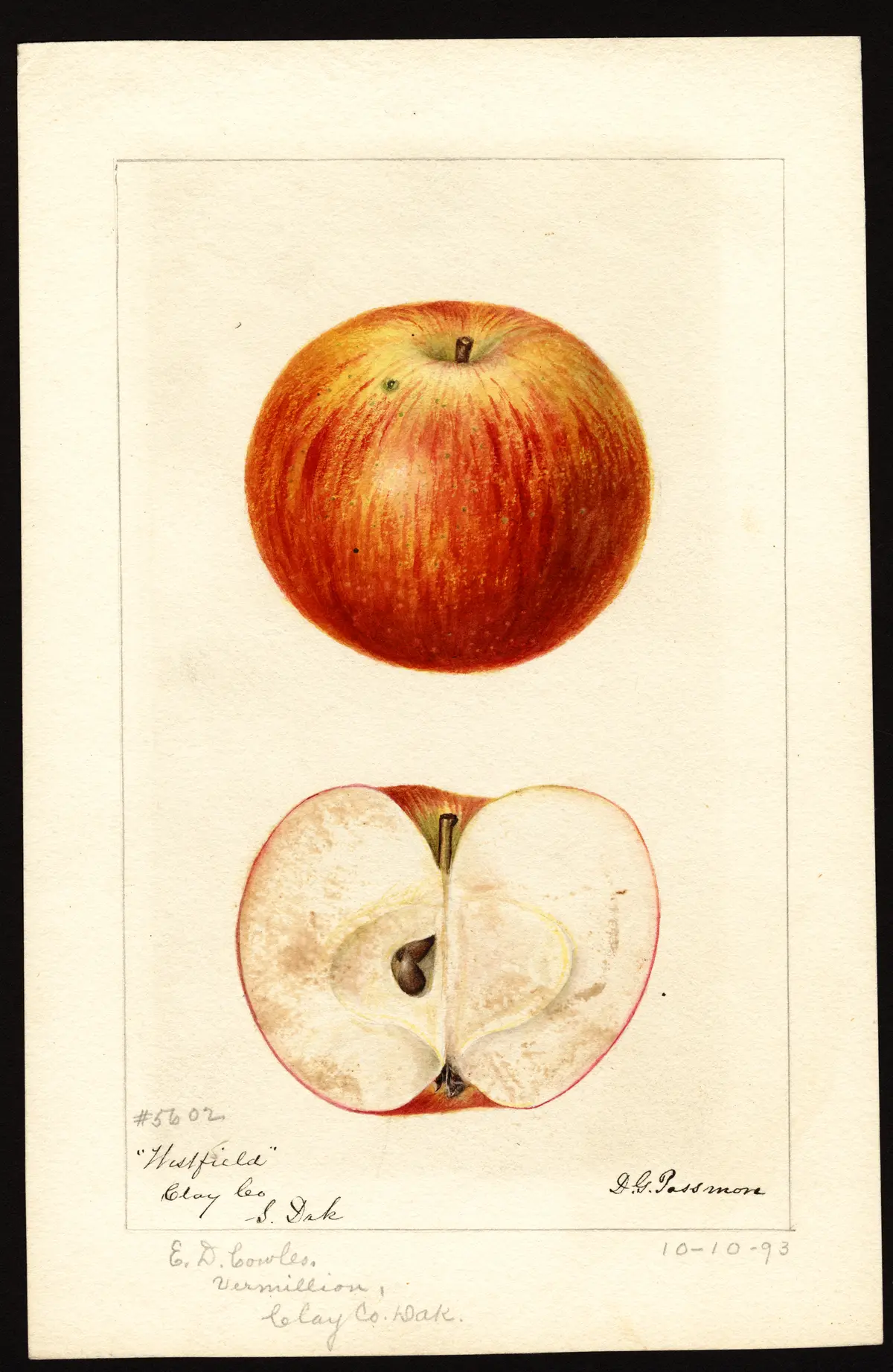
USDA Pomological Watercolor Collection
Westfield Seek-No-Further
Origin / History
Westfield Seek-No-Further is an old and highly esteemed variety originating in Connecticut (Elliott; Warder; Downing; Thomas; Budd-Hansen), or more specifically at Westfield, Massachusetts — "a beautiful meadow town, about ten miles west of Springfield, in the Connecticut valley" — where it was under cultivation at least as early as the Revolutionary War (Beach; Hedrick). It found its way into New York from New England with the early settlers more than one hundred years before Beach's writing, and was introduced into Ohio from Connecticut as early as 1796. It became "the apple, par excellence" of the Connecticut Valley — "as much so as is the Newtown Pippin on Long Island, or the Esopus Spitzenburgh in Ulster" — with whole orchards planted of it. It was regarded as flourishing especially well in the western counties of New York.
Among fruit growers and fruit dealers this variety is commonly called Seek or Seek-No-Further (shortened to "Seeks" in the New York market), though pomologists recognize Westfield Seek-No-Further as the correct name in order to distinguish it from other varieties that have been cultivated under the name Seek-No-Further (notably the Rambo in New Jersey and Pennsylvania, and the American Domine in parts of New York). Beach notes that Elliott listed "Red Winter Pearmain, of some" as another name in use. It is well known in New England, New York, Ohio, and Michigan (Hedrick). By the early twentieth century it was generally well known throughout New York but for the most part found only in old orchards, with few localities where its cultivation was being extended.
Tree
Tree medium to large (Beach; Hedrick), or large (Hedrick's second entry), rather slender, moderately vigorous to vigorous (Beach) — described elsewhere simply as vigorous, thrifty, spreading, productive (Warder; Budd-Hansen; Thomas notes productive with fruit always fair). Form spreading or roundish (Beach; Hedrick); upright-spreading and dense (Hedrick's first entry). Twigs above medium, sometimes long; internodes short, varying from rather slender to moderately stout. Bark dark brownish-red or brownish-green, mottled or blotched with gray scarf-skin, sparingly pubescent. Lenticels of a clear light color, rather conspicuous, irregular in size and shape. Buds medium, often projecting, obtuse or sometimes acute, often not pubescent, free from bark.
Generally the tree is very hardy, remarkably healthy and long-lived — reputed to be superior in hardiness to Baldwin and Rhode Island Greening — though its successful cultivation is more restricted to particular districts than either of those. It does not commonly develop as good color or quality on heavy, cold soils, particularly if not well drained, as it does on well-drained, fertile, gravelly or sandy loam. In many parts of New York it has not proved reliably productive, but in certain localities in the Lake Ontario apple belt it has been a regular and abundant cropper. There is usually little loss from drops if the crop is picked at the proper season, and the fruit is quite uniform in grade with comparatively few culls. It loves a warm, free soil (New York State Agricultural Society, 1846, quoted in Beach).
Fruit
Size. Usually about medium (Elliott; Warder; Beach), sometimes below medium, sometimes rather large (Beach); medium or large (Thomas); above medium to large (Budd-Hansen); large (Lowther). Warder notes that on lower parallels the fruit is larger but less compact, more spongy, less beautifully colored, and sometimes almost a russet. Uniform.
Form. Regular, roundish conical, broad at base (Elliott); roundish-conic (Warder); pretty regularly round conical (Downing); roundish, often slightly conical (Thomas); usually roundish conical varying occasionally to roundish ovate and less often to rather oblong conical, regular or obscurely ribbed, symmetrical or nearly so (Beach); roundish conical, nearly regular (Budd-Hansen); round-conic or round-oblate, often irregularly elliptical, broadly ribbed (Hedrick first entry); round-conical, less often oblong-conical, obscurely ribbed, symmetrical (Hedrick second entry). Lowther gives form as "re" (round).
Stem. Long, slender (Elliott; Beach; Hedrick second entry); very slender, three-fourths of an inch long (Downing); slender (Thomas; Budd-Hansen); long (Warder); medium to long, rather slender (Beach); medium, slender (Budd-Hansen); short or very short (Hedrick first entry — noting a conflict with the other sources, which consistently describe the stem as long and slender).
Cavity. Open, regular (Elliott); pointed, regular, brown (Warder); even (Downing); medium in size, acuminate, deep, narrow to medium in width, usually symmetrical, russeted and with some outspreading green or yellow russet (Beach); regular, acute, slightly russeted (Budd-Hansen); small, acuminate, deep, narrow, sometimes gently furrowed, usually russeted and often with outspreading russet rays (Hedrick first entry); acuminate, deep, narrow, symmetrical, russeted with green or yellow-russet (Hedrick second entry). Warder additionally notes leather-cracking and russeting about the apex.
Calyx / eye. Usually small, closed, sometimes open, with short segments (Elliott); small, closed or open (Warder); closed, or with a few reflexed segments (Downing); partly open (Thomas); small to medium, usually partly open, lobes short, reflexed, obtuse or acute (Beach); open or closed with segments erect convergent (Budd-Hansen); small, closed, with lobes converging, usually reflexed, narrow, acute (Hedrick first entry); small, partly open, lobes short, reflexed, obtuse (Hedrick second entry).
Basin. Regular form, moderate depth (Elliott); shallow, regular, leather-cracked (Warder); even, of moderate depth (Downing); small, shallow, narrow to medium in width, obtuse or somewhat abrupt, sometimes decidedly furrowed (Beach); narrow, smooth, shallow, leather-cracked — a marked characteristic (Budd-Hansen); small, abrupt, usually deep, narrow, furrowed, often pubescent (Hedrick first entry — deeper than other sources describe); small, shallow, narrow, obtuse (Hedrick second entry).
Skin. Light yellow ground, the sunny side striped and splashed with red, small russet dots shaded around with light russet yellow; often considerable russet about both stem and calyx (Elliott). Surface smooth, dull red mixed and striped on yellow, in the North clear bright red; dots scattered, large, yellow; leather-cracked and russeted about the apex (Warder). Pale or dull red over a pale clouded green ground — the red sprinkled with obscure russeted yellow dots (Downing). Obscurely striped with light dull red, more or less russeted, rarely covered wholly with russet (Thomas). Skin tough, smooth, rather deep yellow or greenish, shaded and splashed with rather dull red but in highly colored specimens largely overspread with bright pinkish-red, striped with deep carmine; overspread with a thin bloom which gives it a somewhat bluish cast, but when polished it is bright and glossy (Beach). Greenish yellow, thinly shaded with pale dull red, obscurely striped with bright red, surface roughened by the dots and thin russet net-veinings, rarely almost covered with russet (Budd-Hansen). Smooth, thin, tough, pale yellow covered with red, mottled and striped with darker red (Hedrick first entry). Tough, smooth, deep yellow, splashed with dull red, in highly-colored specimens overspread with bright red, striped with carmine; bloom thin (Hedrick second entry). Lowther gives color as "yf" (yellow flushed).
Elliott observed that in Ohio and adjoining states the fruit differed remarkably by region: "grown in rich loamy alluvial soils of the South, it is much russeted, and about the stem the russet has appearance of rich bronze; progressing Northward, it gradually loses its russet, until, on light sandy soils, in Michigan, it becomes a pale yellow ground, with stripes and splashes of clear red and minute dots" (Elliott, quoted also by Beach).
Dots. Small russet dots shaded around with light russet yellow (Elliott); scattered, large, yellow (Warder); obscure russeted yellow dots (Downing); characteristically large and conspicuous, pale yellow, grayish or russet, often areolar with russet center, smaller and more numerous toward the basin, larger and more scattering and more often areolar toward the cavity (Beach); distinct, few, very large, yellow russet (Budd-Hansen); scattering, obscure, pale yellow or russet (Hedrick first entry — note that this contrasts with Beach's and Budd-Hansen's "characteristically large and conspicuous"); characteristically large, pale yellow, gray or russet, often areolar with russet center (Hedrick second entry).
Flesh and flavor. Yellowish, tender, sub-acid, pearmain flavor (Elliott). Yellowish-white, tender, breaking; flavor very mild sub-acid, aromatic, satisfying, not high flavored nor spicy; quality only good in Warder's estimation. White, fine-grained, tender, with a rich pearmain flavor; very good or best; a first-rate fruit (Downing). Tender, rich, spicy, of fine flavor (Thomas). Slightly tinged with pale yellow, firm, medium in grain or a little coarse, crisp, tender, breaking, juicy, mild subacid, rich, sometimes a little astringent, peculiarly aromatic, sprightly, very good to best (Beach). Yellowish white, tender, fine-grained, rich, spicy, pleasant subacid, very good or best (Budd-Hansen). Yellow, sometimes stained with red, firm, crisp, coarse, tender, very juicy, briskly subacid, eventually becoming mild subacid, aromatic; good (Hedrick first entry). Pale yellow, firm, coarse, crisp, tender, breaking, juicy, mild subacid, rich, peculiarly aromatic, sprightly; very good to best (Hedrick second entry). Beach summarizes the "peculiarly pleasant, rich, mild subacid flavor which has made it popular." Lowther rates quality "best."
Core and seeds. Core medium; seeds ovate (Elliott). Core medium, regular, closed, meeting and clasping the eye; seeds numerous, small, pointed (Warder). Core medium, axile; cells usually symmetrical, open; core lines meeting or slightly clasping; carpels somewhat elliptical or varying to roundish and approaching truncate at the base and narrowing toward the apex, mucronate, but slightly emarginate if at all; seeds numerous, rather small to medium, plump, acute to somewhat obtuse (Beach). Core closed, meeting; cells ovate; slit; tube conical; stamens basal; seeds many, short, rounded, very plump (Budd-Hansen). Core small, axile or abaxile with hollow central cylinder; cells uniformly developed, symmetrical, closed or partly open; core-lines meeting; carpels broadly round, elliptical, emarginate, mucronate, smooth or nearly so; seeds numerous, small, narrow, acute, plump, dark, sometimes tufted (Hedrick first entry). Core medium, axile; cells symmetrical, open; core-lines meeting; carpels elliptical or round and somewhat truncate at the base, narrowing toward the apex, mucronate; seeds numerous, small, plump, acute (Hedrick second entry). Calyx tube rather wide, cone-shape; stamens basal (Beach; Hedrick second entry); calyx-tube long, cone-shape, sometimes extending into the core, stamens median (Hedrick first entry).
Season
November to February (Elliott); December (Warder); October to February (Downing); early and mid-winter (Thomas); October, February (Budd-Hansen); winter (Lowther); November to April (Hedrick first entry); October to March (Hedrick second entry). Its season in ordinary storage is late fall and early winter, but when properly handled it may be held in cold storage about as late as Baldwin; toward the close of the season it is apt to shrivel badly (Beach).
Uses
Table and market (Warder); dessert (Beach — "an old favorite dessert apple ... but little valued for cooking"); both kitchen and market (Lowther); "excelled by few apples whatever for all household purposes" (New York State Agricultural Society, 1846, quoted in Beach); dessert fruits of a full rich flavor and a pleasing aroma (Hedrick). It stands handling and shipping well. Because it is not particularly attractive in color and is used only for dessert purposes, it commonly finds but a limited demand in general market and often brings less than the average prices for the leading standard commercial varieties of its season (Beach).
Subtypes / Variants
Red Type of Westfield Seek-No-Further. Beach reports that some growers hold that there is a distinct strain with characteristically deep red fruit. W. J. Gahan of Clarkson, Monroe County, N.Y., always thought there were two strains — a red Seek-No-Further and a gray Seek-No-Further. D. D. Stone of Lansing, Oswego County, N.Y., grows a Westfield Seek-No-Further which, as compared with the common type, is considerably more highly colored, having more of a solid red color and being less noticeably striped; the dots are decidedly more conspicuous; the flesh is perhaps more highly flavored but otherwise identical with the common type, as are the core characters. Mr. Stone reports that the tree of the red type is of a more roundish form, that of the common type more spreading. Beach notes that they had not determined whether there is in fact a distinct type or whether such differences are brought about by differences in growing conditions.
Other
Regional distribution (Lowther, Encyclopedia of Practical Horticulture, 1914): Northern Division reported at 8 stations (also reported in another division); Central Division reported at 9 stations (also reported in another division); Southern Division blank.
Book Sources
Described in 8 period pomological works
- Beach, The Apples of New York Vol. 1 (1905)
- Warder, American Pomology: Apples (1867)
- Budd & Hansen, Systematic Pomology (1914)
- Downing, Fruits and Fruit Trees of America (1900)
- Elliott, The Western Fruit Book (1865)
- Lowther (ed.), Encyclopedia of Practical Horticulture (1914)
- Thomas, The American Fruit Culturist (1903)
- Hedrick, Cyclopedia of Hardy Fruits (1922) — listed as SEEK-NO-FURTHER
Nursery Catalog Sources
Found in 13 catalogs (1894–1921) from Illinois, Missouri, Oregon, Washington
- Woodburn Nurseries , Woodburn, Marion Co. , Oregon — 1894
- Central Experimental Farm , Dominion Department of Agriculture, Agassiz, British Columbia (under test; Bulletin No. 3, Second Series) — 1900
- Washington Nursery Co. , Toppenish , Washington — 1901
- Mountain Grove Nurseries (Tippin & Moore , Proprietors; Geo. T. Tippin, J. W. Tippin, J. C. Moore), Mountain Grove , Missouri — 1901
- Benjamin Buckman (personal inventory) , Farmingdale , Illinois — 1901 — listed as Westfield
- OSU Bulletin 81 — 1904
- The Dalles Nurseries , The Dalles , Oregon — 1906
- Washington Nursery Company , Toppenish , Washington — 1909
- Pacific Nursery Company , Portland , Oregon — 1912
- Washington Nursery Company , Toppenish , Washington — 1912
- Benjamin Buckman (personal inventory) , Farmingdale , Illinois — 1913 — listed as Westfield
- Union Nurseries , J.B. Weaver & Sons, Union , Oregon — 1915
- Benedict Nursery Co. , Portland , Oregon — 1921
View original book sources (8)
— F.R. Elliott, The Western Fruit Book (1865)Westfield Seek-no-further.
Connecticut Seek-no-further, | Seek-no-further, | Red Winter Pearmain, of some.
An old variety from Connecticut. For all qualities of tree and fruit has no superior. Very popular in its native State all South and West. Grown in rich loamy alluvial soils of the South, it is much russeted, and about the stem the russet has appearance of rich bronze; progressing Northward it gradually loses its russet, until, on light sandy soils, in Michigan, it becomes a pale yellow ground, with stripes and splashes of clear red and minute dots.
Fruit, medium; form, regular, roundish conical — broad at base; color, light yellow ground, the sunny side striped and splashed with red, small russet dots shaded around with light russet yellow; often considerable russet about both stem and calyx; stem, long, slender; cavity, open, regular; calyx, usually small, closed, sometimes open, with short segments; basin, regular form, moderate depth; flesh, yellowish, tender, sub-acid, pearmain flavor; core, medium; seeds, ovate. November to February.
— John A. Warder, American Pomology: Apples (1867)Westfield Seek-no-Further.
This favorite Connecticut apple has been widely disseminated throughout the country, and is universally ad-
Fig. 158.—WESTFIELD SEEK-NO-FURTHER.
mired by those who come from the Northern States; on lower parallels it is less known, and not so highly appreciated, nor is it so fine a fruit, being larger, but less compact, more spongy, less beautifully colored and sometimes almost a russet.
Tree vigorous, thrifty, spreading, productive.
Fruit medium, roundish-conic; Surface smooth dull red, mixed and striped on yellow, in the North clear bright red; Dots scattered, large, yellow; leather-cracked and russeted about the apex.
Basin shallow, regular, leather-cracked; Eye small, closed or open.
Cavity pointed, regular, brown; Stem long.
Core medium, regular, closed, meeting and clasping the eye; Seeds numerous, small, pointed; Flesh yellowish-white, tender, breaking; Flavor very mild sub-acid, aromatic, satisfying, not high flavored nor spicy; Quality only good in my estimation; Use, table and market; Season, December.
— A.J. Downing, The Fruits and Fruit Trees of America (1900)Westfield Seek-no-Further.
Connecticut Seek-no-Further. Seek-no-Further.
The Westfield Seek-no-Further is the Seek-no-Further of Connecticut, and is an old and highly esteemed variety of that district. It has a Fruit pretty regularly round conical, pale or dull red over a pale clouded green ground—the red sprinkled with obscure russeted yellow dots. Stalk very slender, three-fourths of an inch long, inserted in an even cavity. Calyx, closed, or with a few reflexed segments, and set in an even basin of moderate depth. Flesh white, fine-grained, tender, with a rich pearmain flavor. Very good or best. A first-rate fruit. October to February.
— John J. Thomas, The American Fruit Culturist (1903)Westfield Seek-no-Further.* (Connecticut Seek-no-further, New England Seek-no-further.) Medium or large, roundish, often slightly conical; obscurely striped with light dull red, more or less russeted, rarely covered wholly with russet; stalk slender; calyx partly open; flesh tender, rich, spicy, of fine flavor. Early and mid-winter. Tree productive, fruit always fair. Connecticut. Fig. 443. Succeeds well throughout the Northern States.
— S.A. Beach, The Apples of New York, Vol. 1 (1905)WESTFIELD SEEK-NO-FURTHER.
REFERENCES. 1. Downing, 1845:96. 2. N. Y. Agr. Soc. Trans., 1846:207. fig. 3. Kirtland, Horticulturist, 2:544. 1848. 4. Hovey, Mag. Hort., 15:26. 1849. fig. 5. Thomas, 1849:175. fig. 6. Cole, 1849:127. fig. 7. Horticulturist, 4:470. 1850. 8. Emmons, Nat. Hist. N. Y., 3:24. 1851. fig. 9. Elliott, 1854:115. fig. 10. Hooper, 1857:97. 11. Gregg, 1857:61. 12. Am. Pom. Soc. Cat., 1862. 13. Warder, 1867:520, 707, 708. fig. 14. Downing, 1869:399. fig. 15. Barry, 1883:356. 16. Lyon, Mich. Hort. Soc. Rpt., 1890:298. 17. Bailey, An. Hort., 1892:249. 18. Ib., 1892:252. 19. Burrill and McCluer, Ill. Sta. Bul., 45:311, 340, 345. 1896. 20. Waugh, Vt. Sta. An. Rpt., 14:312. 1901. 21. Munson, Me. Sta. Rpt., 1902:90. 22. Budd-Hansen, 1903:199. 23. Powell and Fulton, U. S. B. P. I. Bul., 48:60. 1903. 24. Beach and Clark, N. Y. Sta. Bul., 248:150. 1904.
SYNONYMS. Connecticut Seeknofurther (5). Connecticut Seek-No-Further (9). Marietta Seek-No-Further (3, 4). New-England Seeknofurther (5). Red Winter Pearmain, of some (9). Russet Seek-No-Further (4). SEEKNO-FURTHER (17). Seeknofurther (23). Seek-No-Further (4, 19, 20, 21, of Connecticut 1 and 2). WESTFIELD (16, 20, 21, 23). WESTFIELD SEEK-NOFARTHER (7). WESTFIELD SEEK-NO-FURTHER (1, 2, 3, 4, 6, 9, 10, 11, 12, 13, 14, 15, 18, 19). Westfield Seek-No-Further (5, 8).
Among fruit growers and fruit dealers this variety is commonly called Seek or Seek-No-Further and doubtless will continue to be so called as long as it remains in cultivation. Pomologists recognize Westfield Seek-No-Further as the correct name, thus distinguishing this from certain other varieties which have been cultivated under the name Seek-No-Further. In 1845 Downing observed, "The Seekno-further of New-Jersey and Pennsylvania is the Rambo, that of some parts of New-York is the (American) Domine. The Seekno-further of Coxe is a large, roundish fruit, narrower at the eye. Skin smooth, pale yellowish-green, or nearly white. * * * Ripe in October, and will keep a couple of months."
Westfield Seek-No-Further is an old favorite dessert apple. It is but little valued for cooking. The fruit usually averages about medium size. It is not remarkably attractive in appearance, being creamy-yellow striped with dull red and sometimes partly russeted, but at its best it has a peculiarly pleasant, rich, mild subacid flavor which has made it popular. Its season in ordinary storage is late fall and early winter, but when properly handled it may be held in cold storage about as late as Baldwin. It stands handling and shipping well, but toward the close of the season it is apt to shrivel badly. Since it is not particularly attractive in color and is used only for dessert purposes it commonly finds but a limited demand in general market and often brings less than the average prices for the leading standard commercial varieties of its season. It has gained the reputation of being a very hardy variety, being superior to Baldwin and Rhode Island Greening in this respect, but its successful cultivation is more restricted to particular districts or regions than is the case with either of the other varieties named. It does not commonly develop as good color or quality on heavy, cold soils, particularly if they are not well drained, as it does on well-drained, fertile, gravelly or sandy loam. In 1854 Elliott observed that in Ohio and adjoining states the fruit of this variety differed remarkably when grown in different regions. He reported that as "grown in rich loamy alluvial soils of the South, it is much russeted, and about the stem the russet has appearance of rich bronze; progressing northward, it gradually loses its russet, until on light sandy soils in Michigan, it becomes a pale-yellow ground, with stripes and splashes of clear red and minute dots."
In many parts of New York it has not proved reliably productive, but in other regions, particularly in certain localities in the Lake Ontario apple belt, it has been a regular and abundant cropper, developing good color and fine flavor and is still regarded as a good commercial variety. Generally the tree is very hardy, remarkably healthy and long-lived. There is usually little loss from drops if the crop is picked at the proper season. The fruit is quite uniform in grade and the amount of culls is comparatively small.
Historical. This old variety found its way into this state from New England with the early settlers more than one hundred years ago. It was introduced into Ohio from Connecticut as early as 1796 (2). In 1846 the committee of the New York State Agricultural Society on the selection of the best varieties of apples for cultivation in New York reported concerning the Westfield Seek-No-Further: "This truly excellent apple originated in Westfield, or its neighborhood, a beautiful meadow town, about ten miles west of Springfield, in the Connecticut valley, in Massachusetts. For many miles up and down, and round about that river, it is the apple, par excellence, of that locality; as much so as is the Newtown Pippin on Long Island, or the Esopus Spitzenburgh in Ulster. Whole orchards are planted of this fruit, and no where does it flourish in higher luxuriance and perfection. It loves a warm, free soil; is hardy, vigorous and prolific. In flavor, it is excelled by few apples whatever for all household purposes. It flourishes well in this State, particularly in the western counties. Wherever it will grow, its cultivation is recommended, both for domestic and market purposes."
It is generally well known throughout the state but for the most part is found only in old orchards, and there are few, if any, localities where its cultivation is being extended.
TREE.
Tree medium to large, rather slender, moderately vigorous to vigorous. Form spreading or roundish. Twigs above medium, sometimes long; internodes short, varying from rather slender to moderately stout. Bark dark brownish-red or brownish-green, mottled or blotched with gray scarf-skin, sparingly pubescent. Lenticels of a clear light color, rather conspicuous, irregular in size and shape. Buds medium, often projecting, obtuse or sometimes acute, often not pubescent, free from bark.
FRUIT.
Fruit usually about medium size, sometimes below medium, sometimes rather large, uniform. Form usually roundish conical varying occasionally to roundish ovate and less often to rather oblong conical, regular or obscurely ribbed, symmetrical or nearly so. Stem medium to long, rather slender. Cavity medium in size, acuminate, deep, narrow to medium in width, usually symmetrical, russeted and with some outspreading green or yellow russet. Calyx small to medium, usually partly open; lobes short, reflexed, obtuse or acute. Basin small, shallow, narrow to medium in width, obtuse or somewhat abrupt, sometimes decidedly furrowed.
Skin tough, smooth, rather deep yellow or greenish, shaded and splashed with rather dull red but in highly colored specimens largely overspread with bright pinkish-red, striped with deep carmine. It is overspread with a thin bloom which gives it a somewhat bluish cast but when polished it is bright and glossy. Dots characteristically large and conspicuous, pale yellow, grayish or russet, often areolar with russet center, smaller and more numerous toward the basin, larger and more scattering and more often areolar toward the cavity.
Calyx tube rather wide, cone-shape. Stamens basal.
Core medium, axile; cells usually symmetrical, open; core lines meeting or slightly clasping. Carpels somewhat elliptical or varying to roundish and approaching truncate at the base and narrowing toward the apex, mucronate, but slightly emarginate if at all. Seeds numerous, rather small to medium, plump, acute to somewhat obtuse.
Flesh slightly tinged with pale yellow, firm, medium in grain or a little coarse, crisp, tender, breaking, juicy, mild subacid, rich, sometimes a little astringent, peculiarly aromatic, sprightly, very good to best.
RED TYPE OF WESTFIELD Seek-No-Further.
Besides the general type of the Westfield Seek-No-Further above described some growers hold that there is a distinct strain with characteristically deep red fruit. W. J. Gahan of Clarkson, Monroe county, N. Y., reports that he has always thought that there were two strains of this variety—a red Seek-No-Further and a gray Seek-No-Further. D. D. Stone of Lansing, Oswego county, N. Y., grows Westfield Seek-No-Further which, as compared with the common type, is considerably more highly colored, having more of a solid red color and being less noticeably striped. The dots are decidedly more conspicuous; the flesh is perhaps more highly flavored but otherwise identical with the common type as also are the core characters. Mr. Stone reports that the tree of the red type is of a more roundish form, that of the common type more spreading. We have not had the opportunity of determining whether there is in fact a distinct type characterized by more highly colored fruit or whether such differences as are above mentioned are brought about altogether by differences in the conditions under which the fruit is grown.
[Additional entry in this volume: "Seek-No-Further", pp. 516–517]
SEEK-NO-FURTHER.
The meaning of this name is evident. It has been applied to many different apples but the variety which pomologists know as the Westfield Seek-No-Further New York fruit growers and fruit buyers commonly call by the simple name Seek-No-Further or its abbreviation, Seek. For an account of this apple the reader is referred to Westfield Seek-No-Further.
Among the other varieties described in this volume with Seek-No-Further occurring in either the accepted name or in a synonym are those mentioned in the following list.
Long Island Seek-No-Further see Ferris. May Seek-No-Further see Grayhouse. Oakland County Seek-No-Further see Oakland. Rhode Island Seek-No-Further see Ferris. Seek-No-Further of some see Rambo. Westchester Seek-No-Further see Ferris.
— J.L. Budd & N.E. Hansen, American Horticultural Manual, Part II: Systematic Pomology (1914)Westfield Seek-no-further — Origin, Connecticut; the name is shortened to "Seeks" in the New York market; an old and highly esteemed variety in the northeastern States. Tree vigorous, spreading, productive.
Westfield Seek-no-further.
Fruit above medium to large, roundish conical, nearly regular; surface greenish yellow, thinly shaded with pale dull red, obscurely striped with bright red, surface roughened by the dots and thin russet net-veinings, rarely almost covered with russet; dots distinct, few, very large, yellow russet; cavity regular, acute, slightly russeted; stem medium, slender; basin narrow, smooth, shallow, leather-cracked (a marked characteristic); calyx open or closed; segments erect convergent. Core closed, meeting; cells ovate; slit; tube conical; stamens basal; seeds many, short, rounded, very plump; flesh yellowish white, tender, fine-grained, rich, spicy, pleasant subacid, very good or best. October, February.
— Granville Lowther (ed.), Encyclopedia of Practical Horticulture (1914)Westfield Seek-no-further. Size: large. Form: re. Color: yf. Quality: best. Use: both kitchen and market. Season: winter. Northern Division: 8 stations (also reported in another division). Central Division: 9 stations (also reported in another division). Southern Division: blank.
— U.P. Hedrick, Cyclopedia of Hardy Fruits (1922)SEEK-NO-FURTHER. See Westfield.
Tree large, vigorous, upright-spreading, dense. Fruit medium in size, round-conic or round-oblate, often irregularly elliptical, broadly ribbed; stem short or very short; cavity small, acuminate, deep, narrow, sometimes gently furrowed, usually russeted and often with outspreading russet rays; calyx small, closed; lobes converging, usually reflexed, narrow, acute; basin small, abrupt, usually deep, narrow, furrowed, often pubescent; skin smooth, thin, tough, pale yellow covered with red, mottled and striped with darker red; dots scattering, obscure, pale yellow or russet; calyx-tube long, cone-shape, sometimes extending into the core; stamens median; core small, axile or abaxile with hollow central cylinder; cells uniformly developed, symmetrical, closed or partly open; core-lines meeting; carpels broadly round, elliptical, emarginate, mucronate, smooth or nearly so; seeds numerous, small, narrow, acute, plump, dark, sometimes tufted; flesh yellow, sometimes stained with red, firm, crisp, coarse, tender, very juicy, briskly subacid, eventually becoming mild subacid, aromatic; good; November to April.
[Additional entry in this volume: "WESTFIELD", pp. 87–87]
WESTFIELD. Connecticut Seek-no-further. Russet Seek-no-further. Westfield Seek-no-further. Westfield or Seek-no-further is an old favorite distinguished by its dessert fruits of a full rich flavor and a pleasing aroma. The apples are not remarkable for size, color, or form, though not unattractive, especially in the creamy yellow color striped with red and spotted with russet. The trees are exceptionally hardy, vigorous, and long-lived, but are productive only on certain soils, the choice being warm, well-drained, fertile, sandy or gravelly loams. The variety is said to have originated at Westfield, Massachusetts, and was under cultivation as early, at least, as the Revolutionary War. The variety is well known in New England, New York, Ohio, and Michigan.
Tree medium to large, slender, vigorous, spreading or roundish.
Fruit medium, sometimes large, uniform, round-conical, less often oblong-conical, obscurely ribbed, symmetrical; stem long, slender; cavity acuminate, deep, narrow, symmetrical, russeted with green or yellow-russet; calyx small, partly open; lobes short, reflexed, obtuse; basin small, shallow, narrow, obtuse; skin tough, smooth, deep yellow, splashed with dull red, in highly-colored specimens overspread with bright red, striped with carmine; bloom thin; dots characteristically large, pale yellow, gray or russet, often areolar with russet center; calyx-tube wide, cone-shape; stamens basal; core medium, axile; cells symmetrical, open; core-lines meeting; carpels elliptical or round and somewhat truncate at the base, narrowing toward the apex, mucronate; seeds numerous, small, plump, acute; flesh pale yellow, firm, coarse, crisp, tender, breaking, juicy, mild subacid, rich, peculiarly aromatic, sprightly; very good to best; October to March.