White Winter Pearmain
Apple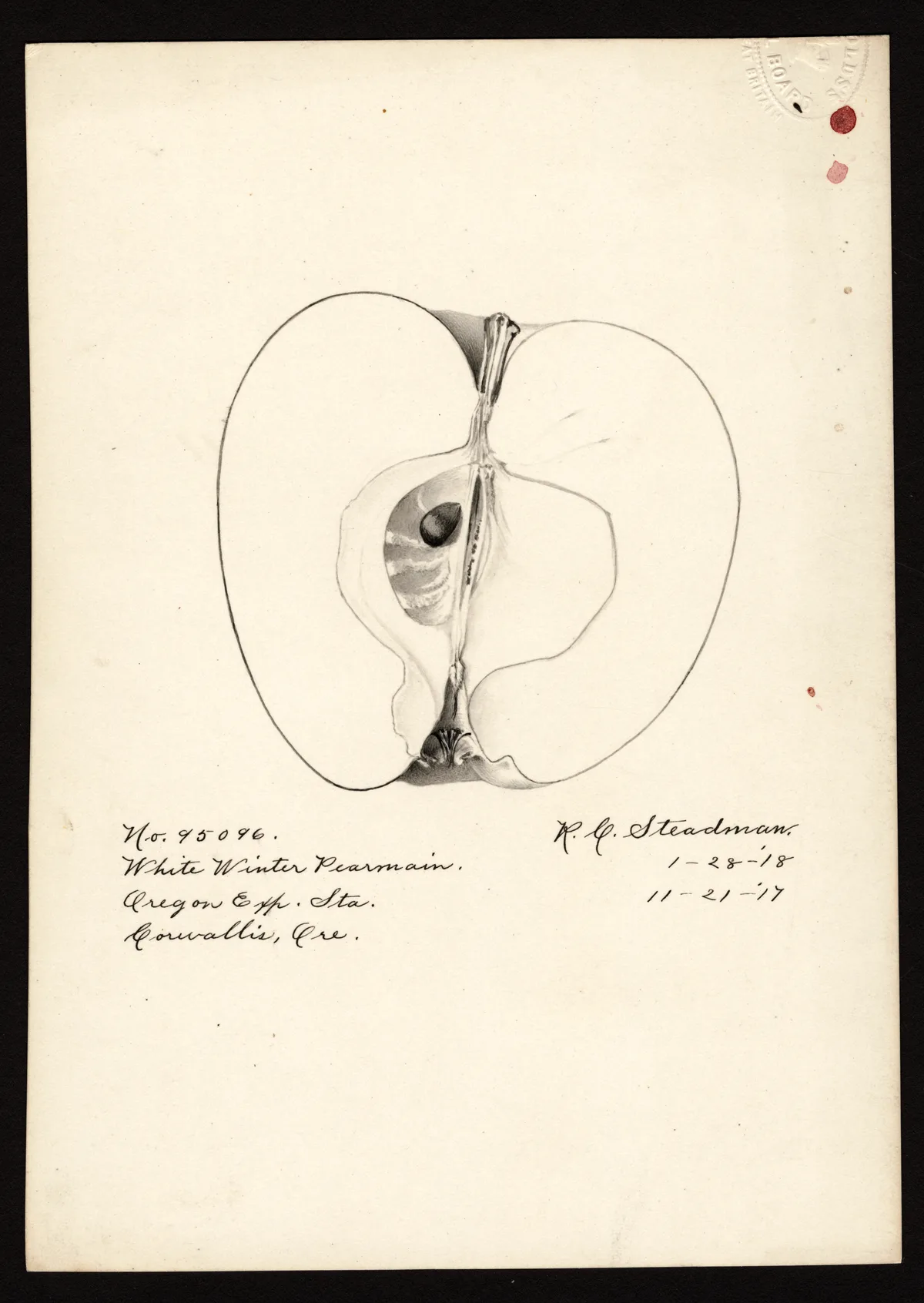
USDA Pomological Watercolor Collection
White Winter Pearmain
Origin / History
Origin unknown; believed to be an old Eastern variety whose original name was lost when it was carried west (Downing; Budd-Hansen; Beach; Hedrick). Warder relates that the fruit "was brought to Indiana by some of the early pomologists, in the days of saddle-bag transportation. In a lot of grafts, two varieties, having lost their labels, were propagated and fruited without name. Being considered Pearmain-shaped, they were called respectively Red and White Winter Pearmains. The former proved to be the Esopus Spitzenberg; the latter has never yet been identified, though believed to be an old eastern variety." Downing suggested it might be the Winter Harvey, a variety Warder had not seen described. Hedrick describes it as "one of the highly prized possessions of the pioneers of Ohio and Indiana."
For a time the variety was confused with the old New Jersey apple Michael Henry Pippin. Elliott originally listed White Pearmain and White Winter Pearmain as synonyms of Michael Henry Pippin in the first edition of his work, but on testing the apple on his own grounds he became confident of its distinctness and retained it under the name by which it was generally known; Warder, Thomas, and Beach all confirm the two are distinct varieties. In 1858 it was catalogued by the American Pomological Society as White Winter Pearmain; since 1897 the Society has listed it as White Pearmain, though Beach doubted whether this change would be generally accepted by fruit growers and dealers.
It has been an old favorite dessert apple in portions of the Middle West from Ohio to Kansas (Beach), extensively grown and much esteemed throughout the Southwest, and in Oregon "one of the most desirable of apples" (Elliott). Beach reports it appears to succeed better in those regions than in New York, where it is not recommended. Hedrick notes its cultivation is largely confined to Ohio and Indiana, though it has been somewhat planted in the Far West. Budd-Hansen's illustration was of a fine specimen from the Pacific slope, in Washington, shown at the Pan-American Exposition, 1901.
Tree
Tree vigorous (Beach; Budd-Hansen; Hedrick), spreading (Downing; Budd-Hansen; Beach; Hedrick), hardy and thrifty (Downing), a regular and good bearer (Downing), productive (Warder; Budd-Hansen). Elliott describes the tree as "thrifty, not rampant grower." Warder notes the bark is often marked by a kind of canker or crack.
Twigs / Young wood: Young shoots very short-jointed, dull reddish brown, slightly grayish or downy at end (Downing). Young wood dark speckled (Elliott). Twigs short, stout, blunt at tips, generally straight; internodes vary from short to long; bark reddish-brown overlaid with heavy scarf-skin, quite pubescent (Beach).
Lenticels: Conspicuous, numerous, above medium, elongated, raised (Beach).
Buds: Large, projecting, acute, quite pubescent, free (Beach); prominent (Elliott).
Foliage: Large, rather light green (Warder).
Fruit
Size: Medium to large (Warder; Hedrick; Lowther: medium); below medium to nearly large, uniform in size and shape (Beach); above medium (Elliott; Budd-Hansen); rather large (Thomas); medium or above (Downing).
Form: Conical, regular, sometimes obscurely angular (Warder); roundish oblong conic, somewhat oblique (Downing); roundish ovate or roundish approaching oblong conic, varying to roundish conic, somewhat ribbed, pretty symmetrical (Beach); above medium to large, roundish oblong conic, somewhat oblique and ribbed toward the base (Budd-Hansen); round-oblate, round or oblong-conic, ribbed, symmetrical (Hedrick); oblong conical, angular or oblique (Elliott); rather large, conical, angular or ribbed (Thomas).
Stem: Medium to long, often knobby and clubbed (Warder); short, in a deep cavity nearly closed (Downing); medium to long (Beach; Hedrick); medium to long, often fleshy or knobbed at branch end (Budd-Hansen); short (Elliott; Thomas).
Cavity: Acute, wavy, brown (Warder); deep (Downing; Elliott); rather small to above medium, acute, deep, moderately narrow to broad, somewhat furrowed, sometimes russeted (Beach); deep, regular, obtuse, with faint trace of russet (Budd-Hansen); small, acute, deep, narrow, furrowed, sometimes russeted (Hedrick).
Calyx: Medium, closed (Warder); nearly closed (Elliott); medium to large, usually closed; lobes long, acute (Beach); open; segments long, divergent (Budd-Hansen); large, usually closed; lobes long, acute (Hedrick). Downing notes "Segments long." Calyx tube long, conical (Beach; Hedrick); tube funnel-shaped, stamens median (Budd-Hansen).
Basin: Abrupt, regular or shallow and folded (Warder); uneven (Downing; Budd-Hansen); uneven, surrounded by five prominences, continued in obscure angles along its sides (Elliott); small to medium, oblique, shallow and obtuse to medium in depth and rather abrupt, medium in width, often distinctly furrowed, wrinkled, pubescent (Beach); shallow, uneven, or ribbed (Budd-Hansen); small, oblique, shallow, obtuse, often distinctly furrowed, wrinkled, pubescent (Hedrick).
Skin / Surface: Surface smooth, yellow, often bronzy (Warder); pale yellow, with a slight blush or warm cheek (Downing); pale yellow, with slight blush cheek (Elliott); light yellowish green, with a brownish red cheek (Thomas); clear pale yellow, with faint bronze blush or warm cheek (Budd-Hansen); skin tough, smooth, slightly waxen, pale yellow, or at first greenish, with a shade of brownish-red (Beach); tough, smooth, waxen, pale yellow, with a shade of brownish-red (Hedrick). Lowther codes the color as "yt." Warder notes the fruit is "handsome when fair, but often scabby on rich limestone soils and on old trees."
Dots: Scattered, small, dark (Warder); thickly sprinkled with minute brown dots (Downing); minute brown dots (Elliott); distinct, numerous, minute, russet (Budd-Hansen); numerous, pale or russet, often submerged, usually larger and much elongated about the cavity (Beach; Hedrick).
Flesh / Flavor: Yellow, fine grained, tender, crisp, juicy; flavor mild sub-acid, very rich; quality best (Warder). Yellowish, tender, crisp, juicy, very pleasant subacid; very good (Downing). Yellowish, tender, crisp, juicy, pleasant, very mild sub-acid; "very good" (Elliott). Whitish, fine-grained, with a mild sub-acid, rich, fine flavor (Thomas). Yellowish, tender, juicy, crisp, spicy, very pleasant subacid, excellent to best (Budd-Hansen). Slightly tinged with yellow, firm, fine-grained, crisp, tender, juicy, mild subacid, sprightly, very pleasantly aromatic, very good to best (Beach). Yellow, firm, fine-grained, crisp, tender, juicy, mild subacid, sprightly, pleasantly aromatic; good to best (Hedrick). Hedrick adds that the apples are "a little too mild for culinary uses, not particularly attractive in appearance, neither shape nor color appealing to the eye." Lowther rates quality "very good."
Core / Seeds: Core regular, closed, slightly clasping the eye; seeds few, pointed, pale or yellow (Warder). Core medium to rather large; cells closed or partly open; core lines somewhat clasping; carpels rather flat, broad or roundish-cordate, emarginate, mucronate, tufted; seeds light brown, medium to large, rather wide, plump, obtuse to acute, tufted (Beach). Core closed; cells round, slit; tube funnel-shaped; stamens median; seeds plump (Budd-Hansen). Core medium to large; cells closed or partly open; core-lines clasping; carpels flat, broad or round-cordate, emarginate, mucronate, tufted; seeds light brown, large, wide, plump, obtuse, tufted (Hedrick).
Season
December to March (Warder; Beach; Hedrick); January to April (Downing; Elliott); December to April (Budd-Hansen); winter (Lowther). Thomas calls it "at the West... one of the best and most productive winter apples."
Uses
Table, kitchen, market (Warder); both kitchen and market (Lowther). A dessert apple (Beach). Hedrick remarks that it is "a little too mild for culinary uses."
Subtypes / Variants
Not described in source.
Other
Lowther classes it as adapted to more than one of the three divisions of the United States as given by the American Pomological Society (N. Div.: 1).
Book Sources
Described in 8 period pomological works
- Warder, American Pomology: Apples (1867)
- Downing, Fruits and Fruit Trees of America (1900)
- Beach, The Apples of New York Vol. 1 (1905) — listed as White Pearmain
- Hedrick, Cyclopedia of Hardy Fruits (1922) — listed as WHITE PEARMAIN
- Elliott, The Western Fruit Book (1865)
- Lowther (ed.), Encyclopedia of Practical Horticulture (1914)
- Thomas, The American Fruit Culturist (1903)
- Budd & Hansen, Systematic Pomology (1914) — listed as White Pearmain (White Winter Pearmain)
Nursery Catalog Sources
Found in 41 catalogs (1886–1925) from Alabama, California, Illinois, Missouri, Nebraska, Oregon, Washington
- W.R. Strong & Co. , Capital and Orange Hill Nurseries (Robert Williamson, prop.), Sacramento , California — 1886
- Puyallup & Yakima Nurseries , Puyallup, Washington (Lock Box 191) and North Yakima , Washington — 1892
- Milwaukie-Canby Nurseries , Canby, OR (and Milwaukie, OR) — 1893
- Oregon Wholesale Nurseries , Salem , Oregon — 1893
- Multnomah Nurseries , Russellville , Oregon — 1894
- The Vineland Nurseries (Kelsey & Co. , Proprietors), St. Joseph, Missouri (Office: 13th and Atchison Sts., 2 Blocks East of the Citizens St. Car Line) — 1894
- Woodburn Nurseries , Woodburn, Marion Co. , Oregon — 1894
- Central Experimental Farm , Dominion Department of Agriculture, Agassiz, British Columbia (under test; Bulletin No. 3, Second Series) — 1900 — listed as White Pearmain
- Alabama Nursery Co. , Huntsville , Alabama — 1900
- Benjamin Buckman (personal inventory) , Farmingdale , Illinois — 1901 — listed as White Pearmain
- Washington Nursery Co. , Toppenish , Washington — 1901
- Mountain Grove Nurseries (Tippin & Moore , Proprietors; Geo. T. Tippin, J. W. Tippin, J. C. Moore), Mountain Grove , Missouri — 1901
- Pacific Nursery Company (W. O. Hudson & A. D. Hudson) , Tangent , Oregon — 1903
- Russellville Nursery Co. , Russellville, OR (three miles east of Portland, one mile from Montavilla car line) — 1903
- Henderson Luelling / Traveling Nursery (historical recall) , Oregon — 1904
- Phoenix Nursery Company (W. E. Rossney , President; Sidney Tuttle, Vice-President), Bloomington , Illinois — 1904
- The Dalles Nurseries , The Dalles , Oregon — 1906
- Stark Bros. Nurseries & Orchards Co. , Louisiana , Missouri — 1906
- J.B. Pilkington , Portland , Oregon — 1907
- Milton Nursery Co. (A. Miller & Sons , Proprietors), Milton , Oregon — 1909
- Washington Nursery Company , Toppenish , Washington — 1909
- C.F. Lansing , Salem , Oregon — 1910
- Stark Bros. Nurseries & Orchards Co. , Louisiana , Missouri — 1910
- Galbraith Nursery Co. (DeWitt Hansen , Pres.-Mgr.), Fairbury , Nebraska — 1911
- Stark Bros. Nurseries & Orchards Co. , Louisiana , Missouri — 1911
- Ballygreen Nurseries , Hanford , Washington — 1912 — listed as White Pearmain
- Ballygreen Nurseries , Hanford , Washington — 1912
- Pacific Nursery Company , Portland , Oregon — 1912
- Stark Bros. Nurseries & Orchards Co. , Louisiana , Missouri — 1912
- Vineland Nurseries Company , Clarkston , Washington — 1912
- Washington Nursery Company , Toppenish , Washington — 1912
- Benjamin Buckman (personal inventory) , Farmingdale , Illinois — 1913 — listed as White Pearmain
- Van Holderbeke Nursery Co. , Incorporated, Spokane, Washington (nurseries at Otis Orchards WA, Pasadena WA, Kennewick WA) — 1913
- Island Nurseries & Fruit Farm , Vashon (Vashon Island) , Washington — 1914
- Island Nurseries & Fruit Farm , Vashon (Vashon Island) , Washington — 1915
- Island Nurseries & Fruit Farm , Vashon (Vashon Island) , Washington — 1916
- Island Nurseries & Fruit Farm , Vashon (Vashon Island) , Washington — 1917
- Stark Bros. Nurseries & Orchards Co. , Louisiana , Missouri — 1918
- Oregon Nursery Co. , Orenco , Oregon — 1920
- Columbia & Okanogan Nursery Co. , Wenatchee , Washington — 1925
- North-Western Nurseries , Walla Walla , Washington
View original book sources (8)
— John A. Warder, American Pomology: Apples (1867)White Winter Pearmain.
This favorite fruit was brought to Indiana by some of the early pomologists, in the days of saddle-bag transportation. In a lot of grafts, two varieties, having lost their labels, were propagated and fruited without name. Being considered Pearmain-shaped, they were called respectively Red and White Winter Pearmains. The former proved to be the Esopus Spitzenberg; the latter has never yet been identified, though believed to be an old eastern variety. Mr. Downing suggests that it may be Winter Harvey, a description of which I have not seen. At one time this apple was confounded with the Michael Henry by many of us, and Mr. Elliott gives it as a synonym of that variety, but they are very distinct.
Tree spreading, vigorous, productive, the bark often marked by a kind of canker or crack. Foliage large, rather light green.
Fruit medium to large, handsome when fair, but often scabby on rich limestone soils and on old trees, conical, regular, sometimes obscurely angular; Surface smooth, yellow, often bronzy; Dots scattered, small, dark.
Basin abrupt, regular or shallow and folded; Eye medium, closed.
Cavity acute, wavy, brown; Stem medium to long, often knobby and clubbed.
Core regular, closed, slightly clasping the eye; Seeds few, pointed, pale or yellow; Flesh yellow, fine grained, tender, crisp, juicy; Flavor mild sub-acid, very rich; Quality best; Uses table, kitchen, market; Season December to March.
— A.J. Downing, The Fruits and Fruit Trees of America (1900)White Winter Pearmain. Campbellite.
Origin unknown, by some thought to be an old Eastern variety, highly esteemed at the West. Tree spreading, hardy, and thrifty, a regular and good bearer. Young shoots very short-jointed, dull reddish brown, slightly grayish or downy at end.
Fruit medium or above, roundish oblong conic, somewhat oblique. Stalk short, in a deep cavity nearly closed. Segments long. Basin uneven. Skin pale yellow, with a slight blush or warm cheek, thickly sprinkled with minute brown dots. Flesh yellowish, tender, crisp, juicy very pleasant subacid. Very good. January to April.
— S.A. Beach, The Apples of New York, Vol. 1 (1905)WHITE PEARMAIN.
References. 1. N. Y. Agr. Soc. Trans., 1849:124. 2. Phoenix, Horticulturist, 4:471. 1850. 3. Downing, 1857:110. fig. 4. Hooper, 1857:59, 60, 99, 100. 5. Am. Pom. Soc. Cat., 1858. 6. Mag. Hort., 27:60, 62. 1861. 7. Warder, 1867:508. 8. Thomas, 1875:232. 9. Barry, 1883:357. 10. Wickson, 1889:248. 11. Bailey, An. Hort., 1892:252. 12. Stinson, Ark. Sta. An. Rpt., 7:47. 1894. 13. Am. Pom. Soc. Cat., 1897:15. 14. Dickens and Greene, Kan. Sta. Bul., 106:56. 1902. 15. Powell and Fulton, U. S. B. P. I. Bul., 48:60. 1903. 16. Budd-Hansen, 1903:201. fig.
Synonym. White Winter Pearmain (1, 2, 3, 4, 5, 6, 7, 8, 9, 10, 11, 12, 14). White Winter Pearmain (15, 16).
This is an old favorite dessert apple in portions of the Middle West from Ohio to Kansas. It appears to succeed better in those regions than it does in New York. It is not recommended for planting in this state.
Historical. Warder says "This favorite fruit was brought to Indiana by some of the early pomologists, in the days of saddle-bag transportation. In a lot of grafts, two varieties, having lost their labels, were propagated and fruited without name. Being considered Pearmain-shaped, they were called respectively Red and White Winter Pearmains. The former proved to be the Esopus Spitzenberg; the latter has never yet been identified, though believed to be an old eastern variety." For a time it was confused with an old New Jersey apple by the name of Michael Henry Pippin, and Elliott fell into the error of publishing White Pearmain and White Winter Pearmain as synonyms of Michael Henry Pippin¹ but it was finally conceded that White Pearmain and Michael Henry Pippin are distinct varieties (4, 7). In 1858 it was catalogued by the American Pomological Society as White Winter Pearmain (5). Since 1897 (13) it has been listed as White Pearmain but it is very doubtful whether this change will be generally accepted by fruit growers and fruit dealers. This variety has been little grown in New York and is now seldom or never planted here.
¹ Elliott, 1854:91.
Tree.
Tree vigorous. Form spreading. Twigs short, stout, blunt at tips, generally straight; internodes vary from short to long. Bark reddish-brown overlaid with heavy scarf-skin, quite pubescent. Lenticels conspicuous, numerous, above medium, elongated, raised. Buds large, projecting, acute, quite pubescent, free.
Fruit.
Fruit below medium to nearly large, uniform in size and shape. Form roundish ovate or roundish approaching oblong conic, varying to roundish conic, somewhat ribbed, pretty symmetrical. Stem medium to long. Cavity rather small to above medium, acute, deep, moderately narrow to broad, somewhat furrowed, sometimes russeted. Calyx medium to large, usually closed; lobes long, acute. Basin small to medium, oblique, shallow and obtuse to medium in depth and rather abrupt, medium in width, often distinctly furrowed, wrinkled, pubescent.
Skin tough, smooth, slightly waxen, pale yellow, or at first greenish, with a shade of brownish-red. Dots numerous, pale or russet, often submerged, usually larger and much elongated about the cavity.
Calyx tube long, conical.
Core medium to rather large; cells closed or partly open; core lines somewhat clasping. Carpels rather flat, broad or roundish-cordate, emarginate, mucronate, tufted. Seeds light brown, medium to large, rather wide, plump, obtuse to acute, tufted.
Flesh slightly tinged with yellow, firm, fine-grained, crisp, tender, juicy, mild subacid, sprightly, very pleasantly aromatic, very good to best.
Season December to March.
— Granville Lowther (ed.), Encyclopedia of Practical Horticulture (1914)White W. Pearmain. Size: medium. Form: "re". Color: "yt". Quality: very good. Use: both kitchen and market. Season: winter. N. Div.: 1 (reported as adapted to more than one of the three divisions of the United States as given by the American Pomological Society).
— F.R. Elliott, The Western Fruit Book (1865)White Winter Pearmain.
This variety is extensively grown and much esteemed throughout the Southwest, and in Oregon it is one of the most desirable of apples. In our first edition we made it a synonym of Michael Henry Pippin, from the fact that all the specimens we gathered from various places were identical with that variety. Having since tested it on our own grounds, we are confident of its distinctness. It is undoubtedly an old variety, but what we are unable to determine, therefore retain it under the name by which it is generally known. Tree, thrifty, not rampant grower, young wood, dark speckled, buds, prominent. Fruit, above medium, oblong conical, angular or oblique; pale yellow, with slight blush cheek and minute brown dots; stem, short; cavity, deep; calyx, nearly closed; basin, uneven, surrounded by five prominences, continued in obscure angles along its sides; flesh, yellowish, tender, crisp, juicy, pleasant, very mild sub-acid; "very good." January to April.
— John J. Thomas, The American Fruit Culturist (1903)White Winter Pearmain.* Rather large, conical, angular or ribbed; light yellowish green, with a brownish red cheek; stem short; flesh whitish, fine-grained, with a mild sub-acid, rich, fine flavor. This is distinct from the Michael Henry Pippin, which it resembles, and at the West is one of the best and most productive winter apples. Fig. 472.
— J.L. Budd & N.E. Hansen, American Horticultural Manual, Part II: Systematic Pomology (1914)White Pearmain (White Winter Pear-main).— Origin unknown, supposed to be an old eastern variety the name of which was lost in coming to the West, where it is most popular. Tree vigorous, spreading, productive.
Tree above medium to large, roundish oblong conic, somewhat oblique and ribbed toward the base; surface clear pale yellow, with faint bronze blush or warm cheek; dots distinct, numerous, minute, russet; cavity deep, regular, obtuse, with faint trace of russet; stem medium to long, often fleshy or knobbed at branch end; basin shallow, uneven, or ribbed; calyx open; segments long, divergent. Core closed; cells round, slit; tube funnel-shaped: stamens median; seeds plump; flesh yellowish, tender, juicy, crisp, spicy, very pleasant subacid, excellent to best. December to April.
The cut is of a fine specimen from the Pacific slope, in Washington, shown at the Pan-American Exposition, 1901.
— U.P. Hedrick, Cyclopedia of Hardy Fruits (1922)WHITE PEARMAIN. White Winter Pearmain.
White Pearmain, possibly better known as White Winter Pearmain, was one of the highly prized possessions of the pioneers of Ohio and Indiana, having been brought to these states as grafts in the days of saddle-bag transportation. It is thought to be an old sort renamed, but what it is no one knows. The apples are very good to best in quality, a little too mild for culinary uses, not particularly attractive in appearance, neither shape nor color appealing to the eye. Its cultivation is largely confined to the states mentioned, though it has been somewhat planted in the Far West.
Tree vigorous, spreading. Fruit medium to large, uniform in size, round-oblate, round or oblong-conic, ribbed, symmetrical; stem medium to long; cavity small, acute, deep, narrow, furrowed, sometimes russeted; calyx large, usually closed; lobes long, acute; basin small, oblique, shallow, obtuse, often distinctly furrowed, wrinkled, pubescent; skin tough, smooth, waxen, pale yellow, with a shade of brownish-red; dots numerous, pale or russet, often submerged, usually large and much elongated about the cavity; calyx-tube long, conical; core medium to large; cells closed or partly open; core-lines clasping; carpels flat, broad or round-cordate, emarginate, mucronate, tufted; seeds light brown, large, wide, plump, obtuse, tufted; flesh yellow, firm, fine-grained, crisp, tender, juicy, mild subacid, sprightly, pleasantly aromatic; good to best; December to March.