Michael Henry Pippin
Apple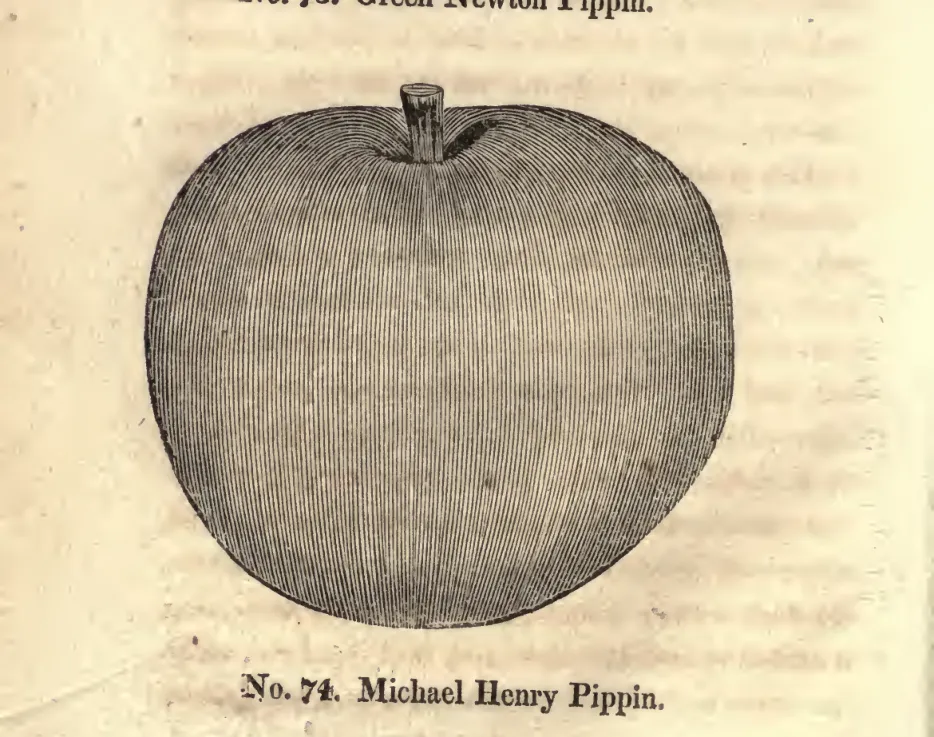
Origin and History
A native of Monmouth County, New Jersey, deriving its name from a resident of that county by whom it was brought into notice. First described by Coxe in 1817. Elliott notes it was in extensive cultivation throughout the West by the 1860s and very successful there.
Tree
The tree has a handsome regular form with strong growth, forming a very upright head. The limbs run straight with an inclination upwards, what Coxe describes as "beesom-headed," with pretty strong shoots. Very productive.
Fruit
Size: Coxe describes the fruit as large; Downing and Thomas call it medium; Elliott says medium to large.
Form: Coxe describes a handsome oblong shape, flat at the stalk end, diminishing towards the crown. Downing gives it as roundish oblong ovate, narrowing to the eye. Elliott describes it as angular, roundish conical. Thomas says roundish-ovate with narrow apex.
Stem: Short and rather thick.
Cavity: Narrow and regular (Elliott).
Calyx: Set in a narrow basin. Elliott notes long segments in the divisions.
Basin: Narrow; Elliott adds shallow and somewhat furrowed.
Skin: When ripe, a lively yellowish green. Elliott provides the most detailed account: light yellowish green with a flush of red in the sun, dotted with irregular-formed specks of russet; often there is a shade of rich yellow, marbled or striped, apparently underneath the skin. Coxe describes the ripe color simply as a lively yellow.
Flesh and Flavor: Very tender and juicy. Coxe describes the flesh as yellow in color, and "when in perfection, it is juicy, highly flavoured, rich, and melting." Downing calls the flesh greenish white with a "mild tame sweet" flavor, rating it "Good." Elliott describes the flesh as white, tender, juicy, and sweet. Thomas gives the flesh color as yellow. In summary, flesh color is given variously as yellow (Coxe, Thomas), greenish white (Downing), and white (Elliott); flavor is described as sweet by Downing, Elliott, and Thomas, though Coxe emphasizes it as highly flavored, rich, and melting without explicitly using the word sweet.
Core and Seeds: Core small and compact, surrounded by a broad, coarse vein giving the semblance of a large core. Seeds ovate, pointed, light brown (Elliott).
Season
Ripening begins in November according to Coxe and Downing; Elliott gives October. Keeps well through the winter, with Downing giving the season as November to March and Elliott as October to March.
Uses
Much valued for cooking and keeping well (Elliott).
Subtypes and Variants
Not described in source.
Other
Thomas notes a figure illustration (Fig. 467) in The American Fruit Culturist.
Book Sources
Described in 4 period pomological works
View original book sources (4)
— William Coxe, A View of the Cultivation of Fruit Trees (1817)NO. 74. MICHAEL HENRY PIPPIN.
This is a large fair apple, of a handsome oblong shape, flat at the stalk end, diminishing towards the crown: the colour when ripe is a lively yellow; the flesh is very tender, and when in perfection, it is juicy, highly flavoured, rich, and melting; of a yellow colour: the time of ripening is in November it keeps well through the winter.
The tree has a handsome regular form, and strong growth, the limbs running straight, with an inclination upwards, what is usually called beesom-headed it derives its name from a resident of Monmouth county, New-Jersey, by whom it was brought into notice.
— A.J. Downing, The Fruits and Fruit Trees of America (1900)Michael Henry Pippin.
Rariton Sweet.
A New Jersey fruit, a native of Monmouth County, first described by Coxe. The tree forms a very upright head, with pretty strong shoots. Very productive.
Fruit of medium size, roundish oblong ovate, narrowing to the eye, when ripe, of a lively yellowish green. Stalk short and rather thick. Calyx set in a narrow basin. Flesh greenish white, very tender, juicy, mild tame sweet. Good. November to March.
— F.R. Elliott, The Western Fruit Book (1865)Michael Henry Pippin.
American. Native of New Jersey. It is in extensive cultivation throughout the West, and is very successful. Trees very productive. Fruit, medium to large ; form, angular, roundish conical ; color, light yellowish green, with a flush of red, in sun, dotted with irregular formed specks of russet ; often there is a shade of rich yellow, marbled or striped, apparently underneath the skin ; stem, usually short ; cavity, narrow, regular ; calyx, with long segments in divisions ; basin, shallow, narrow, somewhat furrowed : flesh, white tender, juicy, sweet : much valued for cooking and keeping well, being in use from October to March ; core, small, compact, surrounded by a broad, coarse vein, giving semblance of a large core ; seeds, ovate pointed, light brown.
— John J. Thomas, The American Fruit Culturist (1903)Michael Henry Pippin.* Size medium, roundish-ovate, apex narrow; yellowish green; stalk short, rather thick; basin narrow; flesh yellow, tender, juicy. Growth upright. Through winter. Origin, Monmouth County, N. J. Fig. 467.