Vandevere
Apple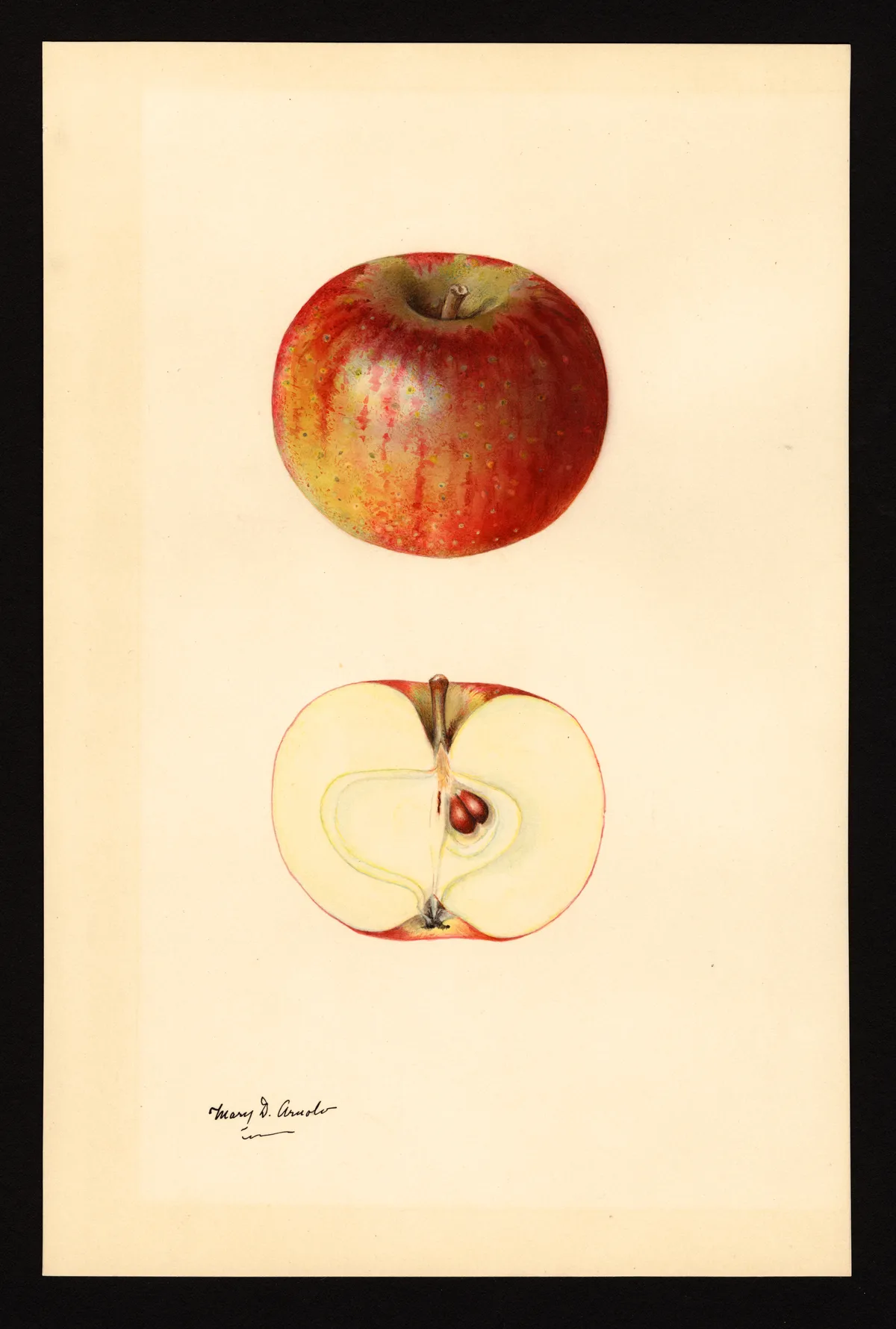
USDA Pomological Watercolor Collection
Vandevere
Origin / History
An old variety, a native of Wilmington, Delaware, taking its name from a family there named Vandiver — by right that should be the spelling of the apple, but it has so long been known and grown under the spelling Vandevere that Downing deemed it best not to change it. Coxe gave Delaware as its origin, and Downing repeats that attribution. It is sometimes called the Vandevere of Delaware or the Vandevere of Pennsylvania. Warder notes this old kitchen favorite of Pennsylvania has migrated westward until it has reached every State and county on its appropriate parallels of latitude, 39° to 42°. Warder adopted the name "Pennsylvania Vandervere" (in accordance with common acceptance in the regions where it is best known) to distinguish it from several other Vanderveres, and especially from the Newtown Spitzenburg, to which the name Vandervere had been applied in New York and westward on that parallel; Coxe describes the fruit in question under the name Vandervere. Beach likewise notes that the old variety commonly called Vandevere in New York is the Newtown Spitzenburg, and that the true Vandevere here considered is quite distinct from it; Vandevere has never been much cultivated in New York and is now seldom or never planted there. Downing observes there is much confusion existing respecting this apple and its sub-varieties, some of which may possibly be grown under the synonyms attributed to it. Budd & Hansen distinguish this variety from the Vandevere Pippin grown at the West. Downing also notes there is a Vandevere received from Virginia, the young wood of which is slender, with very small inconspicuous buds.
Tree
Warder: vigorous, healthy, large, spreading, very twiggy and drooping, with abundant fruit on the ends of the spray; foliage bright yellowish-green, shining, pointed, the whole aspect of the tree peculiar and characteristic in summer or winter. Downing: of moderate horizontal growth, not very productive; young shoots smooth, dark grayish reddish brown, with bold, full, projecting, rounded conical buds. Beach: tree of medium size, spreading, moderately vigorous, not very productive. Central Experimental Farm (planted Spring 1896): a vigorous grower.
Fruit
Size and Form: Medium or less (Warder) / medium (Downing, Beach, Budd & Hansen, Central Experimental Farm); oblate, or globular-oblate, regular (Warder); oblate (Downing, Budd & Hansen, Central Experimental Farm).
Stem / Cavity: Stem long, slender (Warder); stalk about an inch long, inserted in a deep cavity (Downing); stem about one inch long, cavity deep (Budd & Hansen); cavity wide, regular (Warder).
Calyx / Basin: Eye small, closed (Warder); calyx small and closed, set in a round, moderate basin (Downing); calyx small, closed; basin round, moderate (Budd & Hansen); basin wide, regular, not deep (Warder).
Skin / Surface: Surface smooth, but having raised hemispherical warts of a yellow russet color; yellow, mottled, and striped light red, often a gray appearance over the whole exterior; dots large, yellow, indented (Warder). Color waxen yellow, striped with red, and covered with numerous green dots (Downing); surface waxen yellow, striped with red; dots numerous, green (Budd & Hansen). Beach: marked with light red in indistinct streaks over a yellow background; well colored specimens become deep red; dots numerous, green or light gray. Central Experimental Farm: skin greenish yellow, with a little russet, and some red blush.
Flesh / Flavor: Warder: flesh yellow, breaking, granular, juicy; flavor highly aromatic, acid. Downing: flesh yellowish, compact, but tender, with a fine, rich, subacid flavor; Good. Budd & Hansen: flesh yellowish, compact, but tender, with a fine, rich, subacid flavor; good. Beach: flesh yellowish, crisp and tender with a rich, sprightly, mild subacid flavor — when in perfection a beautiful and fine apple. Central Experimental Farm: flesh yellowish, solid, juicy, tender, rich, sub-acid, with a pleasant flavour; quality good.
Quality: Warder: for table third, for kitchen first, for cider Coxe says very good, yielding a heavy must.
Core / Seeds: Warder: core regular, closed, meeting and clasping the eye; seeds numerous, pointed, plump.
Season
December and January (Warder); October to January (Downing, Beach, Budd & Hansen); October and November (Central Experimental Farm).
Uses
Valued especially for culinary purposes (Downing, Beach, Budd & Hansen — "valuable for culinary use"). For cider, Coxe (via Warder) says very good, yielding a heavy must. Warder notes the fruit may be used for cooking as soon as any other apple, making good sauce in July when not half grown.
Subtypes / Variants
Downing notes much confusion existing respecting this apple and its sub-varieties, and mentions a Vandevere received from Virginia whose young wood is slender, with very small inconspicuous buds. Budd & Hansen distinguish the variety from the Vandevere Pippin grown at the West. Warder adopts "Pennsylvania Vandervere" to distinguish it from several other Vanderveres, especially the Newtown Spitzenburg called Vandervere in New York.
Other
Warder: the fruit is subject to bitter rot, and does not keep well.
Book Sources
Described in 4 period pomological works
Nursery Catalog Sources
Found in 15 catalogs (1864–1920) from Alabama, California, Illinois, Oregon, Washington
- St. Helena Nursery , Howell's Prairie, Marion County , Oregon — 1864
- California Nursery Co. , Niles , California — 1889
- Sherwood Hall Nursery Co. , Timothy Hopkins (Menlo Park Nurseries), San Francisco / Menlo Park , California — 1893
- The Vineland Nurseries (Kelsey & Co. , Proprietors), St. Joseph, Missouri (Office: 13th and Atchison Sts., 2 Blocks East of the Citizens St. Car Line) — 1894
- Woodburn Nurseries , Woodburn, Marion Co. , Oregon — 1894
- Alabama Nursery Co. , Huntsville , Alabama — 1900
- Central Experimental Farm , Dominion Department of Agriculture, Agassiz, British Columbia (under test; Bulletin No. 3, Second Series) — 1900
- Washington Nursery Co. , Toppenish , Washington — 1901
- Benjamin Buckman (personal inventory) , Farmingdale , Illinois — 1901
- Henderson Luelling / Traveling Nursery (historical recall) , Oregon — 1904
- Washington Nursery Company , Toppenish , Washington — 1909
- Washington Nursery Company , Toppenish , Washington — 1912
- Pacific Nursery Company , Portland , Oregon — 1912
- Benjamin Buckman (personal inventory) , Farmingdale , Illinois — 1913
- Oregon Nursery Co. , Orenco , Oregon — 1920
View original book sources (5)
— John A. Warder, American Pomology: Apples (1867)Pennsylvania Vandervere.
VANDERVERE (Coxe and Downing)—LITTLE VANDERVERE—GRAY VANDERVERE—STAALCUBS, ETC.
This old kitchen favorite, of Pennsylvania, has migrated westward until it has reached every State and county on its appropriate parallels of latitude, 39° to 42°.
Mr. Downing gives Delaware as its origin, on the authority of Coxe. In accordance with common acceptance in the regions where it is best known, I have adopted the above name, which was given to distinguish it from several other Vanderveres, and especially from the Newtown Spitzenberg, to which the name Vandervere had been applied in New York and westward on that parallel. Coxe describes the fruit in question under the name Vandervere.
Tree vigorous, healthy, large, spreading, very twiggy and drooping, with abundant fruit on the ends of the spray; Foliage bright yellowish-green, shining, pointed, the whole aspect of the tree peculiar and characteristic in summer or winter.
Fruit medium or less, oblate, or globular-oblate, regular; Surface smooth, but having raised hemispherical warts of a yellow russet color, yellow, mottled, and striped light red, often a gray appearance over the whole exterior; Dots large, yellow, indented.
Basin wide, regular, not deep; Eye small, closed.
Cavity wide, regular; Stem long, slender.
Core regular, closed, meeting and clasping the eye; seeds numerous, pointed, plump; Flesh yellow, breaking, granular, juicy; Flavor highly aromatic, acid; Quality for table third, for kitchen first, for cider Coxe says very good, yielding a heavy must; Season December and January.
The fruit is subject to bitter rot, and does not keep well, but may be used for cooking as soon as any other apple, making good sauce in July, when not half grown.
— A.J. Downing, The Fruits and Fruit Trees of America (1900)Vandevere.
White Vandevere. Vandevere of Pa. Green Vandevere. Little Vandevere of Indiana. Stalclubs. Vandiver. Vanderveer. Yellow Vandervere. Striped Vandervere. Pennsylvania Vandevere. Lasting Vandervere ? Fall Vandevere ? Red Vandevere.
The Vandevere is an old fruit, a native of Wilmington, Del., and took its name from a family there by name of Vandiver, which should be by right the name of the Apple ; but it has so long been known and grown under the spelling Vandevere, that we deem it best not to change it. There is much confusion existing respecting this Apple and its sub-varieties, which possibly some of those may be, grown under what we give as synonyms. Tree of moderate horizontal growth, not very productive. Young shoots smooth, dark grayish reddish brown, with bold, full, projecting, rounded conical buds.
Fruit of medium size, oblate. Stalk about an inch long, inserted in a deep cavity. Calyx small and closed, set in a round, moderate basin. Color waxen yellow, striped with red, and covered with numerous green dots. Flesh yellowish, compact, but tender, with a fine, rich, subacid flavor. Good. October to January. Valuable for culinary purposes.
There is a Vandevere which we have received from Virginia, the young wood of which is slender, with very small inconspicuous buds.
— S.A. Beach, The Apples of New York, Vol. 2 (1905)VANDEVERE.
REFERENCES. 1. Am. Gard. Cal., 1806:585. 2. Coxe, 1817:141. fig. 3. Thacher, 1822:139. 4. Buel, N. Y. Bd. Agr. Mem., 1826:477. 5. Floy-Lindley, 1833:85. 6. Downing, 1845:141. fig. 7. Thomas, 1849:173. 8. Cole, 1849:122. 9. Horticulturist, 10:87. 1855. 10. Ib., 11:89. 1856. 11. Warder, 1867:735. 12. Fitz, 1872:121, 149, 153. 13. Am. Pom. Soc. Cat., 1873. 14. Lyon, Mich. Hort. Soc. Rpt., 1890:298. 15. Bailey, An. Hort., 1892:251. 16. Budd-Hansen, 1903:193.
SYNONYMS. Oxeye (8, 12). Staalcubs (2, 4). Stalcubs (3, 6). VANDERVERE (2, 6, 9, 10, 11). VANDEVEER (4). VANDEVERE (1, 3, 5, 7, 8, 12, 13, 14, 15, 16).
The old variety which is commonly called Vandevere in New York is known to pomologists by the name Newtown Spitzenburg, under which name it is described in Vol. I, page 225. It originated in Newtown, L. I. The true Vandevere which we are here considering is quite distinct from this Newtown Spitzenburg. When in perfection Vandevere is a beautiful and fine apple, medium in size, marked with light red in indistinct streaks over a yellow background; well colored specimens become deep red; dots numerous, green or light gray; flesh yellowish, crisp and tender with a rich, sprightly, mild subacid flavor, valued especially for culinary purposes; in season from October to January.
The tree is of medium size, spreading, moderately vigorous, not very productive (2, 6, 7).
Historical. An old variety native of Wilmington, Del. (2, 6). It is sometimes called the Vandevere of Delaware or the Vandevere of Pennsylvania. It has never been much cultivated in New York and is now seldom or never planted here.
— J.L. Budd & N.E. Hansen, American Horticultural Manual, Part II: Systematic Pomology (1914)Vandevere.—An old variety, originated at Wilmington, Delaware; distinct from Vandevere Pippin grown at the West.
Fruit medium, oblate; surface waxen yellow, striped with red; dots numerous, green; cavity deep; stem about one inch long; basin round, moderate; calyx small, closed; flesh yellowish, compact, but tender, with a fine, rich, subacid flavor, good, valuable for culinary use. October to January.
— Central Experimental Farm, Central Experimental Farm, Agassiz BC — Catalogue of Fruit Trees under Test (Bulletin No. 3, 1900) (1900)Planted Spring 1896. Tree a vigorous grower. Fruit of medium size, oblate. Skin greenish yellow, with a little russet, and some red blush. Flesh yellowish, solid, juicy, tender, rich, sub-acid, with a pleasant flavour, quality good. Season October and November.