Alfriston
Apple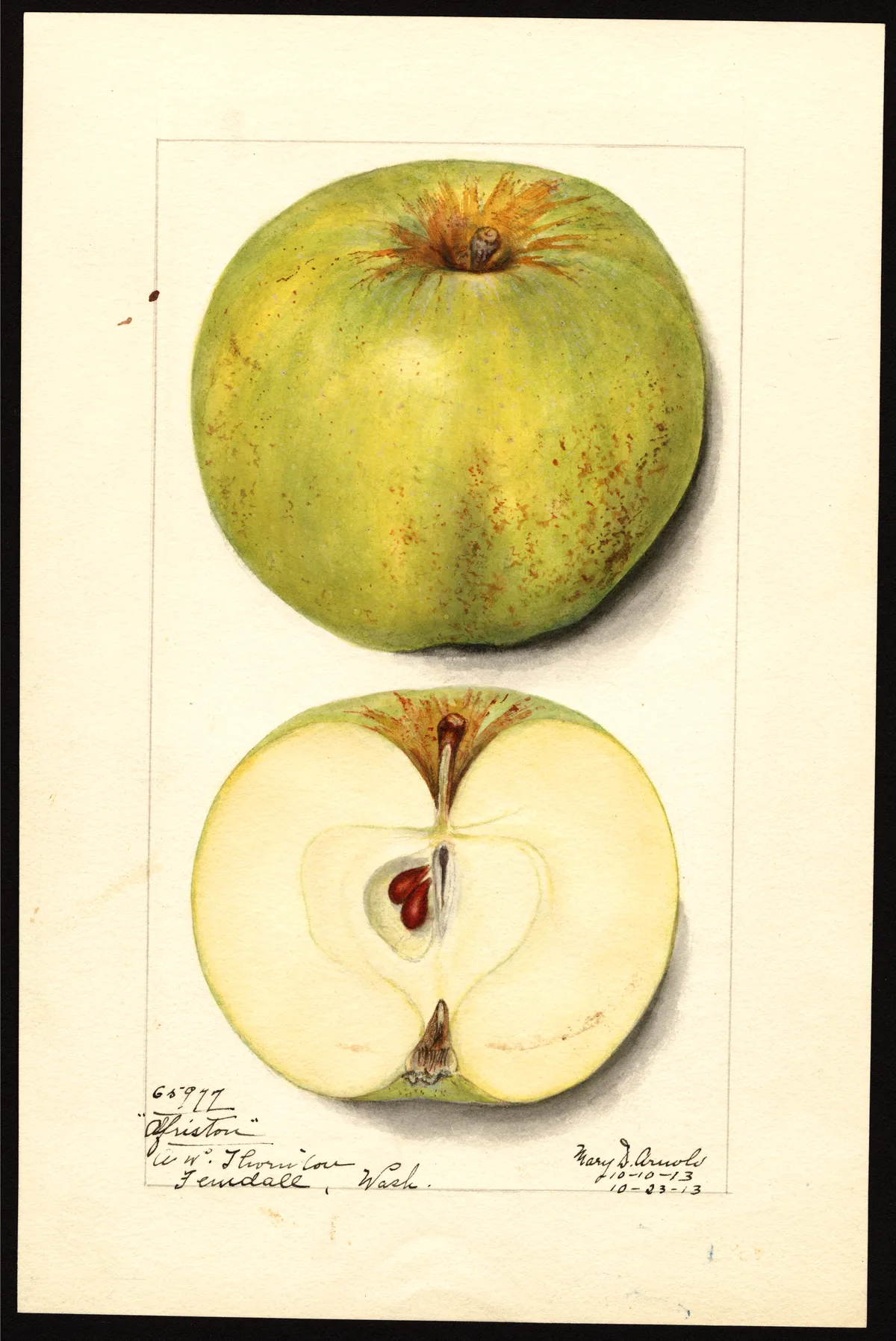
USDA Pomological Watercolor Collection
Alfriston
Origin/History
Raised by a Mr. Shepherd at Alfriston, Sussex, about the end of the eighteenth century (Bunyard). It was originally known under several names, including Shepherd's Pippin and Shepherd's Seedling; Ronalds (p. 35) also records it. The name Baltimore has been applied to it incorrectly (Downing). Downing describes it as a third-rate apple valued in England for cooking.
Tree
Growth vigorous and fertile. Leaf pea green, flat and undulating, broadly serrate (Bunyard). Not further described in sources.
Fruit
Size and Form: Large. Bunyard gives dimensions of 3½ inches by 2¾ inches; round, conical, flattened, and irregular. Downing describes it as roundish, a little ribbed, and rather broadest at the base.
Stem: Not described in sources.
Cavity: Not described in sources.
Calyx: Not described in sources.
Basin: Not described in sources.
Skin: Downing gives the color as pale greenish-yellow. Bunyard describes the color as green to yellow with russet veining.
Flesh and Flavor: Flesh crisp. Downing gives the color as yellowish-white; Bunyard as pale yellow. Downing describes the flavor as tolerable and somewhat acid. Bunyard describes it as sub-acid. When cooked, it renders a tender, golden brown with a delicious pear-like flavor (Bunyard).
Core and Seeds: Not described in sources.
Season
Downing gives the season as October to January. Bunyard states it keeps until April.
Uses
Culinary. Valued in England for cooking (Downing). Cooks to a tender, golden brown with a delicious pear-like flavor (Bunyard).
Subtypes/Variants
Not described in sources.
Other
Not described in sources.
Book Sources
Described in 2 period pomological works
Nursery Catalog Sources
Found in 8 catalogs (1897–1917) from England, Illinois
- Kelway & Son , Langport, Somerset , England — 1897
- George Bunyard & Co. , Royal Nurseries, Maidstone, Kent , England — 1900
- Central Experimental Farm , Dominion Department of Agriculture, Agassiz, British Columbia (under test; Bulletin No. 3, Second Series) — 1900
- Benjamin Buckman (personal inventory) , Farmingdale , Illinois — 1901
- James Veitch & Sons , Ltd., Royal Exotic Nursery, Chelsea, London (also Coombe Wood, Langley, and Feltham) , England — 1911
- Benjamin Buckman (personal inventory) , Farmingdale , Illinois — 1913
- George Bunyard & Co. , Royal Nurseries, Maidstone, Kent , England — 1914
- George Bunyard & Co. , Royal Nurseries, Maidstone, Kent , England — 1917
View original book sources (2)
— A.J. Downing, The Fruits and Fruit Trees of America (1900)Alfriston.
Lord Gwydr's Newtown Pippin. Oldaker's New. Shepherd's Pippin. Baltimore, incorrectly.
A third-rate Apple, valued in England for cooking. Fruit large, roundish, a little ribbed, and rather broadest at the base, pale greenish-yellow. Flesh yellowish-white, crisp, tender, with a tolerable, somewhat acid flavor. Good. October to January.
— E.A. Bunyard, A Handbook of Hardy Fruits (1920)ALFRISTON. Ronalds p. 35. (Shepherds Pippin, Shepherds Seedling), culinary, keeps till April, large, 3½ by 2¾, round, conical, flattened, irregular. Colour, green to yellow russet veined. Flesh, crisp, pale yellow, sub-acid. Growth, vigorous, fertile. Leaf, pea green, flat undulating, broadly serrate. Origin, raised by a Mr. Shepherd at Alfriston, Sussex, about the end of the eighteenth century. This apple cooks a tender, golden brown with a delicious pear-like flavour.