Roseau
Apple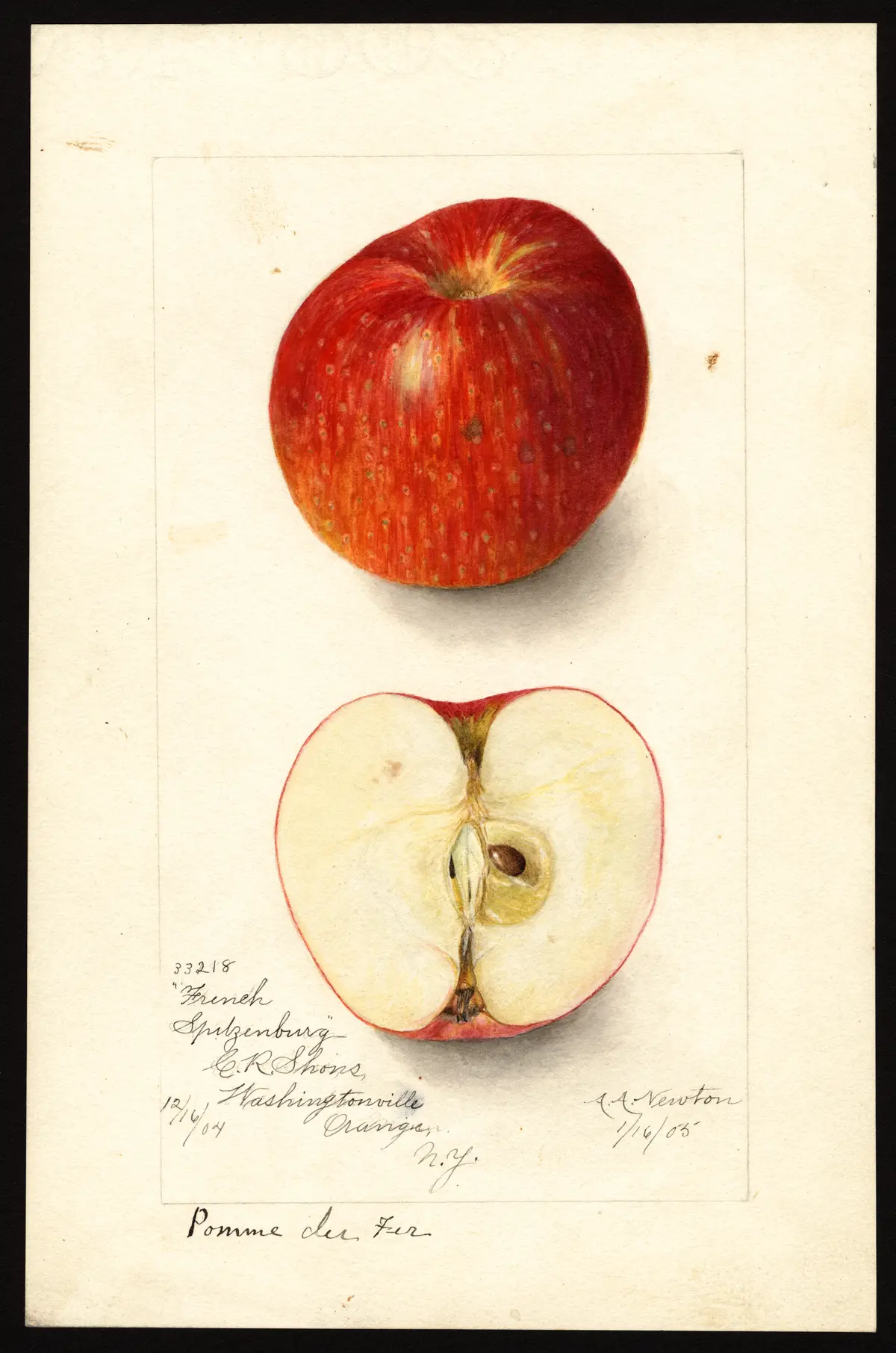
USDA Pomological Watercolor Collection
Roseau
Origin/History
Period sources disagree on geographic origin. Elliott (1865), Downing (1900), and Thomas (1903) describe Roseau simply as "Foreign." However, the same variety appears in these and later sources under the historical synonyms Baltimore, Flushing Spitzenburg, Cable's Gilliflower, and Royal Pippin, and under those names the attribution shifts to America. Warder (1867), writing of it as Baltimore (also called Flushing Spitzenberg of Northwest, Cable's Gilliflower, or Royal Pippin in Illinois), states the origin "is unknown, though it is extensively cultivated in western orchards, especially in the lake country, for it is scarcely known within the Ohio river fruit region." Downing (1900), under Baltimore, gives "Origin unknown." Beach (1905) records that "this variety probably originated in America. Although it has long been known in cultivation it is not regarded favorably by commercial orchardists and is now seldom planted." Hedrick (1922) writes "Nothing is known of the early history of Flushing Spitzenburg, but it has been cultivated since 1800, when it was first described." Budd & Hansen (1914) state simply "Of American origin." Beach (1905) additionally notes that a variety known in portions of Ontario under the name Red Canada or Canada Red is said to be quite different from the Red Canada of Western New York. Downing (1900) records, as a separate identification, that "an apple received from Maryland as Baltimore proves identical with Fallawater." Earliest references trace to the North American Pomological Convention, 1849, and to Thacher 1822 and Kenrick 1832 under the Flushing Spitzenburg name (per Beach).
Tree
Sources conflict sharply on tree character.
Under the name Roseau, judgments are dismissive: Downing (1900) "Tree poor grower and unprofitable"; Thomas (1903) "of little value"; Elliott (1865) "unprofitable."
Under the Baltimore form, the tree is rated more highly. Elliott (1865): "Tree, thrifty, slender, very productive, on warm, rich soils." Warder (1867): "Tree thrifty, sufficiently vigorous but with slender growth, very productive, spreading." Downing (1900): "Tree healthy, hardy, moderately vigorous, making a round head that when loaded with fruit appears almost drooping. Young shoots slender, dull reddish brown. A profitable variety for market or table use."
Under the Flushing Spitzenburg form, the tree is consistently described as vigorous with stout, distinctively reddish-brown shoots, repeatedly contrasted with the slender yellowish-gray shoots of Esopus Spitzenburg — a variety with which Roseau has frequently been confounded due to the similarity of the names. Elliott (1865): "Tree, vigorous, strong brown shoots." Downing (1900): "The tree makes strong reddish brown shoots, different from the slender yellowish ones of [Esopus Spitzenburgh]." Thomas (1903): "Shoots strong, brown, unlike the slender, gray shoots of Esopus Spitzenburgh." Beach (1905): "Tree large, vigorous. Form round-headed or spreading. Twigs stout, reddish-brown, quite distinct from the small yellowish gray shoots of Esopus Spitzenburg." Hedrick (1922): "Tree large, vigorous, round-headed or spreading." Budd & Hansen (1914): "The young shoots are strong reddish brown, unlike the slender yellowish shoots of the Esopus Spitzenburg." Beach (1905) further notes the tree "generally has the reputation of being a shy bearer," with "considerable loss from the dropping of the fruit before it is fully mature."
Fruit
Size
Under Roseau: Elliott (1865), Downing (1900), and Thomas (1903) all give "large." Under Baltimore: Elliott "medium to large"; Warder "medium"; Downing "medium"; Thomas "medium." Under Flushing Spitzenburg: Elliott, Warder, Downing, Thomas, and Budd & Hansen all give "medium"; Beach "medium to nearly large"; Hedrick "medium to large."
Form
Under Roseau: Elliott and Thomas describe "irregular in size and form." Under Baltimore: Elliott "round, or roundish ovate"; Warder "regular, oblate, almost round in some specimens"; Downing "roundish, conical, regular"; Thomas "roundish." Under Flushing Spitzenburg: Elliott "roundish, slightly conical"; Downing "roundish conical"; Thomas "roundish conical"; Budd & Hansen "regular, roundish conical"; Beach "roundish conic or sometimes oblate conic, obscurely ribbed, pretty symmetrical"; Hedrick "round-conic or sometimes oblate-conic, obscurely ribbed, symmetrical."
Stem
Under Baltimore: Elliott "short"; Warder "short to medium"; Downing "short." Under Flushing Spitzenburg: Elliott "slender"; Beach "short to medium"; Hedrick "short"; Budd & Hansen "medium."
Cavity
Under Baltimore: Elliott "open, deep, regular"; Warder "wide, regular, brown"; Downing "medium size, rather thinly russeted." Under Flushing Spitzenburg: Elliott "narrow"; Downing "narrow, projecting beyond the fruit"; Thomas "small"; Beach "acuminate, moderately deep to deep, narrow to rather broad, smooth and red or greenish, sometimes more or less overspread with greenish or red russet"; Hedrick "acuminate, deep, narrow, smooth and red or greenish"; Budd & Hansen "deep, wide, regular, obtuse, some radiating russet."
Calyx
Under Baltimore: Elliott "small, half open"; Warder (eye) "small, closed"; Downing "small, closed. Segments drawn to a point." Under Flushing Spitzenburg: Elliott "small"; Downing "small, in an even basin"; Thomas "small"; Beach "medium to rather small, closed or partly open; lobes broad, obtuse"; Hedrick "small, closed or open; lobes broad, obtuse"; Budd & Hansen "open; segments flat convergent."
Basin
Under Baltimore: Elliott "shallow, regular"; Warder "shallow, regular"; Downing "shallow, nearly smooth." Under Flushing Spitzenburg: Elliott "shallow"; Beach "varying from narrow and shallow to medium in width and depth, obtuse to abrupt, sometimes somewhat furrowed and wrinkled"; Hedrick "narrow and shallow, obtuse, sometimes furrowed and wrinkled"; Budd & Hansen "very shallow, wide, with many small corrugations and ribs."
Skin and Color
Under Roseau: Elliott (1865), Downing (1900), and Thomas (1903) all describe the skin as "dark red."
Under Baltimore the color picture is more elaborate and significantly lighter. Elliott (1865): "light yellow, striped, and splashed with purplish red, a little bronzed russet about the stem, large whitish dots, and often a blue tinge marbled toward the stem, resembling a bloom." Warder (1867): "Surface smooth, red, striped with deep red and often covered with whitish or gray markings that give it a blue appearance like a bloom; dots scattered, large, yellow or fawn color." Downing (1900): "pale yellow, shaded with light red, striped and splashed with dark red, almost purplish, having a grayish appearance of bloom, large light dots, with a dark centre." Thomas (1903): "striped purplish red."
Under Flushing Spitzenburg, the skin is yellow or greenish-yellow ground heavily covered with red and dotted with whitish or fawn spots. Elliott (1865): "greenish yellow, mostly covered with warm yellowish red, russet dots, with suffused fawn shade surrounding." Warder (1867) quotes Elliott. Downing (1900): "Skin nearly covered with red, on a greenish yellow ground, dotted with large fawn spots, and coated with a slight bloom." Thomas (1903): "rich red on yellow, with large whitish or fawn spots." Beach (1905): "Skin tough, yellow or greenish overspread with orange-red, becoming a bright deep red on the exposed side, coated with a light bloom. Dots conspicuous, whitish, scattered over the base but very numerous around the basin." Hedrick (1922): "skin tough, yellow, overspread with orange-red, becoming bright deep red on the exposed side, coated with light bloom; dots conspicuous, white." Budd & Hansen (1914): "surface yellow, mostly covered with mixed dark red, overlaid with whitish; dots distinct, numerous, minute, russet."
Flesh and Flavor
Under Roseau: Downing (1900) gives "Flesh crisp, juicy, rich. Good."
Under Baltimore: Elliott (1865) "white, with a slight tinge of yellow, tender, crisp, juicy, sub-acid, sprightly." Warder (1867) "yellow, fine grained, juicy, almost sweet, aromatic, lacking character; Of second quality, but valuable for market." Downing (1900) "whitish, tender, juicy, mild, subacid... Very good." Thomas (1903) "sub-acid, very good."
Under Flushing Spitzenburg: Elliott (1865) "white, tinged yellow, juicy, mild, crisp, nearly sweet; 'very good.'" Warder (1867) quotes Elliott. Downing (1900) "white, juicy, crisp, nearly sweet, and of pleasant flavor, but without the brisk richness or yellow color of the Esopus Spitzenburgh. Good." Thomas (1903) "whitish yellow, crisp, with a very mild sub-acid, moderate flavor." Beach (1905) "whitish tinged with yellow, sometimes streaked with red, firm, moderately coarse, crisp, not very tender, moderately juicy, mild subacid, not high in flavor, good in quality." Hedrick (1922) "yellow, sometimes streaked with red, firm, coarse, crisp, juicy, mild subacid; good in quality." Budd & Hansen (1914) "white, juicy, pleasant, nearly sweet, good."
Core and Seeds
Under Baltimore: Elliott (1865) "core, medium, or small; seeds, obovate pyriform." Warder (1867) "Core large, closed; Seeds numerous, plump." Downing (1900) "Core medium."
Under Flushing Spitzenburg: Elliott (1865) "core, rather large." Beach (1905) gives the fullest dissection: "Calyx tube long, funnel-form, extending to the core. Stamens median. Core distant, abaxile with a wide hollow cylinder at the center, varying to nearly axile; cells pretty symmetrical, partly open or closed; core lines clasping the funnel cylinder. Carpels roundish, wide, mucronate, slightly emarginate, somewhat tufted. Seeds dark, medium to large, wide, plump, acute to obtuse, sometimes tufted." Hedrick (1922): "calyx-tube long, funnel-form, extending to the core; stamens median; core distant, abaxile with a wide hollow cylinder at the center, nearly axile; cells symmetrical, partly open or closed; core-lines clasping; carpels round, wide, mucronate, emarginate, somewhat tufted; seeds dark, large, wide, plump, acute, sometimes tufted." Budd & Hansen (1914): "Core closed; cells round, entire; tube conical; stamens median; seeds plump."
Season
Under Roseau: Downing (1900) "November, February"; Thomas (1903) "Winter." Under Baltimore: Elliott (1865) "December to March"; Warder (1867) "December and January"; Downing (1900) "December to April"; Thomas (1903) "Winter." Under Flushing Spitzenburg: Elliott (1865) "November to February"; Downing (1900) "October to February"; Thomas (1903) "Early winter"; Beach (1905) "October to February"; Hedrick (1922) "October to February"; Budd & Hansen (1914) "October to February."
Uses
Judgments range from dismissive to commercially favorable. Elliott (1865), under Roseau: "unprofitable." Thomas (1903): "of little value." Hedrick (1922), under the Flushing Spitzenburg name: "passing into deserved oblivion." Beach (1905): "Fruit of good color but not very good in quality."
Under the Baltimore form, the verdict is more positive. Warder (1867): "valuable for market; Not disposed to rot, does not show bruises." Downing (1900): "A profitable variety for market or table use." Warder rates it "second rate" overall but commercially worthwhile in the western/lake-country orchards.
Subtypes/Variants
Not described in source.
Other
Multiple authorities stress that under the Flushing Spitzenburg name the variety has frequently been confounded with Esopus Spitzenburg, but the two are reliably distinguished by shoot character — strong reddish-brown in Roseau versus slender yellowish or gray in Esopus Spitzenburg — and by the lack of "the brisk richness or yellow color of the Esopus Spitzenburgh" in the flesh (Downing 1900). Beach (1905) further notes the variety has been called by a wide range of regional names — Canada Red and Red Canada of Ontario (distinct from the Red Canada of Western New York), French Spitzenburg of Vermont, Pomme de Fer of Quebec, and Winesap of Vermont — reflecting independent reception across French Canadian, Ontario, and New England orchards. Downing (1900) separately records that an apple received from Maryland as Baltimore "proves identical with Fallawater," a distinct identification that should not be conflated with Roseau itself.
Book Sources
Described in 7 period pomological works
- Beach, The Apples of New York Vol. 1 (1905)
- Warder, American Pomology: Apples (1867) — listed as Baltimore
- Downing, Fruits and Fruit Trees of America (1900)
- Elliott, The Western Fruit Book (1865)
- Thomas, The American Fruit Culturist (1903)
- Budd & Hansen, Systematic Pomology (1914) — listed as Flushing Spitzenburg
- Hedrick, Cyclopedia of Hardy Fruits (1922) — listed as FLUSHING SPITZENBURG
Nursery Catalog Sources
Found in 5 catalogs (1864–1913) from Illinois, Oregon
- St. Helena Nursery , Howell's Prairie, Marion County , Oregon — 1864 — listed as Flushing Spitzenberg
- Central Experimental Farm , Dominion Department of Agriculture, Agassiz, British Columbia (under test; Bulletin No. 3, Second Series) — 1900 — listed as Flushing Spitzenburg
- Benjamin Buckman (personal inventory) , Farmingdale , Illinois — 1901 — listed as Flushing Spitzenburg
- Benjamin Buckman (personal inventory) , Farmingdale , Illinois — 1913 — listed as Flushing Spitzenburg
- Benjamin Buckman (personal inventory) , Farmingdale , Illinois — 1913 — listed as Baltimore
View original book sources (7)
— F.R. Elliott, The Western Fruit Book (1865)ROSEAU.
Foreign. Large, dark red, irregular in size and form ; unprofitable.
[Additional entry in this volume: "Baltimore", pp. 69–69]
Baltimore.
Baltimore Pippin, | Cable's Gilliflower, | Royal Pippin.
Origin, unknown. Tree, thrifty, slender, very productive, on warm, rich soils; size, medium to large; form, round, or roundish ovate; color, light yellow, striped, and splashed with purplish red, a little bronzed russet about the stem, large whitish dots, and often a blue tinge marbled toward the stem, resembling a bloom; stem, short; cavity, open, deep, regular; calyx, small, half open; basin, shallow, regular; flesh, white, with a slight tinge of yellow, tender, crisp, juicy, sub-acid, sprightly; core, medium, or small; seeds, obovate pyriform. December to March. This is distinct from the Baltimore of Lindley, which is of pale lemon color, tinged with red, and with large open calyx.
[Additional entry in this volume: "Flushing Spitzenberg", pp. 145–145]
FLUSHING SPITZENBERG.
American. Tree, vigorous, strong brown shoots. Fruit, medium, roundish, slightly conical, greenish yellow, mostly covered with warm yellowish red, russet dots, with suffused fawn shade surrounding; stem, slender; cavity, narrow; calyx, small; basin, shallow; core, rather large; flesh, white, tinged yellow, juicy, mild, crisp, nearly sweet; "very good." November to February.
— John A. Warder, American Pomology: Apples (1867)Baltimore.—[Of Elliott.] FLUSHING SPITZENBERG, OF NORTHWEST. — CABLE'S GILLIFLOWER. — ROYAL PIPPIN IN ILLINOIS.
The origin of this very satisfactory second rate fruit is unknown, though it is extensively cultivated in western orchards, especially in the lake country, for it is scarcely known within the Ohio river fruit region.
Tree thrifty, sufficiently vigorous but with slender growth, very productive, spreading.
Fruit medium, regular, oblate, almost round in some specimens, Surface smooth, red, striped with deep red and often covered with whitish or gray markings that give it a blue appearance like a bloom; Dots scattered, large, yellow or fawn color.
Basin shallow, regular; Eye small, closed.
Cavity wide, regular, brown; Stem short to medium.
Core large, closed; Seeds numerous, plump; Flesh yellow, fine grained, juicy, almost sweet, aromatic, lacking character; Of second quality, but valuable for market; December and January; Not disposed to rot, does not show bruises.
[Additional entry in this volume: "Flushing Spitzenberg", pp. 516–516]
Flushing Spitzenberg.
As some doubt has existed in the minds of many pomologists in respect to this variety, and as many have had this name applied to the Baltimore of Elliott, I quote that author's description:
"American. Tree vigorous, strong brown shoots; Fruit medium, roundish, slightly conical, greenish-yellow, mostly covered with warm yellowish-red; russet dots, with suffused fawn shade surrounding; Stem slender; Cavity narrow; Calyx small; Basin shallow; Core rather large; Flesh white, tinged yellow, juicy, crisp, mild, nearly sweet; 'very good.'" November to February.
— A.J. Downing, The Fruits and Fruit Trees of America (1900)Roseau.
Foreign. Tree poor grower and unprofitable.
Fruit large, dark red, irregular in size and form. Flesh crisp, juicy, rich. Good. November, February.
[Additional entry in this volume: "Baltimore", pp. 111–111]
Cable's Gilliflower. Baltimore Pippin. Royal Pippin.
Origin unknown. Tree healthy, hardy, moderately vigorous, making a round head that when loaded with fruit appears almost drooping. Young shoots slender, dull reddish brown. A profitable variety for market or table use.
Baltimore.
Fruit medium. Form roundish, conical, regular. Color pale yellow, shaded with light red, striped and splashed with dark red, almost purplish, having a grayish appearance of bloom, large light dots, with a dark centre. Stalk short. Cavity medium size, rather thinly russeted. Calyx small, closed. Segments drawn to a point. Basin shallow, nearly smooth. Flesh whitish, tender, juicy, mild, subacid. Core medium. Very good. December to April.
An apple received from Maryland as Baltimore proves identical with Fallawater.
[Additional entry in this volume: "Flushing Spitzenburgh", pp. 204–204]
Flushing Spitzenburgh.
This variety has been confounded with the Esopus Spitzenburgh, but is really quite distinct. The tree makes strong reddish brown shoots, different from the slender yellowish ones of that sort.
The fruit is roundish conical. Stalk set in a narrow cavity projecting beyond the fruit. Skin nearly covered with red, on a greenish yellow ground, dotted with large fawn spots, and coated with a slight bloom. Calyx small, in an even basin. Flesh white, juicy, crisp, nearly sweet, and of pleasant flavor, but without the brisk richness or yellow color of the Esopus Spitzenburgh. Good. October to February.
— John J. Thomas, The American Fruit Culturist (1903)Roseau. Large, irregular, dark red; of little value. Foreign.
[Additional entry in this volume: "Baltimore", pp. 716–716]
Baltimore. Medium, roundish, striped purplish red; sub-acid, very good. Winter.
[Additional entry in this volume: "Flushing Spitzenburgh", pp. 351–351]
Flushing Spitzenburgh. Medium, roundish conical; rich red on yellow, with large whitish or fawn spots; cavity, basin, and calyx small; flesh whitish yellow, crisp, with a very mild sub-acid, moderate flavor. Early winter. Shoots strong, brown, unlike the slender, gray shoots of Esopus Spitzenburgh.
— S.A. Beach, The Apples of New York, Vol. 1 (1905)ROSEAU.
REFERENCES. 1. North American Pomological Convention, 1849. (cited by 6). 2. Downing, 1869:340. 3. Plumb, Can. Hort., 18:184, 1895. 4. Waugh, Rural N. Y., 62:141, 143, 282. 1903. figs. under name Canada Red. 5. Rural N. Y., 62:238. 1903. 6. Ragan, U. S. B. P. I. Bul., 56:267. 1905.
SYNONYMS. BALTIMORE (3). CANADA RED (5). Canada Red of Ontario, not RED CANADA of Western New York (4). FLUSHING SPITZENBURG (3). French Spitzenburg of Vermont (4). Pomme de Fer of Quebec (4). Red Canada of Ontario, not RED CANADA of Western New York (3). ROSSEAU (6). Winesap of Vermont (4).
A variety is known in portions of Ontario under the name of Red Canada or Canada Red which is said to be quite different from the Red Canada of
[Additional entry in this volume: "Flushing Spitzenburg", pp. 219–220]
FLUSHING SPITZENBURG.
REFERENCES. 1. Thacher, 1822:137. 2. Kenrick, 1832:44. 3. Downing, 1845:139. 4. Thomas, 1849:173. 5. Emmons, Nat. Hist. N. Y., 3:71. 1851. 6. Elliott, 1858:133. fig. 7. Warder, 1867:515. 8. Downing, 1881:11. app. index. 9. Hogg, 1884:78. 10. Lyon, Mich. Hort. Soc. Rpt., 1890:292. 11. Bailey, An. Hort., 1892:239. 12. Budd-Hansen. 1903:85.
SYNONYMS. Black Spitzenberg (8). Flushing (10). Flushing Spitzenberg (2, 6, 7). Flushing Spitzenburg (1, 3, 4, 5, 9).
Fruit of good color but not very good in quality. There is considerable loss from the dropping of the fruit before it is fully mature. The tree generally has the reputation of being a shy bearer.
Historical. This variety probably originated in America. Although it has long been known in cultivation (1, 2) it is not regarded favorably by commercial orchardists and is now seldom planted.
TREE.
Tree large, vigorous. Form round-headed or spreading. Twigs stout, reddish-brown, quite distinct from the small yellowish gray shoots of Esopus Spitzenburg with which, on account of the similarity of the names, this variety has sometimes been confounded.
FRUIT.
Fruit medium to nearly large. Form roundish conic or sometimes oblate conic, obscurely ribbed, pretty symmetrical. Stem short to medium. Cavity acuminate, moderately deep to deep, narrow to rather broad, smooth and red or greenish, sometimes more or less overspread with greenish or red russet. Calyx medium to rather small, closed or partly open; lobes broad, obtuse. Basin varying from narrow and shallow to medium in width and depth, obtuse to abrupt, sometimes somewhat furrowed and wrinkled. Skin tough, yellow or greenish overspread with orange-red, becoming a bright deep red on the exposed side, coated with a light bloom. Dots conspicuous, whitish, scattered over the base but very numerous around the basin. Calyx tube long, funnel-form, extending to the core. Stamens median. Core distant, abaxile with a wide hollow cylinder at the center, varying to nearly axile; cells pretty symmetrical, partly open or closed; core lines clasping the funnel cylinder. Carpels roundish, wide, mucronate, slightly emarginate, somewhat tufted. Seeds dark, medium to large, wide, plump, acute to obtuse, sometimes tufted. Flesh whitish tinged with yellow, sometimes streaked with red, firm, moderately coarse, crisp, not very tender, moderately juicy, mild subacid, not high in flavor, good in quality. Season October to February.
— J.L. Budd & N.E. Hansen, American Horticultural Manual, Part II: Systematic Pomology (1914)Flushing Spitzenburg. — Of American origin. The young shoots are strong reddish brown, unlike the slender yellowish shoots of the Esopus Spitzenburg.
Fruit medium, regular, roundish conical; surface yellow, mostly covered with mixed dark red, overlaid with whitish; dots distinct, numerous, minute, russet; cavity deep, wide, regular, obtuse, some radiating russet; stem medium; basin very shallow, wide, with many small corrugations and ribs; calyx open; segments flat convergent. Core closed; cells round, entire; tube conical; stamens median; seeds plump; flesh white, juicy, pleasant, nearly sweet, good. October to February.
— U.P. Hedrick, Cyclopedia of Hardy Fruits (1922)FLUSHING SPITZENBURG. Black Spitzenburg. Flushing. This old variety, still grown but passing into deserved oblivion, has had its career prolonged by an inapt name which has caused it to be confounded with Esopus Spitzenburg. The apples are poor in quality, and the trees are seldom fruitful. Nothing is known of the early history of Flushing Spitzenburg, but it has been cultivated since 1800, when it was first described. Tree large, vigorous, round-headed or spreading. Fruit medium to large, round-conic or sometimes oblate-conic, obscurely ribbed, symmetrical; stem short; cavity acuminate, deep, narrow, smooth and red or greenish; calyx small, closed or open; lobes broad, obtuse; basin narrow and shallow, obtuse, sometimes furrowed and wrinkled; skin tough, yellow, overspread with orange-red, becoming bright deep red on the exposed side, coated with light bloom; dots conspicuous, white; calyx-tube long, funnel-form, extending to the core; stamens median; core distant, abaxile with a wide hollow cylinder at the center, nearly axile; cells symmetrical, partly open or closed; core-lines clasping; carpels round, wide, mucronate, emarginate, somewhat tufted; seeds dark, large, wide, plump, acute, sometimes tufted; flesh yellow, sometimes streaked with red, firm, coarse, crisp, juicy, mild subacid; good in quality; October to February.