Jonathan
Apple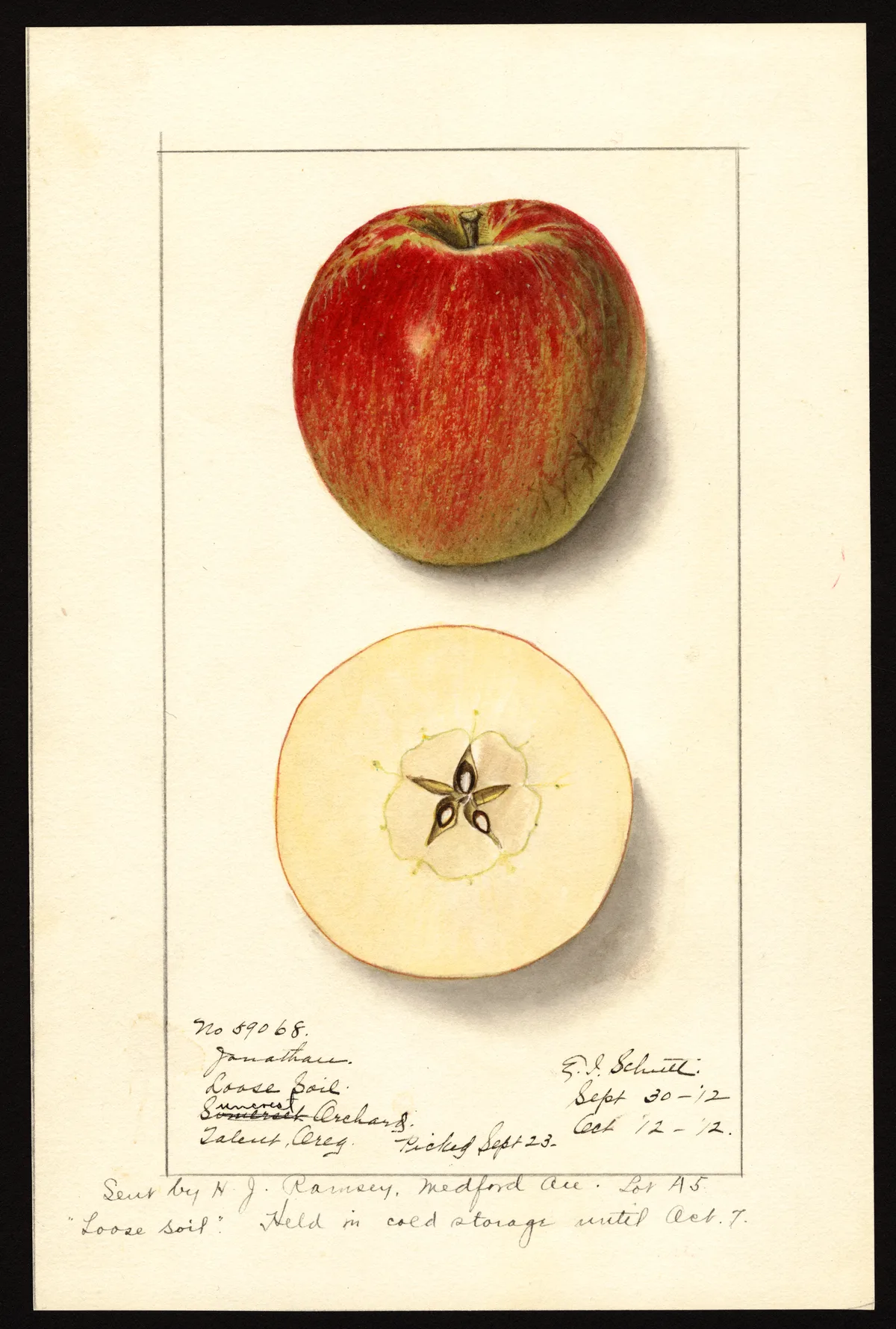
USDA Pomological Watercolor Collection
Jonathan
Origin / History
Jonathan originated on the farm of Mr. Philip Rick of Ulster County, New York. Sources locate the original tree more specifically: Elliott (1865), Warder (1867), Hansen (1902), Thomas (1903), Budd-Hansen (1914), and Stark Bros. (1910) place it at Kingston, New York; Hovey (cited via Beach 1905) and Lowther (1914) specify Woodstock, Ulster County, New York. Hedrick (1922) dates the origin to about 1800. According to Downing (1900), the original tree was still alive in 1845.
The first published account is that given by Judge J. Buel of Albany in 1826, in an article on "Observations on the utility of a Descriptive Catalogue of Garden and Orchard Fruit," addressed to the members of the New York Horticultural Society, in which he presented "A Descriptive Catalogue of some of the most valuable apples propagated in the nurseries of this state." In that catalogue the variety was listed as "Esopus Spitzenberg (New)" with the synonym "Ulster Seedling." In 1829 Judge Buel sent specimens to the Massachusetts Horticultural Society with the statement that it was "An Esopus Seedling and sometimes called the New Spitzenberg." It was at first disseminated under various names, all of which were soon superseded by the name Jonathan, which was assigned to it by Judge Buel in honor of Jonathan Hasbrouck, Esq., by whom Buel's attention was first called to the variety.
Several sources (Downing 1900, Hansen 1902, Beach 1905, Budd-Hansen 1914, Lowther 1914) place it in the Esopus Spitzenburg class; Hansen and Budd-Hansen note that some consider it to be a seedling of that variety. Beach (1905) observes that it excels its parent in hardiness, productiveness, health and vigor, and is adapted to a wider range of territory, but the fruit is not so large nor does it keep as well as that of Esopus Spitzenburg. Warder (1867) calls it a "gentleman's apple, though quite acceptable to the farmers' boys."
The variety has been widely disseminated throughout the apple-growing regions of New York but in none of them is it grown extensively. It is extensively planted in regions farther west and south where it is recognized in many localities as one of the leading commercial varieties — in some localities ranking next to Ben Davis in commercial importance (Beach 1905). Hansen (1902) and Budd-Hansen (1914) consider Jonathan and Grimes Golden the two best varieties for dessert use in the West. Hedrick (1922) notes that Jonathan is grown best in parts of the Middle West and the Pacific Coast states. Stark Bros. (1910) states that "Jonathan leads all reds in big demand" and is "a profit-maker in all parts of the United States."
Tree
Tree medium in size, a moderate or rather slow grower (Beach 1905); Warder (1867) describes it as of rather slender growth; Downing (1900) calls it hardy and moderately vigorous; Hedrick (1922) calls it vigorous; the Central Experimental Farm catalog (1900) calls it a vigorous grower. Hansen (1902) notes the tree is not hardy in northern Iowa, Minnesota, or the Dakotas, but specimens have been raised in a small way in very favorable locations and between the test winters, by top-grafting on hardy stocks. Hedrick (1922) calls the trees usually hardy, vigorous, productive, and very accommodating as to soils and climates, requiring however a fertile soil and developing fullest perfection in cool climates. The variety is an inviting prey to insects and fungi, and the trees must be carefully sprayed (Hedrick 1922).
Form upright spreading, round-headed (Downing 1900, Budd-Hansen 1914), roundish or spreading, somewhat drooping, rather dense (Beach 1905); Hedrick (1922) likewise: round or spreading, drooping, dense. Warder (1867) describes it as spreading, rather drooping, productive. Elliott (1865) notes that when grown and fruiting, the tree has a drooping and pendent habit; very productive; needs rich, strong soil.
Top-working is recommended on account of its slender growth: Warder (1867) says it is "top-grafted in the orchard and stock-grafted in the nursery to produce early results"; Beach (1905) recommends top-working upon some more vigorous stock such as Northern Spy, Baldwin, or Rhode Island Greening; Budd-Hansen (1914) states that top-grafting Jonathan on stronger-growing varieties to overcome its slender growth is often practised, and a grower in Iowa found Haas especially well adapted for this purpose. The tree does not grow much above medium size and may be planted more closely than Baldwin (Beach 1905). Thomas (1903) notes that "the slender growth of the tree is an objection with cultivators."
Particular attention should be given to keeping the soil fertile, well supplied with humus, and well tilled, and the trees should be thoroughly protected from injurious insects and fungus diseases (Beach 1905). Stark Bros. (1910) states that Jonathan does exceptionally well on all classes of soil, thriving specially well in clay soil. Budd-Hansen (1914) notes that for best results it should not be grown alone but intermingled with other varieties for proper pollination of the blossoms.
Under favorable conditions the tree is a reliable cropper bearing good crops biennially or in some cases almost annually; it comes into bearing rather young; usually the fruit hangs pretty well to the tree (Beach 1905). Stark Bros. (1910) calls the tree a late bloomer that comes into bearing young, bears annually and abundantly.
Twigs medium in length, nearly straight, rather slender; internodes short (Beach 1905). Shoots light brown, slender, diverging (Elliott 1865); shoots slender, light brown, with small buds (Warder 1867); young shoots rather slender, slightly pendulous, grayish brown (Downing 1900); shoots rather slender, drooping (Budd-Hansen 1914). Bark dark brownish-red mingled with dark green, and heavily coated with scarf-skin; pubescent (Beach 1905). Lenticels usually very scattering, sometimes moderately numerous, small to medium or sometimes large, roundish to oblong, not raised (Beach 1905). Buds medium, plump, rather narrow, acute to obtuse, free, pubescent (Beach 1905); Warder (1867) describes the buds as small.
Foliage rather sparse, grayish (Warder 1867; Budd-Hansen 1914). Leaves medium or below, rather narrow (Beach 1905); small, narrow (Hedrick 1922).
Fruit
Size
Medium (Elliott 1865, Warder 1867, Downing 1900, Hansen 1902, Thomas 1903, Budd-Hansen 1914); medium to rather small, rarely large (Beach 1905); small, rarely large (Hedrick 1922); small to medium, roundish, conical (Central Experimental Farm 1900). Hedrick (1922) notes that though only medium in size, the fruits are large enough for a dessert apple. Beach (1905) notes that in New York it is ordinarily rather small with a comparatively high percentage of uneven and irregular fruit, and not at all adapted to the general trade, but in certain portions of the valleys of the Ohio, Mississippi and Missouri, and in the irrigated districts in the mountain regions farther west, it attains better size. Beach (1905) and Hedrick (1922) note the fruit is pretty uniform in shape and size.
Form
Roundish, conical, regular (Elliott 1865); round or oblong, conic, truncated, regular (Warder 1867); regularly formed, roundish conical, or tapering to the eye (Downing 1900); roundish oblong, somewhat conical, truncated, regular (Hansen 1902, Budd-Hansen 1914); round-ovate, or approaching truncate-conical, regular (Thomas 1903); roundish conic to roundish ovate, often somewhat truncate, regular (Beach 1905, Lowther 1914); round-conic to round-ovate, often truncate, regular (Hedrick 1922); roundish, conical (Central Experimental Farm 1900). Hedrick (1922) describes it as having "the shapely, round-conic, smoothly and regularly turned form" that makes it one of the most attractive apples.
Stem / Stalk
Rather long, slender (Elliott 1865); long, slender (Warder 1867, Hansen 1902, Budd-Hansen 1914); three-fourths of an inch long, rather slender (Downing 1900); slender (Thomas 1903); medium to long, rather slender (Beach 1905, Hedrick 1922).
Cavity
Open, wide (Elliott 1865); acute, deep, regular, reddish brown (Warder 1867); deep, regular (Downing 1900); acute, deep, regular, with stellate russet (Hansen 1902, Budd-Hansen 1914); acute to acuminate, deep to very deep, wide, symmetrical, sometimes slightly furrowed (Beach 1905); acute, deep to very deep, abrupt, narrow (Hedrick 1922).
Calyx / Eye
Small, nearly closed (Elliott 1865); eye small, closed, green (Warder 1867); calyx small, closed (Hansen 1902, Beach 1905, Budd-Hansen 1914); calyx small, closed, segments connivent (Hansen 1902, Budd-Hansen 1914).
Basin
Shallow, slightly furrowed (Elliott 1865); deep, regular, russet-veined (Warder 1867); deep, rather broad (Downing 1900); deep, smooth, very abrupt, rather wide (Hansen 1902, Budd-Hansen 1914); very distinct, rather deep (Thomas 1903); deep to very deep, very abrupt, wide to moderately narrow (Beach 1905).
Skin
Light yellow ground, mostly overspread, streaked, or stained with rich light red, and with few minute white dots (Elliott 1865). Surface very smooth, waxy yellow, wholly covered with brilliant dark red, mixed and striped; dots minute, russet-veined (Warder 1867). Skin thin and smooth, the ground clear light yellow, nearly covered by lively red stripes, and deepening into brilliant or dark red in the sun (Downing 1900). Surface very smooth, clear light yellow, almost or wholly covered with solid brilliant dark red on the sunny side, on the shaded side mixed and striped with lighter red; dots distinct, many, minute, whitish (Hansen 1902, Budd-Hansen 1914). Nearly covered with brilliant stripes of clear red on a pale yellow ground (Thomas 1903).
Beach (1905): skin thin, tough, smooth, pale bright yellow overlaid with lively red, striped with carmine. When well colored the fruit is almost completely covered with red which deepens to purplish on the sunny side and often shows a beautiful contrasting bit of clear pale yellow about the cavity where a twig or leaf lay in contact with the skin. Less highly colored fruit has more of a striped appearance particularly toward the basin. Dots minute, usually inconspicuous. Prevailing effect attractive lively deep red. Lowther (1914) repeats: skin tough, thin, smooth, pale bright yellow overlaid with a lively red, striped with carmine; in the irrigated regions it often takes on a deep or dark red color.
Hedrick (1922): the brilliant red skin, indistinctly striped with carmine and underlaid with pale yellow, contrasting with the nearly white flesh; skin thin, tough, smooth, pale yellow striped with carmine, covered with red which deepens on the sunny side, often showing contrasting bits of pale yellow about the cavity; dots minute, inconspicuous.
Central Experimental Farm (1900): yellowish green, nearly covered with dark red. Stark Bros. (1910): a deep red, almost black color on the sunny side.
Flesh / Flavor
Yellowish white, tender, juicy, slightly acid unless fully matured, when it is sub-acid, sprightly (Elliott 1865). Whitish yellow, tender, breaking, very juicy; flavor sub-acid, aromatic, equal to Spitzenberg; quality best (Warder 1867). White, rarely a little pinkish, very tender and juicy, with a mild, sprightly, vinous flavor; "best" in quality (Downing 1900). White, very tender, juicy, spicy, aromatic, sprightly subacid, best (Hansen 1902); white, very tender and juicy, spicy, aromatic, sprightly subacid, quality best (Budd-Hansen 1914). White, very juicy, spicy, sub-acid, moderately rich (Thomas 1903).
Beach (1905) and Lowther (1914): flesh whitish or somewhat yellow, sometimes with a tinge of red, firm, moderately fine, crisp, tender, juicy, very aromatic, sprightly subacid, very good to best. Hedrick (1922): flesh yellow, sometimes with a tinge of red, firm, fine, crisp, tender, juicy, very aromatic, sprightly subacid; very good to best. Hedrick further describes the flesh as "firm, crisp, tender, juicy, not especially rich in flavor, but peculiarly sprightly and refreshing, having a distinct and most pleasing aroma." Central Experimental Farm (1900): flesh white, tender, juicy, aromatic, having a delicious flavour, quality very good. Stark Bros. (1910): fine-grained, very crisp and juicy; sub-acid flavor, slightly vinous.
Core / Seeds
Core medium; seeds full, abundant, dark brown (Elliott 1865). Core medium, roundish-oval, regular, closed, scarcely clasping the eye; seeds numerous, large, angular (Warder 1867). Core closed, scarcely clasping; cells obovate; tube conical; stamens median or basal; seeds plump, long, pointed (Hansen 1902, Budd-Hansen 1914).
Beach (1905): calyx tube rather small, funnel-shape or sometimes conical; stamens basal to median. Core medium or below, axile or nearly so; cells symmetrical but often not uniformly developed, usually closed, sometimes open; core lines clasp the funnel cylinder. Carpels rather concave, roundish to roundish cordate, emarginate, smooth. Seeds rather large, long, acute to acuminate, dark, numerous.
Hedrick (1922): calyx-tube small, funnel-shape; stamens basal; core small, axile; cells symmetrical but often not uniformly developed, usually closed; core-lines clasping the funnel cylinder; carpels concave, round to round-cordate, emarginate, smooth; seeds large, long, acute, dark, numerous.
Season
December to February (Elliott 1865); December, January (Warder 1867); November to March (Downing 1900); December to March north, late fall and early winter in the south (Hansen 1902); keeps through winter (Thomas 1903); November to January or later (Beach 1905); December to March East, late fall and early winter in the South (Budd-Hansen 1914); November to January, longer in cold storage, with the greatest demand at Christmas (Hedrick 1922); November to March (Central Experimental Farm 1900).
Lowther (1914) gives picking-and-marketing season as September to first of November, depending on section: "may be held in storage until January and February, if grown in the colder higher altitudes. I have seen Colorado Jonathans in the markets of Texas in prime condition in February; but when grown in the Ozarks, they could not be marketed later than December."
Beach (1905): its season is about the same as that of Tompkins King. It may be kept through the winter but when held in ordinary storage later than January, dark spots are liable to develop in the skin and seriously injure the appearance of the fruit. Handled in this way its commercial limit is December or early January. In cold storage its commercial limit varies from January to March or sometimes later. Hedrick (1922) likewise notes that when the apples are kept long in either common or cold storage, dark spots develop in the skin which greatly mar their appearance.
Uses
A very superior dessert fruit; good for all purposes (Warder 1867) — dessert, cooking, etc. A very beautiful dessert apple (Downing 1900). Considered (with Grimes Golden) one of the two best varieties for dessert use in the West (Hansen 1902, Budd-Hansen 1914). Excellent quality for either dessert or culinary use (Beach 1905, Lowther 1914). At its best it is one of the most desirable varieties for the fancy trade at the holiday season (Beach 1905). Among the very best in both appearance and quality (Hedrick 1922); large enough for a dessert apple. A popular market variety in many sections, both East and West (Thomas 1903). Stark Bros. (1910): "Jonathan leads all reds in big demand. The fruit that has proven itself to be a profit-maker in all parts of the United States."
Subtypes / Variants
Not described in source.
Other
Elliott (1865) lists "Philip Rick, Winesap, erroneously" and "King Philip, Wine, erroneously" — i.e., the names Winesap and Wine have been erroneously applied to this variety. Downing (1900) and Beach (1905) similarly note the erroneous application of Wine and Winesap. Beach (1905) compiles an extensive list of historical references spanning Buel (1826) through Beach and Clark (1904), indicating broad documentation of the variety across nineteenth-century pomological literature.
Book Sources
Described in 9 period pomological works
- Beach, The Apples of New York Vol. 1 (1905)
- Lowther (ed.), Encyclopedia of Practical Horticulture (1914)
- Warder, American Pomology: Apples (1867)
- Downing, Fruits and Fruit Trees of America (1900)
- Hansen, A Study of Northwestern Apples (1902)
- Budd & Hansen, Systematic Pomology (1914)
- Elliott, The Western Fruit Book (1865)
- Hedrick, Cyclopedia of Hardy Fruits (1922)
- Thomas, The American Fruit Culturist (1903)
Nursery Catalog Sources
Found in 76 catalogs (1864–1947) from Alabama, California, England, Illinois, Kansas, Missouri, Nebraska, Oregon, Washington
- St. Helena Nursery , Howell's Prairie, Marion County , Oregon — 1864
- Hutchison Nursery , James Hutchison, Oakland , California — 1881
- Felix Gillet , Barren Hill Nursery, Nevada City , California — 1884
- W.R. Strong & Co. , Capital and Orange Hill Nurseries (Robert Williamson, prop.), Sacramento , California — 1886
- Felix Gillet , Barren Hill Nursery, Nevada City , California — 1888
- California Nursery Co. , Niles , California — 1889
- Felix Gillet , Barren Hill Nursery, Nevada City , California — 1889
- Palouse Nursery and Pleasant Dale Fruit Farm , Colfax, Washington Territory (situated two miles northeast of Colfax) - undated (single-page broadside flyer; "Washington Territory" suggests pre — 1889
- Felix Gillet , Barren Hill Nursery, Nevada City , California — 1890
- Felix Gillet , Barren Hill Nursery, Nevada City , California — 1891
- Missouri Nursery Co. , Louisiana , Missouri — 1891
- Milwaukie-Canby Nurseries , Canby, OR (and Milwaukie, OR) — 1893
- Oregon Wholesale Nurseries , Salem , Oregon — 1893
- Sherwood Hall Nursery Co. , Timothy Hopkins (Menlo Park Nurseries), San Francisco / Menlo Park , California — 1893
- Multnomah Nurseries , Russellville , Oregon — 1894
- The Vineland Nurseries (Kelsey & Co. , Proprietors), St. Joseph, Missouri (Office: 13th and Atchison Sts., 2 Blocks East of the Citizens St. Car Line) — 1894
- Woodburn Nurseries , Woodburn, Marion Co. , Oregon — 1894
- Felix Gillet , Barren Hill Nursery, Nevada City , California — 1895
- Stark Bros. Nurseries & Orchards Co. , Louisiana , Missouri — 1896
- Felix Gillet , Barren Hill Nursery, Nevada City , California — 1897
- Kelway & Son , Langport, Somerset , England — 1897
- J.V. Cotta (Cotta Nursery) , Carroll County , Illinois — 1898
- Stark Bros. Nurseries & Orchards Co. , Louisiana , Missouri — 1898
- Alabama Nursery Co. , Huntsville , Alabama — 1900
- Central Experimental Farm , Dominion Department of Agriculture, Agassiz, British Columbia (under test; Bulletin No. 3, Second Series) — 1900
- Washington Nursery Co. , Toppenish , Washington — 1901
- Benjamin Buckman (personal inventory) , Farmingdale , Illinois — 1901
- Mountain Grove Nurseries (Tippin & Moore , Proprietors; Geo. T. Tippin, J. W. Tippin, J. C. Moore), Mountain Grove , Missouri — 1901
- S.L. Watkins , Grizzly Flats, El Dorado County , California — 1901
- Forestville Nurseries , T.J. True, Forestville , California — 1902
- Pacific Nursery Company (W. O. Hudson & A. D. Hudson) , Tangent , Oregon — 1903
- Russellville Nursery Co. , Russellville, OR (three miles east of Portland, one mile from Montavilla car line) — 1903
- Phoenix Nursery Company (W. E. Rossney , President; Sidney Tuttle, Vice-President), Bloomington , Illinois — 1904
- The Dalles Nurseries , The Dalles , Oregon — 1906
- Stark Bros. Nurseries & Orchards Co. , Louisiana , Missouri — 1906
- J.B. Pilkington , Portland , Oregon — 1907
- Russellville Nursery Co. , Montavilla Station, Portland, OR (three miles east of Portland, one mile from Montavilla car line) — 1907
- Carlton Nursery Co. , Carlton , Oregon — 1909
- Milton Nursery Co. (A. Miller & Sons , Proprietors), Milton , Oregon — 1909
- Washington Nursery Company , Toppenish , Washington — 1909
- C.F. Lansing , Salem , Oregon — 1910
- Wapato Nursery , Wapato , Washington — 1910
- Cashmere Nurseries , Cashmere , Washington — 1910
- Milton Nursery Co./Montana Fruit Growers — 1910
- Quaker Nurseries (Patterson/Lansing) — 1910
- Stark Bros. Nurseries & Orchards Co. , Louisiana , Missouri — 1910
- Galbraith Nursery Co. (DeWitt Hansen , Pres.-Mgr.), Fairbury , Nebraska — 1911
- Stark Bros. Nurseries & Orchards Co. , Louisiana , Missouri — 1911
- James Veitch & Sons , Ltd., Royal Exotic Nursery, Chelsea, London (also Coombe Wood, Langley, and Feltham) , England — 1911
- Ballygreen Nurseries , Hanford , Washington — 1912
- Pacific Nursery Company , Portland , Oregon — 1912
- Stark Bros. Nurseries & Orchards Co. , Louisiana , Missouri — 1912
- Vineland Nurseries Company , Clarkston , Washington — 1912
- Washington Nursery Company , Toppenish , Washington — 1912
- J. B. Pilkington , Nurseryman, Portland, OR (nurseries near Newberg, forty miles from Portland) — 1913
- Van Holderbeke Nursery Co. , Incorporated, Spokane, Washington (nurseries at Otis Orchards WA, Pasadena WA, Kennewick WA) — 1913
- Benjamin Buckman (personal inventory) , Farmingdale , Illinois — 1913
- Island Nurseries & Fruit Farm , Vashon (Vashon Island) , Washington — 1914
- Island Nurseries & Fruit Farm , Vashon (Vashon Island) , Washington — 1915
- Ornamental & Fruit Nursery Company , Wapato, County of Yakima , Washington — 1915
- Union Nurseries , J.B. Weaver & Sons, Union , Oregon — 1915
- Holsinger Bros. Nurseries (Holsinger Brothers Nursery) , Rosedale , Kansas — 1916
- Island Nurseries & Fruit Farm , Vashon (Vashon Island) , Washington — 1916
- Island Nurseries & Fruit Farm , Vashon (Vashon Island) , Washington — 1917
- Fancher Creek Nurseries , George C. Roeding, Fresno , California — 1918
- Stark Bros. Nurseries & Orchards Co. , Louisiana , Missouri — 1918
- Oregon Nursery Co. , Orenco , Oregon — 1920
- Christopher Nurseries / John Stewart & Sons , Christopher , Washington — 1920
- Benedict Nursery Co. , Portland , Oregon — 1921
- Fresno Nursery Co. , Fresno , California — 1924
- Columbia & Okanogan Nursery Co. , Wenatchee , Washington — 1925
- Hudson's Wholesale Nurseries , Tangent , Oregon — 1926
- Stark Bro's Nurseries , Louisiana , Missouri — 1932
- Milton Nursery Co. , Milton-Freewater , Oregon — 1947
- Rich & Sons Nursery , Hillsboro , Oregon
- North-Western Nurseries , Walla Walla , Washington
View original book sources (11)
— F.R. Elliott, The Western Fruit Book (1865)Jonathan.
Philip Rick, Winesap, erroneously. King Philip, Wine, "
American: originated Kingston, N. Y. Shoots, light brown, slender, diverging; when grown and fruiting, tree has a drooping and pendent habit; very productive; needs rich, strong soil.
Fruit, medium; form, roundish, conical, regular; color, light yellow ground, mostly overspread, streaked, or stained with rich light red, and with few minute white dots; stem, rather long, slender; cavity, open, wide; calyx, small, nearly closed; basin, shallow, slightly furrowed; flesh, yellowish white, tender, juicy, slightly acid unless fully matured, when it is sub-acid, sprightly; core, medium; seeds, full, abundant, dark brown. December to February.
— John A. Warder, American Pomology: Apples (1867)Jonathan.
Origin, Kingston, New York. Described by Judge Buell. A very superior dessert fruit; good for all purposes, and seems to do well everywhere. Its excellence has caused it to be called, particularly, a gentleman's apple, though quite acceptable to the farmers' boys.
Tree of rather slender growth; hence top-grafted in the orchard and stock-grafted in the nursery to produce early results; Spreading, rather drooping, productive; Shoots slender, light brown, buds small; Foliage rather sparse, grayish.
Fruit medium, round or oblong, conic, truncated, regular; Surface very smooth, waxy yellow, wholly covered brilliant dark red, mixed and striped; Dots minute, russet-veined.
Basin deep, regular, russet-veined; Eye small, closed, green.
Cavity acute, deep, regular, reddish brown; Stem long, slender.
Core medium, roundish-oval, regular, closed, scarcely clasping the eye; Seeds numerous, large, angular; Flesh whitish yellow, tender, breaking, very juicy; Flavor sub-acid, aromatic, equal to Spitzenberg; Quality best; Use, dessert, cooking, &c.; December, January.
Should be in every orchard.
— A.J. Downing, The Fruits and Fruit Trees of America (1900)Jonathan.
King Philip. Philip Rick.
The Jonathan is a very beautiful dessert Apple, and its great beauty, good flavor, and productiveness in all soils, unite to recommend it to orchard planters. The original tree of this variety is growing on the farm of Mr. Philip Rick, of Kingston, New York. It was first described by the late Judge Buel, and named by him, in compliment to Jonathan Hasbrouck, Esq., of the same place, who made known the fruit to him. It succeeds wherever grown, and proves one of the best in quality, and most profitable either for table or market. The tree is hardy, moderately vigorous, forming an upright spreading, round head. Young shoots rather slender, slightly pendulous, grayish brown.
Fruit of medium size, regularly formed, roundish conical, or tapering to the eye. Skin thin and smooth, the ground clear light yellow, nearly covered by lively red stripes, and deepening into brilliant or dark red in the sun. Stalk three-fourths of an inch long, rather slender, inserted in a deep, regular cavity. Calyx set in a deep, rather broad basin. Flesh white, rarely a little pinkish, very tender and juicy, with a mild, sprightly, vinous flavor. This fruit evidently belongs to the Spitzenburg class. Best. November to March.
— N.E. Hansen, A Study of Northwestern Apples (1902)Jonathan—Origin, Kingston, New York; this and Grimes Golden are considered the two best varieties for dessert use in the west. Jonathan is evidently of the Spitzenburg type and by some considered to be a seedling of that variety. Tree not hardy, in northern Iowa, Minnesota or the Dakotas, but specimens have been raised in a small way in very favorable locations and between the test winters, by top-grafting on hardy stocks—Fruit medium, roundish oblong, somewhat conical, truncated, regular; surface very smooth, clear light yellow, almost or wholly covered with solid brilliant dark red on sunny side, on shaded side mixed and striped with lighter red; dots distinct, many, minute, whitish; cavity acute, deep, regular, with stellate russet; stem long, slender; basin deep, smooth, very abrupt, rather wide; calyx small, closed, segments connivent. Core closed, scarcely clasping; cells obovate; tube conical; stamens median or basal; seeds plump, long, pointed; flesh white, very tender, juicy, spicy, aromatic, sprightly subacid, best. December to March north, late fall and early winter in the south.
— John J. Thomas, The American Fruit Culturist (1903)Jonathan.* Medium in size, round-ovate, or approaching truncate-conical; regular, nearly covered with brilliant stripes of clear red on a pale yellow ground; stalk slender; basin very distinct, rather deep; flesh white, very juicy, spicy, sub-acid, moderately rich. Keeps through winter. Shoots slender, diverging; tree very productive; fruit always handsome and fair. Fig. 422. Kingston, N. Y. The slender growth of the tree is an objection with cultivators. It succeeds well in most localities and is a popular market variety in many sections, both East and West.
— S.A. Beach, The Apples of New York, Vol. 1 (1905)JONATHAN.
REFERENCES.
- Buel, N. Y. Bd. Agr. Mem., 1826:476, Cat. No. 392. 2. Cat. Hort. Soc. London, 1831. 3. Kenrick, 1832:47. 4. Downing, 1845:113. 5. Thomas, 1849:167, 189, fig. 6. Cole, 1849:123. 7. Hovey, Mag. Hort., 16:60. 1850. fig. 8. Emmons, Nat. Hist. N. Y., 3:60. 1851. col. pl. No. 25. 9. Am. Pom. Soc. Cat., 1856. 10. Hooper, 1857:48. 11. Reynolds, Horticulturist, 12:51. 1857. 12. Dewey, Ib., 12:198. 1857. 13. Elliott, 1858:86. fig. 14. Warder, 1867:679. fig. 15. Barry, 1883:348. 16. Hogg, 1884:119. 17. Lyon, Mich. Hort. Soc. Rpt., 1890:294. 18. Meehan, Can. Hort., 14:75. 1891. fig. 19. Wickson, 1891:246. 20. Bailey, An. Hort., 1892:242. 21. Stinson, Ark. Sta. An. Rpt., 7:46. 1894. 22. Lyon, Mich. Sta. Bul., 118:60. 1895. 23. Ib., 143:200, 202. 1897. 24. Powell, Del. Sta. Bul., 38:18. 1898. 25. Van Deman, Rural N. Y., 59:224. 1900. 26. Kan. Sta. Bul., 106:53. 1902. 27. Hansen, S. D. Sta. Bul., 76:61. 1902. 28. Budd-Hansen, 1903:106. fig. 29. Powell and Fulton, U. S. B. P. I. Bul., 48:45. 1903. 30. Beach and Clark, N. Y. Sta. Bul., 248:127. 1904.
SYNONYMS. ESOPUS SPITZENBERG (NEW) (1). JOHNATHAN (21). Jonathan (11). King Philip (4, 7, 10, 11, 13). PHILIP RICK (11). Philip Rick (4, 7, 13). Ulster Seedling (1). Wine (erroneously 10, 13). Winesap (erroneously 10, 13).
This is a fruit of the Esopus Spitzenburg class. It is very beautiful, of a brilliant red color, highly flavored and of excellent quality for either dessert or culinary use. It excels its parent in hardiness, productiveness, health and vigor and is adapted to a wider range of territory, but the fruit is not so large nor does it keep as well as that of Esopus Spitzenburg. In New York state it does fairly well in favorable localities if grown on rich soil and given careful attention but even under such circumstances it does not usually attain as good size as it does in certain portions of the valleys of the Ohio, Mississippi and Missouri and in the irrigated districts in the mountain regions farther west. In some localities in these regions it ranks next to Ben Davis in commercial importance. As grown in this state it is ordinarily rather small with a comparatively high percentage of uneven and irregular fruit, and is not at all adapted to the general trade. At its best it is one of the most desirable varieties for the fancy trade at the holiday season. Its season is about the same as that of Tompkins King. It may be kept through the winter but when held in ordinary storage later than January dark spots are liable to develop in the skin and seriously injure the appearance of the fruit. Handled in this way its commercial limit is December or early January. In cold storage its commercial limit varies from January to March or sometimes later (30).
As grown in New York the tree is but a moderate grower and for this reason it is well to top-work it upon some stock that is more vigorous such as Northern Spy, Baldwin or Rhode Island Greening. It does not grow much above medium size and may be planted more closely than Baldwin. Particular attention should be given to keeping the soil fertile, well supplied with humus and well tilled, and the trees should be thoroughly protected from injurious insects and fungus-diseases. Under favorable conditions the tree is a reliable cropper bearing good crops biennially or in some cases almost annually. It comes into bearing rather young. Usually the fruit hangs pretty well to the tree. It is not recommended for general commercial planting in New York but in some places under good management it has proved a profitable variety.
Historical. The first published account which we find of the Jonathan is that given by Judge J. Buel, of Albany, in 1826, in an article on "Observations on the utility of a Descriptive Catalogue of Garden and Orchard Fruit," addressed to the members of the New York Horticultural Society, in which he presents "A Descriptive Catalogue of some of the most valuable apples propagated in the nurseries of this state." In this catalogue the Jonathan is listed as the Esopus Spitzenberg (New) with the synonym Ulster Seedling (1). In 1829 Judge Buel sent specimens of the fruit to the Massachusetts Horticultural Society with the statement that it was "An Esopus Seedling and sometimes called the New Spitzenberg." It originated on the farm of Mr. Philip Rick of Woodstock, Ulster county, New York (7). According to Downing the original tree was still alive in 1845. It was at first disseminated under various names, all of which were soon superseded by the name Jonathan which was assigned to it by Judge Buel in honor of Jonathan Hasbrouck by whom his attention was first called to the variety. It has been widely disseminated throughout the apple-growing regions of New York but in none of them is it grown extensively. It is extensively planted in regions farther west and south where, as above stated, it is recognized in many localities as one of the leading commercial varieties.
TREE. Tree medium in size, a moderately vigorous or rather slow grower. Form roundish or spreading, somewhat drooping, rather dense. Twigs medium in length, nearly straight, rather slender; internodes short. Bark dark brownish-red mingled with dark green, and heavily coated with scarf-skin; pubescent. Lenticels usually very scattering, sometimes moderately numerous, small to medium or sometimes large, roundish to oblong, not raised. Buds medium, plump, rather narrow, acute to obtuse, free, pubescent. Leaves medium or below, rather narrow.
FRUIT. Fruit medium to rather small, rarely large. Form roundish conic to roundish ovate, often somewhat truncate, regular; pretty uniform in shape and size. Stem medium to long, rather slender. Cavity acute to acuminate, deep to very deep, wide, symmetrical, sometimes slightly furrowed. Calyx small, closed. Basin deep to very deep, very abrupt, wide to moderately narrow.
Skin thin, tough, smooth, pale bright yellow overlaid with lively red, striped with carmine. When well colored the fruit is almost completely covered with red which deepens to purplish on the sunny side and often shows a beautiful contrasting bit of clear pale yellow about the cavity where a twig or leaf lay in contact with the skin. Less highly colored fruit has more of a striped appearance particularly toward the basin. Dots minute, usually inconspicuous. Prevailing effect attractive lively deep red.
Calyx tube rather small, funnel-shape or sometimes conical. Stamens basal to median.
Core medium or below, axile or nearly so; cells symmetrical but often not uniformly developed, usually closed, sometimes open; core lines clasp the funnel cylinder. Carpels rather concave, roundish to roundish cordate, emarginate, smooth. Seeds rather large, long, acute to acuminate, dark, numerous.
Flesh whitish or somewhat yellow, sometimes with tinge of red, firm, moderately fine, crisp, tender, juicy, very aromatic, sprightly subacid, very good to best.
Season November to January or later.
— J.L. Budd & N.E. Hansen, American Horticultural Manual, Part II: Systematic Pomology (1914)Jonathan. — Origin, Kingston, New York; this and Grimes Golden are considered the two best varieties for dessert use in the West. Jonathan is evidently of the Spitzenburg type and by some is considered to be a seedling of that variety. For best results should not be grown alone but intermingled with other varieties for proper pollination of the blossoms; tree of moderate vigor, forming an upright, spreading; round head; shoots rather slender, drooping; foliage rather sparse, grayish.
Fruit medium, roundish oblong, somewhat conical, truncated, regular; surface very smooth, clear light yellow, almost or wholly covered with solid brilliant dark red on sunny side, on shaded side mixed and striped with lighter red; dots distinct, many, minute, whitish; cavity acute, deep, regular, with stellate russet; stem long, slender; basin deep, smooth, very abrupt, rather wide; calyx small, closed; segments connivent. Core closed, scarcely clasping; cells obovate; tube conical; stamens median or basal; seeds plump, long, pointed; flesh white, very tender and juicy, spicy, aromatic, sprightly subacid, quality best. December to March East, late fall and early winter in the South.
Top-grafting Jonathan on stronger growing varieties to overcome its slender growth is often practised; a grower in Iowa found Haas especially well adapted for this purpose.
— Granville Lowther (ed.), Encyclopedia of Practical Horticulture (1914)Jonathan
The Jonathan belongs to the Spitzenburg class. It is very beautiful, of a brilliant red color, highly flavored and of excellent quality for either dessert or culinary purposes. It excels the Spitzenburg in productivity, hardiness and vigor of the tree, and is adapted to a wider range of territory. In form the fruit is roundish conic to roundish ovate, often somewhat truncate, regular, rather uniform in shape and size. Skin tough, thin, smooth, pale bright yellow overlaid with a lively red, striped with carmine. In the irrigated regions it often takes on a deep or dark red color. Flesh whitish or somewhat yellow, sometimes with a tinge of red, firm, moderately fine, crisp, tender, juicy, very aromatic, sprightly subacid, very good to best.
Its season is from September to first of November for picking and marketing, depending on the sections in which grown, but may be held in storage until January and February, if grown in the colder higher altitudes. I have seen Colorado Jonathans in the markets of Texas in prime condition in February; but when grown in the Ozarks, they could not be marketed later than December.
Historical. The first published account which we find, is that given by Judge J. Buel of Albany in 1826, in an article the "Utility of a Descriptive Catalogue of Orchard Fruits." He listed the Jonathan as "Esopus Spitzenburg, New," with the synonym "Ulster Seedling" It originated on the farm of Mr. Philip Rick of Woodstock, Ulster county, New York. The name Jonathan was assigned to it by Judge Buel in honor of Jonathan Hasbrouck, by whom his attention was first called to the variety.
— U.P. Hedrick, Cyclopedia of Hardy Fruits (1922)JONATHAN. Fig. 29. Jonathan has a world-wide reputation, and the apples by general consent are placed among the very best in both appearance and quality. Though only medium in size, the fruits are large enough for a dessert apple. The brilliant red skin, indistinctly striped with carmine and underlaid with pale yellow, contrasting with the nearly white flesh; and the shapely, round-conic, smoothly and regularly turned form, make it one of the most attractive apples. The flesh is firm, crisp, tender, juicy, not especially rich in flavor, but peculiarly sprightly and refreshing, having a distinct and most pleasing aroma. The season is from November to January, longer in cold storage, with the greatest demand at Christmas. Unfortunately, when the apples are kept long in either common or cold storage, dark spots develop in the skin which greatly mar their appearance. The trees are usually hardy, vigorous and productive, and very accommodating as to soils and climates, requiring, however, a fertile soil, and developing fullest perfection in cool climates. The variety is an inviting prey to insects and fungi, and the trees must be carefully sprayed. Jonathan is grown best in parts of the Middle West and the Pacific Coast states. The variety originated on the farm of Philip Rick, Ulster County, New York, about 1800, and the name commemorates Jonathan Hasbrouck, who had the honor of first calling attention to this excellent apple. Tree medium in size, vigorous, round or spreading, drooping, dense. Leaves small, narrow. Fruit small, rarely large, round-conic to round-ovate, often truncate, regular, uniform in shape and size; stem medium to long, slender; cavity acute, deep to very deep, abrupt, narrow; skin thin, tough, smooth, pale yellow striped with carmine, covered with red which deepens on the sunny side, often showing contrasting bits of pale yellow about the cavity; dots minute, inconspicuous; calyx-tube small, funnel-shape; stamens basal; core small, axile; cells symmetrical but often not uniformly developed, usually closed; core-lines clasping the funnel cylinder; carpels concave, round to round-cordate, emarginate, smooth; seeds large, long, acute, dark, numerous; flesh yellow, sometimes with a tinge of red, firm, fine, crisp, tender, juicy, very aromatic, sprightly subacid; very good to best; November to January.
— Central Experimental Farm, Central Experimental Farm, Agassiz BC — Catalogue of Fruit Trees under Test (Bulletin No. 3, 1900) (1900)Planted Spring 1890. Tree a vigorous grower. Fruit small to medium, roundish, conical. Skin yellowish green, nearly covered with dark red. Flesh white, tender, juicy, aromatic, having a delicious flavour, quality very good. Season November to March.
— Stark Bros. Nurseries & Orchards Co., Stark Bros. Year Book (1910) (1910)Jonathan is fine-grained, very crisp and juicy, a deep red, almost black color on sunny side; sub-acid flavor, slightly vinous. Originated in Kingston, N.Y., and named after Jonathan Hasbrouck. The tree is a late bloomer, comes into bearing young, bears annually and abundantly. Jonathan does exceptionally well on all classes of soil, thriving specially well in clay soil.
To-day Jonathan leads all reds in big demand. The fruit that has proven itself to be a profit-maker in all parts of the United States.