Niagara
Apple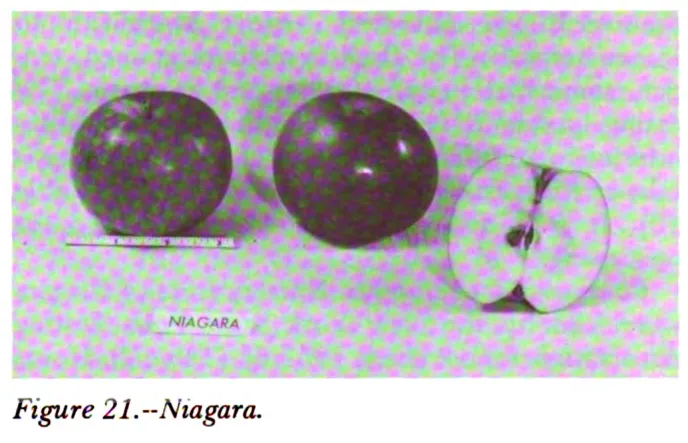
Niagara
Origin / History
Niagara came from the cross Carlton x McIntosh, made in 1939. It is a reciprocal sister of Redhook. The breeding record number was 39201 and the seedling number N.Y. 50-2. It was selected in 1950 from a population of 16 seedlings and, after 12 years of observation on second test, was introduced in 1962 by the Geneva Station (Way, 1979), when Wayne and Spigold were also named. It was named for Niagara County, New York. Klein and others published the introductory description in 1962. Brief descriptions appeared in the Register of New Fruit and Nut Varieties and in Brooks (1963), and it was described for the New York State Horticultural Society in 1963 and 1967.
Niagara was introduced as a McIntosh type ripening before McIntosh, which could be harvested after it became fully mature. Many commercial growers often attempt to take advantage of the early-market high prices by harvesting McIntosh while still immature, and Niagara was meant to fill that need. A few years of testing showed that growers did not appear to accept it for this purpose, because Niagara has "the fault of too large dots"; these conspicuous dots have caused growers to reject the cultivar. Nursery trees were nonetheless sold by the New York State Fruit Testing Association for 12 years, 1957–68, five of them before introduction. In 1960–68 ten commercial nurseries sold it, which Way takes to show that it "was commercially accepted very quickly." In 1968 it was under test at experiment stations in Massachusetts, New York, North Carolina, Pennsylvania, Vermont, and Washington. In 1967 it was one of 12 cultivars recommended for planting in New York, and in 1966 it was recommended as a new cultivar for trial in Massachusetts. A commercial New York grower found it attractive, excellent eating, high yielding, bearing at a young age and annually, large fruited, and hanging well to the tree. Way sums it up as "a very good, well colored cultivar ripening in early September," but because many commercial growers have rejected it, he recommends it only for growers favorably impressed with its fruiting performance. Zielinski (1964) calls it a promising McIntosh type and says further evaluation is needed in Oregon.
Tree
Tree large, vigorous, upright, tall, dense, with many fine branches, round-topped (Way); "strong growing" (Way, 1979). Zielinski alone calls it moderately vigorous, with well developed limbs, and says it resembles McIntosh in growth habit and productiveness. Leaves very resistant to mildew infection (Zielinski). Susceptible to fire blight. After the severe freeze in British Columbia in 1966, fruit spurs of Niagara were found to be only moderately hardy, while McIntosh was very hardy.
Trees productive, though somewhat biennial in bearing (Way, 1971), tending to alternate cropping (Way, 1979). The commercial New York grower cited by Way reported annual bearing and bearing at a young age.
Blossoms early to midseason, more than 2 days before Delicious. Full bloom coincides with McIntosh, Gravenstein, and other early flowering varieties, and Zielinski considers it should be a good pollinizer. Diploid, with viable (fertile) pollen. Fruit has a slight tendency to drop with approaching maturity (Zielinski), or somewhat of a tendency to drop after ripening (Way).
Fruit
Size: Medium sized to large (medium-large, Way 1979), mostly 2¾ inches in diameter, sometimes up to 3¼ inches.
Form: Roundish, somewhat irregular in shape like McIntosh, sometimes slightly oblique.
Stem: Short and thick.
Cavity: Acute, medium sized, narrow, usually symmetrical. Somewhat russeted on about half of the fruits and lipped on about 10 per cent.
Calyx: Medium sized, almost closed. Lobes medium sized, broad, acute. Calyx tube very short, narrow, conic. Stamens usually median, sometimes marginal.
Basin: Medium in depth, narrow, abrupt, almost symmetrical, slightly furrowed.
Skin: Medium in thickness, tough, slightly rough, somewhat dull, covered with heavy bloom. Color 90 per cent dark red, the pattern somewhat striped; "almost fully red" (Way, 1979). Appearance resembles McIntosh (Zielinski). Called attractive by the New York grower cited by Way, and well colored in Way's summary.
Dots: Numerous, large, conspicuous, of two kinds: small russeted lenticels, and large whitish dots up to ¼ inch in diameter. The whitish dots develop more conspicuously in humid regions than in less humid areas. Near large bodies of water, in areas of high humidity, the lenticels grow abnormally large and cause unattractive russet dots (Way, 1979). If fruits are held in cold storage until April, the dots develop into depressed areas in the skin.
Flesh and flavor: Whitish cream, with a greenish tinge in immature fruits (greenish until fully ripe, Way 1979); more yellow than McIntosh after ripening. Texture semifirm to somewhat soft; medium grained, tender, somewhat juicy. Zielinski alone describes the flesh as firm, white, crisp, and flavorful. Flavor subacid, aromatic, resembling McIntosh. Eating quality "fair to good," similar to but slightly inferior to McIntosh (Way, 1971); Way's summary calls the cultivar "very good." The commercial grower cited by Way found it "excellent eating."
Core and seeds: Core medium sized to small, nearly closed. Carpels ovate. Seeds rather large, wide, plump, acute.
Season
Early fall. At Geneva the average ripening date is September 12, 4 weeks before Delicious and 10 days before McIntosh, with an average of 119 days from full bloom to harvest, 26 fewer than Delicious. In western New York it ripens at the end of August, about 3 weeks before McIntosh (Way, 1979). Zielinski places it just before Jonathan. Keeping quality fair; at 31°F fruits store about 70 days.
Uses
Dessert type, not suited for processing. A McIntosh type for the early market. Zielinski recommends it when a superior variety that colors well and ships satisfactorily is needed.
Subtypes / Variants
Not described in source.
Other
Fruits are illustrated in Figure 21 of Way (1971) and in Farm Research. Ten tree characteristics and ten fruit characteristics of Niagara have been listed by Way.
Book Sources
Described in 3 period pomological works
View original book sources (3)
— Quentin B. Zielinski, Apple Varieties for Oregon (1964)Niagara†
This variety was selected in New York from a cross of Carlton x McIntosh. It is a promising McIntosh type, ripening just before Jonathan when a superior variety that colors well and ships satisfactorily is needed. It resembles McIntosh in growth habit, productiveness, appearance, and flavor. The flesh is firm, white, crisp, and flavorful. The tree is moderately vigorous with well developed limbs. The leaves are very resistant to mildew infection. The fruit has a slight tendency to drop with approaching maturity. It is a diploid type with fertile pollen. Niagara's full bloom coincides with McIntosh, Gravenstein, and other early flowering varieties, and it should be a good pollinizer. Further evaluation is needed in Oregon.
— Roger D. Way, Apple Cultivars Introduced by the New York State Agricultural Experiment Station, 1914–1968 (1971)Niagara
Origin. Niagara originated from the cross, Carlton x McIntosh, made in 1939 (see Carlton). Niagara is a reciprocal sister of Redhook (see Redhook). The breeding record number was 39201, and the seedling number was N.Y. 50-2. It was selected in 1950 from a population of 16 seedlings. After 12 years of observations on second test, it was introduced in 1962 (Table 2), at the same time Wayne and Spigold were named. It was named for Niagara County, New York.
The introductory description of Niagara was published in 1962 by Klein, et al (131, 132). It was briefly described in the Register of New Fruit and Nut Varieties (39) and also by Brooks in 1963 (30). It was described for the New York State Horticultural Society in 1963 (224) and again in 1967 (220).
Winter Hardiness. Following a severe freeze in British Columbia in 1966 (143), fruit spurs of Niagara were found to be only moderately hardy, while McIntosh was very hardy.
Tree. The tree characteristics of Niagara are summarized in Table 5. Ten characteristics of Niagara trees have been listed by Way (221). The tree is large, vigorous, upright, tall, dense, with many fine branches, and round-topped. Trees are productive, though somewhat biennial in their bearing habit (Table 5). They are susceptible to fire blight.
Pollination. Niagara blossoms early (Table 6) to midseason (98), more than 2 days before Delicious. It is diploid (Table 4), and the pollen is viable.
Fruit. Niagara fruits are illustrated in Figure 21. They were also illustrated in Farm Research (131). The fruit characteristics are summarized in Table 8. Ten fruit characteristics of Niagara have been listed by Way (221). The average ripening date at Geneva is September 12, 4 weeks before Delicious and 10 days before McIntosh (Table 7) (213). The average number of days between full bloom and harvest is 119, 26 fewer than Delicious.
Niagara was introduced as a McIntosh type but ripening before McIntosh. Many commercial growers often attempt to take advantage of the early market high prices by harvesting their McIntosh while they are still immature. Niagara was introduced to fill the need for a McIntosh type ripening before McIntosh and which could be harvested after it became fully mature. A few years of testing showed that growers did not appear to accept Niagara to fill this need because Niagara has the fault of too large dots.
After ripening, Niagara fruits have somewhat of a tendency to drop from the tree. The fruits are medium sized to large, mostly 2¾ inches and sometimes up to 3¼ inches in diameter. They are roundish and somewhat irregular in shape like McIntosh, and sometimes slightly oblique. The stems are short and thick. The cavity is acute, medium sized, narrow, and usually symmetrical. Cavities on about half of the fruits are somewhat russeted and on about 10 per cent of the fruits, lipped. The calyx is medium sized and almost closed. The calyx lobes are medium sized, broad, and acute. The basin is medium in depth, narrow, abrupt, almost symmetrical, and slightly furrowed.
The skin is medium in thickness, tough, slightly rough, somewhat dull, and covered with heavy bloom. The skin color is 90 per cent dark red, and the color pattern is somewhat striped. The dots are numerous, large, and conspicuous. Dots are of two kinds, small russeted lenticels, and large whitish dots, up to ¼ inch in diameter. The whitish dots apparently develop more conspicuously in humid regions than they do in less humid areas. These conspicuous dots have caused growers to reject the cultivar. If fruits are held in cold storage until April, the dots develop into depressed areas in the skin.
The calyx tube is very short, narrow, and conic. The stamens are usually median but sometimes marginal. The core is medium sized to small and nearly closed. The carpels are ovate. The seeds are rather large, wide, plump, and acute.
The flesh color is whitish cream, with a greenish tinge in immature fruits. The flesh is more yellow than McIntosh. The flesh texture is semifirm to somewhat soft. The flesh is medium grained, tender, somewhat juicy, subacid, and aromatic. The eating quality is fair to good, similar but slightly inferior to McIntosh quality. The keeping quality is fair; at 31°F fruits will store about 70 days (Table 10). It is a dessert type and is not suited for processing.
Commercial Usefulness. Nursery trees of Niagara were sold by the New York State Fruit Testing Association for 12 years, 1957-68 (Table 2). It was sold for 5 years before it was introduced. In the 1960-68 period, it was sold by 10 commercial nurseries (Table 3). This illustrates that it was commercially accepted very quickly.
In 1968 (184), Niagara was tested at experiment stations in Massachusetts, New York, North Carolina, Pennsylvania, Vermont, and Washington. In 1967, Niagara was one of the 12 cultivars recommended for planting in New York (176). In an evaluation by a commercial New York grower (141), Niagara was attractive, excellent eating, high yielding, bore at a young age, bore annually, was large fruited, and hung well to the tree. In 1966 (231), it was recommended as a new cultivar for trial in Massachusetts.
In summary: Niagara is a very good, well colored cultivar ripening in early September, but because many commercial growers have rejected it, it is recommended only for those growers who have been favorably impressed with its fruiting performance.
— Roger D. Way, Apple Varieties Grown in New York State (1979)
- Niagara is an early fall apple, introduced by the Geneva Station in 1962. It is a McIntosh type. In western New York, it ripens at the end of August, about 3 weeks before McIntosh. The fruits are medium-large and almost fully red. In areas of high humidity near large bodies of water, the skin lenticels grow abnormally large, causing unattractive russet dots. The flesh is greenish until fruits are fully ripe; after ripening, the flesh is more yellowish than McIntosh. Trees are strong growing and tend to be alternate in cropping.