Wayne
Apple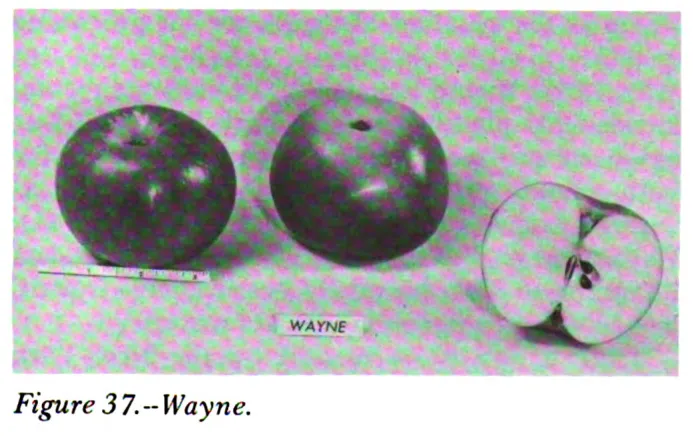
Wayne
Origin / History
Wayne is a New York Spy-type variety, from the cross Northwestern Greening x Red Spy made in 1944 at the New York State Agricultural Experiment Station. The breeding record number was 44420 and the seedling number N.Y. 44420-1. It was selected in 1951 from a population of 59 seedlings. After several years of fruiting on second-test trees with seedling and EM VII roots, it was introduced in 1962. It was named for Wayne County, the most important apple-producing county in New York State. The introductory description was published in 1962 by Klein, Way, and Einset. Way described it again in 1965. It was briefly described in the Register of New Fruit and Nut Varieties and by Brooks, and was described to the New York State Horticultural Society in 1963 and again two years later.
Trees were sold by the New York State Fruit Testing Association for 8 years, 1961-68, and by eight commercial nurseries in 1960-68, which Way takes as evidence of commercial acceptance. In 1965 only four cultivars exceeded Wayne in the number of new trees planted in New York State, much of this planting being subsidized and encouraged by a commercial processor of canned apple slices. Way says Wayne got off to a good start because processors pushed it on the basis of its processing qualities. In 1967 Wayne was one of 12 cultivars recommended for planting in New York State. In 1968 it was under test at experiment stations in Arkansas, Colorado, Kansas, Massachusetts, New York, North Carolina, Pennsylvania, and Washington. Zielinski (1964) reports it being extensively tested in variety trials in many areas of Oregon, finds it "worthy of limited planting on a trial basis," and says further evaluation is needed there.
Tree
Tree large, vigorous, upright spreading, tall, dense, full of fine twigs, round-topped, somewhat drooping when heavily cropped. Moderately early in coming into bearing. Unlike its parent Red Spy, Wayne is comparatively precocious. In New York trees begin commercial crops at 7 years (Way); Zielinski notes an early bearing tendency, young grafted trees bearing commercial crops within 4 years. A tree on seedling roots, 11 years old, bore 8 bushels in October 1963. Trees are generally productive, though some have been less productive than a good cultivar should be. Way thinks they probably inherit this unproductivity, since the pollen parent is a red sport of Northern Spy, and "Spy is notoriously a poor cropper." A commercial grower's evaluation found Wayne a fair yielder, late beginning to bear, and biennially bearing. Way adds that a cultivar of excellent processing quality can succeed commercially only if it is also a heavy cropper; a grower's profits are almost directly related to the amount of fruit grown per acre, and if Wayne proves a marginal yielder it cannot succeed. Whether it produces heavy annual crops will determine its future.
Blooms very late, 3 days later than Delicious. Diploid; pollen viable. Zielinski considers it, from its late bloom, a good pollinizer for late-blooming varieties.
Fruit
Size: Large, mostly 3 inches in diameter.
Form: Round-oblate to oblate, only slightly irregular, rather symmetrical, tending to be somewhat five-sided.
Stem: Short and thick.
Cavity: Generally acute, sometimes obtuse; medium in depth, broad, heavily russeted, with rays of russet sometimes extending up onto the shoulders. Symmetrical, only very slightly furrowed. The skin in the cavity sometimes cracks on overripe fruits, the fault of Wayne about which growers have been most quick to complain.
Calyx: Nearly closed, medium sized; lobes short, broad, acute. Calyx tube short (8 mm long), narrow (6 mm wide), funnel-shaped. Stamens median on the side of the calyx tube.
Basin: Shallow, narrow, obtuse, very slightly furrowed, usually symmetrical.
Skin: Medium in thickness, tender, smooth, somewhat dull. Bruise marks conspicuous, as often on Northern Spy. Ground color yellow. Skin 80 per cent light and bright red, somewhat pink on poorly colored fruits; color pattern distinctly striped. Partially covered with heavy scarfskin. Overall appearance attractive. In Oregon Zielinski finds it a very attractive apple, usually solidly blushed and washed with light scarlet, with no striping, and far more attractively colored than Northern Spy.
Dots: Few, small, grayish brown, obscure.
Flesh and flavor: Yellowish cream colored, semifirm, medium grained, crisp, tender, juicy; subacid, somewhat aromatic. Eating quality "good" (Way). Zielinski credits it with the Spy qualities of texture, flavor, and color, but in Oregon rates its fresh eating quality slightly lower than Northern Spy.
Core and seeds: Core very large, up to 4 cm wide, open. Carpels oval. Seeds very numerous, up to 19 per fruit, medium sized, wide, plump, obtuse.
Season
At Geneva the average ripening date is October 1, 1½ weeks before Delicious; the average interval from full bloom to harvest is 133 days, 12 days less than Delicious. Zielinski places it between Jonathan and Golden Delicious. Fruits adhere to the tree quite well after maturity. Storage life is "not especially good," about 110 days at 31° F, somewhat longer than McIntosh.
Uses
A dual-purpose variety (Zielinski), outstanding for processing. Zielinski reports New York tests showing it outstanding for canned and frozen slices and sauce. Way finds it outstandingly good in processing tests, its canned slices superior to those of Rhode Island Greening and Northern Spy, and rated a very good processing apple in comparative tests. In another study it rated far superior to Northern Spy, the standard of excellence for processing quality. A commercial grower called it an excellent processor. Home economists recommend it for both culinary and dessert uses.
Way calls it "unexcelled as a superior processing type," says it should become an important processing cultivar, and notes that, half of New York State apples being processed, an excellent processor such as Wayne could make a substantial contribution to the processing industry. He finds its appearance attractive enough to make it a good fresh-market cultivar. He rates its commercial potential good, though tree productivity has sometimes been a problem.
Subtypes / Variants
Not described in source.
Other
This Wayne is not the same cultivar as the Wayne described by Ragan. Zielinski says it has the Spy qualities without Spy's susceptibility to bitter pit. Way reports fruits do not develop stippin, except on very young and very vigorous trees.
Book Sources
Described in 2 period pomological works
View original book sources (2)
— Quentin B. Zielinski, Apple Varieties for Oregon (1964)Wayne is a new Spy-type variety from New York derived from crossing N. W. Greening x Red Spy. It is a dual-purpose variety which matures between Jonathan and Golden Delicious. New York tests show it to be outstanding for canned and frozen slices and sauce. It has the Spy qualities of texture, flavor, and color, but without the susceptibility to bitter pit. An advantage is its early bearing tendency, because young grafted trees bear commercial crops within 4 years. Wayne is a very attractive apple, usually solidly blushed and washed with light scarlet, with no striping, in Oregon, its fresh eating quality is slightly lower than Northern Spy, but it is far more attractively colored. Wayne is a diploid and blooms late, indicating that it should be a good pollinizer for late-blooming varieties. Further evaluation is needed in Oregon, but it is worthy of limited planting on a trial basis. It is being extensively tested in variety trials in many areas of Oregon.
— Roger D. Way, Apple Cultivars Introduced by the New York State Agricultural Experiment Station, 1914–1968 (1971)Wayne
Origin. Wayne originated from the cross, Northwestern Greening x Red Spy, made in 1944. The breeding record number was 44420, and the seedling number was N.Y. 44420-1. Wayne was selected in 1951 from a population of 59 seedlings. After several years of fruiting on second-test trees having seedling and EM VII roots, it was introduced in 1962 (Table 2). It was named for Wayne County, the most important apple producing county in New York State.
The introductory description for Wayne was published in 1962 by Klein, Way, and Einset (131, 132). Wayne was also described by Way in 1965 (215). It was briefly described in the Register of New Fruit and Nut Varieties (39). It was also briefly described by Brooks (30). Wayne was described for the New York State Horticultural Society in 1963 (224), and 2 years later it was again described to the same Society (214, 215).
This Wayne is not the same cultivar as the Wayne described by Ragan (181).
Tree. A tree of Wayne is illustrated in Figure 36, and tree characteristics are summarized in Table 5. Ten characteristics of Wayne trees have been listed by Way (217, 221). The tree is large, vigorous, upright spreading, tall, dense, full of fine twigs, round-topped, and somewhat drooping when heavily cropped. It is moderately early in coming into bearing. Wayne, unlike its parent Red Spy (125), is comparatively precocious, with trees beginning to produce commercial crops at 7 years of age (Table 5). Trees are generally productive, though some trees have been less productive than a good cultivar should be (Table 5). They probably inherit their unproductivity. The pollen parent of Wayne is a red sport of Northern Spy, and Spy is notoriously a poor cropper.
Wayne blossoms very late (213), 3 days later than Delicious (Table 6). It is diploid (Table 4), and the pollen is viable.
Figure 36.-- Wayne tree on seedling roots, 11 years old, October, 1963, an 8 bushel crop.
Fruit. The fruits of Wayne are illustrated in Figure 37. They were also illustrated by Klein, Way, and Einset (131), and by Way (217). The fruit characteristics of Wayne are summarized in Table 8. Ten fruit characteristics of Wayne have been listed by Way (217, 221). The average ripening date at Geneva is October 1, 1½ weeks before Delicious (Table 7). The average number of days from full bloom to harvest is 133, 12 days less than Delicious. Wayne fruits adhere to the tree quite well after maturity. They are large, mostly 3 inches in diameter. The shape is round-oblate to oblate, only slightly irregular, rather symmetrical, but tend to be somewhat five-sided. The stem is short and thick. The cavity is generally acute but sometimes obtuse, medium in depth, broad, and heavily russeted, with rays of russet sometimes extending up onto the shoulders. The cavity is symmetrical and only very slightly furrowed. The skin in the cavity sometimes cracks on overripe fruits. This has been the fault of Wayne about which growers have been most quick to complain. The calyx is nearly closed and medium sized. The calyx lobes are short, broad, and acute. The basin is shallow, narrow, obtuse, very slightly furrowed, and usually symmetrical.
Figure 37.--Wayne.
The fruit skin is medium in thickness, tender, smooth, and somewhat dull. Bruise marks are conspicuous, as they often are on Northern Spy fruits. The skin color is 80 per cent light and bright red, but on poorly colored fruits, it is somewhat pink. The color pattern is distinctly striped. The ground color is yellow. The skin is partially covered with heavy scarfskin. The over-all appearance is attractive. The dots are few, small, grayish brown, and obscure. The calyx tube is short (8 mm long), narrow (6 mm wide), and funnel-shaped. The stamens are median on the side of the calyx tube. The core is very large, up to 4 cm wide, and open. The carpels are oval. The seeds are very numerous, up to 19 per fruit, medium sized, wide, plump, and obtuse. The flesh is yellowish cream colored, semifirm, medium grained, crisp, tender, juicy, subacid, and somewhat aromatic. The eating quality is good.
Wayne fruits do not develop stippin, except on very young and very vigorous trees. The storage life of Wayne is not especially good, about 110 days at 31° F (Table 10), somewhat longer than that of McIntosh fruits.
Commercial Usefulness. In 1968 (184), Wayne was tested at experiment stations in Arkansas, Colorado, Kansas, Massachusetts, New York, North Carolina, Pennsylvania, and Washington.
In processing tests (Table 9), Wayne fruits have been outstandingly good, producing canned slices which are superior to those of Rhode Island Greening and Northern Spy. It has been rated as a very good processing apple (129) in tests where it was compared with other cultivars. In another study (187), Wayne rated far superior to Northern Spy which is the standard of excellence for processing quality.
In 1967, Wayne was one of 12 cultivars recommended for planting in New York State (176). It has been recommended by home economists for both culinary and dessert uses (66).
In an evaluation by a commercial grower (141), Wayne was an excellent processor, fair yielder, late beginning to bear, biennially bearing, large fruited, and adhering to the tree well after maturity.
Trees of Wayne were sold by the New York State Fruit Testing Association for 8 years, 1961-68 (Table 2). In the 1960-68 period, Wayne trees were sold by eight commercial nurseries (Table 3). This is evidence of its commercial acceptance.
In 1965 (Table 1), only four cultivars exceeded Wayne in the number of new trees planted in that year in New York State. Much of this heavy planting was subsidized and encouraged by a commercial processor of canned apple slices. A cultivar having excellent processing qualities can become commercially successful only if it is also a heavy cropper. A grower's profits are almost directly related to the amount of fruit he is able to grow per acre. If Wayne proves to be a marginal yielder, it cannot succeed.
The commercial potential for Wayne is good. It is unexcelled as a superior processing type, although tree productivity has sometimes been a problem. Wayne should become an important processing cultivar. Since half of New York State apples are processed, an excellent processor such as Wayne could make a substantial contribution to the processing industry. Wayne's appearance is also sufficiently attractive to make it a good freshmarket cultivar. Wayne got off to a good start because processors pushed it on the basis of its processing qualities. Will it produce heavy annual crops for the grower? That will determine its future.