Redhook
Apple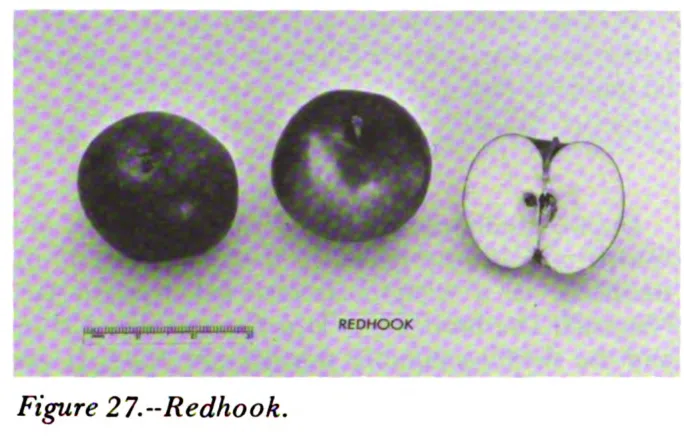
Redhook
Origin / History
Redhook originated from the cross McIntosh x Carlton, made in 1923. It is a reciprocal sister of Niagara. The breeding record number was 23106, and the seedling number was Station 4284. It was selected in 1935 from a population of 5 seedlings. Redhook was named and introduced in 1938 after only 4 years of observations and without benefit of a second test. It was named for the village of Red Hook in Dutchess County, New York, but the name was converted to a single word. It was briefly described in the Register of New Fruit and Nut Varieties and in the catalog of the New York State Fruit Testing Association for 1938 to 1961. Trees were sold by the Fruit Testing Association for 24 years, 1938 to 1961. In 1954, Redhook was tested at experiment stations in Nova Scotia, Ottawa, Massachusetts, and Wisconsin. In 1963, a survey of apple clones in the United States showed that it was then tested at stations in Michigan, New York, Oregon, and Vermont. In 1968, it was tested at stations in New York, North Carolina, and Ontario. In the 1960-68 period, Redhook trees were sold by one commercial nursery. Redhook never became a commercially important cultivar anywhere.
Tree
The tree is large, vigorous, upright, spreading, tall, medium in density, and round-topped. Trees are late coming into bearing. They are not highly productive and tend to bear a good crop only in alternate years. The trunk is stocky, and the trunk bark is only slightly shaggy, gray in color, and has a slightly brownish tinge. Redhook trees bloom in midseason, about 1 day before Delicious. The variety is diploid, and its pollen is viable.
Fruit
Size: Medium sized to large, up to 3 inches in diameter.
Form: Roundish oblate, tending to be 5-sided, irregular in shape with somewhat unequal halves.
Stem: Variable in length from long to short, medium in thickness.
Cavity: Acute, medium in depth, broad, russeted, mostly symmetrical, and sometimes lipped.
Calyx: Closed and medium sized. The calyx lobes are medium in length, broad, and acute. The calyx tube is short, narrow, and conical, with a fleshy pistil point. The stamens are basal.
Basin: Shallow, narrow, obtuse, very slightly furrowed, slightly symmetrical, and very slightly compressed.
Skin: Medium in thickness and toughness, smooth, dull, with heavy bloom. The skin is 100 per cent red, and 90 per cent of it is solid dark blush with the light red areas somewhat striped. Dayton found that in Redhook fruit skins, 95 per cent of the epidermal cells and 95 per cent of the outer hypodermal cells contained red pigment.
Dots: Few, large, brown russet, and conspicuous.
Flesh and flavor: Cream colored to white, with the outer half of the flesh pink in fully ripe fruits. The flesh is soft, medium grained, crisp, juicy, subacid, aromatic, and slightly astringent when not fully mature. The eating quality is very good, but the quality is fleeting, good only for a few days.
Core and seeds: The core is medium large (20 mm wide) and slightly open, with the core flesh at the base of the calyx tube sometimes dark green. The carpels are ovate. The seeds are medium in size, wide, plump, and acute.
Season
The fruits ripen in early midseason, on the average about September 20 at Geneva, 3 weeks before Delicious. The average number of days from full bloom to harvest is 126, 19 less than Delicious. The fruits hang fairly well to the tree after they have become harvest ripe. Redhook is the poorest keeper of all Geneva cultivars, having a storage life of only a few days.
Uses
Redhook is a dessert type and is not suited for processing. Because of its rather low yields, tendency to drop its fruits, and very soft flesh, Redhook is not suggested for extensive commercial plantings but is a delightful possession for the home gardener.
Subtypes / Variants
Not described in source.
Other
The Redhook described here is a different cultivar from the Red Hook described by Beach, et al and by Ragan.
Book Sources
Described in 1 period pomological work
View original book sources (1)
— Roger D. Way, Apple Cultivars Introduced by the New York State Agricultural Experiment Station, 1914–1968 (1971)Redhook
Origin. Redhook originated from the cross, McIntosh x Carlton, made in 1923 (see Carlton). Redhook is a reciprocal sister of Niagara (see Niagara). The breeding record number was 23106, and the seedling number was Station 4284. It was selected in 1935 from a population of 5 seedlings. Redhook was named and introduced in 1938 (Table 2) after only 4 years of observations and without benefit of a second test. It was named for the village of Red Hook in Dutchess County, New York, but the name was converted to a single word. This Redhook is a different cultivar from the Red Hook described by Beach, et al (19) and by Ragan (181). Redhook was briefly described in the Register of New Fruit and Nut Varieties (31) and in the catalog of the New York State Fruit Testing Association for 1938 to 1961.
Tree. The tree characteristics of Redhook are summarized in Table 5. The tree is large, vigorous, upright, spreading, tall, medium in density, and round-topped. Trees are late coming into bearing (Table 5); they are not highly productive and tend to bear a good crop only in alternate years. The trunk is stocky, and the trunk bark is only slightly shaggy, gray in color, and has a slightly brownish tinge. Redhook trees bloom in midseason, about 1 day before Delicious (Table 6). It is diploid (Table 4), and its pollen is viable.
Fruit. Redhook fruits are illustrated in Figure 27, and the fruit characteristics are summarized in Table 8. The fruits ripen in early midseason, on the average, about September 20 at Geneva, 3 weeks before Delicious (Table 7). The average number of days from full bloom to harvest is 126, 19 less than Delicious. The fruits hang fairly well to the tree after they have become harvest ripe. They are medium sized to large, up to 3 inches in diameter. They are roundish oblate, tend to be 5-sided, and irregular in shape with somewhat unequal halves. The stems are variable in length from long to short, and they are medium in thickness. The cavity is acute, medium in depth, broad, russeted, mostly symmetrical, and sometimes lipped. The calyx is closed and medium sized. The calyx lobes are medium in length, broad, and acute. The basin is shallow, narrow, obtuse, very slightly furrowed, slightly symmetrical, and very slightly compressed.
The skin is medium in thickness and toughness, smooth, dull, and with heavy bloom. The skin is 100 per cent red, and 90 per cent of it is solid dark blush with the light red areas somewhat striped. Dayton (60) found that in Redhook fruit skins, 95 per cent of the epidermal cells and 95 per cent of the outer hypodermal cells contained red pigment. The dots are few, large, brown russet, and conspicuous. The calyx tube is short, narrow, and conical; the pistil point is fleshy. The core flesh at the base of the calyx tube is sometimes dark green. The stamens are basal. The core is medium large (20 mm wide) and slightly open. The carpels are ovate. The seeds are medium in size, wide, plump, and acute. The flesh is cream colored to white, with the outer half of the flesh pink in fully ripe fruits. The flesh is soft, medium grained, crisp, juicy, subacid, aromatic, and slightly astringent when not fully mature. The eating quality is very good, but the quality is fleeting, good only for a few days. Redhook is the poorest keeper of all Geneva cultivars, having a storage life of only a few days (Table 10). Redhook is a dessert type and is not suited for processing.
Commercial Usefulness. Trees of Redhook were sold by the Fruit Testing Association for 24 years, 1938 to 1961 (Table 2). In the 1960-68 period, Redhook trees were sold by one commercial nursery (Table 3). Redhook never became a commercially important cultivar anywhere. In 1954, Redhook was tested at experiment stations in Nova Scotia, Ottawa, Massachusetts, and Wisconsin (186). In 1963, a survey of apple clones in the United States showed that it was then tested at stations in Michigan, New York, Oregon, and Vermont (79). In 1968 (184), it was tested at stations in New York, North Carolina, and Ontario. Because of its rather low yields, tendency to drop its fruits, and very soft flesh, Redhook is not suggested for extensive commercial plantings but is a delightful possession for the home gardener.