Carlton
Apple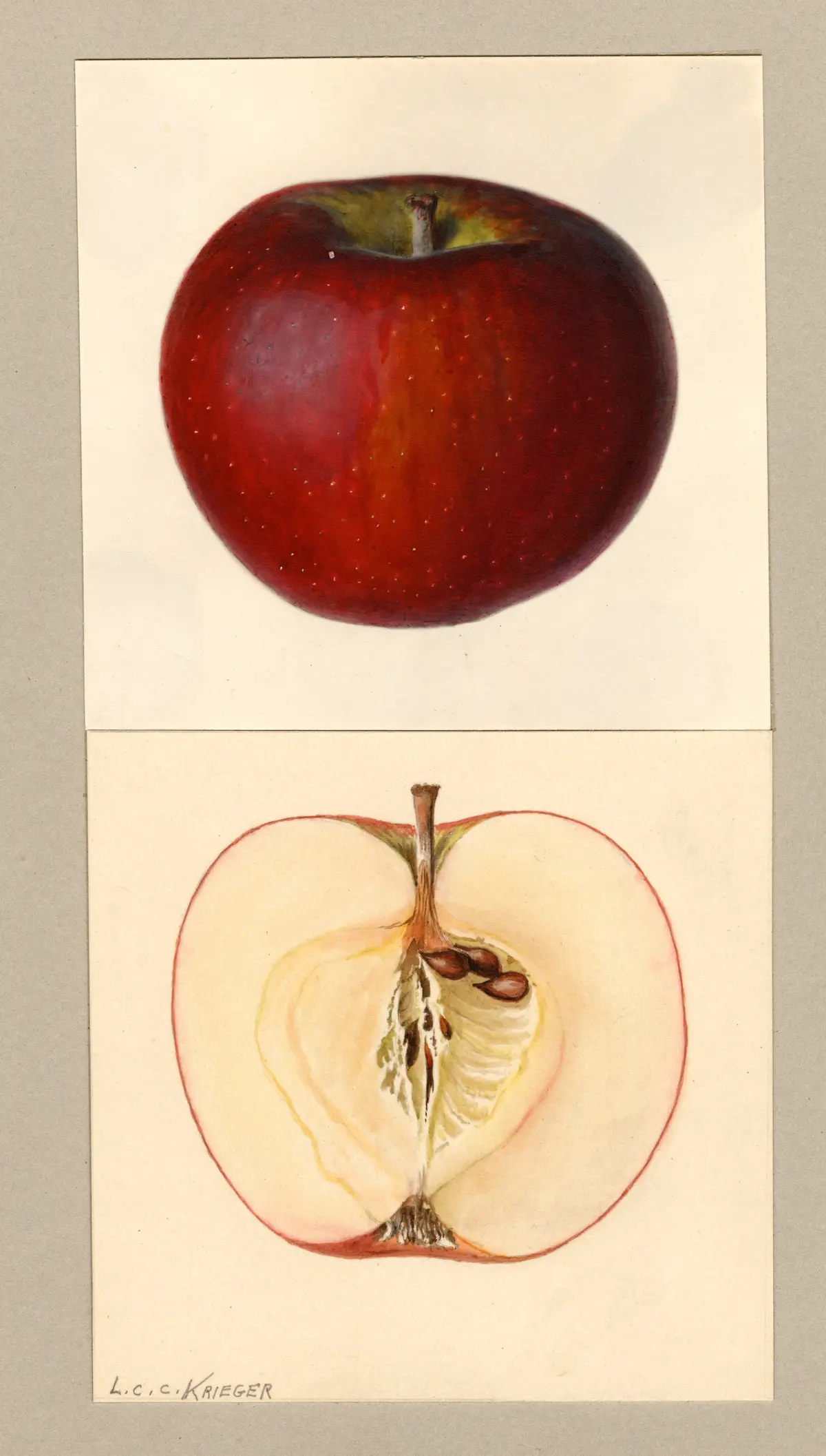
USDA Pomological Watercolor Collection
Carlton
Origin / History
Carlton originated from the cross Montgomery x Red Astrachan, made in 1912 at the New York State Agricultural Experiment Station, Geneva. Breeding record number 12493; seedling number Astrachan No. 2391. Selected in 1920 from a population of 147 seedlings and introduced in 1923, without benefit of a second test. Named for the village of Carlton in Orleans County, New York. A comprehensive description was published by Howe in 1929, and it was briefly described in the Register of New Fruit and Nut Varieties. This Carlton is a different cultivar from the Carlton described by Ragan. Carlton is one of the parents of Niagara.
Nursery trees were sold by the New York State Fruit Testing Association for 29 years, 1923-25 and 1928-53. Only one commercial nursery sold trees of it in the 1960-68 period. In 1954 it was tested at experiment stations in Delaware, Maine, and Minnesota. In 1963 it was tested at experiment stations in only two states, New York and Wyoming. In 1968 it was tested at experiment stations in New York, North Carolina, Ontario, and West Virginia. In a 1941 circular on apple growing in New York, Howe described Carlton as one of the best and most important cultivars; despite this it never gained commercial acceptance, is of doubtful commercial value, and is not recommended for planting.
Tree
Tree vigorous, tall, upright spreading. Diploid; pollen viable. High chilling requirement: after the very mild winter of 1956-57 in Mississippi, trees reached full bloom 4 to 7 weeks later than usual. Trees immune to woolly apple aphid in both Japan and Argentina.
Blossoms early, nearly 2 days earlier than Delicious; other New York pollination studies found that it blooms in mid-season instead of early. Pollination experiments in the Champlain Valley, New York, showed that its pollen produced satisfactory fruit sets but not so good as Delicious; other New York studies showed it a desirable pollinator. Trees bear annually.
Fruit
Size: Medium but variable, about 2 3/4 inches in diameter.
Form: Round-conic, symmetrical.
Stem: Medium in length and thickness.
Cavity: Acute, broad, medium in depth, smooth, symmetrical.
Calyx: Somewhat open, medium sized. Lobes narrow, medium in length, acute. Calyx tube long, wide, funnel-shaped. Stamens median.
Basin: Shallow, medium in width, obtuse, smooth, symmetrical.
Skin: Thin, tender, smooth; 50 per cent red striped. In 1937 Howe described the fruit as very attractive in appearance, unless the color becomes so dark that it is a little dull, as sometimes happens in certain environments.
Dots: Few, small, white, obscure.
Flesh and flavor: Flesh white, fine grained, tender, juicy, sour, sprightly. Eating quality only fair.
Core and seeds: Core large, closed. Carpels cordate. Seeds medium sized, wide, short, plump, obtuse.
Season
Average harvest date at Geneva August 31, 6 weeks before Delicious; 107 days from full bloom to harvest, 38 fewer than Delicious. Fruits ripen unevenly over a period of 2 weeks and hang well on the tree after ripening, unlike those of its parent, Red Astrachan. Storage life short, approximately 25 days at 31° F.
Uses
A dessert type. In 1937 Howe described it as ripening before Milton and sprightly flavored, with considerable merit for the roadside market as an apple for the consumer to eat fresh or to take home for culinary artistry. Of doubtful commercial value. Contains 15 mg ascorbic acid per 100 gm fruit, compared with 37 for Calville Blanc and 4 for McIntosh.
Subtypes / Variants
Not described in source.
Other
Not described in source.
Book Sources
Described in 1 period pomological work
View original book sources (1)
— Roger D. Way, Apple Cultivars Introduced by the New York State Agricultural Experiment Station, 1914–1968 (1971)Carlton
Origin. Carlton originated from the cross, Montgomery x Red Astrachan, made in 1912 (see Montgomery). The breeding record number was 12493 and the seedling number was Astrachan No. 2391. It was selected from a population of 147 seedlings in 1920, and it was introduced in 1923 (Table 2), without benefit of a second test. It was named for the village of Carlton in Orleans County, New York. A comprehensive description of Carlton was published by Howe in 1929 (100), and it was briefly described in the Register of New Fruit and Nut Varieties (31).
This Carlton is a different cultivar from the Carlton described by Ragan (181).
Carlton is one of the parents of Niagara (see Niagara).
Tree. The tree characteristics of Carlton are summarized in Table 5. The tree is vigorous, tall, and upright spreading.
Trees of Carlton have a high chilling requirement. After the very mild winter of 1956-57 in Mississippi, Carlton trees reached full bloom 4 to 7 weeks later than usual (177).
Both in Japan (164) and Argentina (108), trees of Carlton have been found to be immune to woolly apple aphid.
Carlton blossoms early, nearly 2 days earlier than Delicious (Table 6). It is diploid (Table 4), and the pollen is viable.
Pollination experiments using Carlton in the Champlain Valley, New York (152) showed that its pollen produced satisfactory fruit sets but not so good as Delicious. Other pollination studies in New York (236) showed that Carlton is a desirable pollinator, that it blooms in mid-season instead of early, and that the trees bear annually (238).
Fruit. The fruit characteristics of Carlton are summarized in Table 8. The average harvest date at Geneva is August 31, 6 weeks before Delicious (Table 7). The average number of days from full bloom to harvest is 107, 38 fewer than Delicious. Carlton fruits hang well on the tree after they ripen, unlike those of its parent, Red Astrachan. The fruits ripen unevenly over a period of 2 weeks. The fruits are medium but variable in size, about 2 3/4 inches in diameter. They are round-conic and symmetrical. The stem is medium in length and thickness. The cavity is acute, broad, medium in depth, smooth, and symmetrical. The calyx is somewhat open and medium sized. The calyx lobes are narrow, medium in length, and acute. The basin is shallow, medium in width, obtuse, smooth, and symmetrical.
The skin is 50 per cent red striped, thin, tender, and smooth. The dots are few, small, white, and obscure. The calyx tube is long, wide, and funnel-shaped. The stamens are in a median location. The core is large and closed. The carpels are cordate. The seeds are medium sized, wide, short, plump, and obtuse.
The flesh of Carlton fruits is white, fine grained, tender, juicy, sour, and sprightly. The eating quality is only fair. It is a dessert type. The storage life of Carlton fruits is short, approximately 25 days at 31° F (Table 10).
Carlton contains 15 mg ascorbic acid per 100 gm fruit, which compares with 37 for Calville Blanc and 4 for McIntosh (105).
Commercial Usefulness. Nursery trees of Carlton were sold by the New York State Fruit Testing Association for 29 years, 1923-25 and 1928-53 (Table 2). Only one commercial nursery sold trees of it in the 1960-68 period (Table 3).
In 1954, Carlton was tested at experiment stations in Delaware, Maine, and Minnesota (186). In 1963, a survey of apple clones in the United States showed that it was then tested at experiment stations in only two states, New York and Wyoming (79). In 1968 (184), it was tested at experiment stations in New York, North Carolina, Ontario, and West Virginia.
In 1937, Howe (102) described Carlton as ripening before Milton and very attractive in appearance, unless the color becomes so dark that it is a little dull, as sometimes happens in certain environments. It is sprightly flavored and has considerable merit for the roadside market as an apple for the consumer to eat fresh or to take home for culinary artistry.
In a 1941 circular about apple growing in New York (103), Howe described Carlton as one of the best and most important cultivars. Despite this, Carlton never gained commercial acceptance. It is of doubtful commercial value and is not recommended for planting.