Red Astrachan
Apple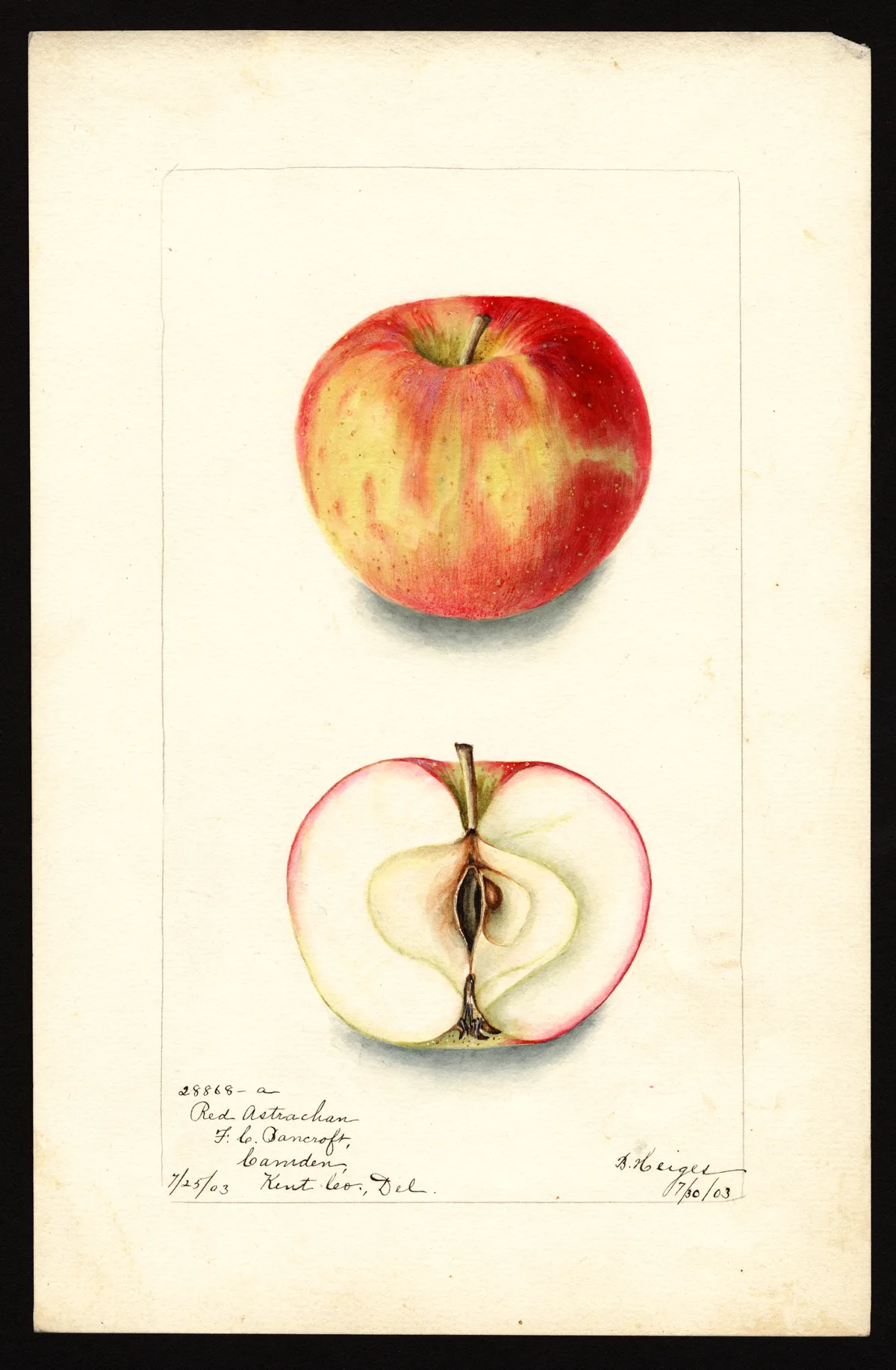
USDA Pomological Watercolor Collection
Red Astrachan
Origin / History
Red Astrachan is a Russian apple, first imported into England from Sweden in 1816 along with the White Astrachan. Lindley records that "This very beautiful apple was imported from Sweden, and first fruited by William Atkinson, Esq., of Grove End, Paddington, in 1816" — Hovey similarly notes that it fruited in Mr. Atkinson's garden at Grove End, near London, in 1820, at which time it was exhibited before the London Horticultural Society and noticed in their Transactions (vol. iv). Hogg states it was imported from Sweden into England in 1816.
It was one of the first of the Russian apples imported into America. It was received by the Massachusetts Horticultural Society from the London (England) Horticultural Society about 1835, but this was not the first importation, for fruit of Red Astrachan was included in one of the exhibitions of the Massachusetts Horticultural Society that same year (1835), grown in Massachusetts. Hedrick gives the American introduction date as 1835. The variety has since become generally disseminated throughout the apple-growing districts of the continent and is commonly listed from the Atlantic to the Pacific and from Canada to the Gulf states. It has proved a great favorite, particularly in the North, by its hardiness and productiveness, beauty, and good qualities, and is described by Hedrick as the standard red summer apple for home orchards in the United States and Canada — not because it is best in any of its characters, but because it is considerably above the average in all.
At the time of Hovey's 1852 account, although in many collections of fruit, it was by no means extensively cultivated and had not yet been so abundantly raised as to be found in markets except in exceedingly small quantities.
Tree
A hardy and exceedingly vigorous variety, admirably adapted for dwarf trees, which when loaded with fruit have a very showy appearance. Form upright, regular in growth, forming a handsome and rather compact head; young trees very erect, with short spurs on the main stem (Hovey). Later authors describe the tree as upright-spreading: Downing — "a vigorous grower, upright spreading"; Warder — "vigorous, upright, productive, hardy"; Beach — "medium to rather large, moderately vigorous to vigorous; form upright spreading to roundish, rather dense"; Hedrick — "large, vigorous, upright-spreading, dense"; Budd-Hansen and Hansen — "of vigorous, upright, spreading growth, an early and abundant bearer." Elliott calls it "a hardy, strong grower, regular, moderate bearer of fruit, always fair."
It comes into bearing rather early, young and thrifty trees often producing fruit the fourth or fifth year (Hovey). Beach notes it "comes into bearing rather young and is a reliable cropper, yielding moderate to good crops biennially or sometimes annually"; Hedrick says trees "come into bearing young and bear regularly and abundantly, but are short-lived and subject to most of the ills that apple-trees are heir to." The fruit hangs to the tree pretty well till fully ripe, but as the crop matures unevenly there is apt to be considerable loss from dropping unless several pickings are made. Bunyard's Handbook (1920) dissents on productivity, calling growth "moderate, fertility poor" and judging it "too poor a cropper for general use."
Wood / shoots. Hovey: "Clear reddish chestnut, sprinkled with distinct whitish specks, stout, rather short-jointed, pubescent at the ends." Downing: "Young shoots clear reddish brown." Warder: "Shoots reddish brown, foliage large, rich green." Elliott and Thomas: "Shoots stout, dark brown" — Thomas adds "diverging and ascending." Beach: "Twigs medium to long, curved, stout to rather slender; internodes long. Bark clear brown, lightly streaked with scarf-skin, pubescent near the tips. Lenticels quite numerous, medium to small, oblong, slightly raised."
Buds. Hovey: "large, broad, with rather stout shoulders, and somewhat flattened; flower-buds oval." Beach: "medium in size, plump, obtuse to acute, free, pubescent."
Leaves. Hovey: "Medium size, roundish oblong, wavy on the margin, shortly acuminate, rather deeply and obtusely serrated; petioles of medium length, and moderately stout; stipules narrow." Elliott and Thomas: "broad" foliage. Bunyard (1920): "long oval, pale green, held flat, crenate."
Flowers. Medium size (Hovey).
Fruit
Size and form
Large, about three inches broad and two and a half deep (Hovey); pretty large, rather above the middle size (Downing); above medium (Hansen, Budd-Hansen, Central Experimental Farm); medium to sometimes large, not very uniform in size or shape (Beach, Hedrick); medium to large (Warder); medium to large, sometimes quite large (Thomas); medium (Lowther); medium, 2¼ by 2¼ (Bunyard 1920). Beach notes the fruit "is not very uniform in size, and a considerable amount of it is small or otherwise unmarketable."
Form roundish, flattened at the base, and narrowing little towards the eye (Hovey); roundish, a little narrowed towards the eye (Downing); roundish, tapering toward the apex (Elliott); oblate, regular (Warder); roundish, somewhat conical (Hansen, Budd-Hansen); roundish-oblate, slightly approaching conical (Thomas); roundish to roundish oblate, inclined to conical, somewhat ribbed, sides a little unequal (Beach); round-oblate, conical, ribbed, sides unequal (Hedrick); roundish (Central Experimental Farm); flattened round, fairly regular (Bunyard 1920).
Stem and cavity
Stem. Short, about half an inch in length, rather stout, straight, and moderately inserted (Hovey); rather short and deeply inserted (Downing); varying, generally short (Elliott); long, yellow (Warder); short (Hansen, Budd-Hansen, Bunyard 1920); one-half to three-fourths of an inch long (Thomas); medium, rather slender, bracted (Beach, Hedrick).
Cavity. Broad, rather shallow basin (Hovey, describing the stem cavity); narrow (Elliott); shallow, regular (Warder); shallow, regular, obtuse, russeted (Hansen, Budd-Hansen); acute to sometimes obtuse, medium to deep, moderately broad, often thinly russeted with greenish russet, usually symmetrical, sometimes lipped (Beach); acute, deep, broad, often russeted with greenish-russet, usually symmetrical, sometimes lipped (Hedrick); scaly russet cavity (Bunyard 1920); sometimes russeted around the stem (Hovey skin description).
Calyx and basin
Calyx / eye. Rather large, partially closed, and slightly depressed (Hovey); partially closed (Downing); large (Elliott); small, closed (Warder, Hansen, Budd-Hansen); medium to rather large, open or closed; lobes rather long, moderately broad (Beach); large, open or closed; lobes long, broad (Hedrick); closed (Bunyard 1920).
Basin. Broad, shallow, and somewhat ridged (Hovey); slight, sometimes a little irregular (Downing); shallow, uneven (Elliott); medium, regular (Warder); shallow, smooth, sometimes a little irregular (Hansen, Budd-Hansen); shallow, narrow to medium in width, obtuse, wrinkled (Beach); shallow, narrow, obtuse, wrinkled (Hedrick); small slightly uneven basin (Thomas); shallow basin (Bunyard 1920).
Skin and color
Very fair, smooth (Hovey, Downing, Hansen, Budd-Hansen, Thomas, Beach, Hedrick). Skin rather thin, moderately tender (Beach); thin, tender, smooth (Hedrick).
Color is rich, brilliant crimson on the sunny side, paler in the shade, though occasionally a little greenish, sometimes russeted around the stem, dotted with large yellow specks, and covered with a thin whitish bloom (Hovey); almost entirely covered with deep crimson, with sometimes a little greenish yellow in the shade, and occasionally a little russet near the stalk, and covered with a pale white bloom (Downing); greenish yellow, mostly overspread with rich purplish crimson, a little russet near the stem and a white bloom (Elliott); smooth, mottled, marbled and striped crimson on greenish-yellow; dots minute, heavy bloom (Warder); greenish yellow, almost entirely covered with mottled, marbled and striped deep crimson, with delicate white bloom, a beautiful fruit; dots minute (Hansen, Budd-Hansen); nearly whole surface brilliant deep crimson, with a thick bloom like a plum (Thomas); pale yellow or greenish often nearly or quite overspread with light and dark red splashed and irregularly striped with deep crimson or carmine and covered with rather heavy distinct bluish bloom; dots numerous, small, whitish (Beach); pale yellow often overspread with light and dark red, splashed and irregularly striped with deep crimson or carmine and covered with heavy bloom; dots numerous, white (Hedrick); yellow, largely covered with light and dark red, presenting a striped appearance, and overspread with bluish bloom (Beach, summary); yellowish red, some parts being a dark red, causing the apple to present a striped appearance, and also overspread with a bluish bloom (Lowther); deep crimson, unstriped (Bunyard 1920 — conflicting note that the color is not striped).
Hovey writes of the variety as a whole that "it has not only a rich, deep crimson skin, often heightened by the peculiar abruptness of the coloring from the sunny to the shaded side, but it is covered with a soft bloom, as beautiful as that of a plum." The Central Experimental Farm (Agassiz BC, 1900) catalog describes the skin as "green, nearly overspread with deep crimson." George Bunyard (1901) describes the catalog form as "medium pale yellow with rosy cheek." Stark Bros. (1910) notes the apple "has precedent with light and dark red."
Flesh and flavor
White, with occasional stains of pink, fine, crisp, and tender (Hovey); quite white, crisp, moderately juicy, with an agreeable, rich, acid flavor (Downing); white, crisp, juicy, acid (Elliott); yellow, breaking, juicy; flavor quite acid, not rich (Warder); white, crisp, juicy, brisk acid (Hansen, Budd-Hansen); white, rather crisp; good, rather acid, slightly austere (Thomas); white often strongly tinged with red, rather fine, crisp, tender, juicy, brisk subacid, aromatic, sometimes slightly astringent, good to very good (Beach); white often tinged with red, fine, crisp, tender, juicy, brisk subacid, aromatic, sometimes astringent; good to very good (Hedrick); crisp, white, sweet (Bunyard 1920 — note this disagrees with the prevailing acid/subacid characterization); white, crisp, juicy, with a rich flavour, quality good (Central Experimental Farm 1900).
Juice. Tolerably abundant (Hovey).
Quality. Hovey: an excellent apple, though not quite equalling the Early Harvest, which ripens at about the same season. Elliott: rather acid as a dessert fruit unless fully ripe, but for marketing or cooking it has few equals at its time. Warder: "Quality first rate for market and cooking, poor for table." Thomas: "of second-rate flavor" but in general cultivation because of earliness, very handsome and fair appearance, vigor and productiveness of the tree, and excellent culinary qualities; "should be picked a few days before fully mature." Beach: "fit for culinary purposes before it becomes fully ripe, so that for home use it is in season from late July to September. When fully ripe and mellow it is desirable for dessert use." Hedrick: "fit for cooking long before maturity, and, when fully ripe, are fair for dessert, having a long season of usefulness." George Bunyard (1901): "not very flavory. Good for stewing." Bunyard Handbook (1920): "A most attractive fruit." Thomas Rivers (1914): "a pleasant medium flavour; a prime [apple] — Aug & Sept."
Core and seeds
Core. Large, rather close (Hovey); small (Elliott); regular, closed (Warder); closed, barely clasping; cells open, obovate; tube funnel-shaped; stamens marginal or median (Hansen, Budd-Hansen); small, somewhat abaxile; cells closed or somewhat open; core lines clasping or sometimes nearly meeting; carpels broadly ovate or obovate, slightly tufted; calyx tube long, funnel-form; stamens median to marginal (Beach); small, abaxile; cells closed or open; core-lines clasping; carpels broadly ovate, tufted; calyx-tube long, funnel-form; stamens median (Hedrick).
Seeds. Small, ovate (Hovey); ovate, dark brownish black (Elliott); angular, small, dark (Warder); many, angular, plump, small (Hansen, Budd-Hansen); small, moderately wide, plump, obtuse (Beach); small, wide, plump, obtuse (Hedrick).
Season
Ripe from the middle of August to the beginning of September (Hovey); ripens from last of July to middle of August (Downing); August (Elliott, Central Experimental Farm); July (Warder); a few days after Early Harvest (Thomas); late July, early August (Hansen, Budd-Hansen); late July to September (Beach, Hedrick); early August (Bunyard 1920); August–September (George Bunyard, Thomas Rivers).
The fruit should be gathered as soon as ripe, for, if allowed to hang upon the tree, it soon becomes mealy (Hovey, Downing). The crop matures unevenly, requiring several pickings to save the fruit (Beach, Lowther, Hedrick). The fruit is very perishable, and on this account not well adapted for shipping to distant markets (Beach); cannot be handled or stored, and therefore the variety has small place as a market fruit (Hedrick); tender and perishable, not well adapted to commercial purposes (Lowther).
Uses
Valued for home use; excellent for cooking and for marketing, with few equals at its season (Elliott); first rate for market and cooking, poor for table (Warder); excellent culinary qualities, should be picked a few days before fully mature (Thomas); fit for culinary purposes before fully ripe, desirable for dessert when fully ripe and mellow (Beach); fit for cooking long before maturity, fair for dessert when fully ripe (Hedrick); good for stewing (George Bunyard 1901); dessert (Bunyard 1920). Hardy far West (Thomas). Very common in local markets, though often the supply so much exceeds the demand that prices are consequently low (Beach).
Subtypes / Variants
Not described in source.
Other
Hovey rates the variety on appearance alone as bearing off the palm among the great number of varieties of his day for beauty, citing "the peculiar abruptness of the coloring from the sunny to the shaded side" and the soft bloom "as beautiful as that of a plum." Downing describes it as "a fruit of extraordinary beauty" and "one of the handsomest dessert fruits." Stark Bros. (1910) characterizes the tree as "handy and prolific... being sure to produce good crops." Bunyard (1920) notes the origin as "probably from the country of its name."
Book Sources
Described in 12 period pomological works
- Beach, The Apples of New York Vol. 2 (1905)
- Warder, American Pomology: Apples (1867)
- Budd & Hansen, Systematic Pomology (1914)
- Downing, Fruits and Fruit Trees of America (1900)
- Elliott, The Western Fruit Book (1865)
- Hedrick, Cyclopedia of Hardy Fruits (1922)
- The Herefordshire Pomona (1876–1885)
- Thomas, The American Fruit Culturist (1903)
- Lowther (ed.), Encyclopedia of Practical Horticulture (1914)
- Hansen, A Study of Northwestern Apples (1902)
- Bunyard, A Handbook of Hardy Fruits (1920) — listed as Astrachan Red
- Hovey, The Fruits of America (1852) — listed as The Red Astrachan Apple
Nursery Catalog Sources
Found in 72 catalogs (1845–1947) from Alabama, Arkansas, California, England, Florida, Illinois, Massachusetts, Missouri, New Jersey, Oregon, Virginia, Washington
- Winship's Nursery (Brighton Nurseries , operated by the Winship family), Brighton (Boston) , Massachusetts — 1845
- Hovey & Co. , Cambridge , Massachusetts — 1849
- Azell Bowditch (Nursery / Fruit Catalog) , Boston , Massachusetts — 1850
- Joseph Breck & Co. , Boston , Massachusetts — 1855
- Hutchison Nursery , James Hutchison, Oakland , California — 1881
- Felix Gillet , Barren Hill Nursery, Nevada City , California — 1884
- Fancher Creek Nursery , Fresno , California — 1886
- Huntsville Wholesale Nurseries (Jessie S. Moss , Proprietor; W.F. Heikes, Manager), Huntsville , Alabama — 1886
- Felix Gillet , Barren Hill Nursery, Nevada City , California — 1888
- California Nursery Co. , Niles , California — 1889
- Felix Gillet , Barren Hill Nursery, Nevada City , California — 1889
- Palouse Nursery and Pleasant Dale Fruit Farm , Colfax, Washington Territory (situated two miles northeast of Colfax) - undated (single-page broadside flyer; "Washington Territory" suggests pre — 1889
- Felix Gillet , Barren Hill Nursery, Nevada City , California — 1890
- Felix Gillet , Barren Hill Nursery, Nevada City , California — 1891
- Puyallup & Yakima Nurseries , Puyallup, Washington (Lock Box 191) and North Yakima , Washington — 1892
- Glen St. Mary Nurseries (G.L. Taber , Proprietor), Glen St. Mary , Florida — 1893
- Milwaukie-Canby Nurseries , Canby, OR (and Milwaukie, OR) — 1893
- Oregon Wholesale Nurseries , Salem , Oregon — 1893
- Sherwood Hall Nursery Co. , Timothy Hopkins (Menlo Park Nurseries), San Francisco / Menlo Park , California — 1893
- Multnomah Nurseries , Russellville , Oregon — 1894
- The Vineland Nurseries (Kelsey & Co. , Proprietors), St. Joseph, Missouri (Office: 13th and Atchison Sts., 2 Blocks East of the Citizens St. Car Line) — 1894
- Woodburn Nurseries , Woodburn, Marion Co. , Oregon — 1894
- Felix Gillet , Barren Hill Nursery, Nevada City , California — 1895
- Stark Bros. Nurseries & Orchards Co. , Louisiana , Missouri — 1896
- The Lovett Company , Little Silver , New Jersey — 1896
- Felix Gillet , Barren Hill Nursery, Nevada City , California — 1897
- The Salem Nursery (John A. Francis , Proprietor), Salem , Virginia — 1897
- Arthur J. Collins & Sons , Moorestown , New Jersey — 1898
- Stark Bros. Nurseries & Orchards Co. , Louisiana , Missouri — 1898
- Brown Brothers Co. , Continental Nurseries, Rochester, NY (also operated from Toronto, Canada) — 1899
- Central Experimental Farm , Dominion Department of Agriculture, Agassiz, British Columbia (under test; Bulletin No. 3, Second Series) — 1900
- George Bunyard & Co. , Royal Nurseries, Maidstone, Kent , England — 1900
- Benjamin Buckman (personal inventory) , Farmingdale , Illinois — 1901
- The Dalles Nurseries , The Dalles , Oregon — 1901
- Washington Nursery Co. , Toppenish , Washington — 1901
- Brown Brothers Co. , Continental Nurseries, Rochester, NY (also operated from Toronto, Canada) — 1901
- Mountain Grove Nurseries (Tippin & Moore , Proprietors; Geo. T. Tippin, J. W. Tippin, J. C. Moore), Mountain Grove , Missouri — 1901
- S.L. Watkins , Grizzly Flats, El Dorado County , California — 1901
- Yarbrough Bros. , Stephens , Arkansas — 1901
- Forestville Nurseries , T.J. True, Forestville , California — 1902
- Pacific Nursery Company (W. O. Hudson & A. D. Hudson) , Tangent , Oregon — 1903
- Russellville Nursery Co. , Russellville, OR (three miles east of Portland, one mile from Montavilla car line) — 1903
- Henderson Luelling / Traveling Nursery (historical recall) , Oregon — 1904
- OSU Bulletin 81 — 1904
- Phoenix Nursery Company (W. E. Rossney , President; Sidney Tuttle, Vice-President), Bloomington , Illinois — 1904
- Stark Bros. Nurseries & Orchards Co. , Louisiana , Missouri — 1906
- J.B. Pilkington , Portland , Oregon — 1907
- Russellville Nursery Co. , Montavilla Station, Portland, OR (three miles east of Portland, one mile from Montavilla car line) — 1907
- Carlton Nursery Co. , Carlton , Oregon — 1909
- Washington Nursery Company , Toppenish , Washington — 1909
- C.F. Lansing , Salem , Oregon — 1910
- Stark Bros. Nurseries & Orchards Co. , Louisiana , Missouri — 1910
- Stark Bros. Nurseries & Orchards Co. , Louisiana , Missouri — 1911
- James Veitch & Sons , Ltd., Royal Exotic Nursery, Chelsea, London (also Coombe Wood, Langley, and Feltham) , England — 1911
- Ballygreen Nurseries , Hanford , Washington — 1912
- Pacific Nursery Company , Portland , Oregon — 1912
- Stark Bros. Nurseries & Orchards Co. , Louisiana , Missouri — 1912
- Vineland Nurseries Company , Clarkston , Washington — 1912
- Washington Nursery Company , Toppenish , Washington — 1912
- Benjamin Buckman (personal inventory) , Farmingdale , Illinois — 1913
- J. B. Pilkington , Nurseryman, Portland, OR (nurseries near Newberg, forty miles from Portland) — 1913
- Van Holderbeke Nursery Co. , Incorporated, Spokane, Washington (nurseries at Otis Orchards WA, Pasadena WA, Kennewick WA) — 1913
- Union Nurseries , J.B. Weaver & Sons, Union , Oregon — 1915
- Fancher Creek Nurseries , George C. Roeding, Fresno , California — 1918
- Stark Bros. Nurseries & Orchards Co. , Louisiana , Missouri — 1918
- Oregon Nursery Co. , Orenco , Oregon — 1920
- Benedict Nursery Co. , Portland , Oregon — 1921
- Fresno Nursery Co. , Fresno , California — 1924
- Columbia & Okanogan Nursery Co. , Wenatchee , Washington — 1925
- Hudson's Wholesale Nurseries , Tangent , Oregon — 1936
- Milton Nursery Co. , Milton-Freewater , Oregon — 1947
- North-Western Nurseries , Walla Walla , Washington
View original book sources (16)
— C.M. Hovey, The Fruits of America (1852)THE RED ASTRACHAN APPLE.
Red Astrachan. Pomological Magazine, vol. iii. pl. 123.
If a fruit should be entitled to the attention of cultivators for its beauty alone, the Red Astrachan, among our great number of varieties, would bear off the palm. It has not only a rich, deep crimson, skin, often heightened by the peculiar abruptness of the coloring from the sunny to the shaded side, but it is covered with a soft bloom, as beautiful as that of a plum. Its fine appearance, however, is not its only recommendation ; for, although not quite equalling the Early Harvest, which ripens at about the same season, it is an excellent apple, and one without which no collection can be complete.
It was first introduced into England, from Sweden, about the year 1816, and fruited in the garden of Mr. Atkinson, at Grove End, near London, in 1820, at which period it was exhibited before the London Horticultural Society, and noticed in their Transactions, (vol. iv.) Its beauty as well as excellence commended it to the notice of cultivators, and it was very generally disseminated. At what time it was introduced into this country we have no precise information. Though in many collections of fruit, it is by no means extensively cultivated, and we believe that it has not yet been so abundantly raised as to be found in our markets, only in exceedingly small quantities.
It is a hardy and exceedingly vigorous variety, admirably adapted for dwarf trees, which, when loaded with fruit, have a very showy appearance. It comes into bearing rather early, young and thrifty trees often producing fruit the fourth or fifth year. The fruit should be gathered as soon as ripe, for, if allowed to hang upon the tree, it soon becomes mealy.
Tree. — Vigorous, upright, and regular in growth, forming a handsome and rather compact head ; young trees very erect, with short spurs on the main stem : our vignette is from a tree two years from the bud.
Wood. — Clear reddish chestnut, sprinkled with distinct whitish specks, stout, rather short-jointed, pubescent at the ends ; buds large, broad, with rather stout shoulders, and somewhat flattened : Flower-buds oval.
Leaves. — Medium size, roundish oblong, wavy on the margin, shortly acuminate, rather deeply and obtusely serrated ; petioles of medium length, and moderately stout ; stipules narrow.
Flowers. — Medium size.
Fruit. — Large, about three inches broad, and two and a half deep : Form, roundish, flattened at the base, and narrowing little towards the eye : Skin, very fair, smooth, rich brilliant crimson on the sunny side, paler in the shade, though occasionally little greenish, sometimes russeted around the stem, dotted with large yellow specks, and covered with a thin whitish bloom : Stem, short, about half an inch in length, rather stout, straight, and moderately inserted in a broad, rather shallow basin : Eye, rather large, partially closed, and slightly depressed in a broad, shallow, and somewhat ridged basin : Flesh, white, with occasional stains of pink, fine, crisp, and tender : Juice, tolerably abundant, subacid and good : Core, large, rather close : Seeds, small, ovate.
Ripe from the middle of August to the beginning of September.
— F.R. Elliott, The Western Fruit Book (1865)RED ASTRACHAN.
Foreign. Most valuable as a hardy, strong grower, regular, moderate bearer of fruit, always fair. As a dessert fruit, it is rather acid, unless fully ripe; but, for marketing or cooking, it has few equals, at its time. Shoots stout, dark brown, broad foliage.
Fruit, medium to large; form, roundish, tapering toward the apex; color, greenish yellow, mostly overspread with rich purplish crimson, a little russet near the stem and a white bloom; stem, varying, generally short: cavity, narrow; calyx, large; basin, shallow, uneven; flesh, white, crisp, juicy, acid; core, small; seeds, ovate, dark brownish black. August.
— John A. Warder, American Pomology: Apples (1867)Red Astrachan.
This Russian fruit has been perfectly adopted by our countrymen, and has proved itself a great favorite, particularly in the North, by its hardiness and productiveness, beauty and good qualities.
Tree vigorous, upright, productive, hardy ; Shoots reddish brown, foliage large, rich green.
Fig. 100.—RED ASTRACHAN.
Fruit medium to large, regular, oblate ; Surface smooth, mottled, marbled and striped crimson on greenish-yellow ; Dots minute, heavy bloom.
Basin medium, regular ; Eye small, closed.
Cavity shallow, regular ; Stem long, yellow.
Core regular, closed ; Seeds angular, small, dark ; Flesh yellow, breaking, juicy ; Flavor quite acid, not rich ; Quality first rate for market and cooking, poor for table ; Season July.
— Woolhope Naturalists Field Club, The Herefordshire Pomona (1885)[Page 409 text not captured by OCR — description unavailable for verbatim transcription]
— A.J. Downing, The Fruits and Fruit Trees of America (1900)Red Astrachan.
Deterding's Early. Vermilion d'Ete. Astrachan Rouge. Abe Lincoln. Rother Astrakan.
A fruit of extraordinary beauty, first imported into England, with the White Astrachan, from Sweden, in 1816. It bears abundantly with us, and its singular richness of color is heightened by an exquisite bloom on the surface of the fruit, like that of a plum. It is one of the handsomest dessert fruits, and its quality is good, but if not taken from the tree as soon as ripe it is liable to become mealy. Tree a vigorous grower, upright spreading. An early and abundant bearer. Young shoots clear reddish brown.
Fruit pretty large, rather above the middle size, and very smooth and fair, roundish, a little narrowed towards the eye. Skin almost entirely covered with deep crimson, with sometimes a little greenish yellow in the shade, and occasionally a little russet near the stalk, and covered with a pale white bloom. Stalk rather short and deeply inserted. Calyx partially closed, set in a slight basin, which is sometimes a little irregular. Flesh quite white, crisp, moderately juicy, with an agreeable, rich, acid flavor. Good to very good. Ripens from last of July to middle of August.
— N.E. Hansen, A Study of Northwestern Apples (1902)Red Astrachan—Origin, Russia—First imported into England with the White Astrachan from Sweden in 1816. Tree of vigorous, upright, spreading growth, an early and abundant bearer—Fruit above medium, roundish, somewhat conical; surface smooth, greenish yellow, almost entirely covered with mottled, marbled and striped deep crimson, with delicate white bloom, a beautiful fruit; dots minute; cavity shallow, regular, obtuse, russeted; stem short; basin shallow, smooth, sometimes a little irregular; calyx small, closed. Core closed, barely clasping; cells open, obovate; tube funnel-shaped; stamens marginal or median; seeds many, angular, plump, small; flesh white, crisp, juicy, brisk acid, good. Late July, early August.
— John J. Thomas, The American Fruit Culturist (1903)Red Astrachan.* Rather large, sometimes quite large, roundish-oblate, slightly approaching conical, rather smooth; nearly whole surface brilliant deep crimson, with a thick bloom like a plum; stalk one-half to three-fourths of an inch long; calyx in a small slightly uneven basin; flesh white, rather crisp; good, rather acid, slightly austere. A few days after Early Harvest. Excellent for cooking. Shoots stout, dark brown, diverging and ascending; leaves broad. This apple, although of second-rate flavor, because of its earliness and very handsome and fair appearance, by the vigor and productiveness of the tree, and its excellent culinary qualities, is now in general cultivation. It should be picked a few days before fully mature. Hardy far West. Russian. Fig. 367.
— S.A. Beach, The Apples of New York, Vol. 2 (1905)RED ASTRACHAN.
REFERENCES. 1. London Hort. Soc. Trans., 4:522 (cited by 2). 2. Forsyth, 1824:131. 3. Pom. Mag., 1830:No. 123, col. pl. 4. London Hort. Soc. Cat., 1831:No. 31. 5. Kenrick, 1832:90. 6. Floy-Lindley, 1833:4. 7. Kenrick, 1835:58. 8. Mag. Hort., 1:391. 1835. 9. Manning, 1838:50. 10. Ib., Mag. Hort., 7:48. 1841. 11. Downing, 1845:75. fig. 12. Horticulturist, 1:146. 1846. 13. Hovey, Mag. Hort., 14:15. 1848. fig. 14. Cole, 1849:98. fig. 15. Goodrich, 1849:49. 16. Thomas, 1849:143. 17. Waring, 1851:29. 18. Barry, 1851:279. 19. Emmons, Nat. Hist. N. Y., 3:14. 1851. col. pl. No. 53. 20. Hovey, 1:35. 1851. col. pl. and fig. 21. Mass. Hort. Soc. Trans., 1852:103. col. pl. 22. Am. Pom. Soc. Cat., 1852. 23. Horticulturist, 7:437. 1852. 24. Elliott, 1854:103. fig. 25. Horticulturist, 10:443. 1855. fig. 26. Hooper, 1857:13, 77. 27. Gregg, 1857:38. fig. 28. Mag. Hort., 30:162. 1864. 29. Ib., 32:17, 51. 1866. 30. Warder, 1867:456. fig. 31. Downing, 1869:323. fig. 32. Todd, 1871:210. fig. 33. Fitz, 1872:143, 160, 172. 34. Leroy, 1873:82. fig. 35. Hatch, Horticulturist, 29:51. 1874. 36. Montreal Hort. Soc. Rpt., 1876:8. 37. Hogg, 1884:185. 38. Wickson, 1889:243. 39. Lyon, Mich. Hort. Soc. Rpt., 1890:296. 40. Can. Hort., 14:261. 1891. 41. Bailey, An. Hort., 1892:234, 247. 42. Am. Gard., 15:404. 1894. fig. 43. Woolverton, Ont. Fr. Stas. An. Rpt., 2:10. 1895. fig. 44. Burrill and McCluer, Ill. Sta. Bul., 45:337. 1896. 45. Waugh, Vt. Sta. Bul., 61:131. 1897. 46. Bunyard, Jour. Roy. Hort. Soc., 1898:354. 47. Craig, Cyc. of Am. Hort., 1901:1404. 48. Waugh, Vt. Sta. An. Rpt., 14:305. 1901. 49. Can. Hort., 25:305. 1902. figs. 50. Hansen, S. D. Sta. Bul., 76:90. 1902. 51. Bruner, N. C. Sta. Bul., 182:21. 1903. 52. Budd-Hansen, 1903:160. fig.
SYNONYMS. Abe Lincoln (31, 32, 34, 48). AMERICAN RED (4, 46). Anglesea Pippin (37). ASTRACAN ROUGE (34). ASTRACHAN (23). ASTRACHAN RED (2, 18). Astrachan Rouge (31). Astrakhan Rouge (32). Deterding's Early (31, 32). Hamper's American (37). RED ASTRACAN (6, 7, 8, 9, 10, 19). RED ASTRACHAN (1, 3, 5, 11, 12, 13, 14, 15, 16, 17, 20, 21, 22, 24, 25, 26, 27, 28, 29, 30, 31, 33, 35, 36, 37, 39, 40, 41, 42, 43, 44, 45, 47, 48, 49, 50, 51, 52). Red Astrachan (34). RED ASTRAKHAN (32). Rother Astrakhan (31, 32). Vermilion d'Ete (31, 32, 34). Waterloo (37).
This is a very beautiful early summer apple of good medium size, yellow, largely covered with light and dark red, presenting a striped appearance, and overspread with bluish bloom. It is generally well known throughout the state, being valued particularly for home use. It is fit for culinary purposes before it becomes fully ripe, so that for home use it is in season from late July to September. When fully ripe and mellow it is desirable for dessert use. The tree is of medium size, a good grower, moderately long-lived, comes into bearing rather young and is a reliable cropper, yielding moderate to good crops biennially or sometimes annually. The fruit hangs to the tree pretty well till it is fully ripe, but as the crop matures unevenly there is apt to be considerable loss from the dropping of the fruit unless several pickings are made. It is not very uniform in size, and a considerable amount of it is small or otherwise unmarketable. It is very perishable, and on this account not well adapted for shipping to distant markets. It is very common in local markets, but often the supply so much exceeds the demand that prices are consequently low.
Historical. Hogg states that Red Astrachan was imported from Sweden into England in 1816 but Lindley (6) states that "This very beautiful apple was imported from Sweden, and first fruited by William Atkinson, Esq., of Grove End, Paddington, in 1816." It was one of the first of the Russian apples imported into America. It was received by the Massachusetts Horticultural Society from the London (Eng.) Horticultural Society about 1835 but this was not the first importation for fruit of Red Astrachan was included in one of the exhibitions of the Massachusetts Horticultural Society in 1835 (8). It has become generally disseminated throughout the apple-growing districts of the continent and is commonly listed from the Atlantic to the Pacific and from Canada to the Gulf states.
TREE.
Tree medium to rather large, moderately vigorous to vigorous. Form upright spreading to roundish, rather dense. Twigs medium to long, curved, stout to rather slender; internodes long. Bark clear brown, lightly streaked with scarf-skin, pubescent near the tips. Lenticels quite numerous, medium to small, oblong, slightly raised. Buds medium in size, plump, obtuse to acute, free, pubescent.
FRUIT.
Fruit medium to sometimes large, not very uniform in size or shape. Form roundish to roundish oblate, inclined to conical, somewhat ribbed; sides a little unequal. Stem medium, rather slender, bracted. Cavity acute to sometimes obtuse, medium to deep, moderately broad, often thinly russeted with greenish russet, usually symmetrical, sometimes lipped. Calyx medium to rather large, open or closed; lobes rather long, moderately broad. Basin shallow, narrow to medium in width, obtuse, wrinkled. Skin rather thin, moderately tender, smooth, pale yellow or greenish often nearly or quite overspread with light and dark red splashed and irregularly striped with deep crimson or carmine and covered with rather heavy distinct bluish bloom. Dots numerous, small, whitish. Calyx tube long, funnel-form. Stamens median to marginal. Core small, somewhat abaxile; cells closed or somewhat open; core lines clasping or sometimes nearly meeting. Carpels broadly ovate or obovate, slightly tufted. Seeds small, moderately wide, plump, obtuse. Flesh white often strongly tinged with red, rather fine, crisp, tender, juicy, brisk subacid, aromatic, sometimes slightly astringent, good to very good. Season late July to September.
— J.L. Budd & N.E. Hansen, American Horticultural Manual, Part II: Systematic Pomology (1914)Red Astrachan.
Red Astrachan. — Origin, Russia ; first imported into England with the White Astrachan from Sweden in 1816. Tree of vigorous, upright, spreading growth, an early and abundant bearer. Fruit above medium, roundish, somewhat conical; surface smooth, greenish yellow, almost entirely covered with mottled, marbled and striped deep crimson, with delicate white bloom, a beautiful fruit; dots minute; cavity shallow, regular, obtuse, russeted; stem short; basin shallow, smooth, sometimes a little irregular; calyx small, closed. Core closed, barely clasping; cells open, obovate; tube funnel-shaped; stamens marginal or median; seeds many, angular, plump, small; flesh white, crisp, juicy, brisk acid, good. Late July, early August.
— Granville Lowther (ed.), Encyclopedia of Practical Horticulture (1914)Red Astrachan
This is an early summer apple, medium size, yellowish red, some parts being a dark red, and causing the apple to present a striped appearance, and is also overspread with a bluish bloom. It is good for culinary purposes before it becomes fully ripe, so that it is valued for home use.
The tree is of medium size, a good grower, moderately long lived, comes into bearing young and produces well. The crop matures unevenly and in order to save the fruit it is important to give several pickings. The fruit is tender and perishable, and for this reason not well adapted to commercial purposes.
Historical. Hogg states that the Red Astrachan was imported into England from Sweden in 1816. It was one of the first Russian apples imported into America, and was received by the Massachusetts Horticultural Society from London, England, about 1835; but this was not the first importation, for the same year fruit of this variety grown in Massachusetts was exhibited at the meeting of the Massachusetts Horticultural Society.
— E.A. Bunyard, A Handbook of Hardy Fruits (1920)ASTRACHAN RED. Ronalds, p. V. (American Red, Anglesea Pippin.) Dessert, early August, medium, 2¼ by 2¼, flattened round, fairly regular. Colour, deep crimson, unstriped. Flesh, crisp, white, sweet. Eye, closed in a shallow basin. Stem, short in a scaly russet cavity. Growth, moderate, fertility poor. Leaf, long oval, pale green, held flat, crenate. Origin, probably from the country of its name. Introduced to England in 1816. A most attractive fruit but too poor a cropper for general use.
— U.P. Hedrick, Cyclopedia of Hardy Fruits (1922)RED ASTRACHAN. Fig. 45. Red Astrachan is the standard red summer apple for home orchards in the United States and Canada, not because it is best in any of its characters, but because it is considerably above the average in all. The apples are beautiful in color and shape when well grown, but are often poorly colored and lacking in uniformity of size and shape. They are fit for cooking long before maturity, and, when fully ripe, are fair for dessert, having a long season of usefulness. The trees come into bearing young and bear regularly and abundantly, but are short-lived and subject to most of the ills that apple-trees are heir to. The apples cannot be handled or stored, and, therefore, the variety has small place as a market fruit. Red Astrachan is a Russian apple introduced into America in 1835, and has long been grown in all of the apple regions of America.
Tree large, vigorous, upright-spreading, dense.
Fruit medium to large, not uniform in size or shape, round-oblate, conical, ribbed, sides unequal; stem slender, bracted; cavity acute, deep, broad, often russeted with greenish-russet, usually symmetrical, sometimes lipped; calyx large, open, or closed; lobes long, broad; basin shallow, narrow, obtuse, wrinkled; skin thin, tender, smooth, pale yellow often overspread with light and dark red, splashed and irregularly striped with deep crimson or carmine and covered with heavy bloom; dots numerous, white; calyx-tube long, funnel-form; stamens median; core small, abaxile; cells closed or open; core-lines clasping; carpels broadly ovate, tufted; seeds small, wide, plump, obtuse; flesh white often tinged with red, fine, crisp, tender, juicy, brisk subacid, aromatic, sometimes astringent; good to very good; late July to September.
— Central Experimental Farm, Central Experimental Farm, Agassiz BC — Catalogue of Fruit Trees under Test (Bulletin No. 3, 1900) (1900)Planted Spring 1890. Tree a vigorous grower, and productive. Fruit above medium size, roundish. Skin green, nearly overspread with deep crimson. Flesh white, crisp, juicy, with a rich flavour, quality good. Season August.
— George Bunyard & Co., George Bunyard Fruit Catalogue (1901) (1901)Medium pale yellow with rosy cheek, but not very flavory. Good for stewing. Season Aug-Sept.
— Stark Bros. Nurseries & Orchards Co., Stark Bros. Year Book (1910) (1910)Has precedent with light and dark red. A handy and prolific variety, being sure to produce good crops...
— Thomas Rivers & Son, Thomas Rivers Catalogue of Fruits (1914) (1914)large; a pleasant medium flavour; a prime - Aug & Sept.