Manomet
Apple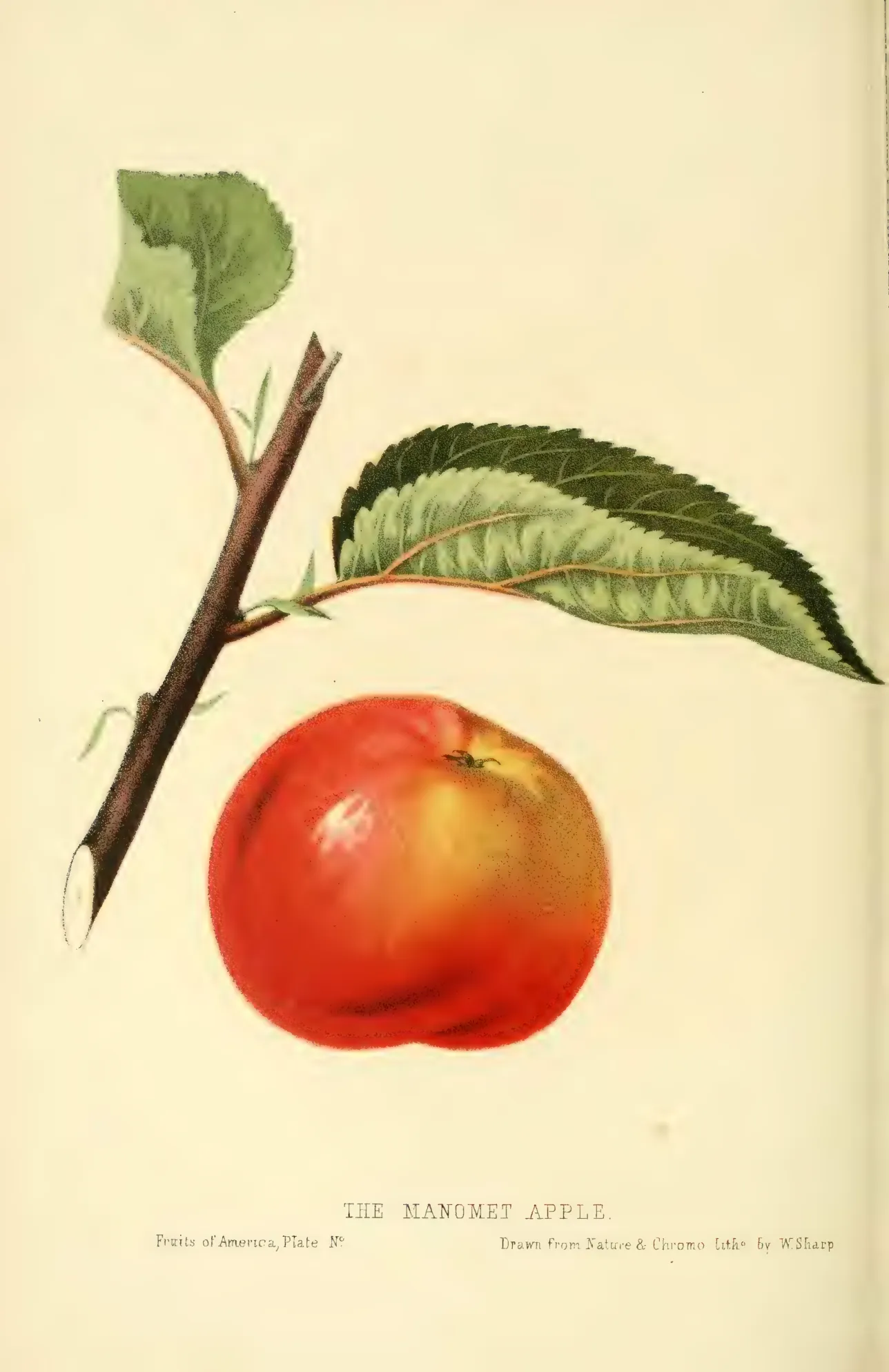
Manomet
Origin / History
Manomet is a native of the Old Colony, originating as a chance seedling that sprang up accidentally on the Holbrook farm at Manomet Pond village in Plymouth, Massachusetts. For a long time it was known locally as the Horseblock apple in its native locality. It was first introduced to wider notice by Mr. John Washburn, a zealous cultivator of Plymouth, Mass., who sent fine specimens to C.M. Hovey in 1847 and subsequently. Hovey described and figured it in the Magazine of Horticulture for 1848 (vol. xiv). Mr. Washburn proposed to call it the Manomet, "as Manomet Point is the prominent head of land of Plymouth Bay." Hovey readily concurred, believing that "such an absurd and unmeaning title as Horseblock, should never be applied to any fruit, especially to one of such excellence as the present variety." The original tree had been in bearing many years by the time of Hovey's account, and it is somewhat remarkable that it should not have attracted attention at an earlier period — its history being the same as that of a majority of American native fruits which have accidentally fallen into the hands of amateurs who could appreciate their excellence. Downing also gives the origin as Plymouth, Mass.
Tree
A very robust grower — Mr. Washburn thought it stronger even than the Baldwin. Downing describes the tree as vigorous and productive. It has a spreading habit when full grown, with wood somewhat resembling the Gravenstein, and is a good bearer every other year. Mr. Washburn also stated that it will make a tree in the nursery sooner than any other apple he had ever cultivated.
Wood. Dark reddish chestnut (Downing: young shoots dark reddish brown), dotted with a very few small whitish specks, moderately stout, short-jointed, and slightly downy; old wood brownish red. Buds: large, broad, slightly flattened, little downy, and erect. Flower-buds: medium size.
Leaves. Large, roundish ovate, broadest about the middle, rounding off to the point, thick, dark green above, slightly pubescent beneath, conspicuously veined, and deeply, coarsely and sharply serrated. Petioles: medium length, about three quarters of an inch long, stout.
Flowers. Medium size; petals cupped.
Fruit
Size. Medium — about three inches broad and two and a half deep (Hovey). Not so large as the Bough, but far surpasses it in the beauty of its appearance; may be classed in appearance with the Red Astrachan (which ripens at the same season) or the Fameuse. Lowther also gives size as medium.
Form. Hovey: roundish, regular, flattened at the base, narrowing slightly to the crown. Downing: roundish oblate. Thomas: roundish.
Skin. Very fair, smooth, lemon yellow (Hovey) / fine yellow (Downing) / yellow (Thomas), nearly covered with pale red and heightened by a brilliant vermilion red cheek on the sunny side (Hovey) — "a richly shaded cheek" (Downing), "a rich cheek" (Thomas); little traced with russet at the base of the stem (Downing: stalk inserted in a shallow cavity, slightly surrounded by russet), and dotted with russet specks.
Stem. Short, about half an inch long, slender, straight (Hovey); rather slender (Downing, Thomas).
Cavity. Rather small, shallow (Hovey); shallow (Downing, Thomas).
Calyx / Eye. Eye large, closed, and slightly depressed (Hovey); calyx closed (Downing). Segments of the calyx long (Hovey).
Basin. Small, finely furrowed, shallow (Hovey); shallow, corrugated (Downing); shallow, furrowed (Thomas).
Flesh / Flavor. Yellow (Hovey), crisp, and tender (Downing and Thomas: tender). Juice abundant, very sweet, rich, and finely flavored (Hovey); "tender, juicy, sweet, and rich. Very good." (Downing); "tender, sweet, rich" (Thomas). One of the finest of early sweet apples, esteemed highly wherever grown. Lowther codes quality as VG (very good).
Core / Seeds. Core closed (Hovey); core small (Downing). Seeds medium size (Hovey).
Season
Ripe in August and the early part of September (Hovey); August, September (Downing); late summer (Thomas). Lowther codes the season as "a."
Uses
Lowther codes the use as "b." Otherwise valued as one of the finest of early/late-summer sweet apples for eating, esteemed highly wherever grown.
Subtypes / Variants
Not described in source.
Other
Lowther additionally codes: Form rob (robust), Color rs, N. Div. 3.
Book Sources
Described in 4 period pomological works
- Thomas, The American Fruit Culturist (1903)
- Downing, Fruits and Fruit Trees of America (1900) — listed as Makomet
- Lowther (ed.), Encyclopedia of Practical Horticulture (1914) — listed as Mahomet
- Hovey, The Fruits of America (1852) — listed as THE MANOMET APPLE
Nursery Catalog Sources
Found in 1 catalog (1901) from Illinois
- Benjamin Buckman (personal inventory) , Farmingdale , Illinois — 1901
View original book sources (4)
— C.M. Hovey, The Fruits of America (1852)THE MANOMET APPLE. Manomet. Magazine of Horticulture, vol. xiv. 1848. Horseblock, in its native locality.
The Manomet is one of the finest of our early sweet apples. It is not so large as the Bough, but far surpasses it in the beauty of its appearance ; indeed, in the latter respect it may be classed with the Red Astrachan, — which ripens at the same season, — or the Fameuse, as a comparison with the beautiful drawings of these varieties, which have already appeared, will show. It is only of medium size ; but it has a pale yellowish skin, nearly covered with pale red, heightened by a bright vermilion cheek.
The Manomet is a native of the Old Colony, and was first introduced to notice by Mr. John Washburn, a zealous cultivator of Plymouth, Mass., who first sent us fine specimens in 1847, and also subsequently, from one of which our drawing was made. We were surprised and delighted to find it such a superior apple, and immediately described and figured it in the Magazine of Horticulture for 1848. Through the kindness of Mr. Washburn, we were furnished with its history, which, though brief, we gave at that time. It is a seedling, which sprang up accidentally on the Holbrook farm, at Manomet Pond village in Plymouth, and was for a long time known as the Horseblock apple. Mr. Washburn proposed to call it the Manomet, "as Manomet Point is the prominent head of land of Plymouth Bay." With his suggestion we readily concurred, believing that such an absurd and unmeaning title as Horseblock, should never be applied to any fruit, especially to one of such excellence as the present variety. The original tree has been in bearing many years, and it is certainly somewhat remarkable that it should not have attracted attention at an earlier period. Its history, however, is the same as that of a majority of our native fruits, which have accidentally fallen into the hands of amateurs who could appreciate their excellence, and aid in making known their superior qualities.
The Manomet is a very robust grower, stronger, Mr. Washburn thinks, than even the Baldwin. It has a spreading habit when full grown, with wood somewhat like the Gravenstein, and is a good bearer every other year. Mr. Washburn also states that it will make a tree in the nursery sooner than any other apple he has ever cultivated.
Wood. — Dark reddish chestnut, dotted with a very few small whitish specks, moderately stout, short-jointed, and slightly downy ; old wood, brownish red ; buds, large, broad, slightly flattened, little downy, and erect : Flower-buds, medium size.
Leaves. — Large, roundish ovate, broadest about the middle, rounding off to the point, thick, dark green above, slightly pubescent beneath, conspicuously veined, and deeply, coarsely and sharply serrated ; petioles, medium length, about three quarters of an inch long, stout.
Flowers. — Medium size ; petals, cupped.
Fruit. — Medium size, about three inches broad, and two and a half deep : Form, roundish, regular, flattened at the base, narrowing slightly to the crown : Skin, very fair, smooth, lemon yellow, covered with a brilliant vermilion red on the sunny side, little traced with russet at the base of the stem, and dotted with russet specks : Stem, short, about half an inch long, slender, straight, and inserted in a rather small, shallow cavity : Eye, large, closed, and slightly depressed in a small, finely furrowed, shallow basin ; segments of the calyx, long : Flesh, yellow, crisp, and tender : Juice, abundant, very sweet, rich, and finely flavored : Core, closed : Seeds, medium size.
Ripe in August and the early part of September.
— A.J. Downing, The Fruits and Fruit Trees of America (1900)Makomet. Horse Block. Manomet Sweet. Origin, Plymouth, Mass. Tree vigorous and productive. Young shoots dark reddish brown. This is one of the finest of sweet apples, esteemed highly wherever grown. Fruit medium, roundish oblate, fine yellow, with a richly shaded cheek. Stalk rather slender, inserted in a shallow cavity, slightly surrounded by russet. Calyx closed. Basin shallow, corrugated. Flesh tender, juicy, sweet, and rich. Very good. Core small. August, September.
[Additional entry in this volume: "Manomet", pp. 290–290]
Makomet.
Horse Block. Manomet Sweet.
Origin, Plymouth, Mass. Tree vigorous and productive. Young shoots dark reddish brown. This is one of the finest of sweet apples, esteemed highly wherever grown.
Fruit medium, roundish oblate, fine yellow, with a richly shaded cheek. Stalk rather slender, inserted in a shallow cavity, slightly surrounded by russet. Calyx closed. Basin shallow, corrugated. Flesh tender, juicy, sweet, and rich. Very good. Core small. August, September.
— John J. Thomas, The American Fruit Culturist (1903)Manomet. (Manomet Sweeting.) Size medium, roundish; yellow, with a rich cheek; stalk rather slender, cavity shallow; basin shallow, furrowed; flesh tender, sweet, rich. Late summer. Massachusetts.
— Granville Lowther (ed.), Encyclopedia of Practical Horticulture (1914)Mahomet. Size: M. Form: rob. Color: rs. Quality: VG. Use: b. Season: a. N. Div.: 3.