Pomeroy
Apple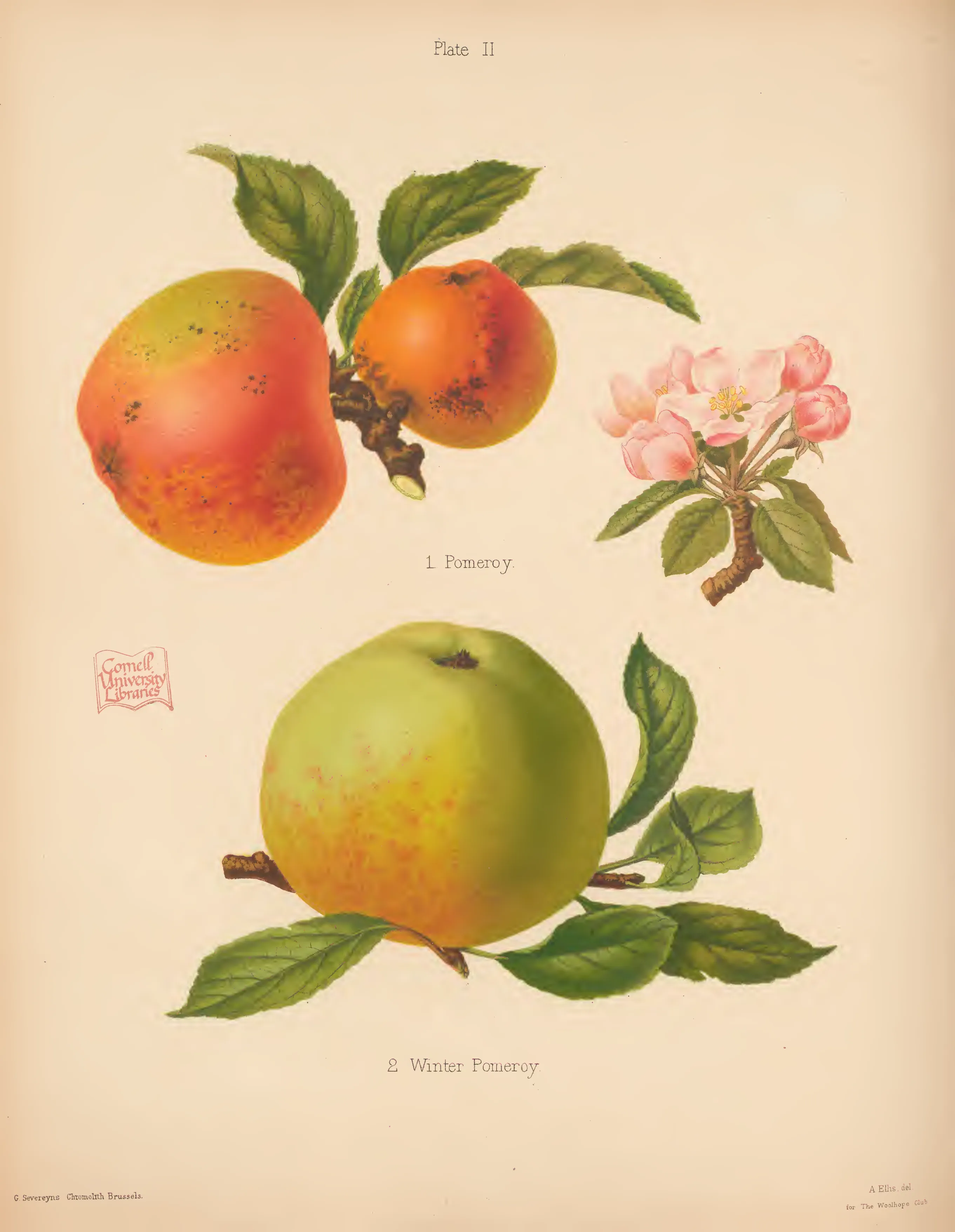
Pomeroy
[NOTE: Source text may be incorrect — the sources describe several distinct apples under the name Pomeroy (Herefordshire; Somersetshire; Lancashire; Massachusetts). The Herefordshire Pomona states that the varieties so named "differ in many respects from one another." Descriptions below are distinguished by locality.]
Origin / History
The Herefordshire Pomona (1885) holds Pomeroy to be probably "a true English Apple of great antiquity," its name given when Norman French was prevalent in England. The name suggests a French origin, but nothing warrants that conclusion: in the most searching investigations no mention of it is found in the records of the oldest French varieties, reaching back to the 13th and 14th centuries, nor in the list of Olivier de Serres in 1600 or of Lectier in 1628, nor in any French work, ancient or modern, from that period downward. The name is also applied to other than apples, as to a place in Devonshire called Stockleigh Pomeroy.
The earliest record is in Leonard Meager's list of 1670; Langford mentions it in 1681 and Ray in 1686. The author of "The Compleat Planter and Cyderist" (1690) says, "The Pome Roy hath a good taste, a pulpy substance, and not yielding much juice, yet that which is, is very good." These early writers all call it a Winter Apple, and it may be the Winter Pomeroy. Philips names it in his poem on "Cyder." Rogers in 1837 speaks of the Pomeroy or "Pomme Roi" as much esteemed in the county of Sussex, to which it was probably received from the opposite coast of France. Forsyth's Treatise describes it as "ripe nearly as soon as the Juneting; and though not so beautifully coloured, is larger and much better tasted. There is a variety which is a Winter Apple." He cites Langley's figure as identical, though Langley gives neither description nor season; his description is identical with Switzer's, published 80 years earlier, which raises the suspicion of a copy rather than original observation. From the lack of proper descriptive characters in the early writers, the Pomona finds it impossible to identify any of these with certainty as the Pomeroy of Herefordshire.
Downing (1900) records two Pomeroy apples from England, one from Somersetshire and one from Lancashire, of which "neither of them proves of much value here," and another from Massachusetts.
Tree
Veitch (1911) calls it one of the most productive varieties.
Fruit
Size: Rather below medium (Herefordshire); medium (Somersetshire, Lancashire and Massachusetts sorts; Veitch).
Form: Short conical or ovate, with ribs on the sides becoming more prominent toward the eye, around which they form ridges (Herefordshire). Roundish conical (Somersetshire). Roundish oblate, ribbed at apex (Lancashire). Roundish oblate (Massachusetts).
Stem: Short; sometimes about half an inch long, deeply inserted nearly the whole of its length (Herefordshire). Short (Massachusetts).
Cavity: Not described in source.
Calyx: Eye with segments connivent and reflexed at the tips; tube short conical; stamens inserted near the margin of the tube (Herefordshire). Closed (Massachusetts).
Basin: Pretty deep and angular (Herefordshire).
Skin: Greenish yellow with some traces of russet and streaks of red where shaded; on the side exposed to the sun a large patch of dense cinnamon-colored russet (Herefordshire). Greenish yellow with stripes of red and russet in the sun (Somersetshire). Pale yellow with a shaded cheek of red in the sun (Lancashire). Yellow, shaded, splashed and marbled in the sun with light and dark red (Massachusetts). Veitch gives bright orange-red.
Dots: Large, russet, strewn over the whole surface (Herefordshire). Russet (Lancashire).
Flesh and flavor: Yellowish, tender, juicy, sweet and richly flavored; remarkable for delicacy of texture; "a dessert apple of great excellence" (Herefordshire Pomona). Yellow, firm, juicy, sugary (Somersetshire). Whitish, tender, brisk subacid (Lancashire). White, tender, moderately juicy, pleasant subacid; "Good or very good" (Massachusetts, Downing). Veitch: tender, juicy and richly flavored.
Core and seeds: Cells of the core open and symmetrical (Herefordshire).
Season
The recorded dates run from September into January and February. The Herefordshire fruit ripens in September, lasts only a short time, and begins to decay before the middle of October; Veitch likewise gives September and October, as does the Lancashire sort. The Massachusetts sort is October, November; the Somersetshire sort October, December. The 1842 catalogue gives the Early Pomeroy ripe in October, the New Pomeroy in use November to December, and the Old Pomeroy in use November to February; Forsyth's manuscript description reads "Ripe in January." Rogers gives October, November and December.
Uses
Dessert apple of great excellence (Herefordshire Pomona). Rogers calls it a "very good culinary apple."
Subtypes / Variants
The third edition of the Horticultural Society of London's "Catalogue of Fruit" (1842) lists three. The Early Pomeroy is conical, striped, ripe in October, and appears to be the Pomeroy of Herefordshire, agreeing in season and in shape and color, "ours being both conical and striped." The New Pomeroy is ovate, russet, in use November to December, and is evidently the Winter Pomeroy of Herefordshire. The Old Pomeroy, also called the Taunton Pomeroy, is conical, brownish yellow, in use November to February. This last may be the variety in Forsyth's manuscript description, received from Kirke of Brompton: "a middle-sized apple, pretty pleasant flavour, rather sharp. Ripe in January."
Other
Not described in source.
Book Sources
Described in 2 period pomological works
View original book sources (3)
— Woolhope Naturalists Field Club, The Herefordshire Pomona (1885)
- POMEROY.
Synonyms.—Herefordshire Pomeroy.
There are several varieties of Apples distributed throughout the country that are known by the name of Pomeroy and which differ in many respects from one another. In the third edition of the "Catalogue of Fruit cultivated in the Garden of the Horticultural Society of London" published in 1842, three varieties are mentioned. The Early Pomeroy, the New Pomeroy and the Old Pomeroy, the first of three appears from the descriptions to be the Pomeroy of Herefordshire. The first is described to have the fruit conical, striped, and ripe in October; the second ovate, russet, and in use from November to December; and the third, which is also called the Taunton Pomeroy, is said to be conical, brownish yellow, and in use from November to February. The one which comes nearest to our Pomeroy in respect of season is the first or Early Pomeroy, and it also agrees in shape and in colour, ours being both conical and striped. The second is evidently our Winter Pomeroy; and the third may be the variety recorded in a MS. description of Forsyth's, which he had from Kirke of Brompton, and which he says is "a middle-sized apple, pretty pleasant flavour, rather sharp. Ripe in January." But in his "Treatise on the Culture and Management of Fruit Trees," Forsyth describes the Pomeroy as "ripe nearly as soon as the Juneting; and though not so beautifully coloured, is larger and much better tasted. There is a variety which is a Winter Apple." He cites Langley's figure as identical with this description, but upon what other ground than the mere name it is difficult to imagine, for Langley gives neither description nor the season of ripening. This description of Forsyth's is identical with that of Switzer's which was published 80 years previously, and excites a suspicion that the one is a mere copy of the other, and not made from original observations.
Although the name appears to indicate that this is originally a French Apple, it does not follow that it is so, and there is nothing to warrant such a conclusion. In the most searching investigations that have been made, no mention of the name can be found even in records of the oldest French varieties, reaching back to the 13th and 14th centuries. It does not appear in the list of Olivier de Serres in 1600, or of Lectier in 1628, nor can any trace be found of it from that period downwards in any French work, ancient or modern. The probability is that it is a true English Apple of great antiquity, and that its name was given at a time when Norman French was prevalent in this country, for we find the name applied to other than apples, as for instance, that of a place in Devonshire called Stockleigh Pomeroy.
The earliest record we have of the Pomeroy is in Leonard Meager's list published in 1670, but it must have been in existence long before. Langford mentions it in 1681, and so does Ray in 1686. The author of "The Compleat Planter and Cyderist" (1690) says, "The Pome Roy hath a good taste, a pulpy substance, and not yielding much juice, yet that which is, is very good," but these all agree in calling it a Winter Apple, and it may be our Winter Pomeroy. It is also named by Philips in his poem on "Cyder." Coming to more modern times we find Rogers in 1837 speaking of the Pomeroy or "Pomme Roi" as a very good culinary apple, usable during October, November and December, and is much esteemed in the county of Sussex, to which locality it is probable it may have been received from the opposite coast of France." But from the great lack of proper descriptive characters by all our early writers on fruits, it is impossible to identify with certainty any of these varieties with the Pomeroy of which we now treat.
Description.—Fruit; rather below medium size, short conical, or ovate, with ribs on the sides which become more prominent as they approach the eye, and around which they form ridges. Skin; greenish yellow, marked with some traces of russet and streaks of red where shaded, but on the side exposed to the sun, it is covered with a large patch of dense cinnamon-coloured russet, and the whole surface is strewed with large russet dots. Eye; set in a pretty deep and angular basin; the segments are connivent and reflexed at the tips; the tube is short conical, and the stamens are inserted near the margin of the tube. Stalk; short, sometimes about half-an-inch in length, and deeply inserted nearly the whole of its length. Flesh; yellowish, tender, juicy, sweet and richly flavoured. The cells of the core are open and symmetrical.
This is a dessert apple of great excellence, and with flesh remarkable for its delicacy of texture. It ripens in September and lasts only for a short time, as it begins to decay before the middle of October.
— A.J. Downing, The Fruits and Fruit Trees of America (1900)Pomeroy.
Taunton.
There are two Pomeroy Apples from England — one from Somersetshire and one from Lancashire; neither of them proves of much value here. The first is medium, roundish conical, greenish yellow, with stripes of red and russet in the sun. Flesh yellow, firm, juicy, sugary. October, December.
The second is medium, roundish oblate, ribbed at apex, pale yellow, shaded cheek of red in the sun, russet dots. Flesh whitish, tender, brisk subacid. September, October.
There is another Pomeroy from Massachusetts, which is of medium size, roundish oblate, yellow, shaded, splashed, and marbled in sun with light and dark red. Stalk short. Calyx closed. Flesh white, tender, moderately juicy, pleasant subacid. Good or very good. October, November.
— James Veitch & Sons, Veitch's Fruit Trees (1911) (1911)medium size, bright orange-red, flesh tender, juicy and richly flavoured, one of the most productive varieties. Sept. & Oct.