Winter Pomeroy
Apple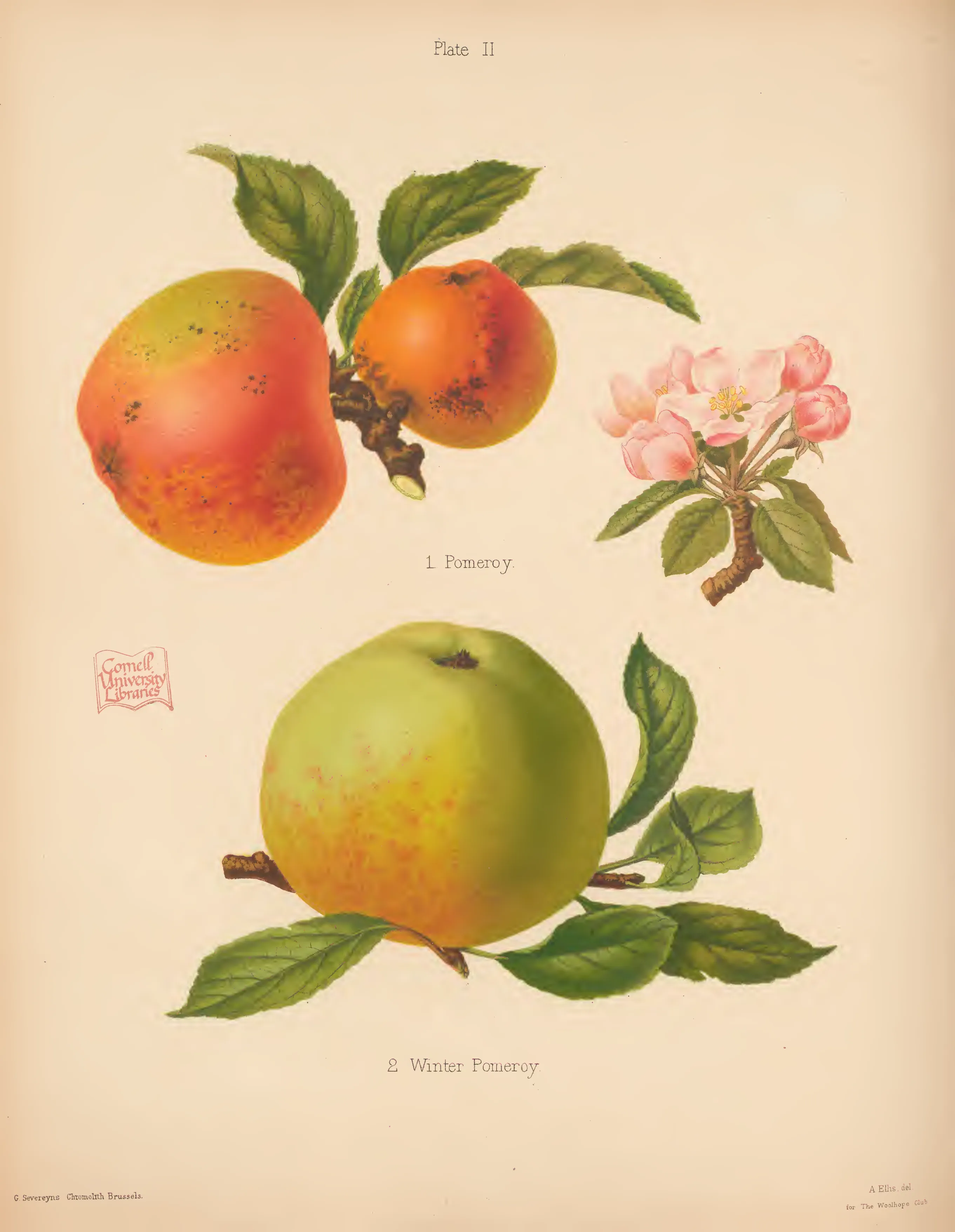
Winter Pomeroy
Origin / History
Found in most of the leading garden-orchards of Herefordshire, though for the most part the names of the two Pomeroys there are forgotten (Herefordshire Pomona, 1885). Winter Pomeroy is the most frequent, "which may perhaps be accounted for by the fact that a tree exists in the old Nursery grounds of the late Mr. Godsall at Hereford, with whom this variety was a great favourite, and who propagated it extensively." Always brought to the Christmas market there and sold under the "absurd name of 'Green Blenheim,'" which is "of course merely a tribute to the popularity of the Blenheim Orange." Thomas (1903) lists it as "Pomeroy," with the locality N. Y.
Tree
Hardy and bears well (Herefordshire Pomona).
Fruit
Size: Medium.
Form: Roundish, inclining to ovate, flattened at the base, distinctly five-sided, especially towards the apex, where the angles form distinct ridges. Thomas gives regular, ovate.
Stem: Upwards of half an inch long, very slender.
Cavity: Deep, narrow, lined with a patch of pale brown russet.
Calyx: Eye open, with somewhat connivent segments; tube short, conical; stamens inserted in the middle of the tube.
Basin: Moderately deep.
Skin: Smooth; deep yellow on the shaded side when ripe, with a bright red cheek on the side next the sun. Thomas gives shaded and striped red.
Dots: Large, russet, strewed over the surface.
Flesh and flavor: Yellowish (Herefordshire Pomona) or whitish (Thomas); crisp, firm in the Pomona. Flavor pleasant subacid in the Pomona; Thomas gives sweet.
Core and seeds: Cells of the core open and regular.
Season
October to December (Herefordshire Pomona); Thomas gives winter. Sold at the Christmas market.
Uses
"An excellent culinary apple" (Herefordshire Pomona). Marketed at Christmas.
Subtypes / Variants
Not described in source.
Other
Not described in source.
Book Sources
Described in 2 period pomological works
- The Herefordshire Pomona (1876–1885)
- Thomas, The American Fruit Culturist (1903) — listed as Pomeroy
View original book sources (2)
— Woolhope Naturalists Field Club, The Herefordshire Pomona (1885)Plate II.
- WINTER POMEROY.
Description.—Fruit; medium sized, roundish, inclining to ovate, flattened at the base, and distinctly five-sided, especially towards the apex, where the angles form distinct ridges. Skin; smooth, deep yellow on the shaded side, when ripe, and strewed with large russet dots; on the side next the sun, it is coloured with a bright red cheek. Eye; open, set in a moderately deep basin with somewhat connivent segments; the tube is short conical, and the stamens are inserted in the middle of the tube. Stalk upwards of half an inch long, very slender, and inserted in a deep narrow cavity, which is lined with a patch of pale brown russet. Flesh yellowish, firm and crisp in texture, with a pleasant subacid flavour. The cells of the core are open and regular.
This is an excellent culinary apple, in season from October to December.
The tree is hardy and bears well. Both these Pomeroys are to be found in most of the leading garden-orchards of Herefordshire, though for the most part their names are forgotten. The Winter Pomeroy is the most frequent, which may perhaps be accounted for by the fact that a tree exists in the old Nursery grounds of the late Mr. Godsall at Hereford, with whom this variety was a great favourite, and who propagated it extensively. It is always brought to the Christmas market, and sold under the absurd name of "Green Blenheim," which is of course merely a tribute to the popularity of the Blenheim Orange.
— John J. Thomas, The American Fruit Culturist (1903)Pomeroy. Medium, regular, ovate; shaded and striped red. Flesh whitish, crisp, sweet. Winter. N. Y.