Taunton
Apple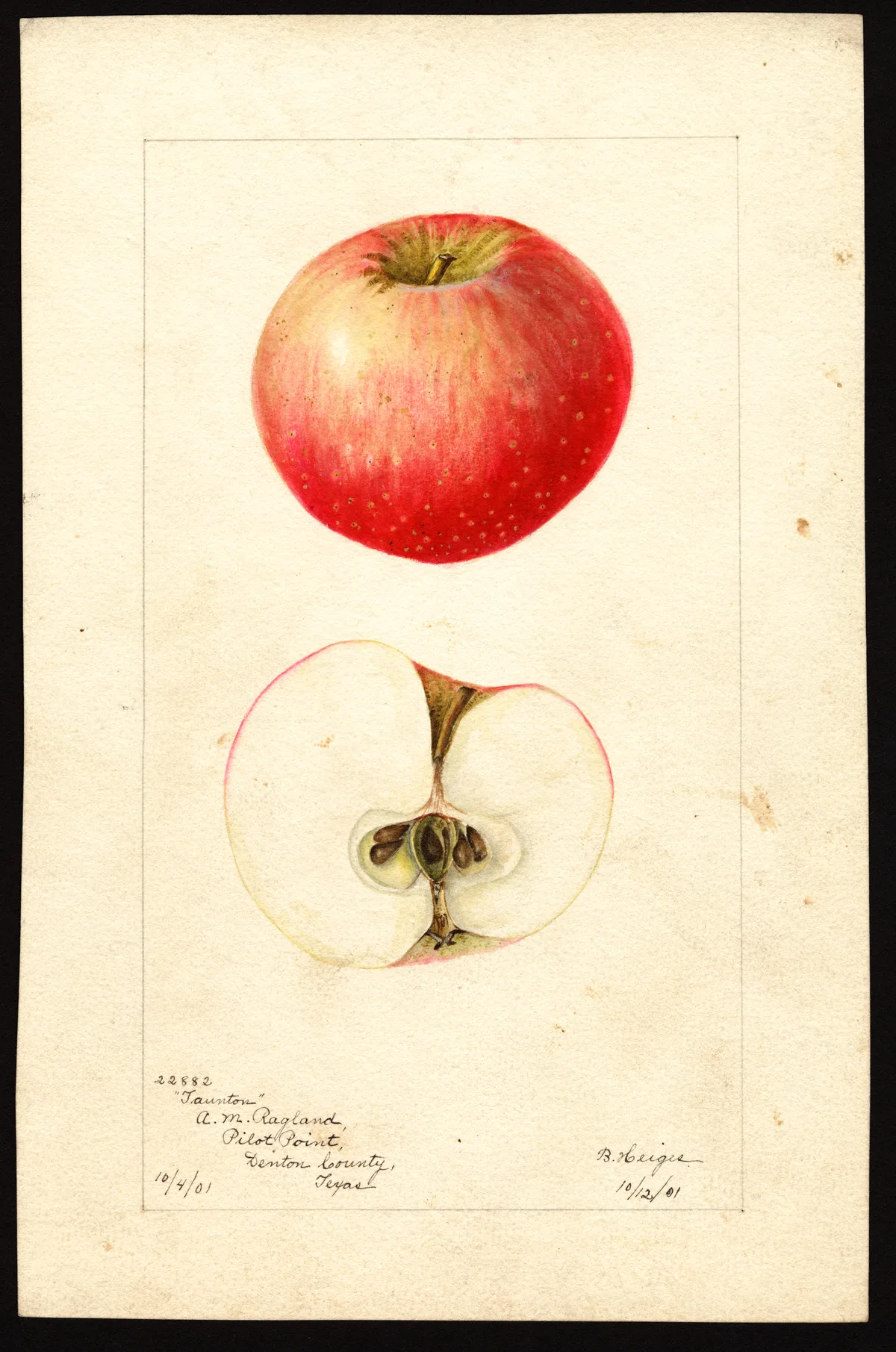
USDA Pomological Watercolor Collection
Taunton
Origin / History
Origin unknown. Some claim it for Alabama, others Georgia.
Tree
Vigorous but straggling grower, very productive. Young shoots reddish brown, slightly downy. Lowther's station table lists it from 1 station in the Northern Division and 10 stations in the Central Division, the asterisk marking it as adapted to more than one division.
Fruit
Size: Rather large to large (Lowther gives "large").
Form: Oblate conic; Lowther gives roundish conical.
Stem: Stalk slender.
Cavity: Deep, russeted.
Calyx: Closed. Segments long, slender.
Basin: Slightly corrugated.
Skin: Greenish yellow, striped and splashed with red, darkest on the sun side. Lowther gives the color as yellow-red.
Dots: Large, light.
Flesh and flavor: Flesh whitish, tender, juicy, aromatic, acid. Good.
Core and seeds: Not described in source.
Season
September, October; Lowther gives autumn.
Uses
Both kitchen and market (Lowther).
Subtypes / Variants
Not described in source.
Other
Not described in source.
Book Sources
Described in 3 period pomological works
Nursery Catalog Sources
Found in 3 catalogs (1886–1913) from Alabama, Illinois
- Huntsville Wholesale Nurseries (Jessie S. Moss , Proprietor; W.F. Heikes, Manager), Huntsville , Alabama — 1886
- Benjamin Buckman (personal inventory) , Farmingdale , Illinois — 1901
- Benjamin Buckman (personal inventory) , Farmingdale , Illinois — 1913
View original book sources (3)
— A.J. Downing, The Fruits and Fruit Trees of America (1900)Taunton.
Origin unknown. Some claim it for Alabama, others Georgia. The tree is a vigorous but straggling grower, very productive. Young shoots reddish brown, slightly downy.
Fruit rather large, oblate conic, greenish yellow, striped and splashed with red, darkest on sun side, large light dots. Stalk slender. Cavity deep, russeted. Calyx closed. Segments long, slender. Basin slightly corrugated. Flesh whitish, tender, juicy, aromatic, acid. Good. September, October.
— J.L. Budd & N.E. Hansen, American Horticultural Manual, Part II: Systematic Pomology (1914)Taunton. — Origin unknown; some claim it for Alabama, others Georgia; tree a vigorous but straggling grower, very productive. Fruit rather large, oblate conic; surface greenish yellow, striped and splashed with red, darkest on sun side; dots large, light; cavity deep, russeted; stem slender; basin slightly corrugated; calyx closed; segments long, slender; flesh whitish, tender, juicy, aromatic, acid; good. September, October.
— Granville Lowther (ed.), Encyclopedia of Practical Horticulture (1914)Taunton. Size: large. Form: roundish conical. Color: yellow-red. Quality: good. Use: both kitchen and market. Season: autumn. Reported by 1 station in the Northern Division and 10 stations in the Central Division; the asterisk indicates the variety is reported as adapted to more than one division.