Montgomery
Apple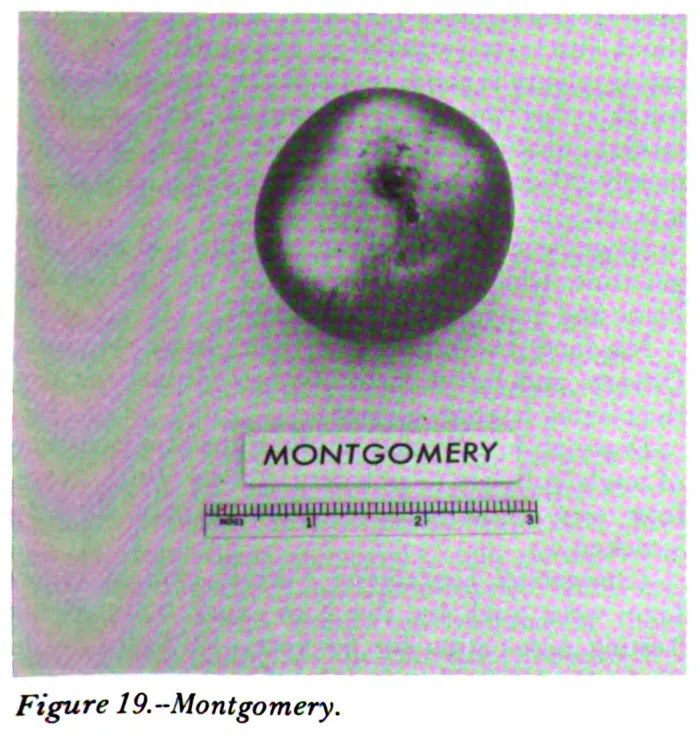
Montgomery
Origin / History
Montgomery was introduced by the New York State Agricultural Experiment Station but did not originate from the Station's apple breeding program. In 1891, W. P. Wheeler, assistant in animal industry research at the Station, examined many wild apple seedlings growing in fields near Chittenango, New York. One seedling, which bore fruits superior to most of the others, was selected and designated Wheeler No. 76. In the spring of 1892, scions were obtained and topgrafted into an established tree growing at Geneva, and the clone was later introduced as Montgomery. Broome and Ulster were selected in this same manner.
Montgomery was introduced in 1914, along with 11 other cultivars, and was named for Montgomery County, New York. Of the 12 cultivars introduced in 1914, 9 became extinct, and only Montgomery, Saratoga, and Westchester were known to exist in 1969. The introductory description of Montgomery was published by Hedrick (87). It was also briefly described in the Register of New Fruit and Nut Varieties (32).
Tree
The tree is medium in size, medium in vigor, tall, dense, and round-topped. Trees are not highly productive. The trunk is medium in stockiness. The trunk bark is gray with reddish patches. The top sides of branches 3/8 to 1 inch in diameter are red in areas where the scarfskin has been rubbed off.
Montgomery trees bloom late, about a day after Delicious. The tree is diploid, and the pollen is viable.
Fruit
Size: Fruits are medium sized, 2½ inches in diameter.
Form: Fruits are round-oblate and symmetrical.
Stem: The stem is short to medium length, about 3/4 to 1 inch long, and slender to medium thick.
Cavity: The cavity is obtuse to acute, sometimes shallow, narrow, slightly russeted, and symmetrical. The cavity sometimes has concentric cracks.
Calyx: The calyx is medium sized and closed. The calyx lobes are medium in length, broad, and acute. The calyx tube is short, narrow, and conic. The stamens are median.
Basin: The basin is shallow, medium in width, obtuse, furrowed, and symmetrical.
Skin: The skin is thin, medium in toughness, smooth, and slightly dull. The skin color is 80 per cent red. The ground color is very light green. The color pattern is a somewhat splashed stripe and blushed. The general appearance is rather attractive.
Dots: The dots are few, small, white, and obscure.
Flesh and flavor: The flesh is snow white, soft, fine grained, tender, juicy, sour, and sprightly. The eating quality is only fair.
Core and seeds: The core is large and closed. The carpels are cordate. The seeds are medium sized, wide, flat, acute, and sometimes with small tufts.
Season
The average ripening date for Montgomery at Geneva is September 6, 5 weeks before Delicious. The average number of days from full bloom to harvest is 110, 35 fewer than Delicious. The keeping quality is very poor, approximately 15 days at 31° F.
Uses
The eating quality is only fair. In a study of apple cultivars which make the best parents, Montgomery produced undesirable progeny. Crosses in which Montgomery was used as a parent were conspicuous for the lack of fruit quality in their progeny. However, Montgomery is one of the parents of the commercially important cultivar Lodi, and it is a grandparent of Greendale.
Trees of Montgomery were distributed to fruit growers in 1914. Montgomery was never propagated by the New York State Fruit Testing Association, and it was never sold by commercial nurseries. It was never planted on a commercial scale. Surveys of apple clones in the United States showed that in 1963 and 1968 Montgomery was tested only at the New York experiment station. Montgomery is one of those unfortunate mistakes. It should never have been named. It is not recommended for planting. Its chief claim to fame is that it damed Lodi, a much more important cultivar.
Subtypes / Variants
Not described in source.
Other
A Montgomery fruit is illustrated in Figure 19 of the source.
Book Sources
Described in 1 period pomological work
View original book sources (1)
— Roger D. Way, Apple Cultivars Introduced by the New York State Agricultural Experiment Station, 1914–1968 (1971)Montgomery
Origin. Although Montgomery was introduced by this Station, it did not originate from the Station's apple breeding program. In 1891, W. P. Wheeler, assistant in animal industry research at the Station, examined many wild apple seedlings growing in fields near Chittenango, New York. One seedling which bore fruits superior to most of the others was selected and designated as Wheeler No. 76. In the spring of 1892, scions were obtained and topgrafted into an established tree growing at Geneva, and the clone was later introduced as Montgomery. Broome and Ulster were selected in this same manner (see Ulster). Montgomery was introduced in 1914 (Table 2), along with 11 other cultivars. It was named for Montgomery County, New York. Of the 12 cultivars introduced in 1914, 9 became extinct and only Montgomery, Saratoga, and Westchester were known to exist in 1969. Montgomery is one of the parents of Lodi (72) (see Lodi). The introductory description of Montgomery was published by Hedrick (87). It was also briefly described in the Register of New Fruit and Nut Varieties (32).
Tree. The tree characteristics of Montgomery are summarized in Table 5. The tree is medium in size, medium in vigor, tall, dense, and round-topped. Trees are not highly productive. The trunk is medium in stockiness. The trunk bark is gray with reddish patches. The top sides of branches 3/8 to 1 inch in diameter are red in areas where the scarfskin has been rubbed off.
Pollination. Montgomery trees bloom late, about a day after Delicious (Table 6). It is diploid (Table 4), and the pollen is viable.
Fruit. A Montgomery fruit is illustrated in Figure 19. The fruit characteristics are summarized in Table 8. The average ripening date for Montgomery at Geneva is September 6, 5 weeks before Delicious (Table 7). The average number of days from full bloom to harvest is 110, 35 fewer than Delicious.
Montgomery fruits are medium sized, 2½ inches in diameter. They are round-oblate and symmetrical. The stem is short to medium length, about 3/4 to 1 inch long, and it is slender to medium thick. The cavity is obtuse to acute, sometimes shallow, narrow, slightly russeted, and symmetrical. The cavity sometimes has concentric cracks. The calyx is medium sized and closed. The calyx lobes are medium in length, broad, and acute. The basin is shallow, medium in width, obtuse, furrowed, and symmetrical. The skin is thin, medium in toughness, smooth, and slightly dull. The skin color is 80 per cent red.
The color pattern is a somewhat splashed stripe and blushed. The general appearance is rather attractive. The ground color is very light green. The dots are few, small, white, and obscure. The calyx tube is short, narrow, and conic. The stamens are median. The core is large and closed. The carpels are cordate. The seeds are medium sized, wide, flat, acute, and sometimes with small tufts.
The flesh is snow white, soft, fine grained, tender, juicy, sour, and sprightly. The eating quality is only fair. The keeping quality is very poor, approximately 15 days at 31° F.
Breeding Behavior. In a study of apple cultivars which make the best parents (234), Montgomery produced undesirable progeny. Crosses in which Montgomery was used as a parent were conspicuous for the lack of fruit quality in their progeny (235). However, it is one of the parents of the commercially important cultivar, Lodi (see Lodi). It is a grandparent of Greendale (see Greendale).
Commercial Usefulness. Trees of Montgomery were distributed to fruit growers in 1914 (87). Montgomery was never propagated by the New York State Fruit Testing Association (Table 2), and it was never sold by commercial nurseries. It was never planted on a commercial scale. Surveys of apple clones in the United States (79, 184) showed that in 1963 and 1968 Montgomery was tested only at the New York experiment station.
In summary: Montgomery is one of those unfortunate mistakes. It should never have been named. It is not recommended for planting. Its chief claim to fame is that it damed Lodi, a much more important cultivar.