Westchester
Apple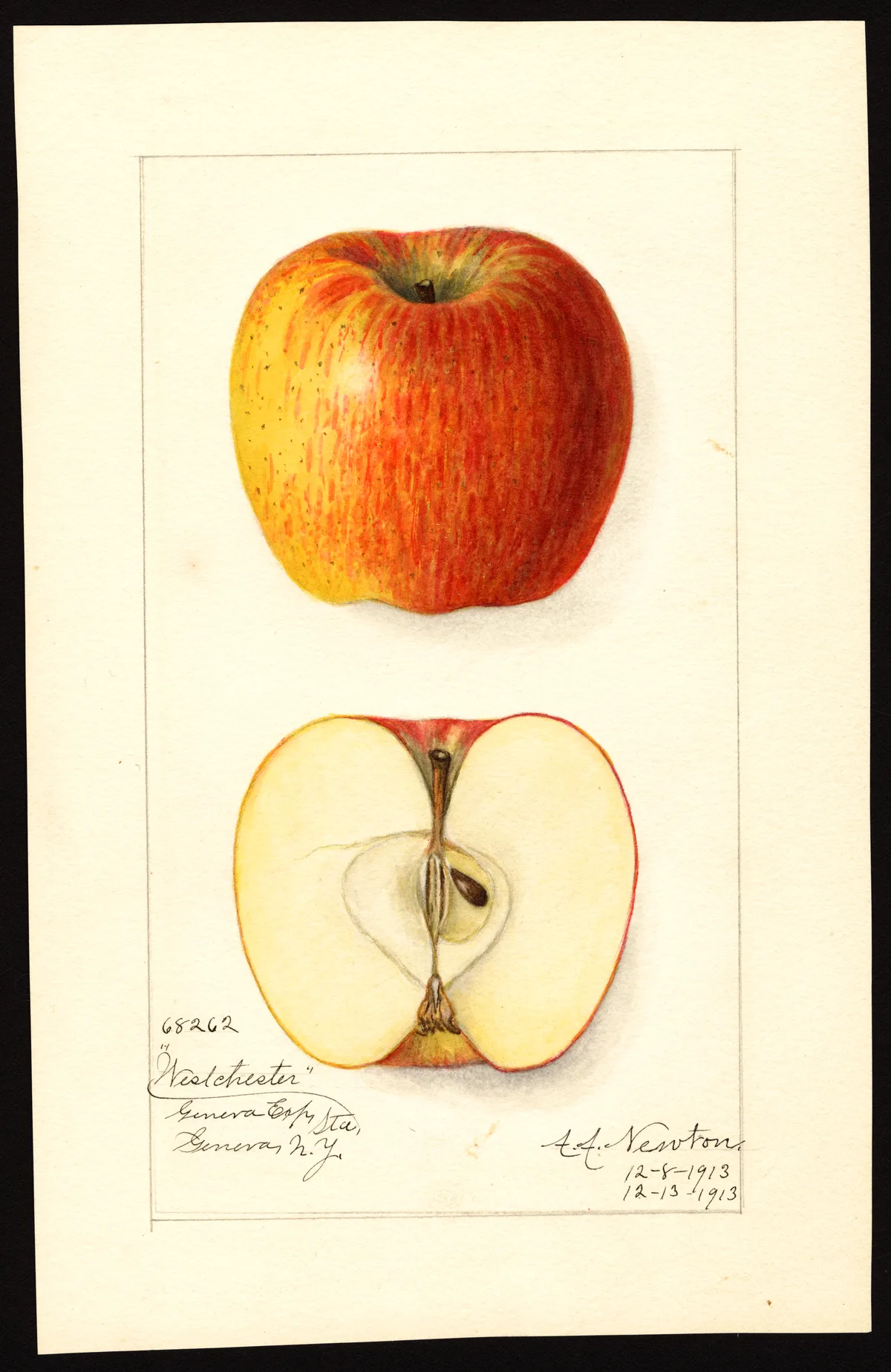
USDA Pomological Watercolor Collection
Westchester
Origin / History
Westchester originated from the cross Ben Davis x Green Newtown, made in 1898. The breeding record number was 3152-2, and the seedling number was Station 94. It was selected in 1908 from a population of 12 seedlings. Westchester was named and introduced in 1914, after only 7 years of observations and without benefit of a second test. It was named for Westchester County, New York. The breeding work that produced Westchester was described by Hedrick and Wellington, and its characteristics were described by Hedrick.
Trees of Westchester were distributed to fruit growers in 1914. The New York State Fruit Testing Association never sold trees of this cultivar, and no commercial nursery sold them.
Tree
The tree is large, vigorous, upright, tall, and dense, with a round-topped form. It bears light crops and bears biennially. The trunk is stocky, grayish in color, and has a rather shaggy surface. The lenticels on the branches are conspicuously large, ¾ inch in diameter. Distinct ¼ inch long lines extend around branches that are ¾ inch in diameter, a distinctive feature of branches of only this size.
Westchester blooms late, about 1 day after Delicious. It is diploid, and its pollen is viable.
Fruit
Size: Large, mostly 3 inches in diameter and up to 3¼ inches.
Form: Roundish to round-oblate, somewhat blocky, and somewhat irregular in shape.
Stem: Short and thick.
Cavity: Acute, deep, medium in width, generally russeted, and almost symmetrical in shape.
Calyx: Somewhat open and medium in size. The calyx lobes are medium in length and width and are acute. The calyx tube is short (10 mm), wide (8 mm), and conical, with basal stamens.
Basin: Deep and wide, abrupt, furrowed, and somewhat asymmetrical in conformation.
Skin: Thick, tough, smooth, waxy, and dull in finish with some bloom. The color is rather attractive, with 90 percent red splashed stripes over a yellow ground color.
Dots: Numerous, small, white, russeted, and obscure.
Flesh and flavor: Yellowish cream in color, firm in texture, slightly coarse grained, and somewhat dry. The flavor is subacid. The eating quality is fair to good after 2 months of storage.
Core and seeds: The core is medium sized (20 mm wide) and open. The carpels are roundish and somewhat cordate. The seeds are numerous, large, wide, plump, acute, and not tufted.
Season
Westchester ripens very late at the end of the apple harvest season, about October 24 at Geneva, 2 weeks after Delicious. The average number of days from full bloom to harvest is 158, 14 more than Delicious. The fruits adhere well on the tree after maturity.
For a firm, late-ripening cultivar, the storage life is rather short. The estimated storage life at 31°F is 60 days. After several months in storage, the skin becomes greasy.
Uses
Westchester has few special attributes and is not suggested for commercial plantings. It probably will never become an important cultivar. The New York State Fruit Testing Association and commercial nurseries did not sell its trees, although they were distributed to fruit growers in 1914.
Subtypes / Variants
Not described in source.
Other
Westchester fruits are illustrated in Figure 40 of the source. The fruit contains 15 mg ascorbic acid per 100 g of fruit, compared with 37 for Calville Blanc and 4 for McIntosh.
Book Sources
Described in 1 period pomological work
Nursery Catalog Sources
Found in 1 catalog (1913) from Illinois
- Benjamin Buckman (personal inventory) , Farmingdale , Illinois — 1913 — listed as West Chester
View original book sources (1)
— Roger D. Way, Apple Cultivars Introduced by the New York State Agricultural Experiment Station, 1914–1968 (1971)Westchester
Origin. Westchester originated from the cross, Ben Davis x Green Newtown, made in 1898. The breeding record number was 3152-2, and the seedling number was Station 94. It was selected in 1908 from a population of 12 seedlings. Westchester was named and introduced in 1914 (Table 2), after only 7 years of observations and without benefit of a second test. It was named for Westchester County, New York.
The breeding work resulting in the origin of Westchester was described by Hedrick and Wellington (94), and the characteristics of Westchester were described by Hedrick (87).
Tree. The tree characteristics of Westchester are summarized in Table 5. The tree is large, vigorous, upright, tall, dense, round-topped, bears light crops, and bears biennially (Table 5). The trunk is stocky, grayish in color, and with a rather shaggy surface. The lenticels on branches are conspicuously large, being ¾ inch in diameter. Distinct ¼ inch long lines extend around branches which are ¾ inch in diameter. This is a distinctive feature of branches of only this size.
Westchester blooms late, about 1 day after Delicious (Table 6). It is diploid (Table 4), and its pollen is viable.
Fruit. Westchester fruits are illustrated in Figure 40, and the fruit characteristics are summarized in Table 8. The fruit ripens very late at the end of the apple harvest season, about October 24 at Geneva, 2 weeks after Delicious (Table 7). The average number of days from full bloom to harvest is 158, 14 more than Delicious. The fruits adhere well on the tree after maturity. They are large, mostly 3 inches in diameter and up to 3¼ inches, roundish to round-oblate, somewhat blocky, and somewhat irregular in shape. The stem is short and thick. The cavity is acute, deep, medium in width, generally russeted, and almost symmetrical in shape. The calyx is somewhat open and medium in size. The calyx lobes are medium in length and width and are acute. The basin is deep and wide, abrupt, furrowed, and somewhat asymmetrical in conformation.
The skin is thick, tough, smooth, waxy, and dull in finish with some bloom. The color is rather attractive with 90 per cent red splashed stripes and a yellow ground color. The dots are numerous, small, white, russeted, and obscure. The calyx tube is short (10 mm), wide (8 mm), and conical, with basal stamens. The core is medium sized (20 mm wide) and open. The carpels are roundish and somewhat cordate. The seeds are numerous, large, wide, plump, acute, and not tufted.
The flesh is yellowish cream in color, firm in texture, slightly coarse grained, somewhat dry, and subacid. The eating quality is fair to good after 2 months of storage.
For a firm, late ripening cultivar, the storage life is rather short. The estimated storage life at 31°F is 60 days (Table 10). After several months in storage, the skin becomes greasy.
Westchester fruits contain 15 mg ascorbic acid per 100 gm fruit, which compares with 37 for Calville Blanc and 4 for McIntosh (105).
Commercial Usefulness. Trees of Westchester were distributed to fruit growers in 1914 (87); however, trees of this cultivar were never sold by the New York State Fruit Testing Association, nor by any commercial nursery.
Because it has few special attributes, Westchester is not suggested for commercial plantings and probably will never become an important cultivar.