Saratoga
Apple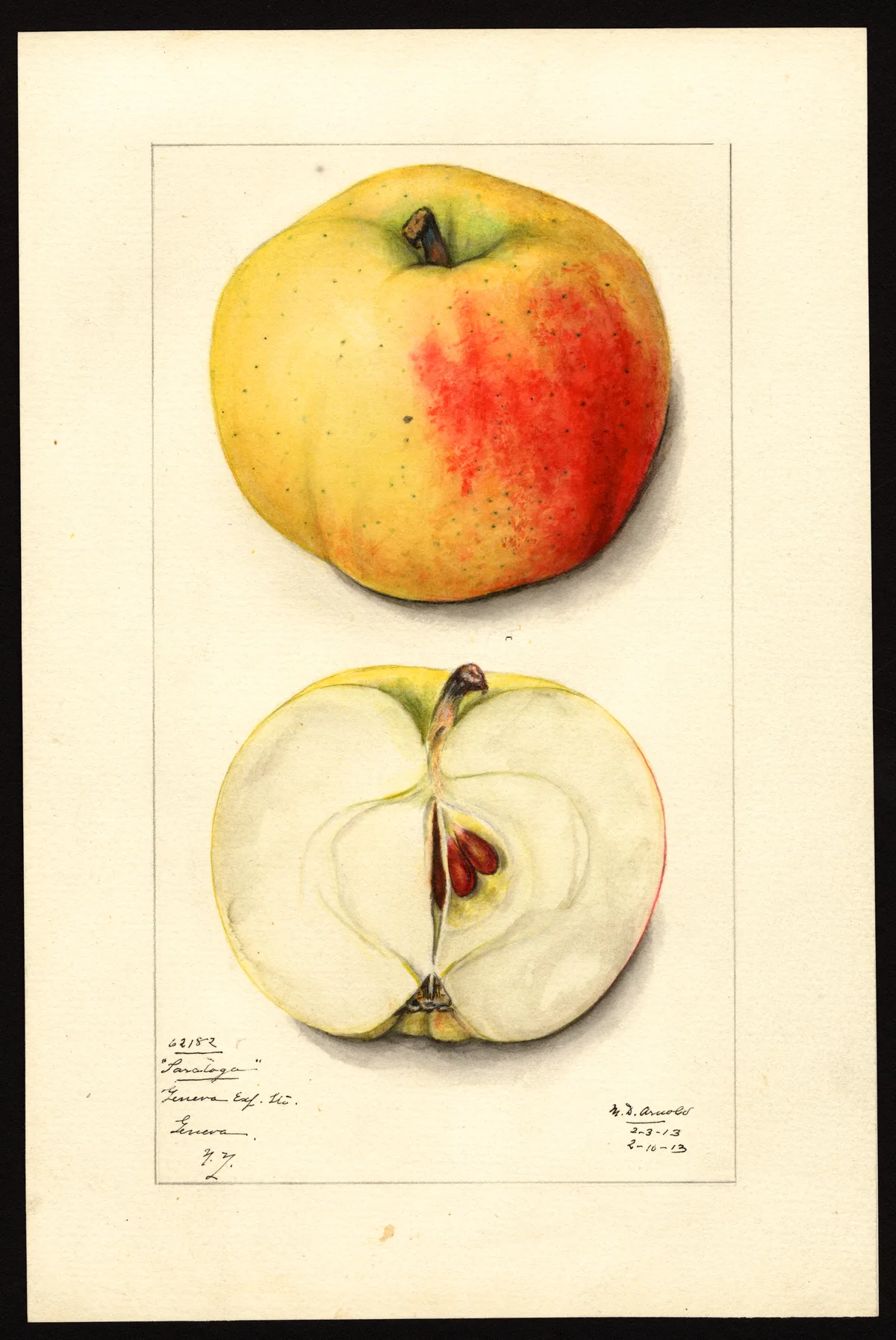
USDA Pomological Watercolor Collection
Saratoga
Origin / History
Saratoga resulted from the cross Ben Davis x Green Newtown, made in 1898. The breeding record number was 3150, and the seedling number was 96. It was selected in 1908 from a population of 12 seedlings. It was introduced in 1914, along with 11 other new cultivars named at the same time (see Broome). Saratoga is one of three 1914 introductions still under test; the other nine no longer exist. It was named for Saratoga County, New York.
The breeding research which resulted in the origin of Saratoga was described by Hedrick and Wellington (94). Its characteristics were described by Hedrick (87), and trees of it were distributed to fruit growers in 1914 (87).
Tree
The tree is large, of medium vigor, upright, spreading, tall, of medium density, and round-topped. Trees bear light crops and have a biennial bearing habit. The trunk is of medium stockiness. The trunk bark is grayish brown and only somewhat shaggy.
Saratoga trees bloom in midseason in the spring, about half a day before Delicious. They are diploid, and the pollen is viable.
Fruit
Size: Saratoga fruits are large, up to 3 inches in diameter. Saratoga fruits are illustrated in Figure 29, and their characteristics are summarized in Table 8.
Form: Round-oblate, slightly ribbed, and nearly symmetrical.
Stem: Short, thick, and pressed tightly against the side of the cavity.
Cavity: Obtuse, shallow, broad, slightly furrowed, symmetrical, russeted, and with horizontal russet cracks.
Calyx: Large and open. It is especially open on fruits from young trees. The calyx lobes are acute, broad, and medium in length. The calyx tube is long, wide, and funnel-shaped. The stamens are median.
Basin: Medium in depth, very wide, abrupt, furrowed, and somewhat compressed.
Skin: Thick, tough, smooth, glossy, and greasy. The skin color is 80 per cent pinkish red stripes, and it is rather attractive.
Dots: Few, small, obscure; some dots are white and some are russet.
Flesh and flavor: Cream colored, very firm, coarse, crisp, somewhat dry, and subacid. The eating quality is only fair. It is probably better suited for processing than eating fresh from the hand.
Core and seeds: Core small and closed. The carpels are oval. The seeds are medium sized, narrow, and flat.
Season
The fruits adhere well to the tree after they have matured. They ripen very late, about October 27 at Geneva, 22 weeks later than Delicious. The average number of days from full bloom to harvest is 163, 1 more than Delicious. Saratoga has a fairly long storage life, about 110 days when held at 31°F.
Uses
The eating quality is only fair, and the fruit is probably better suited for processing than eating fresh from the hand.
Nursery trees of Saratoga have never been sold by the New York State Fruit Testing Association. No commercial nursery has ever sold the cultivar, and no commercial plantings have ever been made of it. It is of doubtful value to the commercial apple growing industry. It is not recommended for planting.
Subtypes / Variants
Not described in source.
Other
The fruits are illustrated in Figure 29 of the source, and the source summarizes the tree characteristics in Table 5, bloom timing in Table 6, ploidy in Table 4, ripening in Table 7, fruit characteristics in Table 8, storage in Table 10, and distribution in Table 2.
Book Sources
Described in 1 period pomological work
Nursery Catalog Sources
Found in 1 catalog (1913) from Illinois
- Benjamin Buckman (personal inventory) , Farmingdale , Illinois — 1913
View original book sources (1)
— Roger D. Way, Apple Cultivars Introduced by the New York State Agricultural Experiment Station, 1914–1968 (1971)Saratoga
Origin. Saratoga resulted from the cross, Ben Davis x Green Newtown, made in 1898. The breeding record number was 3150, and the seedling number was 96. It was selected in 1908 from a population of 12 seedlings. It was introduced in 1914 (Table 2), along with 11 other new cultivars named at the same time (see Broome). Saratoga is one of three 1914 introductions still under test; the other nine no longer exist. It was named for Saratoga County, New York.
The breeding research which resulted in the origin of Saratoga was described by Hedrick and Wellington (94). Its characteristics were described by Hedrick (87), and trees of it were distributed to fruit growers in 1914 (87).
Tree. The tree characteristics of Saratoga are summarized in Table 5. The tree is large, of medium vigor, upright, spreading, tall, of medium density, and round-topped. Trees bear light crops and have a biennial bearing habit (Table 5). The trunk is of medium stockiness. The trunk bark is grayish brown and only somewhat shaggy.
Saratoga trees bloom in midseason in the spring, about half a day before Delicious (Table 6). They are diploid (Table 4), and the pollen is viable.
Fruit. Saratoga fruits are illustrated in Figure 29, and their characteristics are summarized in Table 8. The fruits adhere well to the tree after they have matured. They ripen very late, about October 27 at Geneva, 22 weeks later than Delicious (Table 7). The average number of days from full bloom to harvest is 163, 1 more than Delicious.
SARATOGA
Figure 29.-- Saratoga.
Saratoga fruits are large, up to 3 inches in diameter. They are round-oblate, slightly ribbed, and nearly symmetrical. The stems are short, thick, and pressed tightly against the side of the cavity. The cavity is obtuse, shallow, broad, slightly furrowed, symmetrical, russeted, and with horizontal russet cracks. The calyx is large and open. It is especially open on fruits from young trees. The calyx lobes are acute, broad, and medium in length. The basin is medium in depth, very wide, abrupt, furrowed, and somewhat compressed. The skin is thick, tough, smooth, glossy, and greasy. The skin color is 80 per cent pinkish red stripes, and it is rather attractive. The dots are few, small, obscure; some dots are white and some are russet. The calyx tube is long, wide, and funnelshaped. The stamens are median. The core is small and closed. The carpels are oval. The seeds are medium sized, narrow, and flat. The flesh is cream colored, very firm, coarse, crisp, somewhat dry, and subacid. The eating quality is only fair. It is probably better suited for processing than eating fresh from the hand.
Saratoga has a fairly long storage life, about 110 days when held at 31°F (Table 10).
Commercial Usefulness. Nursery trees of Saratoga have never been sold by the New York State Fruit Testing Association (Table 2). No commercial nursery has ever sold the cultivar. No commercial plantings have ever been made of it. It is of doubtful value to the commercial apple growing industry. It is not recommended for planting.