Greendale
Apple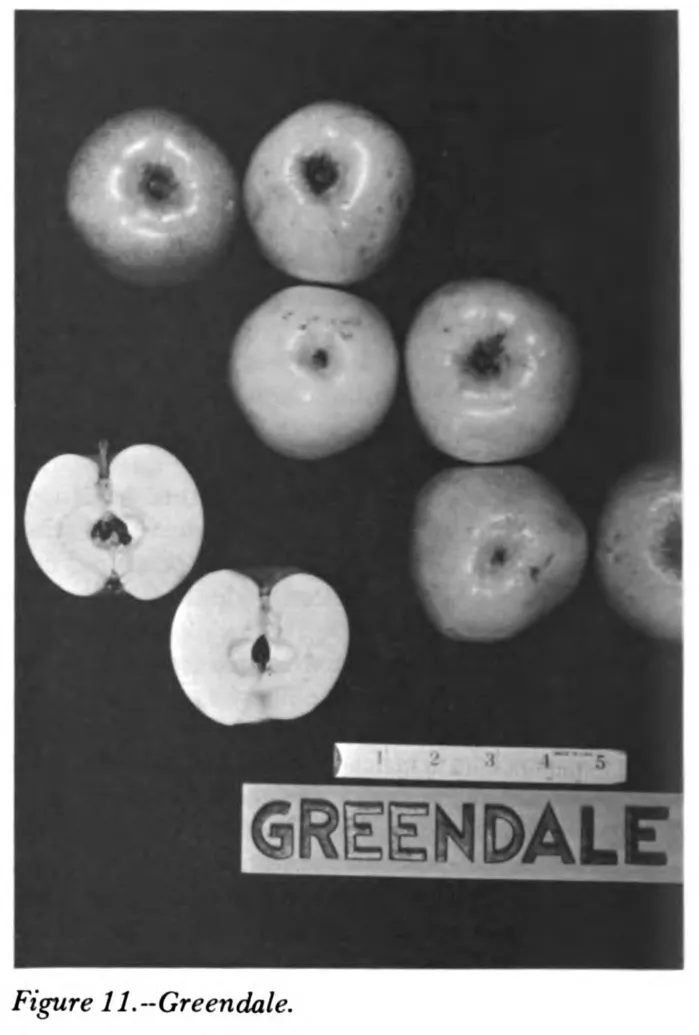
Greendale
Origin / History
Originated at the New York State Agricultural Experiment Station from the cross McIntosh x Lodi, made in 1924. Montgomery, a parent of Lodi, is a grandparent of Greendale. Greendale was the only seedling selected from 10 families of seedlings that grew when McIntosh was crossed with 10 different cultivars. Breeding record number 2464; seedling number Station 4793. Selected in 1936 from a population of 37 seedlings. Introduced in 1938 (for trial, per Zielinski) without being fruited in a second test. Named for the village of Greendale in Columbia County, New York. Briefly described in the Register of New Fruit and Nut Varieties and in the catalogs of the New York State Fruit Testing Association from 1938 to 1962.
Trees were sold by the New York State Fruit Testing Association for 25 years, 1938-62. In 1960-68 only one commercial nursery sold them. Tested in 1954 at the Massachusetts station. A 1963 survey showed it under test at stations in New York, Oregon, Pennsylvania, and Wyoming. In 1968 it was under test at stations in Kansas, New York, North Carolina, Pennsylvania, and Vermont. Suggested for planting in Pennsylvania in 1955. Listed in 1958 as a new summer apple for home and garden in Oregon. Way (1971) writes that because of its green color and soft flesh Greendale never became a widely grown cultivar, and that it is not recommended for planting.
Tree
Tree large, vigorous, upright, spreading, tall, dense, round-topped, moderately productive. Moderately late in coming into bearing, but bears annually; in Georgia trees became biennial when allowed to overcrop. Very hardy: following a severe freeze in Kansas in November 1940, Greendale trees made 90 per cent recovery in a study of 200 apple cultivars. Trunk moderately stocky. Trunk bark somewhat smooth, brown, tinged red, with heavy gray scarfskin. Branchlets slender, short, glabrous.
Leaves numerous, medium in size, wide, of medium length, oval, taper-pointed, medium in thickness, rugose; dark green, pubescent on the under side; margins crenate, the points of the toothed edge rounded. Petiole medium in length, slender, pubescent.
Blooms early, more than 2 days before Delicious. Diploid; pollen viable. In a German study of susceptibility to powdery mildew, Greendale was found resistant or only slightly attacked.
Fruit
Size: Large, mostly 3 inches in diameter.
Form: Round-oblate, ribbed, irregular. Zielinski says it resembles McIntosh in shape.
Stem: Medium in length, rather slender, very thick at the end that was attached to the spur.
Cavity: Acute, medium in depth and width, russeted, symmetrical.
Calyx: Small, slightly open; lobes short, narrow, acute. Calyx tube short, narrow, conical. Stamens median.
Basin: Shallow, narrow, obtuse, very slightly compressed.
Skin: Thin, tender, smooth. Pale green, changing to light yellow as the fruits become overripe (Way). Zielinski calls the green attractive, slowly changing to light greenish-yellow at maturity, somewhat like Lodi.
Dots: Numerous, small, conspicuous, depressed, light brown.
Flesh and flavor: Nearly white, semifirm, tender, somewhat juicy; texture medium grained (Way) or fine (Zielinski). Way also speaks of the soft flesh. Subacid, aromatic, good in flavor; mild and pleasant. Zielinski gives quality and firmness as "good" and adds that some may consider it too mild or lacking in flavor for the best type of eating apple. In Georgia quality was fair if harvested when the color broke into yellow.
Core and seeds: Core medium sized, very open. Carpels ovate. Seeds medium sized, wide, plump, acute.
Season
Ripens early, in August: the average date at Geneva is August 20, 7½ weeks before Delicious, with 96 days from full bloom to harvest, 49 fewer than Delicious. Zielinski places it in mid-August. Fruits adhere to the tree fairly well after maturity. Storage life at 31°F is rather short, estimated at about 25 days, and the fruits shrivel in storage. It is not generally held for extended periods but is marketed soon after harvest.
Uses
Desirable for both dessert and cooking (Zielinski). Not a good processor (Way). Zielinski calls it an ideal variety to extend the Lodi season on local markets with a good green apple in mid-August.
Subtypes / Variants
Not described in source.
Other
Not described in source.
Book Sources
Described in 2 period pomological works
View original book sources (2)
— Quentin B. Zielinski, Apple Varieties for Oregon (1964)Greendale
This variety was originated by the New York Experiment Station as a cross between McIntosh and Lodi. It was introduced for trial in 1938. As the name suggests, the skin is an attractive green that slowly changes to light greenish-yellow at maturity, somewhat like Lodi. In shape it resembles McIntosh. The flesh is fine textured, mild, and pleasant. Quality and firmness are good and it is desirable for both dessert and cooking. Some may consider it too mild or lacking in flavor for the best type of eating apple. It would be an ideal variety to extend the Lodi season on local markets with a good green apple in mid-August.
— Roger D. Way, Apple Cultivars Introduced by the New York State Agricultural Experiment Station, 1914–1968 (1971)Greendale
Origin. Greendale originated from the cross, McIntosh x Lodi, made in 1924 (see Lodi). Montgomery, a parent of Lodi, is a grandparent of Greendale (see Montgomery). Greendale was the only seedling selected from 10 families of seedlings which grew when McIntosh was crossed with 10 different cultivars (240). The breeding record number was 2464, and the seedling number was Station 4793. Greendale was selected in 1936 from a population of 37 seedlings. It was introduced in 1938 (Table 2) without being fruited in a second test. It was named for the village of Greendale in Columbia County, New York. It was briefly described in the Register of New Fruit and Nut Varieties (31) and in the catalogs of the New York State Fruit Testing Association from 1938 to 1962.
Tree. The tree characteristics of Greendale are summarized in Table 5. The tree is large, vigorous, upright, spreading, tall, dense, round-topped, and moderately productive. Trees are moderately late in coming into bearing (Table 5) but they bear annually. Greendale trees are very hardy; in a study of the behavior of 200 apple cultivars following a severe freeze in Kansas in November 1940, Greendale trees made 90 per cent recovery (179). The trunks of Greendale trees are moderately stocky. The trunk bark is somewhat smooth, brown, tinged red, and has heavy, gray scarfskin. The branchlets are slender, short, and glaborous.
The leaves are numerous, medium in size, wide, of medium length, oval, taper-pointed, of medium thickness, and rugose. They are dark green, pubescent on the under side, and their margins are crenate; i.e., the points of the toothed edge are rounded. The leaf petiole is medium in length, slender, and pubescent.
Greendale blooms early, more than 2 days before Delicious (Table 6). It is diploid (Table 4) and its pollen is viable.
Fruit. Greendale fruits are illustrated in Figure 11 and the fruit characteristics are summarized in Table 8. The average ripening date at Geneva is August 20, 7½ weeks before Delicious (Table 7). The average number of days from full bloom to harvest is 96, 49 less than Delicious. The fruits adhere to the tree fairly well after maturity. They are large, mostly 3 inches in diameter, round-oblate, ribbed, and irregular. The stem is of medium length, rather slender, but very thick at the end which has been attached to the spur. The cavity is acute, medium in depth and width, russeted, and symmetrical. The calyx is slightly open and small. The calyx lobes are short, narrow, and acute. The basin is shallow, narrow, obtuse, and very slightly compressed.
The skin is thin, tender, and smooth. The skin color is pale green, changing to light yellow as the fruits become overripe. The dots are numerous, small, conspicuous, depressed, and light brown. The calyx tube is short, narrow, and conical. The stamens are in a median location. The core is medium sized and very open. The carpels are ovate. The seeds are medium sized, wide, plump, and acute. The flesh is nearly white, semifirm, medium grained, tender, somewhat juicy, subacid, aromatic, and good in flavor. The estimated storage life at 31°F is rather short, about 25 days (Table 10). The fruits shrivel in storage. Since Greendale ripens early, it is not generally held in storage for extended periods but is marketed soon after harvest. Greendale is not a good processor (Table 9).
Pests. In a study of the susceptibility of apple cultivars to powdery mildew in Germany (190), Greendale was found to be resistant or only slightly attacked.
Commercial Usefulness. Trees of Greendale were sold by the New York State Fruit Testing Association for 25 years, 1938-62 (Table 2). In the 1960-68 period, Greendale trees were sold by only one commercial nursery (Table 3).
In 1954, Greendale was tested at the experiment station in Massachusetts (186). In 1963, a survey of apple clones in the United States showed that it was then tested at stations in New York, Oregon, Pennsylvania, and Wyoming (79). In 1968 (184), it was tested at stations in Kansas, New York, North Carolina, Pennsylvania, and Vermont.
In Georgia (244), Greendale had fair quality if harvested when the color broke into yellow. Trees became biennial when they were allowed to overcrop.
In 1955, Greendale was suggested for planting in Pennsylvania (50).
In 1958, Greendale was listed as a new summer apple for home and garden in Oregon (247).
Because of its green color and soft flesh, Greendale never became a widely grown cultivar. It is not recommended for planting.