Milton
Apple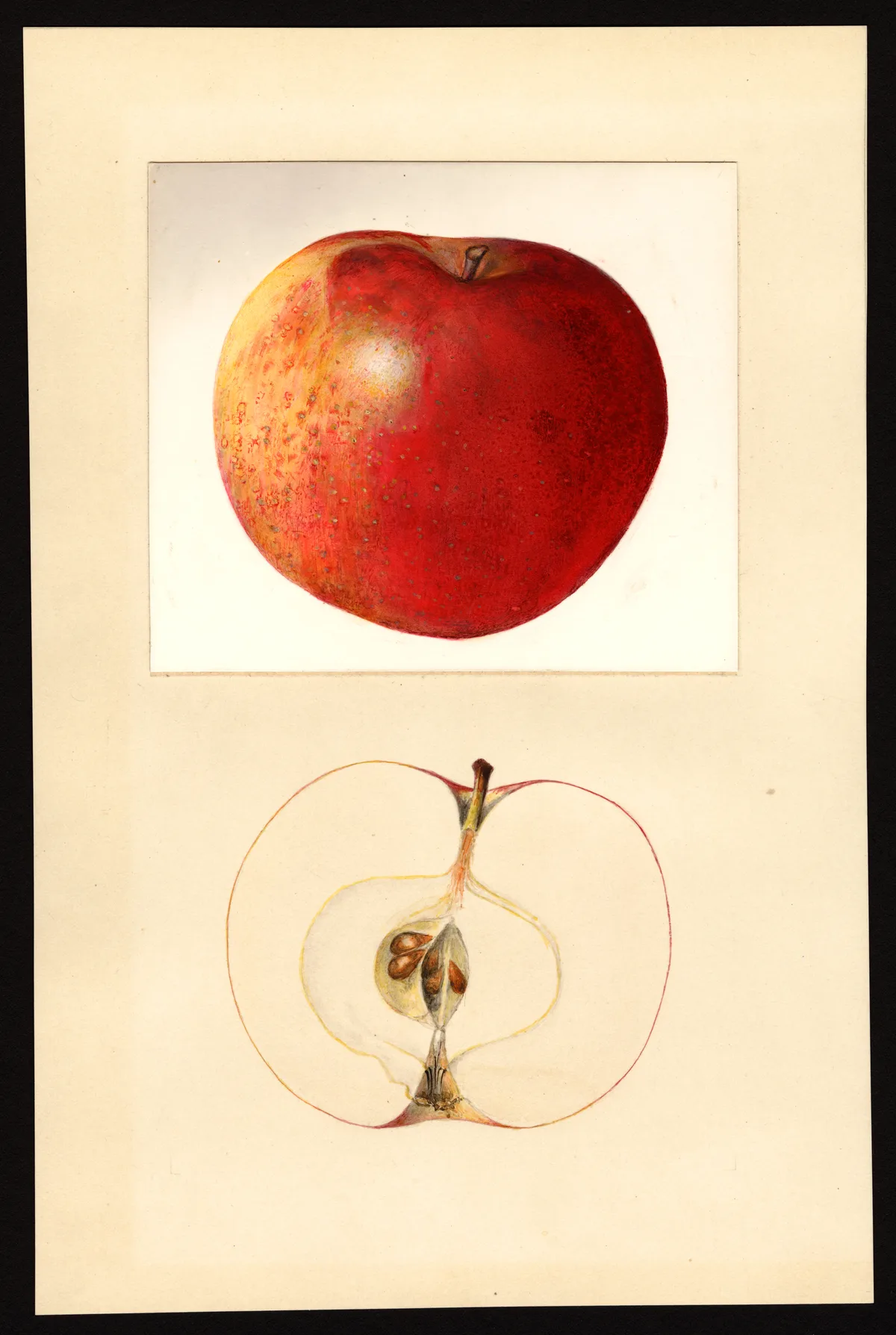
USDA Pomological Watercolor Collection
Milton
Origin / History
Milton originated in 1909 from a cross of Yellow Transparent with McIntosh. It is a sister seedling of Early McIntosh. The breeding record number was 11658, and the seedling number was Station 1040. Milton was selected in 1920 from a population of 134 seedlings and was introduced in 1923 without the benefit of a second test. It was named for the village of Milton in Ulster County, New York.
Wellington described the performance of the cross from which Milton originated. Hedrick published the introductory description of Milton and later described it in Systematic Pomology. Milton was briefly described in the Register of New Fruit and Nut Varieties.
Following the severe 1933-34 winter in New York, Milton trees survived without injury, as did McIntosh. Trees of Milton were sold by the New York State Fruit Testing Association for 45 years, 1923-67. In the 1960-68 period, it was sold by 13 commercial nurseries.
In 1954, Milton was tested at experiment stations in Colorado, Delaware, Massachusetts, Michigan, Nova Scotia, Ontario, Oregon, Ottawa, and West Virginia. A 1963 survey of apple clones in the United States showed that it was tested at stations in Connecticut, Iowa, Kansas, Maine, New York, Oklahoma, Pennsylvania, Vermont, Wisconsin, and Wyoming. In 1968, it was tested at stations in Kansas, New York, North Carolina, Ontario, Pennsylvania, and Vermont.
In a 1946 national appraisal of apple cultivars, 85 percent of fruit growers said they would plant Milton, and 7 percent would plant Wolf River. As observed in 1952 by trueness-to-name nursery inspectors, Milton was one of the less popular cultivars being propagated for northern growers. In 1956, Milton was one of the apple cultivars recommended for planting in New York. It is one of the Geneva introductions that has found the greatest favor with American fruit growers. A 1941 circular about apple growing in New York described Milton as one of the best and most important cultivars. It has been planted on a commercial scale in the Hudson Valley, New York, but plantings have never been really extensive. Milton ranked last among the 20 most important apple cultivars in New York in 1966, and it was no longer being planted during the 1963-65 period.
Milton has been recommended for planting in Pennsylvania, Wisconsin, Virginia, and western Colorado.
Tree
Mature Milton trees are medium sized to large, medium in vigor, upright, tall, medium dense, and round-topped, with strong, wide-angled crotches. The trunk is medium stocky. The trunk bark is gray and shaggy. The bark on branches ½ to 1¼ inches in diameter is reddish brown on the top surface where the cuticle has peeled off. Trees are productive and tend to bear somewhat alternately.
In Massachusetts, Milton trees had a very good growth habit and required 7 years to bear 1 bushel of fruit. They yielded good crops and sometimes bore annually and sometimes biennially. Shaw described in minute detail the vegetative characteristics of young nursery trees of Milton so that they can be distinguished from other cultivars growing in the nursery. In northern New York, Burrell found that Milton trees were biennial and began to bear at 7 years of age, one year younger than McIntosh. Fruit yields were above medium but considerably below McIntosh. Like McIntosh, Milton had wide crotch angles and was winter hardy.
In a laboratory hardiness test, twigs were exposed to -30 or -40°C for 24 to 48 hours in January or February. Hibernal and others belonged to the hardiest group, and Milton belonged to the second hardiest group of apple cultivars. In another study, scion roots of 50 apple cultivars were frozen to 20°F. Milton had outstanding hardiness; it was the third hardiest and was hardier than McIntosh. After the severe November 1940 freeze in Kansas, trees of Milton were found to be very hardy, showing 90 percent recovery.
Milton trees bloom early to midseason, about a day before Delicious. Milton is diploid, and its pollen is viable. Pollination experiments in New York showed that Milton produced satisfactory fruit sets, but not so good as Delicious. Milton was a good pollinator for McIntosh. Other studies showed that it was self-unfruitful but cross compatible with its half sibs, Cortland and Macoun. It was compatible with Orleans and Wealthy, and with Melba and Early McIntosh. Milton blossoms can be thinned by spraying within a week after full bloom with 30 to 50 ppm naphthalacetamide.
In a study comparing the preference of Japanese beetles for various apple cultivars, Milton was unattractive and received only occasional, light injury. Milton is resistant to cedar-apple rust, a disease that could become serious in the Hudson Valley, New York.
Fruit
Size: Fruits are medium sized, mostly 2¼ to 2¾ inches in diameter, with a maximum of 3¼ inches.
Form: Roundish, irregular in shape, ribbed, and sometimes exhibiting distinct low bulges.
Stem: Medium in length to short, medium in thickness to thick, flaring outward to very thick at the base of the stem.
Cavity: Acute, shallow, and narrow. Milton is conspicuous for its small cavity. The cavity is smooth and slightly compressed.
Calyx: Medium sized and usually closed. The calyx lobes are medium in length and width. The calyx tube is medium in length, rather wide, and conic. The stamens are in a median to marginal position.
Basin: Medium in depth and width, abrupt, somewhat furrowed, and rather symmetrical.
Skin: Thin, tender, smooth, glossy, covered with bloom, and greasy when overripe. The color is up to 80 percent pinkish red, sometimes with distinctly splashed stripes, but sometimes blushed with no stripes on the reddest cheek. Fruits are attractive in appearance. Dayton found that in the skin of Milton fruits, 99 percent of the cells in the epidermal layer and 95 percent of the cells in the outer hypodermal layer contained red pigment.
Dots: Very numerous, very large, and very conspicuous. They are dark red to pink on the green cheek and grayish russet on the red cheek. The pink dots have white centers. Raised suture lines extending down the sides of fruits range from very prominent to nonexistent.
Flesh and flavor: White, soft, fine grained, tender, medium juicy, subacid, and aromatic. The eating quality is very good; Burrell rated Milton as excellent. It is a dessert type and is not suitable for processing.
Core and seeds: The core is medium sized and slightly open. The carpels are round and with a few cracks. The seeds are medium sized to large, wide, plump, and acute.
Season
The average ripening date for Milton at Geneva is September 11, 4 weeks before Delicious. The average number of days from full bloom to harvest is 117, 28 fewer than Delicious. After they are ripe, Milton fruits hang fairly well to the tree, though there is some dropping. In Massachusetts, the fruits were moderately free of preharvest drop. In Iowa, the harvest season was 6 weeks before Jonathan. Milton ripens in early September, when few other cultivars are being harvested.
The storage life of Milton is short, approximately 60 days at 31°F. In Massachusetts, it had a very short cold storage life. It is best marketed immediately after harvest.
Uses
Milton is a dessert apple and is not suitable for processing. The eating quality is very good, and Burrell rated it as excellent. It is profitable for commercial and roadside plantings. Because of its softness of flesh, it is difficult to handle.
The color requirements for Milton in U.S. Grades are U.S. Extra Fancy, 50% red; U.S. Fancy, 25%; and U.S. No. 1, 15%. In Massachusetts, the fruits were below medium size to large, good in color, irregular in shape, and very good in quality. In Iowa, the fruits were medium sized and pale red, and Milton was of poor commercial value.
Subtypes / Variants
Not described in source.
Other
Milton fruits are illustrated in Figure 17. Way lists ten tree characteristics and ten fruit characteristics of Milton. A 1946 survey in Massachusetts found that 9 of 15 growers would plant Milton in the future, 4 would discard it, and 58 of 76 would also plant McIntosh.
Book Sources
Described in 1 period pomological work
View original book sources (1)
— Roger D. Way, Apple Cultivars Introduced by the New York State Agricultural Experiment Station, 1914–1968 (1971)Milton
Origin. In 1909, Yellow Transparent was crossed with McIntosh, and this resulted in the origin of Milton. Milton is a sister seedling of Early McIntosh (see Early McIntosh). The breeding record number was 11658, and the seedling number was Station 1040. Milton was selected in 1920 from a population of 134 seedlings, and, without the benefit of a second test, it was introduced in 1923 (Table 2). It was named for the village of Milton in Ulster County, New York.
Wellington (235) described the performance of the cross from which Milton originated. Hedrick (92) published the introductory description of Milton; he also described it in his book Systematic Pomology (91). Milton was briefly described in the Register of New Fruit and Nut Varieties (31).
Winter Hardiness. In a laboratory hardiness test (83), twigs were exposed to -30 or -40°C for 24 to 48 hours in January or February. Hibernal and others belonged to the hardiest group, and Milton belonged to the second hardiest group of apple cultivars. In another study (202), scion roots of 50 apple cultivars were frozen to 20°F. Milton had outstanding hardiness; it was the third hardiest and was hardier than McIntosh.
Following the severe 1933-34 winter in New York, trees of Milton, like McIntosh, survived without injury (2, 3). After the severe November 1940 freeze in Kansas (179), trees of Milton were found to be very hardy, showing 90 per cent recovery.
Tree. The tree characteristics of Milton are summarized in Table 5. Ten tree characteristics of Milton trees have been listed by Way (221).
In Massachusetts, Shaw (192) described in minute detail the vegetative characteristics of young nursery trees of Milton so that they can be distinguished from other cultivars growing in the nursery.
Mature Milton trees are medium sized to large, medium in vigor, upright, tall, medium dense, round-topped, and have strong, wide-angled crotches. The trunk is medium stocky. The trunk bark is gray and shaggy. The bark on branches ½ to 1¼ inches in diameter is reddish brown on the top surface where the cuticle has peeled off. Trees are productive and tend to bear somewhat alternately (Table 5).
In northern New York, Burrell (45) found that Milton trees were biennial and began to bear at 7 years of age, one year younger than McIntosh. Fruit yields were above medium but considerably below McIntosh. Like McIntosh, Milton crotch angles were wide and trees were winter hardy.
Pollination. Milton trees bloom early (198) to midseason (98), about a day before Delicious (Table 6). Milton is diploid (Table 4). The pollen is viable (238).
Pollination experiments in New York (152) showed that Milton produced satisfactory fruit sets but not so good as Delicious. Milton was a good pollinator for McIntosh (46). Other studies (144) showed that it was self-unfruitful but cross compatible with its half sibs, Cortland and Macoun. It was compatible with Orleans and Wealthy (242), and with Melba and Early McIntosh (233).
Milton blossoms can be thinned by spraying within a week after full bloom with 30 to 50 ppm naphthalacetamide (80).
Fruit. Milton fruits are illustrated in Figure 17. Ten fruit characteristics of Milton have been listed by Way (221). Fruit characteristics are summarized in Table 8.
The average ripening date for Milton at Geneva is September 11, 4 weeks before Delicious (Table 7). The average number of days from full bloom to harvest is 117, 28 fewer than Delicious. After they are ripe, Milton fruits hang fairly well to the tree, though there is some dropping.
Milton fruits are medium sized, mostly 2¼ to 2¾ inches in diameter, with a maximum of 3¼ inches. They are roundish, irregular in shape, ribbed, and sometimes exhibit distinct low bulges. The stem is medium in length to short, medium in thickness to thick, and flaring outward to very thick at the base of the stems. The cavity is acute, shallow, and narrow. Milton is conspicuous for its small cavity. The cavity is smooth and slightly compressed. The calyx is medium sized and usually closed. The calyx lobes are medium in length and width. The basin is medium in depth and width, abrupt, somewhat furrowed, and rather symmetrical.
The skin is thin, tender, smooth, glossy, covered with bloom, and greasy when overripe. The color is up to 80 per cent pinkish red, sometimes with distinctly splashed stripes, but sometimes blushed with no stripes on the reddest cheek. Fruits are attractive in appearance.
Figure 17.--Milton.
Dayton (60) found that in the skin of Milton fruits, 99 per cent of the cells in the epidermal layer and 95 per cent of the cells in the outer hypodermal layer contained red pigment.
The color requirements for Milton in U.S. Grades are U.S. Extra Fancy, 50% red; U.S. Fancy, 25%; and U.S. No. 1, 15% (145).
The dots are very numerous, very large, and very conspicuous. They are dark red to pink on the green cheek and grayish russet on the red cheek. The pink dots have white centers. Raised suture lines extending down the sides of fruits range from very prominent to nonexistent. The calyx tube is medium in length, rather wide, and conic. The stamens are in a median to marginal position. The core is medium sized and slightly open. The carpels are round and with a few cracks. The seeds are medium sized to large, wide, plump, and acute.
The flesh of Milton fruits is white, soft, fine grained, tender, medium juicy, subacid, and aromatic. The eating quality is very good; Milton was rated by Burrell (45) as excellent. It is a dessert type and is not suitable for processing. The storage life of Milton is short, approximately 60 days at 31°F (Table 10). It is best marketed immediately after harvest.
Insects and Diseases. In a study comparing the preference of Japanese beetles for various apple cultivars (142), Milton was unattractive and received only occasional, light injury. Milton is resistant to cedar-apple rust, a disease that could become serious in the Hudson Valley, New York (239).
Commercial Usefulness. Trees of Milton were sold by the New York State Fruit Testing Association for 45 years, 1923-67 (Table 3). In the 1960-68 period, it was sold by 13 commercial nurseries (Table 3).
In 1954 (186), Milton was tested at experiment stations in Colorado, Delaware, Massachusetts, Michigan, Nova Scotia, Ontario, Oregon, Ottawa, and West Virginia. In 1963, a survey of apple clones in the United States (79) showed that it was tested at stations in Connecticut, Iowa, Kansas, Maine, New York, Oklahoma, Pennsylvania, Vermont, Wisconsin, and Wyoming. In 1968 (184), it was tested at stations in Kansas, New York, North Carolina, Ontario, Pennsylvania, and Vermont.
In a 1946 national appraisal of apple cultivars (26), 85 per cent of fruit growers said they would plant Milton; 7 per cent would plant Wolf River. As observed in 1952 by trueness-to-name nursery inspectors (185), Milton was one of the less popular cultivars being propagated for northern growers.
In 1956 (10), Milton was one of the apple cultivars recommended for planting in New York. It is one of the Geneva introductions which has found the greatest favor with American fruit growers (241). In a 1941 circular about apple growing in New York (103), Milton was described as one of the best and most important cultivars. It has been planted on a commercial scale in the Hudson Valley, New York, but plantings have never been really extensive. Figure 41 shows that Milton ranked last among the 20 most important apple cultivars in New York in 1966, but Table 1 shows that it was no longer being planted during the 1963-65 period.
In Massachusetts (81), Milton trees had a very good growth habit, required 7 years to bear 1 bushel of fruit, yielded good crops, and sometimes bore annually and sometimes biennially. It was a good pollinator for McIntosh. The fruits were below medium size to large, good in color, irregular in shape, very good in quality, moderately free of preharvest drop, and had a very short cold storage life. In a 1946 survey in Massachusetts (226), 9 of 15 growers would plant Milton in the future, 4 would discard it, and 58 of 76 would also plant McIntosh.
In Iowa (62), Milton trees produced medium yields; its harvest season was 6 weeks before Jonathan; the fruits were medium sized and pale red; and it was of poor commercial value.
Milton has been recommended for planting in Pennsylvania (50), Wisconsin (182), Virginia (175), and western Colorado (85).
In summary: Milton is a profitable cultivar for commercial and roadside plantings. It ripens in early September when few other cultivars are being harvested. Because of its softness of flesh, it is difficult to handle.