Yellow Transparent
Apple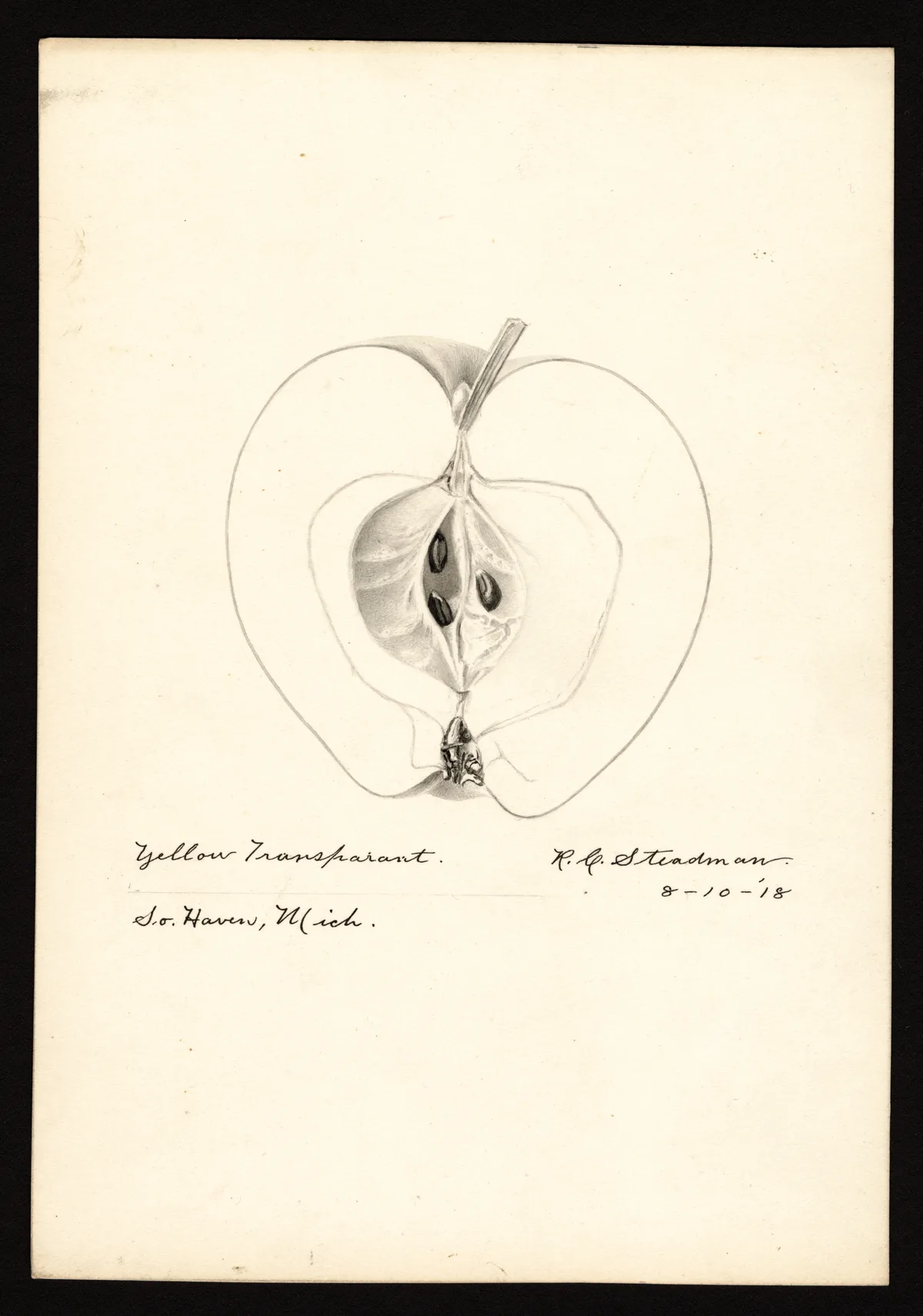
USDA Pomological Watercolor Collection
Yellow Transparent
Origin / History
Yellow Transparent is a Russian variety, imported from St. Petersburg in 1870 by the United States Department of Agriculture (Washington, D.C.). Bunyard's Handbook of Hardy Fruits notes the variety was "introduced early in the nineteenth century" from Russia. Its merits were first brought to the notice of American growers by Dr. T. H. Hoskins of Newport, Vermont. From there it was disseminated throughout the apple-growing regions of the country from the Atlantic to the Pacific and became commonly listed by nurserymen; by the time of Beach (1905), its cultivation for home use was gradually increasing in New York state, and it was occasionally grown there to a limited extent for market. Budd-Hansen (1914) describe it as "now a commercial variety for first early." Downing notes that at the time of its introduction there was "some confusion regarding some of the new Russian apples, a few not being true to name, and others having proved synonymous with older varieties."
Hansen (1902) places Yellow Transparent within a "Transparent Group" alongside No. 60, White Transparent, Red Duck (spurious), Charlottenthaler, Enthaler, Thaler, Erdbeer Streifling, and Nitchner's Erdbeer, citing the Russian Nomenclature Commission.
Tree
Tree of medium size, moderately vigorous to vigorous; Hedrick (1922) qualifies that the trees are "small and lack health and productiveness, but come in bearing very early and are extremely hardy." Hansen (1902) and Budd-Hansen (1914) describe the tree as upright and round-topped; Beach (1905) and Hedrick (1922) describe the form as upright at first but becoming spreading or roundish and rather dense. The branches are short, stout, and crooked, filled with short spurs. Twigs short, curved, stout, with large terminal buds; internodes medium. Bark conspicuously yellow or tawny, lightly streaked with scarf-skin; pubescent. Lenticels quite numerous, medium to small, oval or elongated, not raised. Buds medium size, broad, plump, obtuse, free, slightly pubescent. Leaf (Bunyard 1920) very large, greyish-green, lax, upfolded, undulated, finely serrate or crenate. The tree is hardy, healthy, and comes into bearing very young; an early and good annual (or nearly annual) bearer. Beach notes that in some portions of the West it suffers from twig blight (fire blight), but it appears to be quite free from this disease in New York; Lowther's Encyclopedia of Practical Horticulture (1914) reports that "it is generally believed that this tree, more than most other varieties, is subject to 'blight,' 'fire blight' or 'pear blight.'" The Stark Bros. Year Book (1910) conversely advertises it as "not susceptible to blight." The Central Experimental Farm catalogue (Agassiz BC, 1900) describes its tree, planted Spring 1890, as "a medium grower and regular bearer."
Fruit
Size
Medium, or medium to above medium, sometimes large; Bunyard (1920) gives "fairly large, 3 by 2½ [inches]"; Hansen's Transparent Group description gives size 5 to 6. Pretty uniform in shape and size on young or vigorous-growing trees. Beach notes that on young or vigorous-growing trees the fruit may grow rather large, but on mature slow-growing trees, especially when overloaded, the fruit is apt to be below medium size unless thinned. Hedrick (1922) likewise observes that the fruits on old trees run small and uneven in size and shape.
Form
Roundish ovate to roundish conic, oblate conic, or round-oval; Downing (1900) gives "roundish oblate, slightly conical, slightly angular"; Hansen (1902) "roundish conical, sometimes roundish oblate and slightly conical, obscurely angular"; Budd-Hansen (1914) "roundish conical, sometimes oblate conical, obscurely angular"; Thomas (1903) "round conic"; Bunyard (1920) "round, conical, irregular"; Hedrick (1922) "round-oval, round-conic or oblate-conic, ribbed." Slightly ribbed; sides unequal. The Central Experimental Farm catalogue gives "roundish inclining to conical."
Stem
Stem medium to long, rather thick (Beach, Lowther, Hedrick); Hansen's main description gives "medium to long"; Budd-Hansen and Hansen's Transparent Group description give "long"; Downing gives "short to medium, rather slender." Bunyard describes it as "medium, rather thin."
Cavity
Acute, or approaching obtuse; medium to deep, rather narrow, sometimes slightly lipped, sometimes russeted (Beach, Lowther, Hedrick). Downing describes the cavity as "rather large, sometimes a little greenish." Hansen and Budd-Hansen describe it as "regular, acute [or obtuse], usually russeted." Hansen's Transparent Group description gives "very broad, medium deep." Bunyard gives "narrow, deep cavity, occasionally with light russet."
Calyx
Closed (Downing, Hansen, Beach, Budd-Hansen, Hedrick, Bunyard). Hansen's Transparent Group description gives "open." Lobes medium in length, broad. Calyx tube conical (Beach, Lowther, Hedrick); Hansen gives "tube funnel-shaped." Stamens marginal.
Basin
Medium and slightly corrugated, sometimes with small protuberances (Downing); narrow, shallow, corrugated (Hansen, Budd-Hansen); moderately shallow, rather narrow, somewhat abrupt, furrowed and slightly wrinkled (Beach, Lowther); shallow, narrow, abrupt, furrowed and wrinkled (Hedrick); shallow, regular (Thomas); "moderately deep, plaited basin with distinct knobs" (Bunyard); "medium, wrinkled" (Hansen's Transparent Group). Veitch's catalogue (1911) describes the fruit as "medium size, pale yellow slightly streaked, showy."
Skin
Thin, tender, smooth, waxy. At first clear white or pale greenish-yellow, changing or becoming pale yellow / yellowish-white / "an attractive yellowish-white" at full maturity. Thomas (1903): "skin yellow, almost transparent." Bunyard (1920): "Colour, palest milky-yellow." Hansen's Transparent Group: "pale straw-yellow, skin showing slightly raised irregular gray dots." Hansen (main description): "skin smooth, transparent; surface clear white, becoming pale yellow at maturity." Hedrick (1922) says the apples have "a clear, clean yellow color"; the variety "takes on a good clear yellow color before becoming overripe" (Beach), but is otherwise without red overlay — George Bunyard & Co. (1901): "Good quality green apple without red." On account of its delicate color and tender skin, the fruit shows bruises readily and must be handled with extra care; it is not a good shipper.
Dots
Moderately numerous to numerous; greenish and light colored, often submerged (Beach, Lowther, Hedrick). Downing: "moderately sprinkled with light and greenish dots, somewhat obscure." Hansen: "dots white, large, suffused, obscure." Budd-Hansen: "dots large, white, suffused, many." Hansen's Transparent Group: "slightly raised irregular gray dots." Central Experimental Farm: "a sprinkling of grayish dots."
Flesh and Flavor
Flesh white, moderately firm (Hedrick gives "firm"), fine-grained, crisp, tender, juicy, sprightly subacid, with a pleasant but not high flavor; quality good or sometimes very good. Downing: "white, half fine, tender, juicy, sprightly subacid; quality good to very good." Hansen: "white, tender, fine grained, juicy, pleasant, sprightly subacid, very good." Hansen's Transparent Group: "flesh, fine grained, nearly white; flavor, pleasant acid." Thomas: "flesh crisp, sub-acid, good." Bunyard (1920): "Flesh, greenish-white, crisp, acid"; he calls it "a delicious summer fruit, brisk and digestible." Central Experimental Farm: "whitish, coarse, tender, juicy, pleasantly sub-acid, quality very good." Beach summarizes that the fruit "is not equal in quality to Early Harvest, but it begins to ripen somewhat earlier and is a more reliable cropper."
Core and Seeds
Core medium (Downing, Lowther) or medium to small (Beach, Hedrick); cells partly open to wide open; core lines clasping. Hansen: "Core slightly open, clasping." Budd-Hansen: "Core half open, clasping." Hansen's Transparent Group: "core, medium, nearly closed." Carpels broadly ovate. Seeds medium size, rather wide, rather flat, obtuse to slightly acute (Beach); Hedrick: "seeds wide, flat, obtuse."
Season
Early — ripens before Tetofsky, "a week or two before Tetofsky" (Downing). Late July and August (Beach, Budd-Hansen, Hedrick); early August (Hansen, Bunyard); July and August (Lowther); August 1st to 10th (Hansen's Transparent Group); August and September (Central Experimental Farm, Agassiz BC). Downing: "Season early in August." The crop ripens continuously through a period of three or four weeks, and two or more pickings are required in order to secure the fruit in prime condition (Beach). It begins to ripen in July and continues in season in some cases till early September. The fruit "does not continue long in use" (Downing); "can never be kept long nor shipped far" (Hedrick). The Stark Bros. Year Book (1910), conversely, advertises it as an "early season variety and of good keeping quality"; George Bunyard & Co. (1901) similarly notes it "keeps fresh."
Uses
Excellent for culinary use and acceptable for dessert (Beach, Lowther, Hedrick, Bunyard). Thomas (1903): "Largely grown all over the country as an excellent early market apple. Especially valuable for the kitchen." Generally grown in New York state for home use only, but in some places cultivated to a limited extent for local market; desirable because it takes on a good clear yellow color before becoming overripe (Beach). A. G. Tuttle, quoted by Hansen: "I find this variety profitable for the earliest fancy market, shipped in small boxes." Now grown north and south from the Atlantic to the Pacific (Hedrick). Stark Bros.: "A popular variety in sections where hardiness is needed."
Subtypes / Variants
Hansen (1902) groups Yellow Transparent within a "Transparent Group" together with No. 60, White Transparent, Red Duck (spurious), Charlottenthaler, Enthaler, Thaler, Erdbeer Streifling, and Nitchner's Erdbeer, per the Russian Nomenclature Commission. No distinct sports or named strains are described in the sources.
Other
Beach (1905) summarizes that Yellow Transparent "is one of the best of the extra early apples"; Hedrick (1922) writes that it "is more readily characterized by its faults than by its virtues," with earliness as its chief asset — its chief faults being that fruits on old trees run small and uneven, the tender flesh shows bruises readily, and the fruits can never be kept long nor shipped far.
Book Sources
Described in 8 period pomological works
- Beach, The Apples of New York Vol. 2 (1905)
- Downing, Fruits and Fruit Trees of America (1900)
- Lowther (ed.), Encyclopedia of Practical Horticulture (1914)
- Hansen, A Study of Northwestern Apples (1902)
- Budd & Hansen, Systematic Pomology (1914)
- Hedrick, Cyclopedia of Hardy Fruits (1922)
- Thomas, The American Fruit Culturist (1903)
- Bunyard, A Handbook of Hardy Fruits (1920) — listed as WHITE TRANSPARENT
USDA Nomenclature (1905)
From W.H. Ragan, Nomenclature of the Apple, USDA Bulletin No. 56
May be Yellow Transparent. See A'83
Nursery Catalog Sources
Found in 75 catalogs (1850–1955) from Alabama, Arkansas, England, Illinois, Kansas, Maryland, Massachusetts, Missouri, Nebraska, New Jersey, New York, Oregon, Pennsylvania, Virginia, Washington
- Azell Bowditch (Nursery / Fruit Catalog) , Boston , Massachusetts — 1850
- Huntsville Wholesale Nurseries (Jessie S. Moss , Proprietor; W.F. Heikes, Manager), Huntsville , Alabama — 1886
- Palouse Nursery and Pleasant Dale Fruit Farm , Colfax, Washington Territory (situated two miles northeast of Colfax) - undated (single-page broadside flyer; "Washington Territory" suggests pre — 1889
- William H. Moon Co. , Morrisville, Bucks County , Pennsylvania — 1890
- Missouri Nursery Co. , Louisiana , Missouri — 1891
- Puyallup & Yakima Nurseries , Puyallup, Washington (Lock Box 191) and North Yakima , Washington — 1892
- Milwaukie-Canby Nurseries , Canby, OR (and Milwaukie, OR) — 1893
- Oregon Wholesale Nurseries , Salem , Oregon — 1893
- Green's Nursery Co. (Charles A. Green) , Rochester , New York — 1894
- Multnomah Nurseries , Russellville , Oregon — 1894
- Woodburn Nurseries , Woodburn, Marion Co. , Oregon — 1894
- The Vineland Nurseries (Kelsey & Co. , Proprietors), St. Joseph, Missouri (Office: 13th and Atchison Sts., 2 Blocks East of the Citizens St. Car Line) — 1894
- The Lovett Company , Little Silver , New Jersey — 1896
- Kelway & Son , Langport, Somerset , England — 1897 — listed as White Transparent
- The Salem Nursery (John A. Francis , Proprietor), Salem , Virginia — 1897
- Arthur J. Collins & Sons , Moorestown , New Jersey — 1898
- J.V. Cotta (Cotta Nursery) , Carroll County , Illinois — 1898
- Reading Nursery , Jacob W. Manning, Proprietor, Reading , Massachusetts — 1898
- Stark Bros. Nurseries & Orchards Co. , Louisiana , Missouri — 1898
- Brown Brothers Co. , Continental Nurseries, Rochester, NY (also operated from Toronto, Canada) — 1899
- George Bunyard & Co. , Royal Nurseries, Maidstone, Kent , England — 1900 — listed as White Transparent
- Central Experimental Farm , Dominion Department of Agriculture, Agassiz, British Columbia (under test; Bulletin No. 3, Second Series) — 1900 — listed as White Transparent
- Central Experimental Farm , Dominion Department of Agriculture, Agassiz, British Columbia (under test; Bulletin No. 3, Second Series) — 1900
- Central Experimental Farm , Dominion Department of Agriculture, Agassiz, British Columbia (under test; Bulletin No. 3, Second Series) — 1900 — listed as Red Duck
- The Dalles Nurseries , The Dalles , Oregon — 1901
- Washington Nursery Co. , Toppenish , Washington — 1901
- Benjamin Buckman (personal inventory) , Farmingdale , Illinois — 1901
- Brown Brothers Co. , Continental Nurseries, Rochester, NY (also operated from Toronto, Canada) — 1901
- Mountain Grove Nurseries (Tippin & Moore , Proprietors; Geo. T. Tippin, J. W. Tippin, J. C. Moore), Mountain Grove , Missouri — 1901
- Yarbrough Bros. , Stephens , Arkansas — 1901
- Pacific Nursery Company (W. O. Hudson & A. D. Hudson) , Tangent , Oregon — 1903
- Russellville Nursery Co. , Russellville, OR (three miles east of Portland, one mile from Montavilla car line) — 1903
- Phoenix Nursery Company (W. E. Rossney , President; Sidney Tuttle, Vice-President), Bloomington , Illinois — 1904
- Stark Bros. Nurseries & Orchards Co. , Louisiana , Missouri — 1906
- J.B. Pilkington , Portland , Oregon — 1907
- Russellville Nursery Co. , Montavilla Station, Portland, OR (three miles east of Portland, one mile from Montavilla car line) — 1907
- Carlton Nursery Co. , Carlton , Oregon — 1909
- Milton Nursery Co. (A. Miller & Sons , Proprietors), Milton , Oregon — 1909
- Wm. J. Corse (successor to Robert Sinclair / Sinclair Nurseries) , Baltimore , Maryland — 1909
- Washington Nursery Company , Toppenish , Washington — 1909
- C.F. Lansing , Salem , Oregon — 1910
- Stark Bros. Nurseries & Orchards Co. , Louisiana , Missouri — 1910
- James Veitch & Sons , Ltd., Royal Exotic Nursery, Chelsea, London (also Coombe Wood, Langley, and Feltham) , England — 1911 — listed as White Transparent
- Galbraith Nursery Co. (DeWitt Hansen , Pres.-Mgr.), Fairbury , Nebraska — 1911
- Island Nurseries & Fruit Farm , Vashon (Vashon Island) , Washington — 1911
- Stark Bros. Nurseries & Orchards Co. , Louisiana , Missouri — 1911
- Ballygreen Nurseries , Hanford , Washington — 1912
- Pacific Nursery Company , Portland , Oregon — 1912
- Vineland Nurseries Company , Clarkston , Washington — 1912
- Washington Nursery Company , Toppenish , Washington — 1912
- Thomas Rivers & Son , Sawbridgeworth, Hertfordshire , England — 1913 — listed as White Transparent
- J. B. Pilkington , Nurseryman, Portland, OR (nurseries near Newberg, forty miles from Portland) — 1913
- Samuel Fraser , Geneseo , New York — 1913
- Van Holderbeke Nursery Co. , Incorporated, Spokane, Washington (nurseries at Otis Orchards WA, Pasadena WA, Kennewick WA) — 1913
- Benjamin Buckman (personal inventory) , Farmingdale , Illinois — 1913
- George Bunyard & Co. , Royal Nurseries, Maidstone, Kent , England — 1914 — listed as White Transparent
- Island Nurseries & Fruit Farm , Vashon (Vashon Island) , Washington — 1914
- Island Nurseries & Fruit Farm , Vashon (Vashon Island) , Washington — 1915
- Union Nurseries , J.B. Weaver & Sons, Union , Oregon — 1915
- Holsinger Bros. Nurseries (Holsinger Brothers Nursery) , Rosedale , Kansas — 1916
- Island Nurseries & Fruit Farm , Vashon (Vashon Island) , Washington — 1916
- Manalapan Nurseries , Englishtown , New Jersey — 1916
- George Bunyard & Co. , Royal Nurseries, Maidstone, Kent , England — 1917 — listed as White Transparent
- Island Nurseries & Fruit Farm , Vashon (Vashon Island) , Washington — 1917
- Stark Bros. Nurseries & Orchards Co. , Louisiana , Missouri — 1918
- Oregon Nursery Co. , Orenco , Oregon — 1920
- Christopher Nurseries / John Stewart & Sons , Christopher , Washington — 1920
- Benedict Nursery Co. , Portland , Oregon — 1921
- Island Nurseries & Fruit Farm , Vashon , Washington — 1921
- Columbia & Okanogan Nursery Co. , Wenatchee , Washington — 1925
- Hudson's Wholesale Nurseries , Tangent , Oregon — 1926
- Stark Bro's Nurseries , Louisiana , Missouri — 1932
- Milton Nursery Co. , Milton-Freewater , Oregon — 1947
- Carlton Nursery Co. , Forest Grove , Oregon — 1955
- North-Western Nurseries , Walla Walla , Washington
View original book sources (12)
— A.J. Downing, The Fruits and Fruit Trees of America (1900)Yellow Transparent.
A new Russian variety, which was imported from St. Petersburg in 1870 by the Department of Agriculture, Washington, D. C., and promises to be valuable for a cold climate as an early fruit of good quality, ripening before the Tetofsky, with more tender and delicate flesh, but does not continue long in use. It is said that the tree so far has proved to be very hardy, moderately vigorous, upright, an early and good bearer annually.
Fruit medium, roundish oblate, slightly conical, slightly angular; skin clear white at first, becoming pale yellow when fully mature, moderately sprinkled with light and greenish dots, somewhat obscure; stalk short to medium, rather slender; cavity rather large, sometimes a little greenish; calyx closed; basin medium, slightly corrugated, sometimes small protuberances; flesh white, half fine, tender, juicy, sprightly subacid; quality good to very good; core medium. Season early in August, and a week or two before Tetofsky.
There appears to be some confusion regarding some of the new Russian apples, a few not being true to name, and others having proved synonymous with older varieties; some of the new varieties are large and handsome, and if the trees prove as hardy as is claimed for them, they will be valuable acquisitions for the North and Northwest.
— N.E. Hansen, A Study of Northwestern Apples (1902)Yellow Transparent—Origin, Russia; imported from St. Petersburg, by U. S. Department of Agriculture. Tree upright, round-topped, an early and good annual bearer—Fruit medium, roundish conical, sometimes roundish oblate and slightly conical, obscurely angular; skin smooth, transparent; surface clear white, becoming pale yellow at maturity; dots white, large, suffused, obscure; cavity regular, obtuse, usually russeted; stem medium to long; basin narrow, shallow, corrugated; calyx closed. Core slightly open, clasping; tube funnel-shaped; stamens marginal; flesh white, tender, fine grained, juicy, pleasant, sprightly subacid, very good. Early August.
"TRANSPARENT GROUP.
Yellow Transparent; No. 60; White Transparent; Red Duck (spurious); Charlottenthaler; Enthaler; Thaler; Erdbeer Streifling; Nitchner's Erdbeer.
DESCRIPTION: Transparent—Size, 5 to 6; form, round, conical; color, pale straw-yellow, skin showing slightly raised irregular gray dots; cavity, very broad, medium deep; stem, long, rather stout; basin, medium, wrinkled; calyx, open; core, medium, nearly closed; flesh, fine grained, nearly white; flavor, pleasant acid; season August 1st to 10th; origin, Russia; tree upright; round topped.
A. G Tuttle: I find this variety profitable for the earliest fancy market, shipped in small boxes." (Rus. Nom. Com.)
— John J. Thomas, The American Fruit Culturist (1903)Yellow Transparent.* Medium, round conic; skin yellow, almost transparent; basin shallow, regular, cavity acute; flesh crisp, sub-acid, good. Largely grown all over the country as an excellent early market apple. Especially valuable for the kitchen. Russia.
— S.A. Beach, The Apples of New York, Vol. 2 (1905)YELLOW TRANSPARENT.
REFERENCES. 1. Leroy, 1873:846. fig. 2. Budd, Ia. Hort. Soc. Rpt., 1880:523. 3. Downing, 1881:114 app. fig. 4. Am. Pom. Soc. Cat., 1881:16. 5. Webster, Montreal Hort. Soc. Rpt., 7:54. 1881. 6. Gibb, Ib., 7:154. 1881. 7. Ib., Ia. Hort. Soc. Rpt., 1883:437. 8. Barry, 1883:336. 9. Hoskins, Rural N. Y., 43:651. 1884. fig. 10. Penhollow, Montreal Hort. Soc. Rpt., 10:65. 1884. 11. Thomas, 1885:530. 12. Rural. N. Y., 44:185, 200. 1885. 13. Gibb, Montreal Hort. Soc. Rpt., 1886-87:14. 14. Am. Pom. Soc. Rpt., 1887:92. 15. Rural N. Y., 46:107, 201, 382. 1887. fig. 16. Can. Hort., 11:209, 223. 1888. 17. Fisk, Montreal Hort. Soc. Rpt., 14:33. 1889. 18. Can. Hort., 13:121, 132, 216, 272, 301. 1890. 19. Hamilton, Montreal Hort. Soc. Rpt., 15:27. 1890. 20. Can. Hort., 15:281. 1892. 21. Bailey, An. Hort., 1892:253. 22. Budd, Ia. Sta. Bul., 19:535. 1892. 23. Pa. Sta. Rpt., 1892:110. fig. 24. Hoskins, Gard. and For., 7:138. 1894. 25. Woolverton, Ont. Fr. Stas. An. Rpt., 2:11. 1895. figs. 26. Van Deman, Rural N. Y., 55:613. 1896. 27. Hoskins, Ib., 56:156. 1897. 28. Woolverton, Ont. Fr. Stas. An. Rpt., 4:5. 1897. figs. 29. Waugh, Vt. Sta. Bul., 61:32. 1897. 30. Alwood, Va. Sta. Bul., 130:122. 1901. 31. Waugh, Vt. Sta. An. Rpt., 14:313. 1901. 32. Hansen, S. D. Sta. Bul., 76:119. 1902. fig. 33. Dickens and Greene, Kan. Sta. Bul., 106:56. 1902. 34. Munson, Me. Sta. An. Rpt., 18:85, 88. 1902. 35. Rural N. Y., 61:626. 1902. fig. 36. Budd-Hansen, 1903:213. fig. 37. Farrand, Mich. Sta. Bul., 205:47. 1903. 38. Bruner, N. C. Sta. Bul., 182:24. 1903.
SYNONYMS. De Revel (1). Grand-Sultan (1). Revelstone (1). SKWOSNOI SCHOTOI (7). Skwosnoi Schotoi (5). Transparente de Saint-Leger (1). TRANSPARENTE JAUNE (1). YELLOW TRANSPARENT (2, 3, 4, 5, 6, 8, 9, 10, 11, 12, 13, 14, 15, 16, 17, 18, 19, 20, 21, 22, 23, 24, 25, 26, 27, 28, 29, 30, 31, 32, 33, 34, 35, 36, 37, 38). Yellow Transparent (7).
This is one of the best of the extra early apples, being excellent for culinary use and acceptable for dessert. It is not equal in quality to Early Harvest, but it begins to ripen somewhat earlier and is a more reliable cropper, yielding good crops annually or nearly so. Generally speaking, it is grown in New York state for home use only, but in some places it is cultivated to a limited extent for market, particularly for local market. It is desirable for this purpose because it takes on a good clear yellow color before becoming overripe. On account of its delicate color and tender skin it shows bruises readily and must be handled with extra care. The crop ripens continuously through a period of three or four weeks, and two or more pickings are required in order to secure the fruit in prime condition. It begins to ripen in July, and continues in season in some cases till early September. On young or vigorous-growing trees the fruit may grow rather large, but on mature slow-growing trees, especially when they are overloaded, the fruit is apt to be below medium size unless thinned. The tree is a moderately vigorous grower, hardy, healthy and comes into bearing very young. In some portions of the West it suffers from twig blight (fire blight) but it appears to be quite free from this disease in New York.
Historical. Imported from Russia by the United States Department of Agriculture in 1870. Its merits were first brought to notice in this country by Dr. T. H. Hoskins, of Newport, Vt. (9). It has been disseminated throughout the apple-growing regions of the country from the Atlantic to the Pacific and is now commonly listed by nurserymen (21). In New York its cultivation for home use is gradually increasing, and occasionally it is grown to a limited extent for market.
TREE. Tree of medium size, moderately vigorous, with short, stout, crooked branches filled with short spurs. Form upright at first but becoming spreading or roundish and rather dense. Twigs short, curved, stout with large terminal buds; internodes medium. Bark conspicuously yellow or tawny, lightly streaked with scarf-skin; pubescent. Lenticels quite numerous, medium to small, oval or elongated, not raised. Buds medium size, broad, plump, obtuse, free, slightly pubescent.
FRUIT. Fruit medium or above medium, sometimes large, pretty uniform in shape and size. Form roundish ovate to roundish conic or oblate conic, slightly ribbed; sides unequal. Stem medium to long, rather thick. Cavity acute or approaching obtuse, medium to deep, rather narrow, sometimes slightly lipped, sometimes russeted. Calyx medium size, closed; lobes medium in length, broad. Basin moderately shallow, rather narrow, somewhat abrupt, furrowed and slightly wrinkled. Skin thin, tender, smooth, waxy, pale greenish-yellow changing to an attractive yellowish-white. Dots moderately numerous, greenish and light colored, often submerged. Calyx tube conical. Stamens marginal. Core medium to small; cells partly open to wide open; core lines clasping. Carpels broadly ovate. Seeds medium size, rather wide, rather flat, obtuse to slightly acute. Flesh white, moderately firm, fine-grained, crisp, tender, juicy, sprightly subacid with a pleasant but not high flavor, good or sometimes very good.
Season late July and August.
— J.L. Budd & N.E. Hansen, American Horticultural Manual, Part II: Systematic Pomology (1914)Yellow Transparent. — Origin, Russia; imported from St. Petersburg in 1870 by the U. S. Department of Agriculture. It is now a commercial variety for first early. Tree vigorous, upright, round-topped, a good and early bearer.
Fruit medium or above, roundish conical, sometimes oblate conical, obscurely angular; surface smooth, light yellow; dots large, white, suffused, many; cavity regular, acute, usually russeted; stem long; basin narrow, shallow, corrugated; calyx closed. Core half open, clasping; tube conical; stamens marginal; flesh white, fine-grained, juicy, pleasant, sprightly subacid, good to very good. Late July and early August.
— Granville Lowther (ed.), Encyclopedia of Practical Horticulture (1914)Yellow Transparent
This is one of the best early apples, ripening in July and August, depending on the latitude in which it is grown. It is very good for culinary purposes and acceptable for dessert. It is a good bearer, and the tree a vigorous grower, but on account of its delicate color and tender skin, it is not a good shipper. It is generally believed that this tree, more than most other varieties, is subject to "blight," "fire blight" or "pear blight."
Historical. This variety was imported from Russia by the United States Department of Agriculture in 1870. It first became popular by the attention given it by Dr. T. H. Hoskins, Newport, Vermont, and has been more or less propagated in all the apple growing regions of the United States.
The fruit is medium or above medium, sometimes large, and generally uniform in shape. Form roundish ovate to roundish conic or oblate, conic, slightly ribbed, sides unequal. Stem medium to long, rather thick. Cavity acute or approaching obtuse, medium to deep, rather narrow, somewhat abrupt, furrowed and slightly wrinkled. Skin thin, tender, smooth, waxy, pale greenish yellow, changing to an attractive yellowish white as it approaches the ripening period. Dots moderately numerous, greenish and light colored, often submerged. Calyx tubes conical. Stamens marginal. Core medium to small. Flesh white, moderately firm, fine grained, crisp, tender, juicy, subacid with a pleasant but not high flavor.
— E.A. Bunyard, A Handbook of Hardy Fruits (1920)WHITE TRANSPARENT. F., Transparente jaune. (Grand Sultan, Transparent de St. Leger, Yellow Transparent.) Culinary or dessert, early August, fairly large, 3 by 2½, round, conical, irregular. Colour, palest milky-yellow. Flesh, greenish-white, crisp, acid. Eye, closed, in a moderately deep, plaited basin with distinct knobs. Stem, medium, rather thin, in a narrow, deep cavity, occasionally with light russet. Growth, vigorous; fertile. Leaf, very large, greyish-green, lax, upfolded, undulated, finely serrate or crenate. Origin, Russian. Introduced early in the nineteenth century. A delicious summer fruit, brisk and digestible.
— U.P. Hedrick, Cyclopedia of Hardy Fruits (1922)YELLOW TRANSPARENT. Fig. 65.
Yellow Transparent is more readily characterized by its faults than by its virtues. Earliness is the chief asset of the variety, though, if not over-ripe, the apples are very good culinary fruits, and at the proper stage of maturity are acceptable for dessert. The apples are above medium size, and have a clear, clean yellow color. The chief faults are: the fruits on old trees run small and uneven in size and shape; the tender flesh shows bruises readily; and the fruits can never be kept long nor shipped far. The trees are small and lack health and productiveness, but come in bearing very early and are extremely hardy. The variety was imported from Russia in 1870, and is now grown north and south from the Atlantic to the Pacific.
Tree of medium size, vigorous, upright becoming spreading, dense, with short, stout, crooked branches filled with short spurs. Fruit sometimes large, uniform in shape and size, round-oval, round-conic or oblate-conic, ribbed, sides unequal; stem medium to long, thick; cavity acute, medium to deep, narrow, sometimes lipped, sometimes russeted; calyx closed; lobes medium in length, broad; basin shallow, narrow, abrupt, furrowed and wrinkled; skin thin, tender, smooth, waxy, pale yellow changing to yellowish-white; dots numerous, light colored, often submerged; calyx-tube conical; stamens marginal; core medium in size; cells partly open to wide open; core-lines clasping; carpels broadly ovate; seeds wide, flat, obtuse; flesh white, firm, fine-grained, crisp, tender, juicy, sprightly subacid, with a pleasant but not high flavor; good; July and August.
— Central Experimental Farm, Central Experimental Farm, Agassiz BC — Catalogue of Fruit Trees under Test (Bulletin No. 3, 1900) (1900)Planted Spring 1890. Tree a medium grower and regular bearer. Fruit above medium size, roundish inclining to conical. Skin pale yellow, with a sprinkling of grayish dots. Flesh whitish, coarse, tender, juicy, pleasantly sub-acid, quality very good. Season August and September.
— George Bunyard & Co., George Bunyard Fruit Catalogue (1901) (1901)Good quality green apple without red. Keeps fresh. A Russian variety, very hardy. Early ripening. Very productive. F.D.
— Stark Bros. Nurseries & Orchards Co., Stark Bros. Year Book (1910) (1910)A popular variety in sections where hardiness is needed. Early season variety and of good keeping quality. Not susceptible to blight...
— James Veitch & Sons, Veitch's Fruit Trees (1911) (1911)(Medium size, pale yellow slightly streaked, showy). July & Aug.