Alton
Apple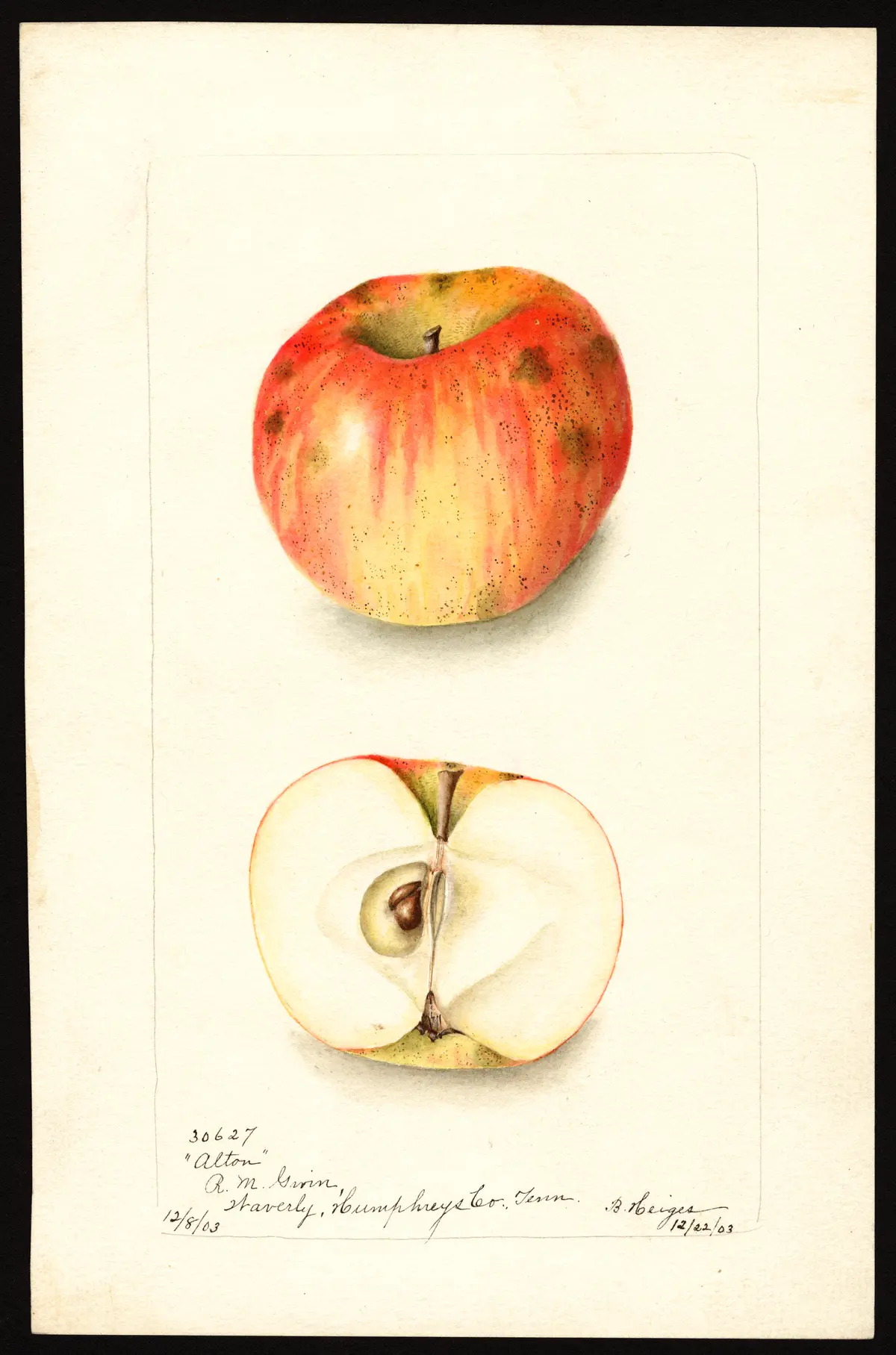
USDA Pomological Watercolor Collection
Alton
Origin / History
Alton originated from the half-sib cross Early McIntosh × Sta. 845 (Red Canada × Yellow Transparent), made in 1923. Breeding record number 23121; seedling number Station 4588. Selected in 1936 from a population of 14 seedlings. Introduced in 1938 without benefit of a second test. Named for the village of Alton in Wayne County, New York. Briefly described in the Register of New Fruit and Nut Varieties. Trees were sold by the New York State Fruit Testing Association for 17 years, 1938–54; in 1960–68 no commercial nursery sold them. Tested in 1954 at experiment stations in Massachusetts, Nova Scotia, and Oregon; in 1963 at stations in Illinois, New York, Pennsylvania, and Wyoming; in 1968 at stations in New York, North Carolina, and Pennsylvania. In Iowa, trees produced medium yields; fruits small and pale red; of poor commercial value. Not recommended for planting.
Tree
Tree medium sized to large, vigorous, upright spreading, unproductive, alternate in bearing. Trunk stocky; bark medium smooth, reddish, with distinctly grayish scarfskin. Twigs slender, long, glabrous. Leaves numerous, medium sized, medium in width and length, oval, taper pointed, medium in thickness, rugose, dark green, pubescent, margins crenate. Blossoms early, about 1½ days before Delicious. Diploid; pollen viable.
Fruit
Size: Medium, usually 2½ to 2¾ inches in diameter. Fruits drop readily after maturing.
Form: Roundish, symmetrical.
Stem: Long and slender.
Cavity: Acute, rather shallow, narrow to medium in width, usually russeted, symmetrical.
Calyx: Closed, small; lobes short, narrow, acute. Calyx tube short, narrow, conical; stamens median.
Basin: Shallow, rather narrow, obtuse, slightly furrowed, slightly corrugated.
Skin: Medium thick, tender, smooth, dull, covered with bloom. Color 80 per cent red, striped and somewhat splashed; a rather dark shade of red, somewhat dull with slight scarfskin, but generally rather attractive.
Dots: Numerous, small, light brown russet, rather obscure.
Flesh and flavor: Flesh nearly white with the outer third pink, especially in fully ripe fruits; soft, fine grained, tender, somewhat dry when fully ripe. Flavor subacid, aromatic; quality good. Overripe fruits split open.
Core and seeds: Core large and open; carpels round. Seeds medium sized, medium in width, plump, acute.
Season
Ripens at Geneva, New York, on average August 15, 8 weeks before Delicious; about 90 days from full bloom to harvest, 55 days fewer than Delicious. In Iowa it ripened 8 weeks before Jonathan. Very poor keeping quality, with an estimated storage life of 20 days.
Uses
A fresh market type. Probably inferior to Early McIntosh and Puritan, which ripen at about the same season.
Subtypes / Variants
Not described in source.
Other
Not described in source.
Book Sources
Described in 1 period pomological work
View original book sources (1)
— Roger D. Way, Apple Cultivars Introduced by the New York State Agricultural Experiment Station, 1914–1968 (1971)Alton
Origin. Alton originated from the half sib cross, Early McIntosh x Sta. 845 (Red Canada x Yellow Transparent), made in 1923 (see Early McIntosh). The breeding record number was 23121, and the seedling number was Station 4588. It was selected in 1936 from a population of 14 seedlings. Alton was introduced in 1938 (Table 2) without benefit of a second test. It was named for the village of Alton in Wayne County, New York. Alton was briefly described in the Register of New Fruit and Nut Varieties (31).
Tree. The tree characteristics of Alton are summarized in Table 5. The tree is medium sized to large, vigorous, upright spreading, unproductive, and alternate in its bearing habit. The tree trunk is stocky. The trunk bark is medium smooth and reddish, with distinctly grayish scarfskin. The twigs are slender, long, and glabrous. The leaves are numerous, medium sized, medium in width and length, oval, taper pointed, medium in thickness, rugose, dark green, pubescent, and with crenate margins. Alton blossoms early, about 1½ days before Delicious (Table 6). It is diploid (Table 4), and the pollen is viable.
Fruit. Alton fruits are illustrated in Figure 1. The fruit characteristics are summarized in Table 8. The average ripening date at Geneva, New York is August 15, 8 weeks before Delicious (Table 7). The average number of days from full bloom to harvest is 90, 55 days fewer than Delicious. The fruits drop readily after they mature. They are medium sized, usually 2 1/2 to 2 3/4 inches in diameter. They are roundish and symmetrical. The stem is long and slender. The cavity is acute, rather shallow, narrow to medium in width, usually russeted, and symmetrical. The calyx is closed and small. The calyx lobes are short, narrow, and acute. The basin is shallow, rather narrow, obtuse, slightly furrowed, and slightly corrugated.
Figure 1.--Alton.
The skin is medium thick, tender, smooth, dull, and covered with bloom. The skin color is 80 per cent red, striped, and somewhat splashed. The color is a rather dark shade of red, somewhat dull with slight scarfskin, but generally rather attractive. The dots are numerous, small, light brown russet, and rather obscure. The calyx tube is short, narrow, and conical. The stamens are in a median location. The core is large and open. The carpels are round. The seeds are medium sized, medium in width, plump, and acute.
The flesh is nearly white with the outer third pink, especially in fully ripe fruits. The flesh is soft, fine grained, tender, and somewhat dry when fully ripe. The flavor is subacid, aromatic, and the quality is good. Overripe fruits split open. Alton is a fresh market type. It probably is inferior to Early McIntosh and Puritan which ripen at about the same season. Alton has very poor keeping quality, with an estimated storage life of 20 days (Table 10).
Commercial Usefulness. Trees of Alton were sold by the New York State Fruit Testing Association for 17 years, 1938-54 (Table 2). In the 1960-68 period, there were no commercial nurseries which sold trees of Alton.
In 1954, Alton was tested at experiment stations in Massachusetts, Nova Scotia, and Oregon (186). In 1963, a survey of apple clones in the United States showed that it was tested at experiment stations in Illinois, New York, Pennsylvania, and Wyoming (79). In 1968 (184), it was tested at experiment stations in New York, North Carolina, and Pennsylvania.
In Iowa (62), Alton trees produced medium yields. It ripened 8 weeks before Jonathan. The fruits were small and pale red. It was of poor commercial value.
Alton is not recommended for planting.