Parry's White
Apple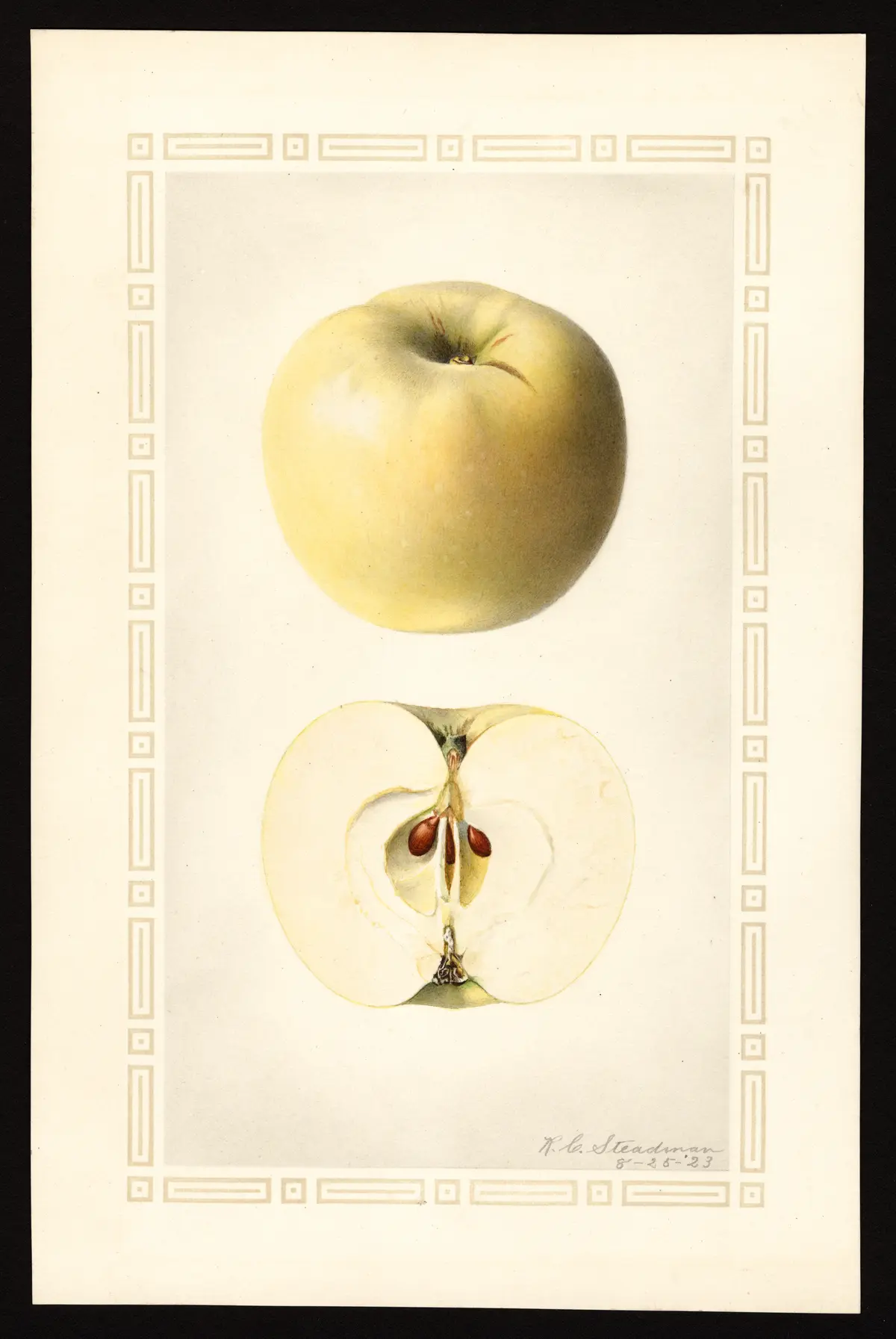
USDA Pomological Watercolor Collection
Parry's White
Origin/History
Of unknown origin, supposed to have originated in Pennsylvania, possibly about the close of the Civil War. It was first described by Downing in 1872. Its culture has been confined chiefly to Pennsylvania, New Jersey, and Delaware. The variety is occasionally listed by nurserymen but had not yet become known to any considerable extent in New York as of the early twentieth century. It is worthy of trial where an apple of its type is desired.
Tree
The tree is of medium size and moderately vigorous. Downing describes it as vigorous, upright, with a compact head; Beach describes the form as at first upright spreading, becoming roundish and somewhat drooping after bearing full crops, dense. In spite of its remarkable productiveness it makes a pretty good growth. It is a regular, annual bearer and very productive, coming into bearing young and yielding good to very heavy crops.
Twigs: Short, curved, stout, with large terminal buds; internodes short. Bark brown tinged with olive-green, lightly streaked with scarf-skin; slightly pubescent near tips.
Lenticels: Quite numerous, rather conspicuous, medium size, round, not raised.
Buds: Medium to large, plump, obtuse, free, pubescent.
Fruit
Size and Form
Fruit usually medium in size, but varies according to the abundance of the crop from below medium to rather large; quite uniform in size and shape. Downing describes the form as roundish oblate, slightly conic. Beach describes it as nearly globular, varying to somewhat oblate or slightly inclined to ovate, quite regular. Hedrick similarly gives globular, oblate, or ovate, regular. The fruit is quite attractive in appearance for an apple of its class.
Stem
Stem short (Downing); above medium to rather short, slender (Beach); short, slender (Hedrick).
Cavity
Slightly acuminate, medium to shallow in depth, medium in width, smooth, symmetrical (Beach). Downing describes the cavity as large and deep. Hedrick gives acuminate, medium in depth and width, smooth, symmetrical.
Calyx
Calyx small, closed. Lobes medium in length, narrow, acute.
Basin
Very shallow, moderately narrow to rather broad (Beach); narrow to broad (Hedrick); obtuse, smooth or slightly wrinkled (Beach) / smooth or wrinkled (Hedrick), symmetrical. Downing describes the basin as rather shallow and a little uneven.
Skin
Moderately thick, rather tough (Beach); thick, tough (Hedrick). Waxen yellowish-white or greenish (Beach); pale waxen-yellow (Hedrick); whitish, smooth (Downing). Occasionally blushed or, per Downing, sometimes showing a slight tinge of red in the sun. The coloring of the skin — pale yellow or waxen — is described by Hedrick as unique for the variety.
Dots: Medium size to very small (Beach); small (Hedrick); pale or brown (Beach); pale (Hedrick); numerous, depressed.
Flesh and Flavor
Flesh white, pure white (Hedrick). Quite firm, rather fine, tender, juicy, subacid, good in quality for either dessert or culinary use. Downing further notes the flesh as crisp and very tender. The white coloring of the flesh is described by Hedrick as unique to the variety.
Core and Seeds
Calyx tube: Short, narrow, funnel-shape.
Stamens: Marginal to median (Beach); marginal (Hedrick).
Core: Medium to small (Beach); small (Hedrick); abaxile; cells open; core lines meeting or slightly clasping (Beach) / meeting or clasping (Hedrick).
Carpels: Round, emarginate.
Seeds: Medium or above, acute or inclined to obtuse (Beach); acute (Hedrick); light brown.
Season
Ripens late August or early September, continuing in use into or through October. Described as following Yellow Transparent in season. Downing gives the season simply as August.
Uses
Table, cooking, and market (Downing). Good in quality for either dessert or culinary use (Beach).
Subtypes/Variants
Not described in source.
Other
Not described in source.
Book Sources
Described in 3 period pomological works
- Beach, The Apples of New York Vol. 2 (1905) — listed as PARRY WHITE
- Downing, Fruits and Fruit Trees of America (1900)
- Hedrick, Cyclopedia of Hardy Fruits (1922) — listed as PARRY WHITE
Nursery Catalog Sources
Found in 2 catalogs (1901–1913) from Illinois
- Benjamin Buckman (personal inventory) , Farmingdale , Illinois — 1901
- Benjamin Buckman (personal inventory) , Farmingdale , Illinois — 1913
View original book sources (3)
— A.J. Downing, The Fruits and Fruit Trees of America (1900)Parry's White.
Imperial White. Superior White. White Apple.
Of unknown origin, supposed to be Pennsylvania. Tree vigorous, upright, compact head, a regular bearer, and very productive; use, table, cooking, and market.
Fruit medium or below, roundish oblate, slightly conic; skin smooth, whitish, sometimes a slight tinge of red in the sun; stalk short, small; cavity large, deep; calyx closed; basin rather shallow, a little uneven; flesh fine, white, crisp, very tender, juicy, subacid; good. August.
— S.A. Beach, The Apples of New York, Vol. 2 (1905)PARRY WHITE.
REFERENCES. 1. Downing, 1872:25 app. 2. Bailey, An. Hort., 1892:246. 3. Beach, N. Y. Sta. An. Rpt., 14:263. 1895. 4. Beach and Clark, N. Y. Sta. Bul., 248:137. 1904.
SYNONYMS. Imperial White (1). PARRY WHITE (1, 2, 3, 4). Superior White (1). White Apple (1).
Fruit pale yellow or whitish, waxen, of medium size; quite attractive in appearance for an apple of its class. The flesh is white, juicy, subacid, good in quality for either dessert or culinary use. It follows Yellow Transparent in season, beginning to ripen late in August or early in September and continuing in use into or through October (4). The tree comes into bearing young and is an annual cropper, yielding good to very heavy crops. In spite of its remarkable productiveness it makes a pretty good growth. It is worthy of trial where an apple of its type is desired.
Historical. Origin unknown. It is supposed to be a Pennsylvania apple. It is occasionally listed by nurserymen (2). It has not yet become known to any considerable extent in New York.
TREE.
Tree of medium size and moderately vigorous. Form at first upright spreading but after bearing full crops it becomes roundish and somewhat drooping; dense. Twigs short, curved, stout with large terminal buds; internodes short. Bark brown tinged with olive-green, lightly streaked with scarf-skin; slightly pubescent near tips. Lenticels quite numerous, rather conspicuous, medium size, round, not raised. Buds medium to large, plump, obtuse, free, pubescent.
FRUIT.
Fruit usually medium but varies according to the abundance of the crop from below medium to rather large; quite uniform in size and shape. Form nearly globular varying to somewhat oblate or slightly inclined to ovate, quite regular. Stem above medium to rather short, slender. Cavity slightly acuminate, medium to shallow, medium in width, smooth, symmetrical. Calyx small, closed; lobes medium in length, narrow, acute. Basin very shallow, moderately narrow to rather broad, obtuse, smooth or slightly wrinkled, symmetrical. Skin moderately thick, rather tough, waxen yellowish-white or greenish, occasionally blushed. Dots medium size to very small, pale or brown, numerous, depressed. Calyx tube short, narrow, funnel-shape. Stamens marginal to median. Core medium to small, abaxile; cells open; core lines meeting or slightly clasping. Carpels round, emarginate. Seeds medium or above, acute or inclined to obtuse, light brown. Flesh white, quite firm, rather fine, tender, juicy, subacid, good. Season very late August into or through October.
— U.P. Hedrick, Cyclopedia of Hardy Fruits (1922)PARRY WHITE. Imperial White. Superior White. White Apple.
The fruit of Parry White is unique in the coloring of both skin and flesh, the former being pale yellow or waxen and the latter pure white. The crop ripens early, following Yellow Transparent closely. The variety does not come up to the mark now set for apples, and will probably never be largely grown. It is supposed to have originated in Pennsylvania about the close of the Civil War, and its culture is confined to that state, New Jersey, and Delaware. It was first described by Downing in 1872.
Tree of medium size and vigor, upright-spreading, somewhat drooping, dense. Fruit medium to large, uniform in size and shape, globular, oblate or ovate, regular; stem short, slender; cavity acuminate, medium in depth and width, smooth, symmetrical; calyx small, closed; lobes narrow, acute; basin very shallow, narrow to broad, obtuse, smooth or wrinkled, symmetrical; skin thick, tough, pale waxen-yellow, occasionally blushed; dots small, pale, numerous, depressed; calyx-tube short, narrow, funnel-shape; stamens marginal; core small, abaxile; cells open; core-lines meeting or clasping; carpels round, emarginate; seeds acute, light brown; flesh white, firm, fine, tender, juicy, subacid; good; late August through October.