Hawthornden
Apple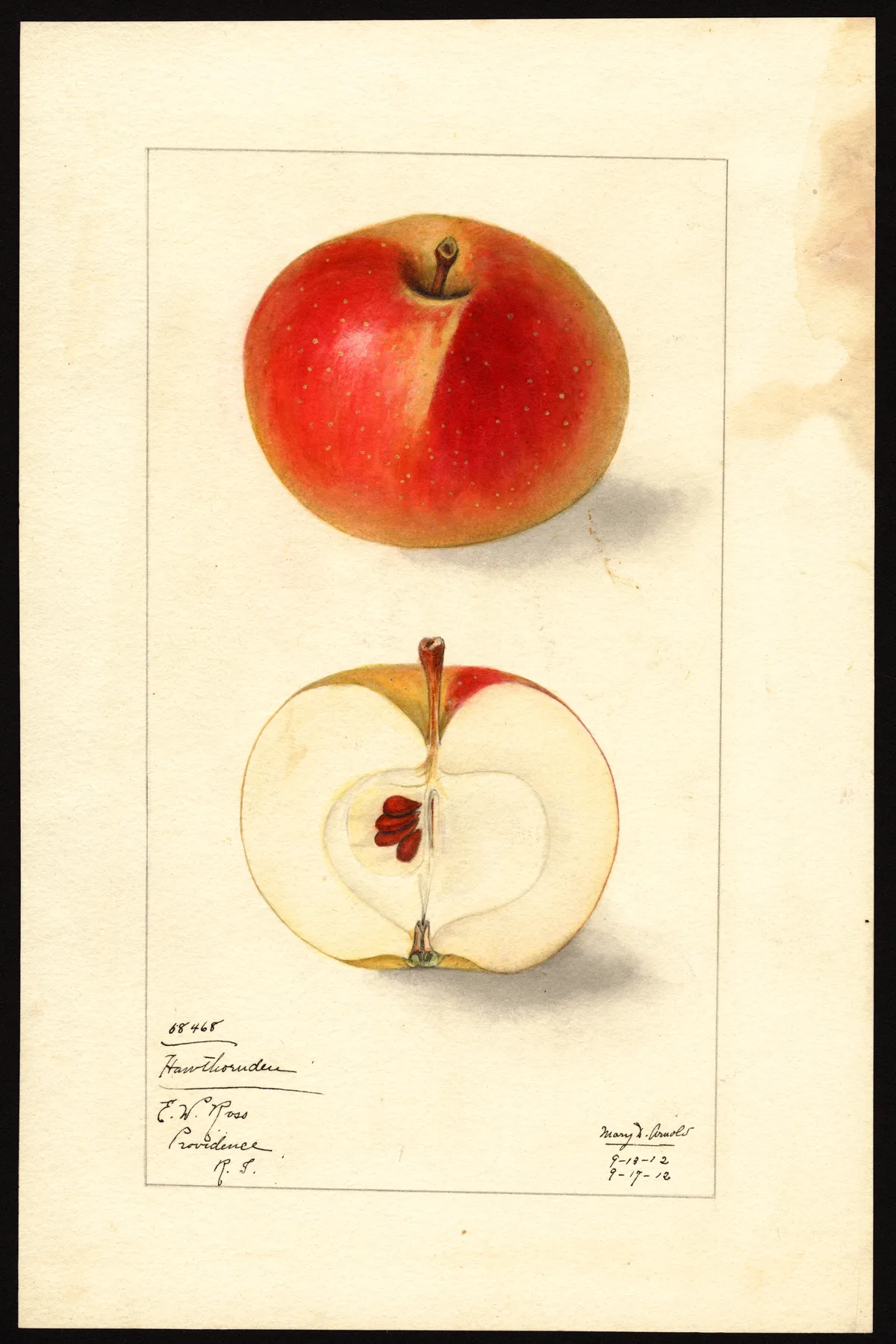
USDA Pomological Watercolor Collection
Hawthornden
Origin / History
Hawthornden was raised at Hawthornden, a village said to lie eight or ten miles south of Edinburgh, Scotland — a romantic spot best known as the birthplace of the poet Drummond (born 1585). The exact period when this apple was first produced is not known. It is first mentioned in the catalogue of Leslie and Anderson of Edinburgh, but was not known about London until 1790, when it was introduced into the Brompton Park Nursery (Herefordshire Pomona). Bunyard dates its origin to "before 1790." Lindley (1841) calls it "the best Apple in Scotland," though notes it is apt to canker in that country. Warder (1867) and Downing (1900) both observe that in America it must yield the palm to its representative cousin, the Maiden's Blush, which possesses its good qualities as a market and kitchen fruit with more attractive appearance — Elliott similarly judges it "not equal to Maiden's Blush." Beach (1905) records that the variety has done fairly well in various parts of the United States from New England to California, but is little known among New York fruit growers, though still occasionally listed by nurserymen. The Herefordshire Pomona (1885) notes that Hawthornden has long been one of the most valuable and popular apples in cultivation, though in later years in some situations it has lost condition and produced only small and diseased fruit, as if it had exhausted the soil of its own particular requirements.
Tree
Vigorous, upright, spreading (Downing); spreading, vigorous, and productive (Warder); always considered very healthy and vigorous, and unrivalled as an early and abundant bearer (Herefordshire Pomona); a vigorous grower and a biennial cropper (Beach); growth moderate, fertility medium (Bunyard). One of the most abundant bearers known, and an early bearer; when in bearing, the habit becomes somewhat pendulous because the extreme buds of the branches are mostly blossom-buds, so the ends become pendulous when the crop is fully grown (Lindley, Downing). Bunyard describes it as making a dwarfish flat tree.
Wood / shoots: Young shoots very short-jointed; Lindley describes the wood as light chestnut colour, downy, with small white specks; Downing describes the young shoots as dull reddish brown. Buds prominent (Downing).
Leaves: Oval, taper-pointed, regularly serrated, with small stipulæ (Lindley); very pale, nearly flat, rather large, shallow serrate (Bunyard).
Flowers: Middle-sized, with bright, rose-coloured, roundish, cordate petals (Lindley).
Fruit
Size: Large (Lindley, Warder); above medium (Elliott); rather above the medium size (Downing); above medium to large (Beach); medium (Lowther); medium, 3 by 2¼ inches (Bunyard). The Herefordshire Pomona notes that the fruit varies very much in size according to soil, situation, or condition of the tree, but is generally above medium.
Form: Flattish, irregularly shaped, one side being larger than the other (Lindley); roundish flattened (Elliott); regular and very flat (Warder); roundish and depressed, with occasionally a prominent rib on one side which produces an irregularity in its appearance (Herefordshire Pomona); pretty regularly formed, roundish, rather flattened (Downing); regular, fair (Beach); roundish (oblate) (Lowther); round, slightly flattened, irregular (Bunyard).
Stem / Stalk: Half an inch long (Lindley); medium (Warder); short, stout, and sometimes fleshy, inserted in a deep and irregular cavity (Herefordshire Pomona); short and very stout, in a rather deep cavity (Bunyard).
Cavity: Wide, wavy, green (Warder); deep and irregular (Herefordshire Pomona); rather deep (Bunyard).
Calyx / Eye: A little depressed (Lindley); small, closed (Warder); small and closed, with broad and flat segments (Herefordshire Pomona); closed, in a moderately deep and ribbed basin (Bunyard).
Basin: Shallow, narrow, regular (Warder); pretty deep and irregular (Herefordshire Pomona); moderately deep and ribbed (Bunyard).
Skin: Clear, greenish yellow, reddish on the side next the sun (Lindley); pale yellow, blush in sun (Elliott); surface perfectly smooth, always fair, of a beautiful white, very rarely and faintly blushed; dots minute (Warder); smooth, covered with a delicate bloom, greenish yellow, with a blush of red on one side which varies in extent and colour according as it has been more or less exposed to the sun (Herefordshire Pomona); very smooth, pale light yellow, nearly white in the shade, with a fine blush where exposed to the sun (Downing); white, sometimes nearly overspread with faint blush that deepens to bright red in the sun (Beach); greenish yellow (Lowther); creamy-yellow with faint red flush (Bunyard).
Flesh / Flavor: White (Lindley, Downing); white, acid (Elliott); greenish-white, breaking, fine grained, juicy; flavor acid, aromatic (Warder); white, crisp and tender, very juicy, with an agreeable and pleasant flavour (Herefordshire Pomona); white, juicy, of a simple, pleasant flavor; good (Downing); mild subacid, not of high flavor, pleasant, good (Beach); tender, white, sub-acid (Bunyard). Lindley describes the juice as plentiful, sweet and pleasant. Warder rates it second quality for table but first rate for cooking. Quality good (Lowther).
Core / Seeds: Core wide, regular, somewhat open, meeting the eye; seeds numerous, angular, imperfect, brown (Warder).
Season
October, keeping good about a month or six weeks (Lindley); October–November (Elliott); September (Downing); October (Warder); in season October to December (Herefordshire Pomona, Bunyard); September and October (Beach); early autumn (Lowther).
Uses
Kitchen and market (Warder); kitchen use only — "suitable only for kitchen use" (Herefordshire Pomona); good for cooking or drying, and exceedingly profitable for market (Downing); both kitchen and market (Lowther); culinary — "one of the best cooking sorts" (Bunyard). Warder judges it of second quality for table but first rate for cooking.
Subtypes / Variants
Downing notes: "There is a New, or winter Hawthornden, the wood of which is brownish red, the tree more robust, the fruit larger, and a longer keeper than the above."
Other
Lowther's regional reporting: Northern Division reports 5* (also reported in another division); Central Division reports 6* (also reported in another division). Beach records that Lyon (1890) and Bailey (1892) listed it among nursery offerings, though it remained little known among New York fruit growers by the time of his writing.
Book Sources
Described in 9 period pomological works
- Warder, American Pomology: Apples (1867)
- Downing, Fruits and Fruit Trees of America (1900)
- Beach, The Apples of New York Vol. 2 (1905)
- Bunyard, A Handbook of Hardy Fruits (1920)
- Elliott, The Western Fruit Book (1865)
- Lowther (ed.), Encyclopedia of Practical Horticulture (1914)
- The Herefordshire Pomona (1876–1885)
- Lindley, Pomologia Britannica Vol. 1 (1841) — listed as The Hawthornden Apple
- Thomas, The American Fruit Culturist (1903) — listed as White Hawthornden
Nursery Catalog Sources
Found in 3 catalogs (1901–1913) from England, Illinois
- Benjamin Buckman (personal inventory) , Farmingdale , Illinois — 1901 — listed as Mountaineer
- James Veitch & Sons , Ltd., Royal Exotic Nursery, Chelsea, London (also Coombe Wood, Langley, and Feltham) , England — 1911
- Benjamin Buckman (personal inventory) , Farmingdale , Illinois — 1913 — listed as Mountaineer
View original book sources (9)
— John Lindley, Pomologia Britannica, Vol. 1 (1841)34
THE HAWTHORNDEN APPLE.
Hawthornden. Hort. Soc. Fruit Cat. no. 440. White Hawthornden. Nicol's Fruit Gardener, p. 256.
This valuable variety is said to have been originally raised eight or ten miles south of Edinburgh, in the village, the name of which it bears, which is better known as the birth-place of the poet Drummond. It is one of the most abundant bearers we have; and as the extreme buds of the branches are mostly blossom-buds, the ends become pendulous when the crop of fruit is fully grown. Ripens in October, and will keep good about a month or six weeks.
WOOD short-jointed, of a light chestnut colour, downy, with small white specks.
LEAVES oval, taper-pointed, regularly serrated, with small stipulæ.
FLOWERS middle-sized, with bright, rose-coloured, roundish, cordate petals.
FRUIT large, flattish, irregularly shaped, one side being larger than the other.
STALK half an inch long.
EYE a little depressed.
SKIN clear, greenish yellow, reddish on the side next the sun.
FLESH white.
JUICE plentiful, sweet and pleasant.
This is reckoned the best Apple in Scotland; but it is apt to canker in that country.
— F.R. Elliott, The Western Fruit Book (1865)Hawthornden. White Hawthornden, | Mountaineer. Foreign. Above medium, roundish flattened, pale yellow, blush in sun ; flesh, white, acid. October, November. Not equal to Maiden's Blush.
— John A. Warder, American Pomology: Apples (1867)Fig. 76.—HAWTHORNDEN.
Hawthornden.
This famous Scotch fruit appears to do very well in this country, but it must yield the palm to its American cousin and representative, the Maiden's Blush, which possesses all its good qualities as a market and kitchen fruit, with attractive appearance.
Tree spreading, vigorous and productive; an early bearer.
Fruit large, regular, and very flat; Surface perfectly smooth, always fair, and of a beautiful white, very rarely and faintly blushed; Dots minute.
Basin shallow, narrow, regular; Eye small, closed.
Cavity wide, wavy, green; Stem medium.
Core wide, regular, somewhat open, meeting the eye; Seeds numerous, angular, imperfect, brown; Flesh greenish-white, breaking, fine grained, juicy; Flavor acid, aromatic; of second quality for table, but first rate for cooking; Uses, kitchen and market; Season October.
— Woolhope Naturalists Field Club, The Herefordshire Pomona (1885)
- HAWTHORNDEN.
[Syn: Hawthorndean; White Hawthorndean; Red Hawthorndean.]
This variety was raised at Hawthornden, a romantic spot near Edinburgh, where Drummond the poet was born in 1585. The period when this apple was first produced is not known. It is first mentioned in the catalogue of Leslie and Anderson of Edinburgh; but was not known about London until 1790, when it was introduced into the Brompton Park Nursery.
Description.—Fruit; varying very much in size according to the soil, situation, or condition of the tree, generally above medium size, roundish and depressed, with occasionally a prominent rib on one side which produces an irregularity in its appearance. Skin; smooth, covered with a delicate bloom, greenish yellow, with a blush of red on one side which varies in extent and colour according as it has been more or less exposed to the sun. Eye; small and closed, with broad and flat segments, placed in a pretty deep and irregular basin. Stalk; short, stout, and sometimes fleshy, inserted in a deep and irregular cavity. Flesh; white, crisp and tender, very juicy, with an agreeable and pleasant flavour.
The Hawthornden has long been one of the most valuable and popular apples in cultivation. It is suitable only for kitchen use, and is in season from October to December.
The tree has always been considered as very healthy and vigorous, and unrivalled as an early and abundant bearer, but of late years in some situations it has lost its condition and only produced small and diseased fruit, as if it had exhausted the soils of its own particular requirements.
— A.J. Downing, The Fruits and Fruit Trees of America (1900)Hawthornden.
White Hawthornden.
A celebrated Scotch Apple, which originated at Hawthornden, the birthplace of the poet Drummond. It resembles, somewhat, our Maiden's Blush, but is inferior to that fruit in flavor. An excellent bearer, a handsome fruit, and good for cooking or drying, and exceedingly profitable for market.
Tree vigorous, upright, spreading, and, when in bearing, somewhat pendulous. Young shoots very short-jointed, dull reddish brown. Buds prominent.
Fruit rather above the medium size, pretty regularly formed, roundish, rather flattened. Skin very smooth, pale light yellow, nearly white in the shade, with a fine blush where exposed to the sun. Flesh white, juicy, of a simple, pleasant flavor. Good. September.
There is a New, or winter Hawthornden, the wood of which is brownish red, tree more robust, the fruit larger, and a longer keeper than the above.
— John J. Thomas, The American Fruit Culturist (1903)White Hawthornden. See Hawthornden.
— S.A. Beach, The Apples of New York, Vol. 2 (1905)HAWTHORNDEN.
REFERENCES. 1. Hooker, Pom. Lond., 1813:T. 44 (cited by 2). 2. Forsyth, 1824:106. 3. Pom. Mag., 1828:No. 34. col. pl. 4. London Hort. Soc. Cat., 1831:No. 530. 5. Mag. Hort., 1:326. 1835. 6. Manning, 1838:48. 7. Ib., Mag. Hort., 7:45. 1841. 8. Downing, 1845:86. 9. Cole, 1849:113. 10. Hovey, Mag. Hort., 17:18. 1851. fig. 11. Barry, 1851:284. 12. Emmons, Nat. Hist. N. Y., 3:40. 1851. 13. Mag. Hort., 19:174. 1853. 14. Elliott, 1854:171. 15. Gregg, 1857:43. 16. Hooper, 1857:43. 17. Am. Pom. Soc. Cat., 1862. 18. Warder, 1867:410. fig. 19. Leroy, 1873:376. fig. 20. Thomas, 1875:501. 21. Montreal Hort. Soc. Rpt., 1:10. 1876. 22. Ib., 5:24. 1879. 23. Hogg, 1884:105. 24. Rural N. Y., 45:233. 1886. figs. 25. Lyon, Mich. Hort. Soc. Rpt., 1890:292. 26. Bailey, An. Hort., 1892:241. 27. Gaudier, 1894:No. 13. col. pl. 28. Dempsey, Out. Fr. Stas. An. Rpt., 1:24. 1894. fig. 29. Bunyard, Jour. Roy. Hort. Soc., 1898:354.
SYNONYMS. Hawley (27) but erroneously. HAWTHORNDEAN (2, 6, 7). Hau'thorndean (23). HAWTHORNDEN (1, 3, 4, 5, 8, 9, 10, 11, 12, 13, 14, 15, 16, 17, 18, 19, 20, 21, 22, 23, 24, 25, 26, 27, 28, 29). Lincolnshire Pippin (27). Lord Kingston (27). Maiden's Blush erroneously (10). Old Hawthorndean (23, 27). Pomme de Hawthornden (27). Red Hawthornden (10). Shoreditch White (27). Weisser Hawthornden (27). Wheeler's Kernel (27). White Apple (27). White Hawthorndean (23, 27). White Hawthornden (3, 4, 8, 10, 12, 14).
A Scotch variety which has done fairly well in various parts of this country from New England to California. Warder (18) says of it: "This famous Scotch fruit appears to do very well in this country, but it must yield the palm to its American cousin and representative, the Maiden's Blush, which possesses all its good qualities as a market and kitchen fruit, with attractive appearance."
The tree is said to be a vigorous grower and a biennial cropper, and the fruit is above medium to large, regular, fair, white sometimes nearly overspread with faint blush that deepens to bright red in the sun. Flesh mild subacid, not of high flavor, pleasant, good. Season September and October.
We are not acquainted with this variety. It appears to be but little known among New York fruit growers. It is still occasionally listed by nurserymen (26).
— Granville Lowther (ed.), Encyclopedia of Practical Horticulture (1914)Hawthornden: size medium; form roundish (oblate); color greenish yellow; quality good; use both kitchen and market; season early autumn; Northern Division reports 5* (also reported in another division); Central Division reports 6* (also reported in another division).
— E.A. Bunyard, A Handbook of Hardy Fruits (1920)HAWTHORNDEN. Her. Pom., 6. (Hawley, Lincolnshire Pippin, Old Hawthornden.) Culinary, October to December, medium, 3 by 2¼, round, slightly flattened, irregular. Colour, creamy-yellow with faint red flush. Flesh, tender, white, sub-acid. Eye, closed, in a moderately deep and ribbed basin. Stem, short and very stout in a rather deep cavity. Growth, moderate; fertility medium. Leaf, very pale, nearly flat, rather large, shallow serrate. Origin, raised at Hawthornden, Scotland before 1790. One of the best cooking sorts, making a dwarfish flat tree.