Wolf River
Apple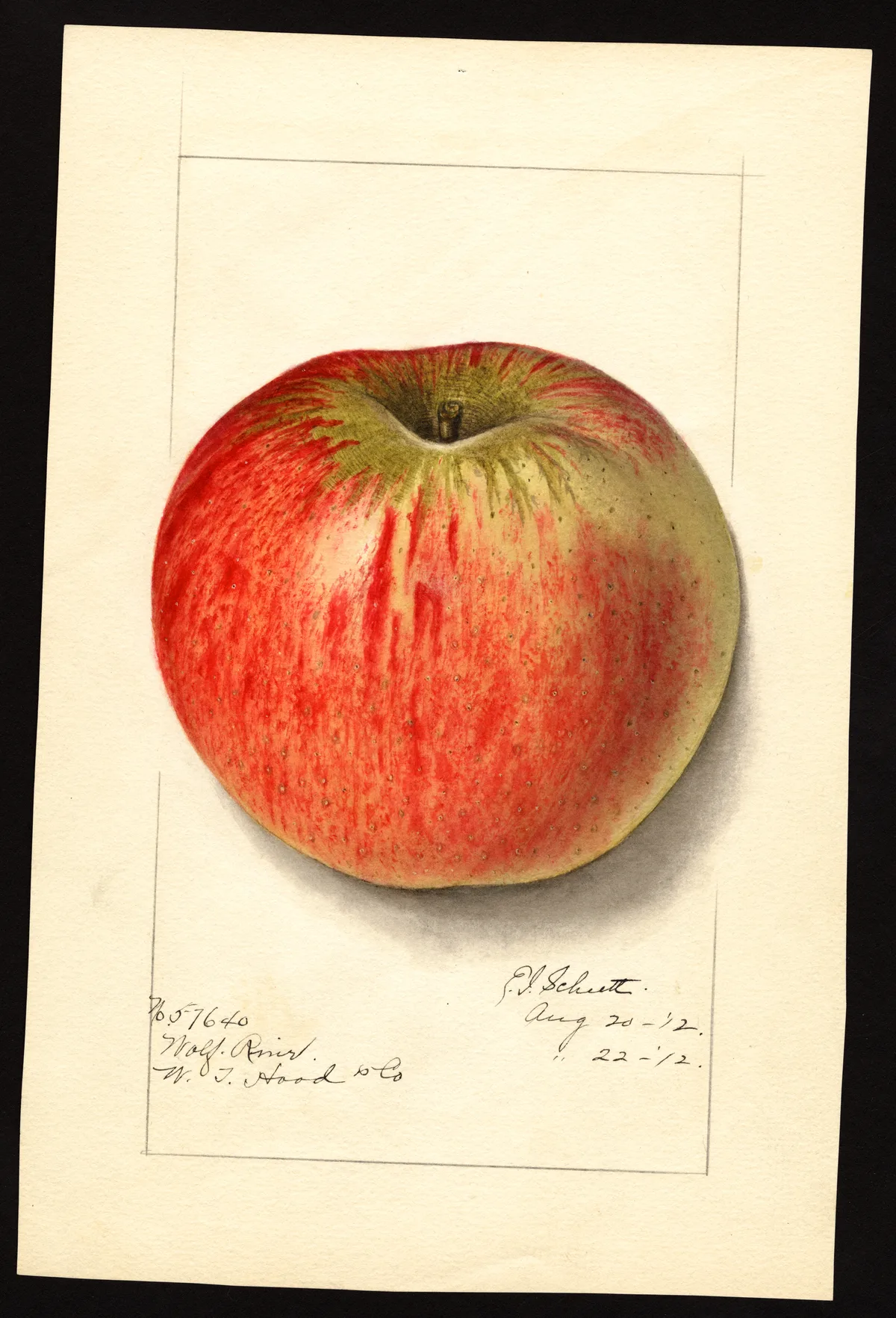
USDA Pomological Watercolor Collection
Wolf River
Origin / History
Originated with W. A. Springer on his farm near the east bank of the Wolf River, Fremont, Wisconsin, and disposed of before fruiting to the late Henry Riflen (Downing; Hansen; Budd-Hansen). Hedrick gives the place simply as Wolf River, Wisconsin, and notes the variety was first described in 1875. Supposed to be a seedling of Alexander, which it somewhat resembles (Downing, Hansen, Budd-Hansen, Hedrick); Beach classes it as a variety of the Aport group. Compared to Alexander, Hansen and Budd-Hansen report it is more round and less conical and averages larger as grown in the West, and that Wolf River has largely superseded Alexander in the western states; Hedrick concurs that in the West many prefer the tree and fruit to Alexander, while in the East they do not. Downing notes it is not usually so large nor so regular in form as Alexander, darker in color, and rather better in quality. Thomas calls it "Valuable in the Northwest." References to it appear in pomological literature from 1875 onward (Beach cites Wis. Hort. Soc. Rpt. 1875, and a long list of subsequent reports and bulletins through 1904).
Tree
Very hardy (Downing; Hedrick — "very hardy and thrifty"). A strong, vigorous, spreading grower (Downing; Hansen; Budd-Hansen; Central Experimental Farm — "vigorous grower"); Hedrick describes it as large, vigorous, spreading, open, drooping. With large thick leaves (Downing). Not an early bearer (Downing; Hansen; Budd-Hansen). Productive in alternate years / producing full crops on alternate years (Downing; Hansen; Budd-Hansen); Hedrick gives the bearing as "only moderately productive."
Fruit
Size: Large to very large, often enormous (Downing — "large to very large"; Hansen and Budd-Hansen — "very large, often enormous"; Central Experimental Farm and Thomas — "very large"; Hedrick — "very large"; Lowther — "large"). Hedrick notes the fruit is uniform in size and shape.
Form: Oblate to roundish oblate, slightly angular; some of the larger specimens uneven and irregular, but those of average size are regular (Downing). Hansen and Budd-Hansen: roundish to roundish oblate, somewhat irregular and angular, especially when overgrown. Central Experimental Farm: roundish, oblate. Thomas: round oblate, regular, smooth. Hedrick: broad and flat at the base, conic or round, often irregular. Lowther: roundish (oblate).
Stem / Stalk: Very short, quite small (Downing); short (Hansen; Budd-Hansen); short, stout (Thomas); short, thick, not exserted (Hedrick).
Cavity: Rather large, greenish, sometimes much russetted (Downing); regular, deep, somewhat acuminate, medium width, russeted (Hansen; Budd-Hansen); deep, wide, very russet (Thomas); acuminate, deep, wide, heavily russeted (Hedrick).
Calyx / Eye: Open, or nearly so (Downing); half open (Hansen; Budd-Hansen); eye medium, open, segments reflexed (Thomas); large, open or closed (Hedrick). Calyx-tube conical (Hedrick); tube conical (Hansen; Budd-Hansen). Stamens median (Hansen; Budd-Hansen; Hedrick).
Basin: Large, very deep, a little uneven (Downing); narrow, abrupt, wavy (Hansen; Budd-Hansen); shallow, small (Thomas); deep, narrow, abrupt, usually smooth, broadly furrowed (Hedrick).
Skin: Pale greenish yellow, becoming whitish when mature, shaded with light and dark red or crimson where fully exposed, with a thin whitish bloom and a few light dots (Downing). Surface whitish yellow, almost wholly covered with bright red and rosy crimson, with carmine splashes and thin whitish bloom — "a very handsome fruit"; dots white, obscure (Hansen; Budd-Hansen). Yellowish white, splashed with bright red; dots large, scattering, light gray (Thomas). Yellowish white, with light and dark red over nearly the whole surface (Central Experimental Farm). Thick, pale yellow, mottled and blushed with bright, deep red and marked with conspicuous splashes and broad stripes of bright carmine; dots numerous, large, areolar, depressed, pale or russet (Hedrick). Color reported simply as red (Lowther).
Flesh / Flavor: White, rather coarse, half tender, juicy, pleasant, mild subacid, with a peculiar spicy, slight quince-like flavor (Downing). Whitish, coarse grained, moderately juicy, pleasant subacid, good only (Hansen; Budd-Hansen). White, juicy, rather coarse, mildly acid (Central Experimental Farm). Yellowish white, coarse, tender, dry when ripe, sub-acid, not rich, medium quality only (Thomas). White tinged with yellow, firm, coarse, tender, juicy, subacid, aromatic; fair to good (Hedrick). Quality reported as good (Lowther).
Core / Seeds: Core medium (Downing). Core open, clasping, medium size; cells roundish ovate, slit (Hansen) / cells rounded, ovate, slit (Budd-Hansen); seeds not many, short, plump (Hansen; Budd-Hansen). Core large, abaxile; cells closed or partly open; core-lines clasping; carpels broadly cordate, emarginate, tufted; seeds dark brown, wide, short, plump, obtuse (Hedrick).
Season
Downing: October, November. Central Experimental Farm: November and December. Hansen and Budd-Hansen: October to midwinter. Hedrick: September to December. Thomas and Lowther: winter. Beach gives the season at his Station as September to December, with October as the commercial limit in ordinary storage; in cold storage it may be held till January. Beach also notes it does not stand heat well.
Uses
A good cooking apple (Central Experimental Farm). Both kitchen and market (Lowther).
Subtypes / Variants
Not described in source.
Other
Beach lists no synonyms. Lowther reports occurrence by horticultural division as "N. Div.: 1 (also reported in another division). C. Div.: 3 (also reported in another division)." Thomas references it as Fig. 447, Wisconsin; Hedrick references it as Fig. 63; Van Deman (cited by Beach) and Hansen include figures in their treatments.
Book Sources
Described in 7 period pomological works
- Beach, The Apples of New York Vol. 2 (1905)
- Budd & Hansen, Systematic Pomology (1914)
- Downing, Fruits and Fruit Trees of America (1900)
- Hansen, A Study of Northwestern Apples (1902)
- Lowther (ed.), Encyclopedia of Practical Horticulture (1914)
- Hedrick, Cyclopedia of Hardy Fruits (1922)
- Thomas, The American Fruit Culturist (1903)
Nursery Catalog Sources
Found in 40 catalogs (1891–1925) from Alabama, California, Illinois, Missouri, Nebraska, Oregon, Washington
- Missouri Nursery Co. , Louisiana , Missouri — 1891
- Puyallup & Yakima Nurseries , Puyallup, Washington (Lock Box 191) and North Yakima , Washington — 1892
- Milwaukie-Canby Nurseries , Canby, OR (and Milwaukie, OR) — 1893
- Oregon Wholesale Nurseries , Salem , Oregon — 1893
- Multnomah Nurseries , Russellville , Oregon — 1894
- The Vineland Nurseries (Kelsey & Co. , Proprietors), St. Joseph, Missouri (Office: 13th and Atchison Sts., 2 Blocks East of the Citizens St. Car Line) — 1894
- Woodburn Nurseries , Woodburn, Marion Co. , Oregon — 1894
- Cotta Nursery (J.V. Cotta) , Carroll County , Illinois — 1895
- J.V. Cotta (Cotta Nursery) , Carroll County , Illinois — 1898
- Stark Bros. Nurseries & Orchards Co. , Louisiana , Missouri — 1898
- Alabama Nursery Co. , Huntsville , Alabama — 1900
- Central Experimental Farm , Dominion Department of Agriculture, Agassiz, British Columbia (under test; Bulletin No. 3, Second Series) — 1900
- Washington Nursery Co. , Toppenish , Washington — 1901
- Benjamin Buckman (personal inventory) , Farmingdale , Illinois — 1901
- Pacific Nursery Company (W. O. Hudson & A. D. Hudson) , Tangent , Oregon — 1903
- Russellville Nursery Co. , Russellville, OR (three miles east of Portland, one mile from Montavilla car line) — 1903
- Phoenix Nursery Company (W. E. Rossney , President; Sidney Tuttle, Vice-President), Bloomington , Illinois — 1904
- The Dalles Nurseries , The Dalles , Oregon — 1906
- Stark Bros. Nurseries & Orchards Co. , Louisiana , Missouri — 1906
- J.B. Pilkington , Portland , Oregon — 1907
- Russellville Nursery Co. , Montavilla Station, Portland, OR (three miles east of Portland, one mile from Montavilla car line) — 1907
- Carlton Nursery Co. , Carlton , Oregon — 1909
- Milton Nursery Co. (A. Miller & Sons , Proprietors), Milton , Oregon — 1909
- Washington Nursery Company , Toppenish , Washington — 1909
- C.F. Lansing , Salem , Oregon — 1910
- Stark Bros. Nurseries & Orchards Co. , Louisiana , Missouri — 1910
- Galbraith Nursery Co. (DeWitt Hansen , Pres.-Mgr.), Fairbury , Nebraska — 1911
- Stark Bros. Nurseries & Orchards Co. , Louisiana , Missouri — 1911
- Ballygreen Nurseries , Hanford , Washington — 1912
- Pacific Nursery Company , Portland , Oregon — 1912
- Vineland Nurseries Company , Clarkston , Washington — 1912
- Washington Nursery Company , Toppenish , Washington — 1912
- Van Holderbeke Nursery Co. , Incorporated, Spokane, Washington (nurseries at Otis Orchards WA, Pasadena WA, Kennewick WA) — 1913
- Benjamin Buckman (personal inventory) , Farmingdale , Illinois — 1913
- Stark Bros. Nurseries & Orchards Co. , Louisiana , Missouri — 1918
- Oregon Nursery Co. , Orenco , Oregon — 1920
- Christopher Nurseries / John Stewart & Sons , Christopher , Washington — 1920
- Fresno Nursery Co. , Fresno , California — 1924
- Columbia & Okanogan Nursery Co. , Wenatchee , Washington — 1925
- North-Western Nurseries , Walla Walla , Washington
View original book sources (8)
— A.J. Downing, The Fruits and Fruit Trees of America (1900)Wolf River.
A new, large, handsome apple, the tree of which was grown by W. A. Springer, and disposed of before fruiting to the late Henry Riflen, near the east bank of Wolf River, Fremont, Wis.; supposed to be a seedling of the Alexander, which it somewhat resembles; not usually so large nor so regular in form, darker in color, and rather better in quality. The tree is said to be very hardy; a strong, vigorous grower, spreading, with large thick leaves; not an early bearer, but producing full crops on alternate years.
Fruit large to very large, oblate to roundish oblate, slightly angular, some of the larger specimens uneven and irregular, but those of average size are regular; skin pale greenish yellow, but becomes whitish when mature, shaded with light and dark red or crimson where fully exposed, having a thin whitish bloom, and a few light dots; stalk very short, quite small; cavity rather large, greenish, sometimes much russetted; calyx open, or nearly so; basin large, very deep, a little uneven; flesh white, rather coarse, half tender, juicy, pleasant, mild subacid, with a peculiar spicy, slight quince-like flavor; core medium. Season, October, November.
— S.A. Beach, The Apples of New York, Vol. 2 (1905)WOLF RIVER.
References. 1. Wis. Hort. Soc. Rpt., 1875:107. 2. Ia. Hort. Soc. Rpt., 1879:452. 3. Budd, Ib., 1880:524. 4. Downing, 1881:113 app. 5. Am. Pom. Soc. Cat., 1881:16. 6. Barry, 1883:357. 7. Wis. Hort. Soc. Rpt., 1886:148. 8. Van Deman, U. S. Pom. Rpt., 1886:271. fig. 9. Am. Pom. Soc. Rpt., 1887:93. 10. Can. Hort., 11:9. 1888. 11. Bailey, An. Hort., 1892:253. 12. Can. Hort., 16:34. 1893. 13. Ib., 20:34. 1897. 14. Thomas, 1897:286. fig. 15. Waugh, Vt. Sta. Bul., 61:132. 1897. 16. Woolverton, Out. Fr. Stas. An. Rpt., 6:32. 1899. 17. Can. Hort., 22:121, 437. 1899. figs. 18. Woolverton, Out. Fr. Stas. An. Rpt., 7:10. 1900. figs. 19. Waugh, Vt. Sta. An. Rpt., 14:313. 1901. 20. Hansen, S. D. Sta. Bul., 76:116. 1902. fig. 21. Dickens and Greene, Kan. Sta. Bul., 106:56. 1902. 22. Budd-Hansen, 1903:207. fig. 23. Powell and Fulton, U. S. B. P. I. Bul., 48:61. 1903. 24. Beach and Clark, N. Y. Sta. Bul., 248:151. 1904.
Synonyms. None.
This is a variety of the Aport group. It resembles Alexander very closely in size, form, and color. Hansen states (20) that it is "supposed to be a seedling of the Alexander, which it sometimes resembles, but is more round and less conical, and averages larger, as grown in the West. The Wolf River has largely superseded Alexander in the western states. Tree a strong spreading grower, not an early bearer, but productive in alternate years." As fruited at this Station it is in season from September to December, with October as the commercial limit in ordinary storage. In cold storage it may be held till January. It does not stand heat well,
— Granville Lowther (ed.), Encyclopedia of Practical Horticulture (1914)Wolf River. Size: large. Form: roundish (oblate). Color: red. Quality: good. Use: both kitchen and market. Season: winter. N. Div.: 1 (also reported in another division). C. Div.: 3 (also reported in another division).
— Central Experimental Farm, Central Experimental Farm, Agassiz BC — Catalogue of Fruit Trees under Test (Bulletin No. 3, 1900) (1900)Planted Spring 1890. Tree a vigorous grower. Fruit very large, roundish, oblate. Skin yellowish white, with light and dark red over nearly the whole surface. Flesh white, juicy, rather coarse, mildly acid. A good cooking apple. Season November and December.
— N.E. Hansen, A Study of Northwestern Apples (1902)Wolf River—Originated with W. A. Springer, near Wolf river, Fremont, Wis., and disposed of before fruiting to the late Henry Riflen; supposed to be a seedling of the Alexander which it sometimes resembles, but is more round and less conical and averages larger, as grown in the west. The Wolf River has largely superseded Alexander in the western states. Tree a strong spreading grower, not an early bearer, but productive in alternate years—Fruit very large, often enormous, roundish to roundish oblate, somewhat irregular and angular, especially when overgrown; surface whitish yellow, almost wholly covered with bright red and rosy crimson, with carmine splashes and thin whitish bloom, a very handsome fruit; dots white, obscure; cavity regular, deep, somewhat acuminate, medium width, russeted; stem short; basin narrow, abrupt, wavy; calyx half open. Core open, clasping, medium size; cells roundish ovate, slit; tube conical; stamens median; seeds not many, short, plump; flesh whitish, coarse grained, moderately juicy, pleasant subacid, good only. October to midwinter.
— John J. Thomas, The American Fruit Culturist (1903)Wolf River. Very large, round oblate, regular, smooth; yellowish white, splashed with bright red, dots large, scattering, light gray; basin shallow, small; eye medium, open, segments reflexed; cavity deep, wide, very russet; stem short, stout; flesh yellowish white, coarse, tender, dry when ripe, sub-acid, not rich, medium quality only. Valuable in the Northwest. Winter. Fig. 447. Wisconsin.
— J.L. Budd & N.E. Hansen, American Horticultural Manual, Part II: Systematic Pomology (1914)Wolf River. — Originated with W. A. Springer, near Wolf River, Fremont, Wis., and disposed of before fruiting to the late Henry Riflen; supposed to be a seedling of the Alexander, which it somewhat resembles, but is more round and less conical and averages larger, as grown in the West. The Wolf River has largely superseded Alexander in the western States; tree a strong spreading grower, not an early bearer, but productive in alternate years.
Fruit very large, often enormous, roundish to roundish oblate, somewhat irregular and angular, especially when overgrown; surface whitish yellow, almost wholly covered with bright red and rosy crimson, with carmine splashes and thin whitish bloom, a very handsome fruit; dots white, obscure; cavity regular, deep, somewhat acuminate, medium width, russeted; stem short; basin narrow, abrupt, wavy; calyx half open. Core open, clasping, medium size; cells rounded, ovate, slit; tube conical; stamens median; seeds not many, short, plump; flesh whitish, coarse-grained, moderately juicy, pleasant subacid, good only. October to midwinter.
— U.P. Hedrick, Cyclopedia of Hardy Fruits (1922)WOLF RIVER. Fig. 63. Wolf River is of note chiefly for its very large apples. The fruits resemble those of the better-known and more desirable Alexander in color, shape, and quality; but average larger and are rounder and less conical. The tree is very hardy and thrifty, but is only moderately productive. In the West, many prefer tree and fruit to the Alexander—not so in the East. The variety originated on the farm of W. A. Springer, Wolf River, Wisconsin, and was first described in 1875. Tree large, vigorous, spreading, open, drooping. Fruit very large, uniform in size and shape, broad and flat at the base, conic or round, often irregular; stem short, thick, not exserted; cavity acuminate, deep, wide, heavily russeted; calyx large, open or closed; basin deep, narrow, abrupt, usually smooth, broadly furrowed; skin thick, pale yellow, mottled and blushed with bright, deep red and marked with conspicuous splashes and broad stripes of bright carmine; dots numerous, large, areolar, depressed, pale or russet; calyx-tube conical; stamens median; core large, abaxile; cells closed or partly open; core-lines clasping; carpels broadly cordate, emarginate, tufted; seeds dark brown, wide, short, plump, obtuse; flesh white tinged with yellow, firm, coarse, tender, juicy, subacid, aromatic; fair to good; September to December.